Ultimate Play the Game · ZX Spectrum · November 1984
The Game That Invented a Genre
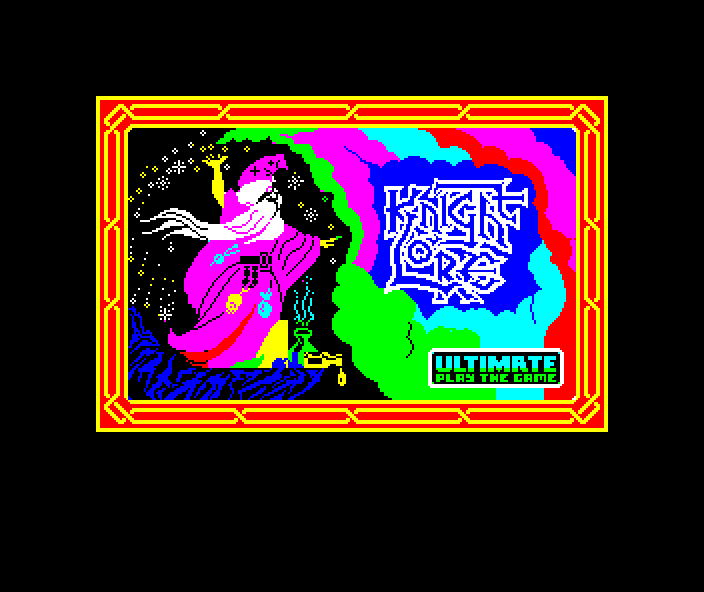
Knight Lore (1984) — ZX Spectrum title screenKnight Lore — the isometric Filmation engine in action
Knight Lore is the game that created isometric gaming. Released in November 1984 by
Ultimate Play the Game — the studio that would become Rare Ltd — it introduced the
"Filmation" engine to the world: a method of projecting a three-dimensional castle environment
onto a two-dimensional screen in a way no home computer game had achieved commercially before.
The player character Sabreman, carried over from Sabre Wulf, moved through a 40-room
castle solving object-based puzzles while managing a werewolf curse triggered by the full moon.
What sounds conceptually modest was, in 1984, genuinely shocking.
The Filmation engine rendered the illusion of 3D space through careful sprite depth-sorting
and a fixed isometric camera. Floors, walls, and objects obeyed perspective rules that no ZX
Spectrum game had implemented before at this speed or quality. Contemporary players and
reviewers described it as playing something that had arrived from the future. Knight Lore
did not just win awards — it redefined what a home computer game could be. Read more
about Sabreman and the Filmation engine in the People section and
the full Games Catalogue.
Six Months in the Dark
The development of Knight Lore is one of the great acts of competitive secrecy in
gaming history. Tim Stamper completed the Filmation engine months before the game's November
1984 release date. Rather than ship immediately, Ultimate Play the Game held the finished
product — completed, debugged, boxed — while they quietly finished Alien 8,
which used the same Filmation 2 engine. By the time Knight Lore reached shops,
Alien 8 was weeks behind it. The strategy guaranteed that competitors could not
study the released game and build their own isometric engine before Ultimate had launched
a sequel on the same technology.
The approach was vintage Stamper: technically brilliant, commercially astute, and ruthlessly
competitive. Ultimate operated with extreme secrecy throughout this period — no
screenshots before release, no advertising copy that hinted at what the game actually looked
like. When players opened the cassette box, the isometric engine was a complete surprise.
The studio had invented a genre and launched two flagship games on the same technology before
any competitor had seen the first.
“We kept everything secret. The philosophy was: if you show people what you’re
doing, they’ll do it too. So we didn’t show anyone. Knight Lore was done.
Alien 8 was done. We just waited.”
— Tim Stamper, speaking to RETRO Gamer magazine, issue 7 (2004)
Seventeen Cauldrons and One Full Moon
Object interaction — the core of Knight Lore’s puzzle design
The player controls Sabreman, a hero who has been cursed to transform into a werewolf when
the on-screen timer (representing the lunar cycle) reaches a threshold. In wolf form,
enemies become afraid of you — but you cannot interact with most objects and cannot
use the cauldron. The objective is to find 17 specific objects scattered across the 40-room
castle and throw them into the cauldron to break the curse, all before time expires across
enough lunar cycles.
The movement system is immediately distinctive. Objects in the world are physical: they
can be pushed, stacked, and used as platforms. To reach a high ledge, you might need to
find a box, drag it under the ledge, and climb it. This object-interaction puzzle model
felt unprecedented in 1984 — most action games were about reflexes; Knight Lore
was about environmental reasoning within a 3D space. The timer added a layer of urgency:
you had to manage the lunar cycle while exploring, creating a loop of planning, execution,
and crisis management that kept even experienced players on edge.
The Filmation Engine: Three Dimensions on 48K
The ZX Spectrum had 48 kilobytes of RAM and no hardware sprite support. It could not
natively rotate sprites or draw 3D geometry. The Filmation engine achieved its isometric
perspective through a combination of pre-drawn sprites for every object orientation and
a depth-sorting algorithm that determined the correct draw order for overlapping elements.
Every room was a logical grid; every object occupied a defined volume within that grid.
The engine checked spatial relationships in real time, drawing objects from back to front
so that nearer objects correctly occluded those behind them.
On a 3.5MHz processor with no floating-point hardware, this was a significant computational
achievement. Tim Stamper's programming pushed the Spectrum into territory machine
specification suggested was impossible. The result was a game that ran fast enough to
feel responsive — important for a genre that required precise object placement.
The Filmation engine was extended into Filmation 2 for Alien 8, with improved
object handling and more complex room geometry.
“The ZX Spectrum simply wasn’t supposed to do what Knight Lore did. The fact
that it did — and did it smoothly — tells you something about what Tim
Stamper was capable of.”
— Stuart Campbell, Your Sinclair, retrospective feature (1992)
Game of the Year, Unanimously
Knight Lore received the highest scores from every major UK games publication
in 1984. CRASH magazine, the dominant Spectrum press title of the era, gave it 96% and
included it in their prestigious Crash Smash category. Your Sinclair called it the most
significant Spectrum game ever made. Sinclair User reviewed it as a "quantum leap" for
the platform. The consensus was immediate and total: this was the best game on the ZX
Spectrum, and it was not close.
Commercially, Knight Lore was a runaway success. Ultimate Play the Game had
already built a reputation for quality, but Knight Lore elevated the studio to
a different level — both critically and commercially. The game sold out on release
and remained a consistent seller throughout 1985. No home computer game that year matched
its critical reception on any platform in the UK market.
Head Over Heels and Everything After
The isometric genre that Knight Lore created produced some of the finest games
of the 8-bit era. Ocean Software's Head Over Heels (1987) is widely considered
the peak of the isometric adventure game, directly building on the Filmation blueprint.
Batman (1986, Ocean), Solstice (NES, 1990), and dozens of other titles
owed their fundamental architecture to what Tim Stamper built on a 48K Spectrum.
For Rare specifically, Knight Lore was the foundation. The engine proved that
the Stamper brothers could do things with hardware that other developers could not
conceptualise — a reputation that followed them through the NES era, through the
SNES, and into the N64. When Nintendo invested in Rare in 1994, they were betting on
the studio that had built the Filmation engine ten years earlier. The trajectory from
a Twycross barn to Donkey Kong Country runs directly through Knight Lore’s
40 isometric rooms.
See the full history of Rare for the complete picture of how
Knight Lore's success shaped what the studio became.
SNES · 1995
Donkey Kong Country 2: Diddy’s Kong Quest
Rare Ltd · Nintendo SNES · November 1995
The Pirate World That Surpassed the Revolution
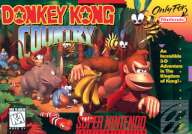
DKC2 — SNES (Nintendo, November 1995)DKC1 (1994) — the foundation DKC2 built upon
Donkey Kong Country 2: Diddy’s Kong Quest is the high-water mark of Rare’s
16-bit era. Released in November 1995, exactly twelve months after the original Donkey
Kong Country reshaped expectations for the SNES, DKC2 took everything that debut had
established and pushed it further in every meaningful direction: level design ambition,
atmospheric coherence, musical depth, and mechanical sophistication. For a great many players
and critics, it is the finest platformer on the SNES — and the strongest argument that
a sequel can exceed its predecessor in every dimension, not merely extend it.
The game follows Diddy Kong and Dixie Kong as they storm Crocodile Isle to rescue Donkey Kong
from Kaptain K. Rool. The pirate setting gave Rare's artists a richer visual palette than
Donkey Kong Island offered — galleon decks, volcanic caves, a rotting ghost-ship graveyard,
an industrial amusement park, a haunted forest — and the team used every environment
to its fullest potential. See the full catalogue entry at
Games and Rare’s biography at People.
Twelve Months to Perfection
Donkey Kong Country (1994) had changed everything. The ACM pre-rendering technique
— Silicon Graphics ONYX workstations rendering 3D models, then compressing them into
SNES sprites — produced a visual quality that contemporary audiences described as a
next-generation game running on 16-bit hardware. It sold over 8 million copies. Nintendo’s
$75 million stake in Rare followed almost immediately, a validation of the studio’s
technical capability.
For DKC2, Rare returned with a larger team and a more focused creative vision. Where DKC1
was an achievement of technical demonstration — look what the SNES can display —
DKC2 is an achievement of design maturity. The same pre-rendering pipeline was used, but
the team had a year's additional experience with it, and the art direction moved away from
the jungle setting into the richer visual territory of a pirate world. Diddy Kong takes the
lead, joined by Dixie Kong, whose helicopter spin added a nuanced vertical dimension that
the original’s character roster could not offer. Kaptain K. Rool, recast as a pirate,
presides over a world that is more atmospherically distinctive than Donkey Kong Island.
Two Kongs, Every Angle Covered
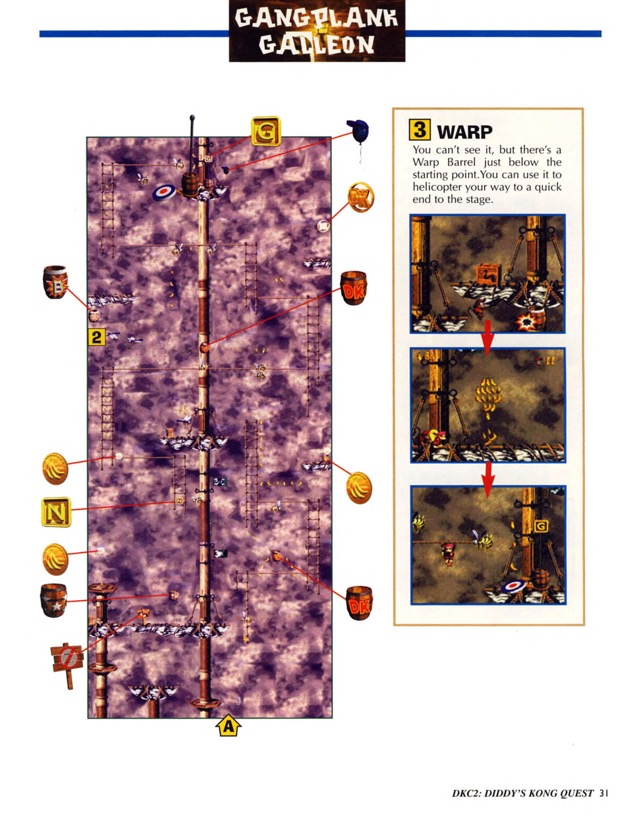
DKC2 Nintendo Player’s Guide — 1995Gangplank Galleon — the opening world, K. Rool’s flagship
The core loop involves two characters with complementary abilities. Diddy is fast and agile;
his cartwheel attacks and running jump suit aggressive play. Dixie’s helicopter spin
— hold the jump button after a leap to glide slowly downward — provides a
recovery tool that fundamentally changes how vertical platforming sections play. Where DKC1’s
Donkey and Diddy partnership was essentially a health mechanic (two hits instead of one),
DKC2’s duo has genuine mechanical differentiation.
Crocodile Isle is organised thematically: Gangplank Galleon (K. Rool’s flagship),
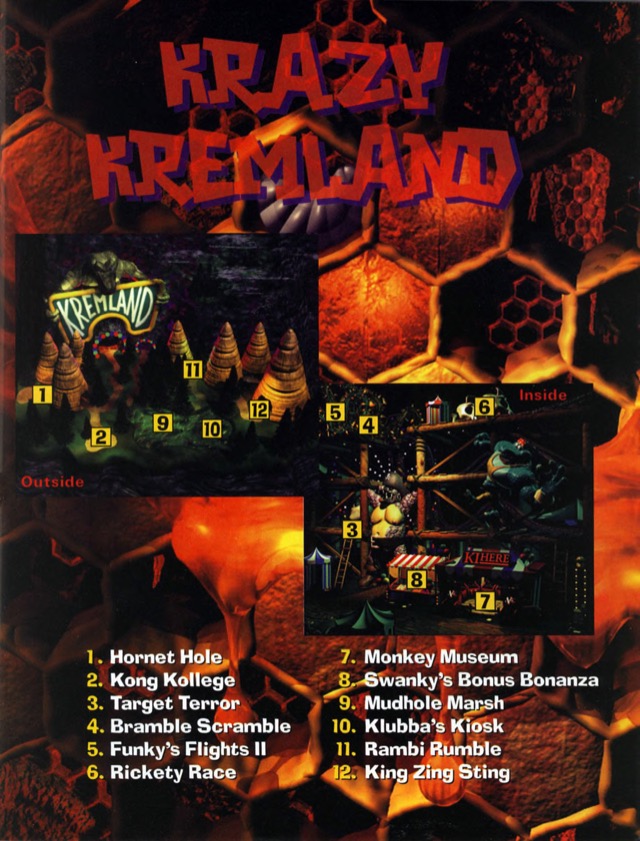
Crocodile Cauldron (volcanic caves), Krem Quay (ghost-ship graveyard), Krazy Kremland
(industrial amusement park), Gloomy Gulch (haunted forest), K. Rool’s Keep (the
castle), and The Flying Krock (the airship finale). The level variety within each world
is exceptional — the Kremland stages combining Ferris wheel platforms, neon
lighting, and mechanical enemies in an aesthetic that predates the grungy industrial
platformer genre by years.
Animal Buddy sequences appear throughout: Rattly the snake’s super-jump, Squawks
the parrot’s illumination in dark caves, Squitter the spider’s web-platform
traversal. Barrel cannon sequences escalate from simple directional blasts to complex
timed puzzles requiring precise rhythm. The difficulty curve builds legitimately —
K. Rool’s Keep’s late-game platforming challenges are demanding without ever
feeling arbitrary.
What the SPC700 Did in David Wise’s Hands
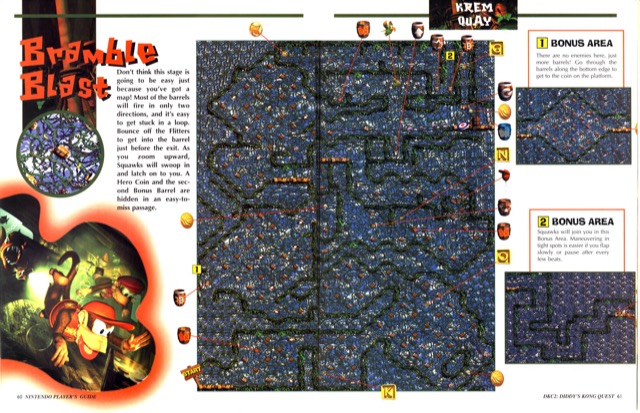
Bramble Blast (Krem Quay) — setting for Stickerbush SymphonyKrazy Kremland — the industrial amusement park world
The pre-rendered ACM graphics continued from DKC1 with a year's additional practice:
character models were refined, environments made more atmospheric, and the compression
pipeline improved to allow richer colour depth per scene. But the genuine technical
achievement of DKC2 lives in the audio.
David Wise was the sole composer for DKC2 — a distinction from DKC1, which shared
credits with Eveline Novakovic-Fischer and Robin Beanland. Working alone on the SNES’s
SPC700 sound chip — a custom Sony processor with 8 voice channels, 64KB of total RAM
for all audio data, and an integrated DSP supporting echo and reverb effects — Wise
produced what many regard as the finest score in the SNES library.
The SPC700’s echo register was Wise’s primary expressive tool in DKC2. He
applied echo delay heavily and unevenly across tracks, giving compositions a layered,
reverberant quality unusual for SNES music. Aquatic-themed tracks benefited most from
this approach. Stickerbush Symphony — the Bramble Scramble theme —
opens without rhythmic percussion, built instead from layered ambient texture and a
melancholy melodic line that moves between warmth and wistfulness. Within the 64KB
constraint that covered every sample, instrument, and song in the game, Wise created
a score of remarkable sonic variety. Visit the Music page
for full coverage of the DKC2 soundtrack.
“The bramble levels had a specific atmosphere that needed the music to carry it.
I wrote something that felt like being lost in a beautiful, slightly dangerous place.
I didn’t overthink it — it came out naturally.”
— David Wise, on Stickerbush Symphony (interview, Screw Attack, 2014)
DKC2 Full OST — David Wise (SNES, 1995)
The Critics Couldn’t Find Fault
Donkey Kong Country 2 received near-universal critical acclaim on release in
November 1995. Nintendo Power scored it 9.3 out of 10 and named it the magazine’s
Game of the Year for 1995. Electronic Gaming Monthly awarded it an aggregated
9.5 out of 10 from their four-reviewer panel. In the UK, Super Play — the
leading SNES-dedicated magazine — gave it 97% and called it "the best game on the
SNES." Edge awarded it 9/10, noting that it surpassed DKC1 in "ambition,
design, and musical achievement."
The critical consensus was not merely that DKC2 was excellent — it was specifically
that it exceeded its predecessor, which had been considered the best-looking game on the
platform. Reviewers who had awarded DKC1 their highest scores returned to award DKC2 the
same or higher. The game sold approximately 5.1 million copies on the SNES, placing it
among the platform’s top 10 best-sellers. That figure was achieved against a backdrop
of SNES owners beginning to consider the PlayStation and Saturn as their next platform —
DKC2 convinced a meaningful portion of them to keep playing the aging 16-bit machine
for another year.
The Ceiling Nobody Has Cleared Since
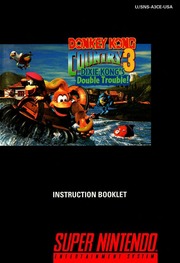
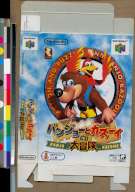
DKC3 (1996) — the trilogy conclusionBanjo-Kazooie (N64, 1998) — Rare’s next platform-defining game
Donkey Kong Country 2 completed in November 1995 is, by almost any measure, the
peak of Rare’s 16-bit output. Donkey Kong Country 3: Dixie Kong’s Double
Trouble followed in November 1996 and is an accomplished game; it is rarely discussed
in the same breath as DKC2. The trilogy format made DKC3’s limitations more visible
by comparison. Where DKC2 refined a design vocabulary into something coherent and complete,
DKC3 attempted novelty — an overworld map with boat travel, a collectible-focused
structure — without matching DKC2’s tonal confidence.
The music legacy of DKC2 has, if anything, grown since 1995. David Wise’s
Stickerbush Symphony has been performed at video game music concerts worldwide
— at MAGFest, at Video Games Live, and by symphony orchestras covering the SNES
canon. The track regularly appears on "greatest video game music" lists and was included
in the Nintendo concert programme for the 2014 Donkey Kong Country: Tropical Freeze
promotional tour. Wise himself performed the piece live at VGM events in the 2010s.
For Rare, DKC2 was the proof that the studio’s first Nintendo-era achievement was
not a single breakthrough but a sustainable creative capability. The team that shipped
DKC2 in twelve months went on to make Banjo-Kazooie (N64, 1998) and
Donkey Kong 64 (1999). The same design thinking — rich theming,
complementary character abilities, dense environmental detail — runs through all
of them. DKC2 is where that vocabulary was first fully articulated.