Sakurai at 19 — The Creation of Kirby
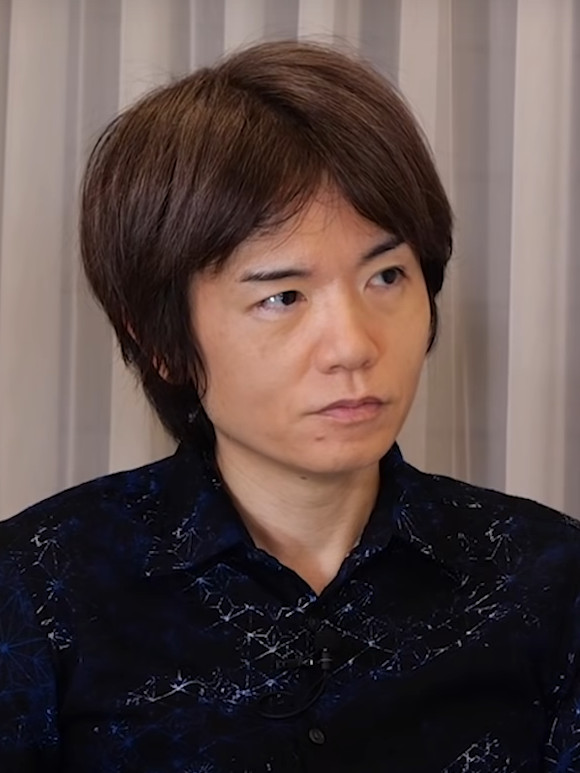
In 1990, Masahiro Sakurai joined HAL Laboratory straight from high school at the age of 19 — one of the most unusual career paths in video game history. HAL Laboratory, a Nintendo partner studio based in Tokyo, was working on Game Boy software at a time when Nintendo’s handheld was hungry for content. Sakurai was placed on a small team developing a new action platformer.
The story of Kirby’s creation is now part of gaming folklore. Sakurai drew a rough placeholder sprite — a simple round blob he internally called “Gordo” — as a temporary character to test gameplay mechanics. The blob was soft, round, and cheerful-looking. It moved well. It felt good to control. The placeholder stayed.
When it came to colour, Sakurai preferred yellow for the character. Shigeru Miyamoto, reviewing the game at Nintendo, saw the design and insisted on pink. The name “Kirby” is widely believed to reference attorney John Kirby, who had helped Nintendo in a landmark legal dispute over Donkey Kong — though Sakurai has remained characteristically vague about confirming this officially.
The design philosophy embedded in that first game was deliberate and radical: easy to start, rewarding to master. Kirby could float indefinitely. He could inhale enemies. He could spit stars as projectiles. None of the controls were punishing. The game would not lock out a player who made mistakes. Sakurai wanted every person who picked it up to feel welcome.
“I designed Kirby to be a character that anyone — any age, any skill level — could enjoy. The round shape, the pink colour, the happy face. Every element was chosen to be welcoming.” — Masahiro Sakurai
Game Boy Roots — Kirby’s Dream Land (1992)
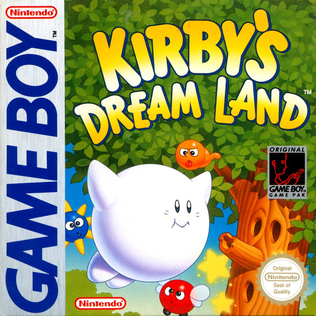
Kirby’s Dream Land was released in Japan on April 27, 1992, and in North America in August of the same year. It was developed in approximately six months — one of the fastest production cycles for a flagship Game Boy title — and it became one of the platform’s best-selling games.
King Dedede, the self-styled ruler of Dream Land, has stolen all the food from the kingdom. Kirby must recover it. The premise is deliberately simple — a villain motivated by gluttony, a hero motivated by justice and hunger in equal measure. The five worlds of Dream Land (Green Greens, Castle Lololo, Float Islands, Bubbly Clouds, and Mt. Dedede) were each two acts long, bookended by a boss encounter.
What Dream Land introduced was Kirby’s core mechanic: the inhale. Kirby could draw in air and suck nearby enemies toward him, then spit them as star-shaped projectiles at other enemies. The copy ability — absorbing an enemy’s power — did not yet exist, but the basic toolkit of inhale and expectoration established the series foundation.
Dream Land was completed in four hours on a first playthrough, which made it controversial at launch — some critics called it too short, too easy. Sakurai’s response was built into the game: an Extra Game mode unlocked after completion, offering a significantly harder remixed version. The Extra Game was not hidden; it was a stated reward for finishing. This structure — accessible main game, demanding optional challenge — became a Kirby series convention.
NES Breakthrough — Kirby’s Adventure (1993)
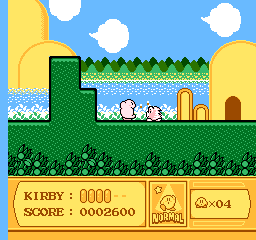
If Dream Land established Kirby, Kirby’s Adventure defined the series. Released in March 1993 for the NES — late in the platform’s lifecycle, when most publishers had already moved to the Super Nintendo — it introduced the copy ability system that would characterise the franchise for three decades.
Twenty-four distinct copy abilities were available at launch: Fire, Ice, Sword, Beam, Hammer, Cutter, Needle, Parasol, and many more. Each was obtained by swallowing a specific enemy type. Each had a distinct visual effect and tactical use. The system gave players genuine agency over how they approached each stage — a player using Sword would experience encounters differently from a player using Ice or Bomb.
Kirby’s Adventure was also technically exceptional for a 1993 NES game. HAL Laboratory pushed the hardware beyond what most developers thought possible: scrolling, colour palette cycling, parallax background layers, and an orchestral NES soundtrack that Jun Ishikawa composed across seven worlds. The game shipped with a six-megabit ROM — one of the largest on the NES — and used every byte.
The narrative also contained the series’ first significant twist: King Dedede, the recurring antagonist, shattered the Star Rod that powers Dream Land’s Fountain of Dreams. But Dedede was not acting out of malice — the Star Rod imprisoned Nightmare, a being who corrupted dreams. Dedede was protecting Dream Land. The twist reframed the entire game’s premise and gave the series its first moment of genuine dramatic storytelling.
“The copy ability was the step that made Kirby feel complete. Inhaling enemies was the premise. Becoming them was the promise.” — Masahiro Sakurai
SNES Anthology — Dream Course, Dream Land 2, Super Star, Dream Land 3
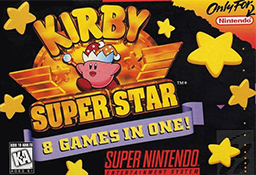
The SNES era of Kirby produced four titles between 1994 and 1997, each distinct in genre, scope, and aesthetic. Kirby’s Dream Course (1994) was a golf-inspired puzzle game where Kirby served as the ball. Kirby’s Dream Land 2 (1995) returned to the Game Boy with copy abilities and three animal friends whose presence modified each power.
Kirby Super Star (1996) was the culmination — eight game modes in a single SNES cartridge, ranging from a condensed remake of Dream Land to a gourmet racing game, an exploration mode with 60 hidden treasures, and a punishing boss rush. The game introduced the Helper system: Kirby could materialise a copy-ability sidekick as an AI companion or a second human-controlled character, creating genuine two-player co-operative play. It remains one of the most complete games ever made for the Super Nintendo.
Kirby’s Dream Land 3 (1997) closed the era on a different note — deliberately slow, pastoral, and rendered in a distinctive crayon-and-watercolour visual style that made it look unlike any other SNES game. Released as the N64 was superseding the platform, Dream Land 3 was a conscious artistic statement: a Kirby game that refused to compete on speed or spectacle, and instead offered warmth, texture, and a horror-tinged final boss.
Sakurai left HAL Laboratory in 2003, prompting a generational shift in Kirby’s direction. His reasons were personal: he could not watch other directors take Kirby somewhere he had not guided. The series continued without him — successfully, commercially — but the original five-year window from 1992 to 1997 remains the canonical Kirby era: the five games that established every convention the franchise has built on since.