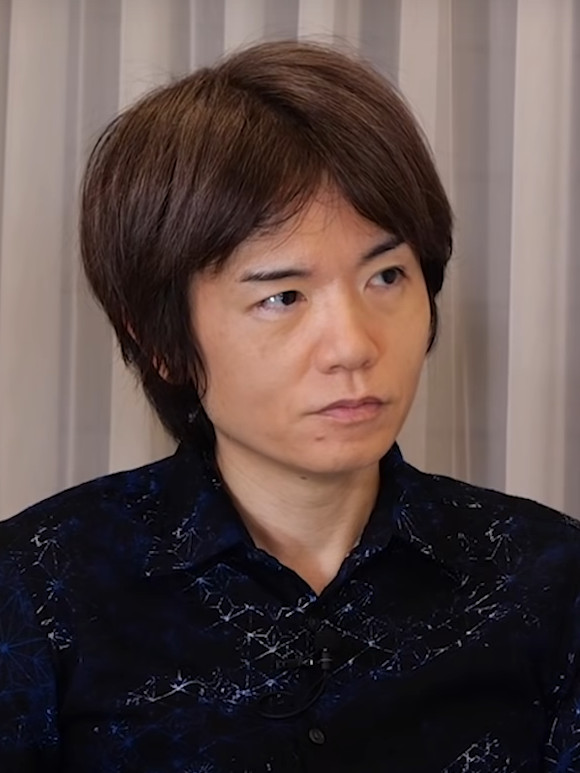
Masahiro Sakurai
桜井政博
Creator & DirectorBorn: 1970, Tokyo, Japan · Role: Creator, Director (Dream Land, Adventure, Super Star)
Masahiro Sakurai created Kirby at the age of 19 while working as an intern at HAL Laboratory — making him one of the youngest people in video game history to create a character that would become a major franchise. Born in Tokyo in 1970, Sakurai joined HAL straight from high school, an unusual path that placed him on the team developing Game Boy software at a time when Nintendo’s handheld was hungry for content.
The story of Kirby’s creation is part of gaming folklore. Sakurai drew a rough placeholder sprite — a simple round blob he called “Gordo” — as a temporary character to test gameplay mechanics for what would become Kirby’s Dream Land. The placeholder worked so well that it became the final design. The pink colour was Miyamoto’s decision, overriding Sakurai’s preference for yellow.
Kirby’s Adventure (1993) introduced the copy ability system — 24 distinct powers absorbed from enemies by swallowing them. This was Sakurai’s solution to a mechanical puzzle: how to give players genuine variety without making controls complicated. The answer was to let players choose their complexity by choosing which enemies to inhale.
Kirby Super Star (1996) represents the apex of Sakurai’s Kirby output — eight game modes in one cartridge, a Helper system that reimagined co-operative play, and production values that pushed the SNES hardware to its limit. It remains the definitive Kirby game. Sakurai left HAL Laboratory in 2003, prompted by the studio’s plan to continue making Kirby games without him — a project he felt should either involve him or be his domain. He founded Sora Ltd. and has focused almost entirely on Super Smash Bros. since.
In 2022 he launched the YouTube channel Masahiro Sakurai on Creating Games, which became one of the most substantive public records of game design philosophy from a major developer. Each episode dissects a specific design decision or concept, using Kirby as a recurring example.
“Kirby is always happy. He never looks sad, never looks angry. I think that’s more radical than it sounds. Most game characters use negative emotions to create drama. Kirby creates drama through action, not expression.” — Masahiro Sakurai
“Games should not be difficult for the wrong reasons. Making someone feel incompetent is not challenge. Challenge is when you can see the solution and working toward it feels rewarding.” — Masahiro Sakurai
Selected Works
- Kirby’s Dream Land (1992) — Creator & Director, HAL Laboratory
- Kirby’s Adventure (1993) — Director, HAL Laboratory
- Kirby Super Star (1996) — Director, HAL Laboratory
- Super Smash Bros. (1999) — Director, HAL Laboratory
- Super Smash Bros. Melee (2001) — Director, HAL Laboratory
- Super Smash Bros. Ultimate (2018) — Director, Sora Ltd.
Jun Ishikawa
石川淳
ComposerNationality: Japanese · Role: Composer (Dream Land, Adventure, Dream Land 2, Super Star, Dream Land 3)
Jun Ishikawa is the composer most closely associated with the Kirby series — the musician who established and then developed the sonic identity of the franchise across its foundational Game Boy and SNES era. Working at HAL Laboratory from the early 1990s, Ishikawa scored Kirby’s Dream Land, Kirby’s Adventure, Kirby’s Dream Land 2, Kirby Super Star, and Kirby’s Dream Land 3, creating a body of work that defined the cheerful, energetic, and occasionally melancholy sound that Kirby fans recognise immediately.
Ishikawa’s compositional approach for Kirby games is rooted in accessibility — music that is immediately pleasant, memorable after a single hearing, and emotionally coherent with the on-screen action. The opening melody of Kirby’s Dream Land, the Green Greens theme, is one of the most recognisable pieces of Game Boy music ever written.
Kirby Super Star is widely considered Ishikawa’s masterpiece. The game’s anthology structure gave him licence to compose across multiple moods and genres: the breezy Gourmet Race theme (remixed for Super Smash Bros. Brawl), the pastoral Float Islands, the racing intensity of Meta Knight’s Revenge, and the unsettling final boss theme of Milky Way Wishes.
Key Compositions
- Green Greens — Kirby’s Dream Land (1992) — the definitive Kirby theme
- Gourmet Race — Kirby Super Star (1996) — remixed for Super Smash Bros. Brawl
- Meta Knight’s Revenge — Kirby Super Star (1996) — intense boss theme
- Float Islands — Kirby’s Adventure (1993) — pastoral NES water world theme
- Butter Building — Kirby’s Adventure (1993) — quirky, precise construction theme
Selected Works
- Kirby’s Dream Land (1992) — Composer, HAL Laboratory
- Kirby’s Adventure (1993) — Composer, HAL Laboratory
- Kirby’s Dream Land 2 (1995) — Composer, HAL Laboratory
- Kirby Super Star (1996) — Composer, HAL Laboratory
- Kirby’s Dream Land 3 (1997) — Composer, HAL Laboratory
- Kirby Air Ride (2003) — Composer, HAL Laboratory