The Anthology Concept
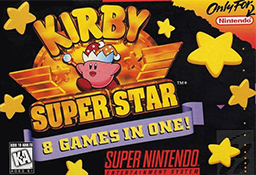
Kirby Super Star - known in Japan as Hoshi no Kābī Sūpā Derakkusu (Kirby Super Deluxe) - was released for the Super Famicom in March 1996, with North American and European releases following in autumn of the same year. It was Masahiro Sakurai's final Kirby title as a HAL Laboratory employee, and he used it to make a definitive statement about what the franchise could be.
The anthology concept was deliberate. Rather than one long game, Sakurai designed eight shorter, focused experiences that each made a different argument for the Kirby format. Some were straightforward action platformers. One was a racing game. One was an exploration puzzle with 60 hidden treasures. One was a timing minigame. The breadth demonstrated that the Kirby framework - accessible premise, copy-ability depth, bright cheerful world - was flexible enough to support many genres, not just action platformers.
“The copy ability was the step that made Kirby feel complete. Inhaling enemies was the premise. Becoming them was the promise.” - Masahiro Sakurai
Development Story - Building the Anthology
By 1994, when development on Kirby Super Star began in earnest, Masahiro Sakurai had already led two successful Kirby titles at HAL Laboratory: the Game Boy original (1992) and the NES follow-up Kirby's Adventure (1993). Both had been well-received, but Sakurai was dissatisfied with the idea of simply making a larger third game in the same format. The SNES offered substantially more hardware power than either the Game Boy or NES, and he wanted to use that power to make a different kind of argument about what Kirby could be.
The anthology structure was conceived as both a design experiment and a commercial proposition. Eight focused modes, each playable to completion in an afternoon, offered something that sprawling single-player games of the era did not: variety within a single cartridge. Players who tired of one format could switch to another without abandoning the disc. The Great Cave Offensive offered 60 treasures for completionists. Spring Breeze offered a tight 20-minute run for casual players. The Arena was reserved for those who had mastered everything else.
The Helper system required the most substantial design work. Sakurai's stated goal was to make two-player feel genuinely different from single-player - not simply add a second Kirby alongside the first. The solution was to make the co-op partner a character native to Kirby's current copy ability: an enemy transformed into an ally. This meant building complete, distinct movesets for more than 20 Helper types, each with different strengths and play feel. The trade-off was explicit and intentional: to create a Helper, Kirby must sacrifice the copy ability he just acquired. Co-operation has a cost, which makes it a genuine choice rather than an automatic benefit.
The music was composed by Jun Ishikawa and Dan Miyakawa, both of HAL Laboratory. Ishikawa had scored Kirby's Adventure and brought established familiarity with the character's sonic identity. Eight distinct game modes required an exceptional tonal range: the breezy Gourmet Race theme, the tense metallic score of Meta Knight's Revenge, the pastoral Float Islands, the unsettling organ-heavy final boss music of Milky Way Wishes. Ishikawa's score for Super Star is considered among the finest original soundtracks in the SNES library. The creator profiles for Masahiro Sakurai and Jun Ishikawa cover their broader careers and how Super Star fits into the arc of their work.
“I wanted players to be able to enjoy Kirby in many different ways. That was the concept behind the multiple game modes - not padding, but genuine variety within a single game.” - Masahiro Sakurai
A Complete Game Collection
Eight distinct game modes, each with a different structure and tone. See the full games catalogue for box art and platform details across the series.
A condensed remake of Kirby's Dream Land - five worlds, King Dedede as final boss. An accessible entry point for new players and a nostalgia loop for series veterans.
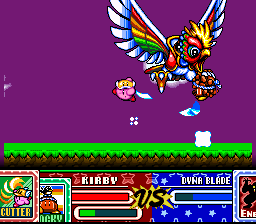
A five-stage adventure featuring the giant mechanical bird Dyna Blade as antagonist. Mid-size scope - more content than Spring Breeze, less than the Great Cave Offensive.
Non-linear cave exploration with 60 hidden treasures to collect. The longest single mode in the anthology - rewards thorough play and mastery of copy abilities.
Race King Dedede through three courses collecting as much food as possible. Home to one of the game's most beloved musical tracks, later remixed for Super Smash Bros. Brawl.
The canonical main story. Copy abilities cannot be obtained from enemies - each must be found as a Copy Essence. The game's hardest and longest mode; unlocked last.
Face all 20 bosses and mid-bosses back to back with limited recovery items shared across the run. The ultimate Kirby Super Star challenge - demands complete mastery.
A button-timing minigame - hit the right moment to split the Earth. Competitive in two-player mode. Simple premise, surprisingly satisfying.
A samurai quick-draw duel - react faster than your opponent. Five escalating opponents. A one-screen reflex test that rewards calm under pressure.
The Helper System - Co-op Reimagined
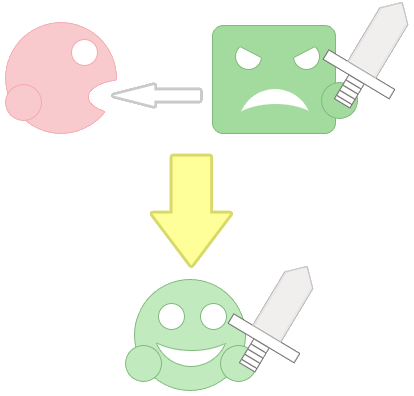
The Helper system is perhaps Kirby Super Star's most original design innovation. When Kirby uses a copy ability, he can press a button to materialise that ability as a physical companion character - a "Helper" based on the enemy type that granted the power. The Fire Helper is a Hot Head. The Sword Helper is a Blade Knight. The Fighter Helper is a Knuckle Joe.
Helpers can be controlled by the CPU or by a second human player. In two-player mode, both Kirby and the Helper have full health bars, full ability movesets, and independent actions. This is not the token simultaneous co-op of many platformers - both characters are complete. The trade-off for Kirby is that materialising a Helper costs him his copy ability: to create a co-op partner, Kirby must sacrifice the power he just gained.
Sakurai has described the Helper system as his solution to a genuine design problem: how to make two-player feel different from single player, rather than simply being single player with a second Kirby running alongside. The answer was asymmetry and cost - the second player has a different character model, a different set of moves, and requires the first player to give something up to create them.
Technical and Design Achievement - The Expanded Copy System
Where Kirby's Adventure gave each copy ability a single move, Kirby Super Star expanded every ability into a full moveset. Fire gained Fire Breath, Fire Ball, Fireworks, and Burn. Sword gained Sword Beam, Spin Slash, Sword Dive, Sword Stab, and Galaxia. Ice gained Ice Breath, Ice Burst, Frozen Block, and Blizzard.
Six new abilities were added: Cook, Fighter, Jet, Plasma, Suplex, and Mirror. The Fighter ability alone has six distinct moves - more than most abilities had in total in Kirby's Adventure. This depth made ability mastery genuinely rewarding in a way the earlier game's simpler system could not achieve. See the full copy abilities list for every ability, its moves, and its source enemy.
In Milky Way Wishes, copy abilities cannot be obtained from enemies at all. Each ability is instead a collectible Copy Essence scattered across the seven planets. This design forces players to use abilities they might otherwise ignore and gives the mode a distinct resource-management dimension unlike any other Kirby experience.
The game's technical performance was exceptional for a late-SNES release. Large, colourfully animated sprites maintained smooth frame rates across all eight modes - a feat requiring careful memory management and hardware-specific optimisation by HAL Laboratory's engineering team. The sprite work for the Helper characters alone - each a fully animated enemy-turned-ally with its own moveset animation set - represented substantial production effort for a game that only a fraction of players would see in two-player mode.
“I designed Kirby to be a character that anyone - any age, any skill level - could enjoy. The round shape, the pink colour, the happy face. Every element was chosen to be welcoming.” - Masahiro Sakurai
Reception - Critical and Commercial Response
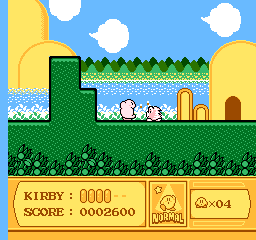
Kirby Super Star launched in Japan in March 1996 to strong critical reception. The Japanese gaming press praised the anthology approach as a genuine answer to a persistent criticism of the Kirby series: that its games were too short. Eight focused modes addressed that concern without sacrificing the approachability that defined the franchise.
The North American release in September 1996 was equally well-received. Nintendo Power awarded it high marks and recommended it as one of the year's essential SNES purchases. Electronic Gaming Monthly praised the Helper system specifically, noting that it represented the most thoughtfully designed two-player implementation on the platform - both players were complete characters, the asymmetry was intentional, and the trade-off mechanic made co-op feel like a real collaboration rather than an add-on.
Critics who had previously characterised Kirby as a franchise for younger or less experienced players found their assumptions challenged. The Arena's relentless boss rush and the resource- management demands of Milky Way Wishes demonstrated that accessibility and depth are not opposites - that a game welcoming to all skill levels could simultaneously contain some of the SNES era's most demanding optional content.
Commercially, Kirby Super Star performed strongly for a late-cycle SNES release, selling over 2 million copies worldwide. It became one of HAL Laboratory's strongest-performing titles and validated the anthology format as a genuine design strategy. Retrospective coverage has been consistently generous: the game appears in nearly every ranked survey of the best SNES games, typically in the top twenty.
Legacy - The Enduring Kirby Benchmark
Kirby Super Star's legacy operates on several levels. As a franchise entry, it set the template for how Kirby games would handle copy abilities for the next decade - the expanded movesets and the Helper concept (echoed in future titles as Animal Friends and partner mechanics) both influenced subsequent HAL Laboratory output. The anthology format itself returned in Kirby's Dream Collection (2012) and established a precedent for how the series would handle retrospective releases.
Individual characters and modes generated disproportionate cultural impact. Meta Knight, who had appeared in previous Kirby games but received his definitive characterisation here as the commander of the Battleship Halberd, became one of Nintendo's most popular secondary characters. He eventually appeared as a playable fighter in Super Smash Bros. Brawl (2008), exposing him to an audience orders of magnitude larger than the original SNES game's.
The Gourmet Race theme became one of the most remixed and referenced pieces of Nintendo music outside Mario and Zelda. Its Super Smash Bros. Brawl arrangement introduced it to millions of players who had never touched a Kirby game. The Arena established the boss rush as a prestige mode in the franchise - the optional maximum-difficulty challenge that rewards series mastery - a format that returned in every major Kirby release afterward.
The game was remade as Kirby Super Star Ultra for the Nintendo DS in 2008, adding four additional game modes (Revenge of the King, Meta Knightmare Ultra, Helper to Hero, and The True Arena) and updating graphics and cutscenes. The original SNES version remains the more mechanically precise of the two, but Ultra re-established Kirby Super Star's reputation with players who had missed the 1996 release. Nintendo included the original in the SNES Classic Mini (2017), confirming its status among the platform's canonical classics.
“Kirby games are designed so that anyone can enjoy them. That doesn't mean they have to be shallow. Depth and accessibility are not in conflict - they're both things we should aim for.” - Masahiro Sakurai