Arcadia and the Megagames
The hit that launched Imagine, and the two games that ended it.
ARCADIA
ZX Spectrum, 1982 - Imagine's breakout title
The Game That Started Everything
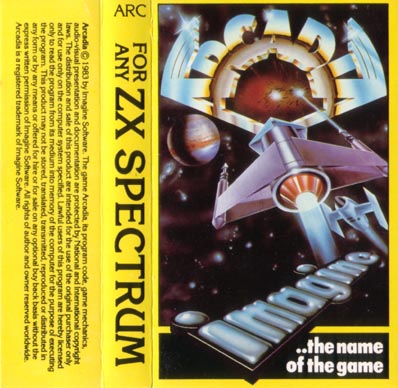
Arcadia arrived in 1982 on a 16 kilobyte ZX Spectrum and sold over 100,000 copies. That number - unprecedented for a British home computer game at the time - is the fact from which every other part of Imagine's story follows.
Without Arcadia's commercial success, there would have been no budget for the subsequent catalogue, no staff, no offices, and no Megagames. The BBC documentary crew that came to film Imagine's story were there, at least in part, because Arcadia had given the company a track record worth profiling. The game's success was the precondition for everything that followed, including the collapse.
Watch It in Action
Arcadia in longplay - the full multi-wave ZX Spectrum experience that 100,000 buyers took home in 1982.
Eight Waves on a 16K Machine
Arcadia is a multi-wave shoot-em-up in the Galaxian tradition. The player controls a ship at the bottom of the screen, firing upward at formations of enemy craft that advance in increasingly aggressive patterns across successive waves. Each wave brings new enemy types and new attack formations, escalating the pressure on the player's positioning and reaction speed.
The design intelligence in Arcadia was the wave progression system. The game maintains forward momentum - there is always a next wave, always a new pattern to read and respond to. On a ZX Spectrum with 16 kilobytes of available RAM, the density of what Arcadia managed to deliver was a genuine technical achievement.
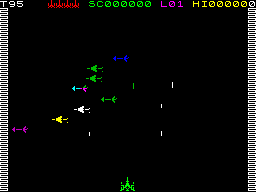
Arcadia has got eight different screens - most games only have one. There are all manner of horrible aliens just aching to shoot you down... this is quite simply the best arcade game I have ever seen on a home computer.
What the Spectrum Could Do
Programming for the ZX Spectrum's 16K configuration required navigating severe constraints. The processor was a Z80 running at 3.5 MHz. The display was 256 by 192 pixels, with a colour attribute system that produced the characteristic "colour clash" of Spectrum games when sprites moved across differently coloured background areas. Smooth, fast gameplay with multiple enemy formations was not a given.
Arcadia achieved it by making careful choices about what to render and how. The enemy formations were designed to work with the attribute system rather than against it. The result was a game that felt fluid by 1982 standards - which is why it sold.
The Commodore 64 port that followed demonstrated the game could travel. While the Spectrum version is the definitive one - the original design - the C64 release extended Arcadia's reach into a second large market and helped establish Imagine as a multi-platform publisher rather than a Spectrum-only house.
THE MEGAGAMES
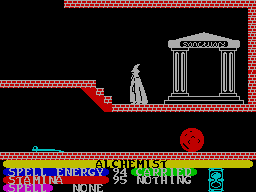
Bandersnatch and Psyclapse - announced 1983-1984, never shipped
The Megagames were not just two unreleased games. They were a business strategy, a marketing proposition, and ultimately a company-ending miscalculation - all announced simultaneously and covered breathlessly by a games press that had no way to predict the outcome.
£39.95: The Number That Changed Everything
When Imagine announced the Megagames in 1983-1984, the price point was the first thing the press reported. Standard ZX Spectrum games cost between £5 and £10. £39.95 was not a premium price - it was a different order of magnitude. Imagine's argument was that the Megagames were a different product category: software bundled with a hardware peripheral that expanded the Spectrum's RAM, making possible things that no existing software could do.
The hardware peripheral framing was genuine. Bandersnatch required more memory than the stock Spectrum provided. The RAM expansion module was a real engineering project, not a marketing fiction. But "real engineering project" and "on schedule" are not the same thing, and the gap between them would prove fatal.
Magazine coverage of the Megagames announcement generated genuine excitement. Features ran with details of what Bandersnatch would do, what the peripheral would enable, what Psyclapse would be like. The gap between what was described and what existed in playable form was substantial. But the games press of 1983-1984 had limited tools for evaluating whether ambitious announcements would result in finished products.
Bandersnatch: The One That Survived
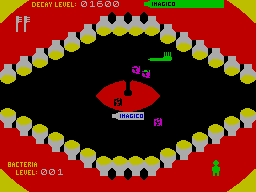
Bandersnatch was Hetherington's project - an action adventure intended to use the RAM peripheral to deliver something no current ZX Spectrum title could match. The design concept was genuine and Hetherington was a capable programmer. Progress was being made. But the development timeline that would have been required to ship a finished product, with working peripheral hardware, before the company ran out of money, was not achievable.
When Imagine collapsed in July 1984, Hetherington took the Bandersnatch code. He did not abandon it. At Psygnosis (then still called Finchspeed), the code was substantially reworked - adapted for different hardware and evolved into a different kind of game. The result was Brataccas, released by Psygnosis in 1985. Brataccas is not Bandersnatch. But the line of development that connects them is direct: the code that Hetherington was writing in Liverpool for a ZX Spectrum expansion became, through revision and time, a commercially released Psygnosis title.
It was going to be the most complex piece of software ever written for a home computer. It needed to be - we were charging nearly forty pounds for it.
Psyclapse: The One That Vanished
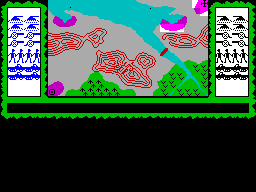
Psyclapse was developed by a separate internal team from Bandersnatch. Where Bandersnatch had Hetherington as a named, publicly identified developer, Psyclapse had no equivalent focal point in the public coverage. It was described as arcade-style - but the descriptions remained abstract enough that the game existed primarily as a name, a price, and a position in the Megagames marketing structure.
When Imagine collapsed, Psyclapse left almost no trace. The code - if it existed in substantial form - has not surfaced publicly in the four decades since. No retrospective interviews have produced detailed accounts of what the game was, what it looked like, or how far development had progressed. It is the gap in the story: one Megagame that became a Psygnosis release, and one that disappeared.
What the Megagames Mean
The Megagames are now the heart of Imagine's legacy. Arcadia is historically significant as a commercial milestone. But it is Bandersnatch and Psyclapse - the games that were announced, hyped, priced, and never delivered - that give Imagine Software its particular place in gaming history.
They represent the moment when a successful British games company decided to change the nature of the product it was selling, and ran out of time before the transformation could be completed. That story played out in front of BBC cameras. The cameras documented a company that had genuinely tried to do something ambitious and was paying the price for the ambition running ahead of the execution.
The Megagames also connect Imagine's collapse directly to what came after. Ian Hetherington carried Bandersnatch to Psygnosis. The talent, the code, and the ambition survived the bankruptcy. Psygnosis, which became one of the most important publishers of the Amiga era, grew in part from the roots of an unfinished ZX Spectrum game that a Liverpool company never got to ship.
That continuity - from Imagine's collapse to Psygnosis's success - is the detail that prevents the Megagames story from being purely a cautionary tale. The technology survived, the programmer survived, and what was built at Imagine became, in a different form, the foundation for something that lasted considerably longer.