From a flying start on the ZX Spectrum to one of the most documented collapses in games history.
Two Men and a Spectrum
Dave Lawson and Ian Hetherington founded Imagine Software in Liverpool in 1982 - the same year
Sinclair's ZX Spectrum arrived in shops and upended the British home computer market. The timing
was not coincidence. Both men saw what the Spectrum represented: a machine with 16 kilobytes of
RAM and a rubber keyboard, selling to hundreds of thousands of families at a price parents could
actually justify. Somebody was going to write the games for it. They intended to be that somebody.
Lawson took the role of technical director. Hetherington led programming. From the outset the
company combined genuine technical capability with an unusual instinct for promotion - and it
was the combination of both that made Imagine distinctive in a market where most publishers
were still operating out of bedrooms and garden sheds.
Bruce Everiss joined as marketing manager and became the company's most visible public face.
Everiss had strong opinions about how a games company should present itself and was not shy
about sharing them with the trade press. At a time when UK games companies often communicated
in dull technical language, Imagine spoke the language of ambition.
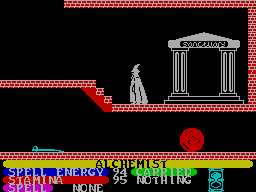
Alchemist (1983) represented Imagine at their technical peak. The colour work on the ZX Spectrum impressed reviewers and pushed the hardware in ways most publishers avoided.
The company released its first titles in 1982, targeting the ZX Spectrum almost exclusively.
Schizoids, Cosmic Cruiser, Zzoom - these early games established a rhythm of regular releases
and began building the Imagine brand. They were competent, commercially successful titles for
their time. None of them hinted at what was coming next.
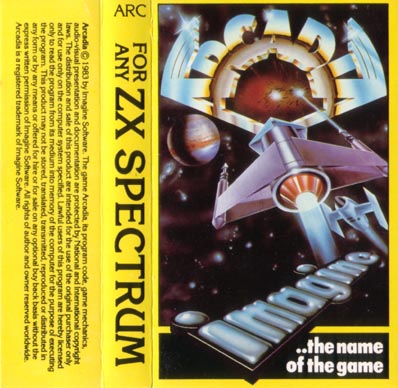
Arcadia changed everything. Released in 1982 as a Galaxian-style multi-wave shoot-em-up for
the ZX Spectrum, it reportedly shifted over 100,000 copies - a number that would have seemed
absurd for a ZX Spectrum game a year earlier. Imagine had its breakout hit, its proof of
concept, and its blueprint for what came next: find the market, understand it, and move fast.
Arcadia (1982) - the ZX Spectrum cassette inlay that sold over 100,000 copies
The Hottest Company in British Games
Through 1982 and 1983, Imagine maintained a publishing rate that kept the company constantly
in the games press. Jumping Jack, Stonkers, Ah Diddums, Molar Maul, Pedro - each new title
arrived with marketing support and packaging that reinforced the brand's visual identity.
The company was hiring, expanding, and presenting itself to the world as a British technology
success story at a moment when politicians were eager to celebrate exactly those kinds of stories.
Alchemist, released in 1983, demonstrated range. Where Arcadia was pure arcade action, Alchemist
was an arcade adventure - a wizard who could transform into an eagle, navigating a castle
environment that required exploration as much as reflexes. The ZX Spectrum version was followed
by a Commodore 64 port, signalling Imagine's growing appetite for multi-platform publishing.
The revenues were real and the profile was growing. BBC producers, looking to make a
programme about the new British software industry, identified Imagine as the right subject.
The company was photogenic, articulate, and willing to put its offices and its founders in
front of cameras. A documentary crew began filming. Nobody involved could have predicted
what those cameras would end up capturing.
Alchemist (1983) - arcade adventure demonstrating Imagine's range beyond pure shoot-em-ups
We were probably the most successful software house in the country in terms of product sales.
We had a very high profile with the media, we had very good products, we were earning a lot of money.
The Megagames: Everything at Stake
The Megagames announcement transformed Imagine from a successful software house into something
that felt genuinely novel. In 1983-1984, the company announced two titles under a new premium
label: Bandersnatch and Psyclapse. Each would be priced at £39.95 - more than three times
the cost of a standard game, and justified by an equally ambitious technological proposition.
The Megagames would ship with a hardware peripheral: an additional RAM cartridge that plugged
into the ZX Spectrum and dramatically expanded its capabilities.
Bandersnatch was Hetherington's project - an action adventure intended to demonstrate that
the Spectrum, properly augmented, could deliver an experience that no current software could
match. The concept was ambitious enough to generate genuine excitement in the games press,
which covered the announcements extensively and helped create the impression that something
revolutionary was imminent.
Psyclapse was being developed by a separate internal team. Less is documented about its
design compared to Bandersnatch - it was described in press coverage as arcade-style, but
the game remained abstract enough that it existed primarily as a name and a price tag
rather than a defined product.
Both projects consumed resources at a rate that the company's revenue, however strong, could
not sustain indefinitely. The Megagames required hardware development alongside software
development. Staff numbers had grown substantially. The offices in Liverpool projected an
image of success that had a significant overhead attached to it.
The games press kept covering the Megagames. Readers kept anticipating them. And inside
Imagine, the completion date kept receding.
Stonkers (1983) - the real-time wargame that showed Imagine could handle serious subject matter
13 December 1984: When the Cameras Kept Rolling
The BBC documentary crew had come to Liverpool to film a positive profile. Paul Anderson's
"Commercial Breaks" series was documenting British business success stories, and Imagine -
young, profitable, making the news - was a natural subject. The crew began filming in early
1984, building what everyone expected to be a story about how the British software industry
had found its feet.
In July 1984, Imagine Software went into receivership. The company's bank was Barclays.
When the financial situation became irretrievable, bailiffs arrived at the Liverpool offices
to begin repossessing assets. The BBC cameras, already present in the building, kept rolling.
The footage captured during those hours became something the games industry had never seen:
a real-time document of a company dying, with the people who built it still in the building.
Dave Lawson, Ian Hetherington, and Bruce Everiss all appear in the documentary. The atmosphere
shifts in the footage from the energy of the earlier sequences to something quieter and stranger
as the reality of the situation became clear.
The collapse was attributed to a combination of factors: the overambitious Megagames
development timeline, staff and office costs that had grown with the company's success
but did not shrink when the revenue pressure increased, and the fundamental tension
between maintaining an expensive public profile and delivering the products that profile
had promised.
Whether the Megagames would have succeeded commercially is unknowable. At £39.95 each,
with hardware requirements, the market they were targeting was significantly smaller than
the market Arcadia had reached. But they never got the chance to find out. The bailiffs
arrived first.
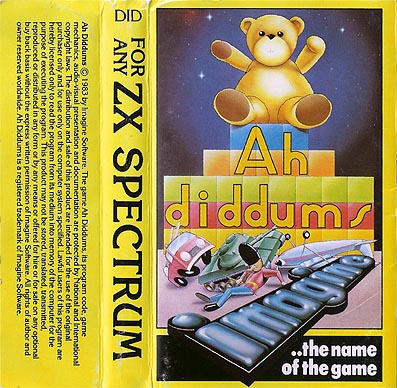
Ah Diddums (1983) - one of Imagine's final released titles before the collapse
The Full Commercial Breaks Documentary
Paul Anderson's complete BBC documentary on Imagine Software, 1984. Footage includes the bailiff arrival, interviews with Lawson, Hetherington, and Everiss, and the immediate aftermath of the collapse.
After Liverpool: Two Roads Forward
Ocean Software, the Manchester publisher founded in 1982 by Jon Woods and David Ward, acquired
Imagine's remaining assets after the collapse. Ocean was already one of the UK's strongest
publishers and would go on to dominate the late 1980s home computer market. The Imagine IP
passed to a company equipped to do something with it.
Ian Hetherington took a different road. In 1984, he co-founded a new company initially called
Finchspeed, which would later rename itself Psygnosis. The Bandersnatch code he had been writing
at Imagine came with him. Reworked substantially over the following year, it became Brataccas -
released by Psygnosis in 1985, and a direct link between Imagine's ambitions and the new company's
output.
In July 1984, Barclays Bank appointed a receiver. Bailiffs arrived at Imagine's offices to repossess assets. Staff who had turned up for work that morning found themselves out of a job by afternoon. The BBC cameras were still rolling. The footage captured Dave Lawson at his desk, computers being wheeled out of the building, and the physical atmosphere of a company that had ceased to exist while everyone inside it was still present to witness it.
The collapse was not a surprise to everyone. The company had been burning through money faster than it was generating it. The Megagames had not shipped and showed no sign of shipping. Key staff had left. The ambitious spending on offices and salaries that had defined Imagine's peak had not been matched by a corresponding growth in revenue.
What made the Imagine collapse significant was not merely that it happened - other software houses folded in the mid-1980s - but that it happened on camera. "Commercial Breaks" became required viewing for anyone interested in British gaming history. The bailiffs sequence in particular became a reference point for discussions of the first boom-and-bust cycle in home computer software.
Ocean Software, the Manchester-based publisher, acquired Imagine's remaining assets after the collapse. The Imagine brand would continue for a short time under Ocean's stewardship, with re-releases of existing titles. But the original Imagine Software - the Liverpool company that had burned so bright for two years - was gone.
The Imagine Software wordmark. Within two years of its first use, it would become synonymous with one of British gaming's most famous failures.
"The biggest thing to happen to home computers since the invention of the microchip."
Imagine Software advertising copy for the Megagames, 1983
After 1984
What the Collapse Left Behind
Ian Hetherington did not stay out of the games industry for long. He co-founded Psygnosis - initially called Finchspeed - in 1984, shortly after Imagine's collapse. The company name was a made-up word; the ambition was thoroughly familiar. Psygnosis went on to publish some of the most celebrated Amiga titles of the late 1980s and early 1990s: Shadow of the Beast, Lemmings, and eventually the entire Wipeout franchise.
The connection between Imagine and Psygnosis was not merely biographical. The code and design work from Bandersnatch survived the collapse and was reworked by Psygnosis as "Brataccas" (1986) - making the unreleased Megagame the direct ancestor of a Psygnosis title. The Bandersnatch code had another life entirely: years later, the name "Bandersnatch" would become famous in a different context when Netflix used it for a Black Mirror interactive film.
Dave Lawson's post-1984 career is less documented. Bruce Everiss went on to work in the industry and has written publicly about the Imagine years on his blog "Bruce on Games," which remains a primary source for the marketing perspective on the company's history.
Stonkers (1983) was one of the released titles that kept Imagine's name in the charts even as the Megagames consumed resources without delivering revenue.
Imagine Software existed for approximately two years. Its catalogue runs to twelve released titles
and two unfinished ones. But the BBC footage ensures that the company's collapse is better
documented than the entire operational histories of most of its contemporaries. In a medium
that tends to discard its own past, Imagine's end was preserved in unusually sharp detail.
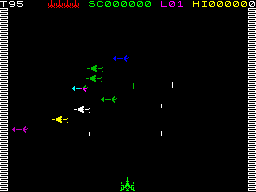
Arcadia gameplay (1982) - the game Hetherington carried forward into the Psygnosis era
Bandersnatch and Psyclapse - announced 1983-1984 at £39.95 each,
bundled with a hardware peripheral, and destined never to ship. Bandersnatch, developed by
Ian Hetherington, was later reworked by Psygnosis as "Brataccas" (1985). Psyclapse vanished
almost without trace.