The First Moral RPG
Ultima IV: Quest of the Avatar
Origin Systems · 1985 · Apple II, DOS, C64, Amiga, NES
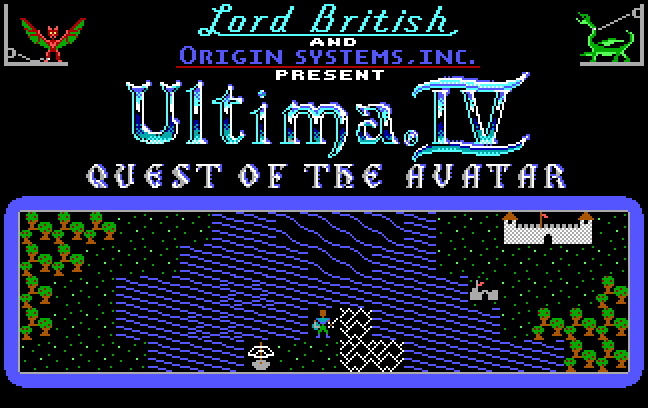
In 1985, Richard Garriott did something no game designer had done before: he removed the villain. There was no evil sorcerer to defeat, no dark lord to destroy. Instead, Ultima IV asked: are you virtuous?
The premise is deceptively simple. The land of Britannia is at peace after the defeat of the Triad of Evil. Lord British believes that what Britannia now needs is not a hero but an exemplar - someone who embodies all Eight Virtues so completely that they inspire the entire population. The player must become the Avatar.
The Eight Virtues
Each virtue is tied to a city, a dungeon, a character class, and a colour of the reagent bag.
Honesty
City of Moonglow · Mage · Blue · Truth in all dealings
Compassion
City of Britain · Bard · Yellow · Care for others before self
Valour
City of Jhelom · Fighter · Red · Courage in the face of danger
Justice
City of Yew · Druid · Green · Equal treatment for all
Sacrifice
City of Minoc · Tinker · Orange · Giving without expectation
Honour
City of Trinsic · Paladin · Purple · Acting with integrity
Spirituality
City of Skara Brae · Ranger · White · Reflection and inner peace
Humility
Village of New Magincia · Shepherd · None · No class, no colour, no advantage
Why Ultima IV Was Revolutionary
The game didn't just remove the villain - it redesigned every system around morality. Combat had consequences: slaying non-hostile monsters reduced your moral standing. Trading fairly, donating to beggars, telling the truth to NPCs even when lies would be more convenient - all tracked.
The game asked players to interrogate their own RPG habits. Had you been stealing from chests? Killing fleeing enemies? Looting dungeons without need? These behaviours, rewarded by most RPGs, were now marks against you.

I wanted players to feel that finishing the game meant they'd become a better person - not just a more powerful character. The Avatar isn't a title you earn by defeating evil. It's a title you earn by being good.
Richard Garriott, speaking about Ultima IV
When Garriott Decided Heroes Were the Problem
After shipping Ultima III in 1983, Richard Garriott began to hear uncomfortable things from parents and teachers: children were playing his games by slaughtering every NPC in a village for gold, or reloading saves after every dishonest choice to optimise their stats. The games rewarded this behaviour. Garriott had not designed a moral world - he had designed a consequence-free one.
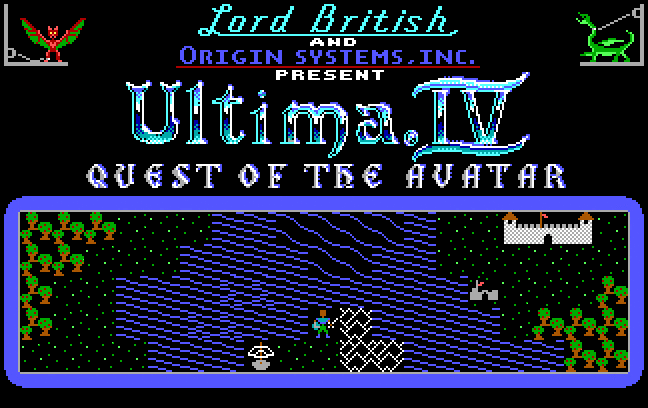
Ultima IV was his response. Over the course of 1984 and into 1985, he redesigned every game system from first principles. Combat was rethought to penalise unnecessary killing. The keyword conversation system was extended to track honesty. The eight character classes were rebuilt to correspond to eight virtues, each rooted in a philosophical principle that Garriott had spent time researching. The world map was redrawn so that every town corresponded to a virtue, every dungeon to a principle. See the people behind the series for more on Garriott's design philosophy and career.
Denis Loubet painted the cover: the Avatar kneeling beneath a giant Ankh against a sky of stars. No monster. No weapon raised in triumph. It was the first Ultima cover to show a character in contemplation rather than combat. The art told you what kind of game this was before you opened the box.
The Gypsy Asks First
Ultima IV opens not with combat but with a conversation. A gypsy at a crossroads presents you with a series of moral dilemmas - not tests with obvious right answers, but genuine choices between competing values. Do you value Honesty or Compassion when they conflict? Justice or Sacrifice? Your answers determine your starting character class and set your initial virtue standings. The game is reading you from the first moment.

Progress in Ultima IV is not measured in experience points or gold. It is measured in virtue. To advance toward Avatarhood in each of the eight areas, you must perform specific acts: donate generously to beggars for Sacrifice, tell the truth in all keyword conversations for Honesty, avoid fleeing from combat with weaker creatures for Valor, give blood at healers even at personal cost. The game does not announce when you succeed. You are expected to figure out what virtuous behaviour looks like and practise it without a reward notification.
The structure gives you eight cities to explore, eight shrines to meditate at, eight dungeons to plumb, and a final journey into the Abyss to retrieve the Codex of Ultimate Wisdom. None of this is marked on a quest log. Discovery happens through conversation, exploration, and note-taking. Browse the full series catalogue on the games page.
The Press Struggled to Explain It
When Ultima IV shipped in September 1985, reviewers were uncertain how to characterise it. The absence of a villain was genuinely disorienting for a genre built around villain defeat. Computer Gaming World praised its moral ambition as unlike anything previously attempted in interactive entertainment, naming it among the best games of the year. Byte magazine highlighted the NPC keyword system as a genuine advance in simulated social interaction.

The slower pace of discovery - Ultima IV requires patience, exploration, and note-taking that most games of the era avoided - initially drew some criticism. But the game's depth rewarded those who committed to it. Contemporary players who completed it often described the experience as genuinely affecting, a response RPGs rarely provoked. Over time, it has come to be recognised as one of the most important games ever made.
The original Ultima games were immoral - you could kill anybody, steal anything. When I realised players were spending time acting as murderers and thieves, I felt I had to create a game where you truly could not win by being evil.
Richard Garriott, interviewed about the origins of the Virtue system
Every Morality System Since Owes This Game Something
Ultima IV did not merely influence games - it created a category of game. The concept of an NPC economy, a world that reacted to player choices, and a moral tracking system beneath the surface has appeared in some form in nearly every major RPG made since 1985. Games as different as Knights of the Old Republic, Fable, Black & White, Fallout, and Mass Effect all owe a traceable debt to Ultima IV's central premise: that choices should matter, that the world should remember what you did.
The influence on Japanese RPGs is direct. Yuji Horii, creator of Dragon Quest, has cited the Ultima series as a primary inspiration. The genre conventions established in Ultima IV - the hero on a moral rather than martial journey, the world rendered as a moral space - are now so fundamental to RPG design that they no longer register as conventions. They are just what RPGs are.
The Greatest Ultima
Ultima VII: The Black Gate
Origin Systems · 1992 · DOS, Amiga
Two centuries after the events of Ultima VI, Britannia has changed. Prosperity has bred complacency. A new organisation, the Fellowship, has spread across the land - offering community, meaning, and fellowship to all. Lord British endorses them. The population adores them. But the Avatar - arriving through a red moongate - senses something deeply wrong.
Ultima VII is a masterwork of systemic design. Every object in the world can be picked up, thrown, combined, cooked, eaten, or examined. Bakers bake bread using real ingredients; beehives produce honey that can be spread on that bread; the economy runs in real time whether the player observes it or not. The world does not exist to serve the player - it exists independently.

The Fellowship is revealed to be a front for the Guardian - a vast malevolent entity who plans to use the Black Gate (a great moongate) to enter Britannia and subjugate it. The Fellowship's theology, its self-help rhetoric, its charismatic leadership structure - all are clearly modelled on cult dynamics. In 1992, this was remarkable subject matter for a game.
The villain is never defeated in combat. Destroying the Black Gate requires understanding - tracing the Fellowship's hierarchy, uncovering its secrets, gathering evidence. Victory comes from knowledge, not from hitting things harder.
Technical and Design Achievements
Fully Interactive World
Every object can be picked up, moved, or combined. The world simulation runs whether the player is present or not - merchants restock, bakers bake, taverns fill for evening meals.
Real-Time Economy
Britannia has a functioning economy. Shops restock from suppliers. Prices fluctuate based on supply and demand. The player can observe - and disrupt - these systems.
NPC Schedules
Every NPC has a daily schedule: waking hours, meals, work, recreation, sleep. Catch an NPC at the wrong time and they may be unavailable - a genuine simulation of social life.
Narrative Sophistication
The Fellowship is a clear allegory for cult psychology - charismatic leader, community pressure, suppression of critical thinking. One of gaming's earliest serious engagements with this subject.
Ultima VII was the game where we finally had the technology to match our ambition. We wanted to build a world - not a game level. Every detail, from the miller's schedule to the texture of the grain sacks, was there to make Britannia feel real.
Warren Spector, reflecting on Ultima VII's development
Origin's Most Ambitious Build
By 1990, Origin Systems was at the peak of its creative ambition. Ultima Underworld - developed in collaboration with Blue Sky Productions (later Looking Glass Studios) - had demonstrated what 3D RPG simulation could achieve. The team building Ultima VII, led by producer Warren Spector, set out to apply that level of systemic simulation to the franchise's isometric format.

The new engine - developed from scratch at Origin's Austin, Texas facility - handled real-time simulation of every object in the world simultaneously. Bread rose in bakeries. Bees in hives produced honey. The mill processed grain into flour. The technical challenge of running all these simulations together in real time required inventive architecture that Origin's engineers spent much of 1990 and 1991 solving.
Spector had come from a background in pen-and-paper RPG design at TSR and Steve Jackson Games before joining Origin, and was particularly interested in the narrative possibilities. The Fellowship - the cult-like organisation at the centre of the story - was written with careful attention to how real cults operate: the charismatic rhetoric, the manufactured community, the gradual suppression of critical thought. When the game shipped in April 1992, EA had not yet acquired Origin. That would happen in September 1992. Ultima VII was Origin at its most independent. See the people page for Warren Spector and the full Origin team.
What Britannia Does When You're Not Watching
Ultima VII begins with a murder - a gruesome tableau in the stable behind Britain's mayor's house. The investigation leads outward through all of Britannia: hundreds of NPCs with daily schedules to interview, hundreds of objects to examine, and a Fellowship whose explanations grow less convincing the more you pull at the threads. The game never marks objectives on a map. You maintain notes.
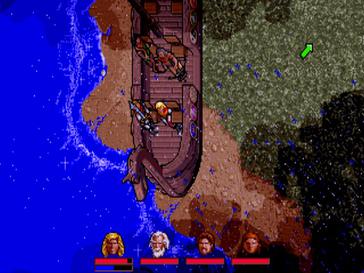
Combat is handled in real time - party members act on their own AI while you direct the Avatar directly. The system is intentionally rough around the edges; Origin was more interested in the world simulation than in combat polish. Experienced players bypass most combat entirely, using the world's physical logic to solve problems - an approach the game actively rewards.
The object interaction system is the game's great achievement. Every object has physical properties: weight, flammability, container capacity. Reagents can be combined into spells; food can be cooked; candles can be lit; locks can be picked; doors broken down. The game does not explain most of this. Discovery comes through play and the world's willingness to simulate consequences for actions the designers could not have anticipated. Browse the full catalogue on the games page.
Critics Had to Invent New Praise
Ultima VII shipped in April 1992 to immediate critical acclaim. PC Gamer awarded it among its highest scores for an RPG, and Computer Gaming World selected it for multiple awards. Reviewers who had praised Ultima IV as the peak of RPG design now argued that VII had surpassed it. The consensus was not merely that Ultima VII was a very good RPG - it was that it had moved the ceiling.
Contemporary critics particularly noted the NPC schedules and world simulation as unprecedented. A reviewer writing in Computer Gaming World in 1992 described watching a baker wake, light his oven, mix flour with other ingredients, and produce bread as "the closest thing to a living city a computer has ever generated." The game was seen as the culmination of everything the RPG genre had been building toward since the early 1980s.
We were trying to make a world, not a game. The distinction mattered. A game is designed around what the player does. A world exists whether the player is there or not.
Warren Spector, postmortem interview on Ultima VII
The World BioWare Studied
BioWare's founders Ray Muzyka and Greg Zeschuk have cited Ultima VII as a foundational influence on their design philosophy. Baldur's Gate (1998) - which defined the modern Western RPG - adopted Ultima VII's approach to NPC schedules, world persistence, and the sense of a world that exists independently of the player. The DNA of Ultima VII runs through Baldur's Gate, Neverwinter Nights, and Dragon Age.
Todd Howard at Bethesda has discussed Ultima as an influence on The Elder Scrolls. Morrowind's commitment to a living world with its own economy, politics, and daily rhythms is a direct inheritance from the design principles Origin established here. The open-world RPG as it exists today traces a clear lineage back to Britannia in 1992.
Ultima VII also gave the world Serpent Isle in 1993 - a standalone companion campaign of comparable depth - and directly influenced Ultima Online (1997), the first large-scale massively multiplayer online RPG, which used Britannia's world simulation as its template. See the spinoffs page for the full Ultima Online story.