A World Through the Ages
Britannia from 1980 to 1999 - each era its own visual revolution.


In Their Own Words
The series that changed RPGs forever - in retrospect and in documentary.
The Saga of Britannia
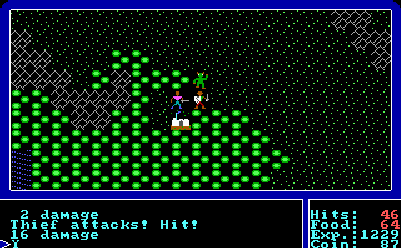
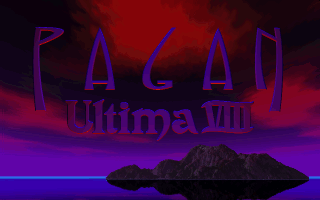
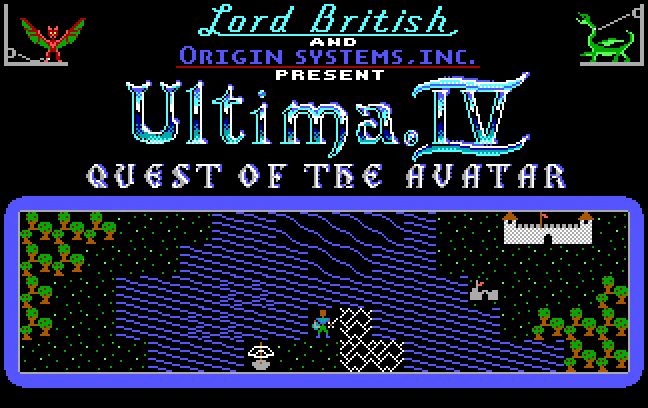
The Ultima series spans three distinct eras - the Age of Darkness (I–III), the Age of Enlightenment (IV–VI), and the Age of Armageddon (VII–IX) - each a radical reimagining of what an RPG could be.
What set Ultima apart was not combat or dungeon design but moral ambition. With Ultima IV in 1985, Garriott abandoned the convention of defeating a villain and instead challenged the player to become virtuous - to embody all Eight Virtues and achieve Avatarhood. No other game had done this.
Britannia was not a backdrop. It was a living world with its own calendar, moons governing magic, a society that reacted to the player's choices, and characters with daily schedules. The cloth maps that came with the box weren't packaging - they were objects in the world.
Three Ages of Britannia
Age of Darkness (I–III)
Classic dungeon crawling in Sosaria. Ultima I, II, and III established the series vocabulary - tiled overworld, first-person dungeons, turn-based combat. Ultima III introduced the party system and genuine moral weight through Exodus.
Age of Enlightenment (IV–VI)
The revolutionary era. Ultima IV replaced victory over a villain with the quest for Avatarhood. Ultima V explored political corruption. Ultima VI challenged assumptions of good and evil. The series became a moral laboratory.
Age of Armageddon (VII–IX)
The mature era. Ultima VII achieved the richest open world of its time. Underworld went underground in 3D. VIII and IX pushed technology and narrative ambition - though troubled development cost both games their potential.