Eighteen Months to Reinvent European Gaming
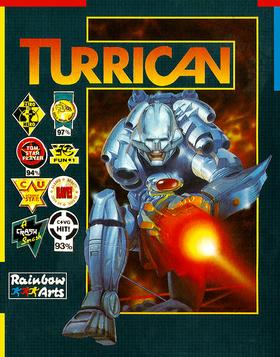
Turrican box art for the Commodore 64 version (Rainbow Arts, 1990).
Before Turrican arrived in early 1990, the Commodore 64 was widely considered past its peak.
Five years of commercial releases had established a clear ceiling for what the machine could display,
and European publishers were already pivoting their marketing attention to the Amiga. Then Manfred Trenz,
a 23-year-old programmer at Rainbow Arts in Sindelfingen, submitted screenshots of his new project -
and the Zzap! 64 editorial team assumed the artwork had been sent to the wrong magazine.
Turrican was originally conceived as a response to games Trenz admired: the exploration-driven
non-linearity of Metroid on the NES, the kinetic pace of Psycho-Nics Oscar
on the arcade, and the ambition of early Amiga titles he wanted to match - on a machine with a
fraction of the memory and a processor running at under one megahertz. What resulted was an
eighteen-month project that transformed both Trenz's career and European gaming's expectations
of what an eight-bit machine could be asked to do.
What Manfred Trenz Saw When He Looked at a C64
Trenz approached the C64's limitations as problems to engineer around rather than constraints
to accept. The game's enormous scrolling worlds - five distinct themed environments, each with
multiple levels and hidden routes - required software tricks in the blitter and raster interrupt
routines that pushed the 6510 processor in directions commodity hardware was never expected to go.
The sprite multiplexing techniques Trenz employed allowed far more simultaneous on-screen objects
than the C64's hardware sprites normally permitted.
Rainbow Arts gave Trenz unusual autonomy for a first major project. The world design was entirely
his: open and non-linear where contemporaries were corridor-driven, built to reward return visits
and exploration rather than linear completion. Weapons were not simply upgrades layered sequentially
but a rotating selection requiring moment-to-moment choice. Chris Hulsbeck - already a staff composer
at Rainbow Arts after winning a 1986 64'er magazine competition - was assigned to score
the game, beginning a creative partnership that would define the series.
"I wanted to create the biggest and most varied world I could on the C64. The player should always feel
like there was more to discover - hidden rooms, secret power-ups, areas they had not yet reached.
Non-linear design was essential to that feeling."
The Gyroscope, the Wheel, and 360 Degrees of Firepower
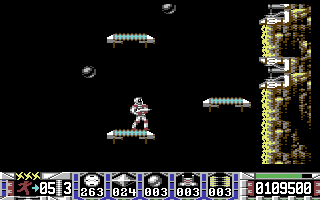
World 1 of Turrican on the Commodore 64 - the vast, open scrolling landscape that defined the game's non-linear design philosophy.
Turrican's protagonist is clad in a power suit with five weapon modes cycling on a single button:
Multi-Shot fires in three directions simultaneously, Power Beam concentrates energy into a narrow
forward blast, Laser locks on for a sustained cutting shot, Bounce sends ricocheting projectiles
down corridors, and a fifth slot holds whatever temporary upgrade has been collected. The weapon
wheel rotates with a single button press, demanding quick decisions mid-firefight rather than
a pause-and-equip system.
The defensive centerpiece is the Gyroscope - pressing down and fire contracts the hero into a
spinning wheel of destruction that rolls through enemies while granting brief invincibility.
It burns through energy reserves rapidly, so using it carelessly in a tough section will leave
the player exposed precisely when they most need cover. Managing the energy bar while navigating
sprawling levels that demand exploration is the game's central mechanical tension.
Multi-directional fire - unusual for European action games of the period - meant enemies flanking
from above or below could be engaged without repositioning, a design decision that prevented the
corridor-based feel of contemporaries and opened up the vertical dimension of each level to
meaningful combat.
When Zzap! 64 Thought the Screenshots Were Amiga
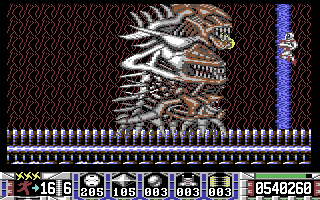
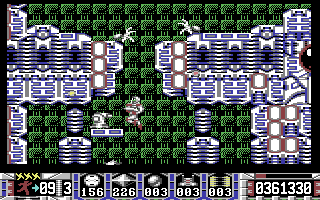
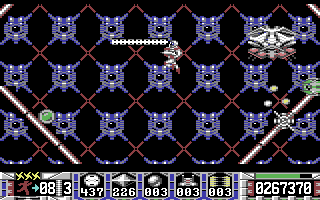
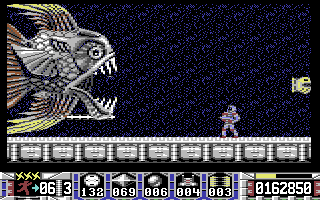
A three-headed boss encounter - multiple simultaneous sprites that editors initially attributed to Amiga hardware.The technology-themed level, showcasing graphic variety across environments that few C64 titles attempted.
Trenz's programming methods produced a game that genuinely confused experienced C64 watchers.
His sprite multiplexing routines allowed enemies, projectiles, and environmental details to coexist
on screen in quantities that exceeded the hardware's documented eight hardware sprites, achieved
by rapidly cycling sprite definitions between raster lines faster than the display could distinguish
individual frames. The result was a game that looked, to untrained eyes, like it was running on
significantly more powerful hardware.
The smooth horizontal and vertical parallax scrolling across large, detailed environments was
equally unconventional. Most C64 action games of the period handled scrolling by redrawing
character cells on a fixed rhythm; Turrican's approach was more fluid, maintaining the illusion
of continuous motion through the large worlds. The game's five themed environments - jungle,
caves, ice, tech, and desert - each had distinct tile sets, lighting atmospheres, and enemy
behavioural patterns, requiring Trenz to manage the C64's limited RAM with careful bank-switching.
The Amiga version, released alongside the C64 in 1990, added enhanced colours, richer parallax
layers, and gave Hulsbeck's compositions the full four-channel Paula hardware to breathe. It
demonstrated clearly that the C64 original had been engineered to punch well above its weight.
Ninety-Four Percent and a New Standard
The press reception was immediate and nearly universal. Zzap! 64's August 1990 review - 94%,
Sizzler - praised "graphics that absolutely scream" and a soundtrack that "sets the pulse racing."
CU Amiga's June 1990 review of the Amiga version awarded 91% and the Screen Star rating, praising
Hulsbeck's expanded soundtrack and the enhanced visual palette. Amiga Format, The One, and
Amiga Action all placed it in the top tier of 1990 releases.
Critical responses frequently reached for the same vocabulary: "enormous," "variety," "ambitious."
Several reviews noted that Turrican represented a qualitative leap for European-developed action
games and positioned Rainbow Arts as a studio capable of competing with Japanese publishers
on technical and design terms. At a time when most European houses were regarded as technically
competent but creatively conservative, Turrican's reception felt like a collective recalibration.
Zzap! 64 (C64)94%
CU Amiga91%
Amiga Format89%
The Blueprint Everyone Would Chase for Five Years
Turrican's legacy in European game development is difficult to overstate. The combination of
enormous non-linear worlds, varied weaponry, and a soundtrack that treated the SID chip as
a genuine compositional instrument rather than a sound-effects machine established a template
that European action developers spent the early 1990s attempting to match or exceed.
Manfred Trenz remained at Rainbow Arts to build the sequel. Chris Hulsbeck's SID compositions
for Turrican became, in time, material for orchestral concert programmes and a Kickstarter
anthology that raised over $175,000. The game itself appeared in Turrican Flashback (2021),
published by ININ Games, making it accessible on PlayStation and Switch. Its reputation
has only grown in the decades since release.
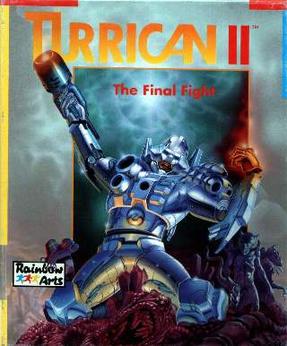
Turrican II: The Final Fight Amiga box art (Rainbow Arts, 1991) - the definitive version of the sequel.
Sequels to landmark games face a specific problem: the original succeeded partly because it
arrived without precedent. Turrican II: The Final Fight solved this problem by being, in virtually
every quantifiable dimension, a larger and more sophisticated game - while also containing a
sequence so startling and genre-crossing that it remains the most discussed single moment in
the entire series.
Released in early 1991 on C64 and Amiga, Turrican II built on the original's engine with
substantially enhanced graphics, new weapon types, refined enemy design, and five distinct
themed worlds that felt more varied and visually distinctive than its predecessor. Trenz had
twelve more months of experience with the hardware and a clear idea of where the first game's
design had room to expand. The result won Game of the Year awards from multiple publications
and is widely cited as one of the greatest games ever released on the Amiga.
The Wall and the Creative Freedom That Made It Possible
Turrican II's most celebrated single element - a vertical-scrolling shoot-em-up sequence
embedded midway through the game and known simply as "The Wall" - was Trenz's direct homage
to classic arcade shooters like Gradius and R-Type. In a run-and-gun where the player had
spent hours exploring large horizontal worlds on foot, The Wall section suddenly converted
the game into a different genre: the hero's suit transforms into a spacecraft and the screen
scrolls vertically through a gauntlet of formations, patterns, and multi-stage enemies.
The inclusion of The Wall required the engine to support a fundamentally different gameplay
mode and rendering approach. It worked partly because Rainbow Arts continued giving Trenz and
Hulsbeck unusual latitude. Hulsbeck composed an entirely distinct score for The Wall section -
a pounding FM-influenced composition that underlined the tonal shift from exploration to
pure arcade action. The contrast was deliberate and dramatically effective.
Hulsbeck's TFMX (The Final Musicsystem eXtended) audio engine, which he had developed
specifically for the Amiga, enabled seven simultaneous audio channels on hardware designed
for four. This gave Turrican II's Amiga soundtrack a layered orchestral richness that
contemporaries - working within the standard Paula chip's four-channel limit - could not
approach. The iconic main theme, a sweeping piece that opens the game on both C64 and Amiga,
was composed in response to a brief asking for music "that would make the player feel heroic
from the first second."
"The Amiga had fantastic possibilities for music with four independent channels, and I wanted
to push that as far as I could. With TFMX I was able to use seven voices simultaneously, which
gave the Turrican II soundtrack a richness that really matched the ambition of the game itself."
- Chris Hulsbeck, composer, speaking to Retro Gamer magazine (2007)
Seven Weapons, One Suit, No Let-Up
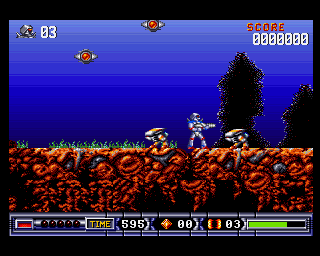
Turrican II on the Amiga - enhanced colour, smoother scrolling, and more varied level design than its predecessor.
The sequel expanded the weapon roster with new variants including the Laser and the Mirror
Ball, and introduced energy-based "super" attacks that rewarded playing aggressively without
hoarding. The energy management system that ran through the original was sharpened: power-ups
distributed through the levels replenished specific resources, encouraging exploration beyond
the obvious path rather than punishing players who had used their defensive abilities freely.
Enemy design was significantly more varied. Where Turrican's opponents were mostly organic
creatures requiring straightforward reflexes, Turrican II introduced mechanised enemies with
behavioural patterns that required reading before engaging - shield-bearing units that needed
to be flanked, formations that split on contact, bosses with multiple attack phases. Boss
encounters in particular were substantially more elaborate, each requiring a different approach.
The Wall sequence breaks the rhythm with intent. After hours of exploration and relatively
self-directed progress, it imposes a single linear corridor of increasing intensity. The
contrast functions dramatically: the relief of returning to the familiar run-and-gun format
immediately after The Wall felt earned rather than routine.
Seven Voices on Four-Channel Hardware
A vertical scrolling section from Turrican I that foreshadowed the full-length The Wall sequence in the sequel.Boss encounters in both games demonstrated Trenz's sprite multiplexing - stacking multiple objects where the hardware specification permitted far fewer.
Hulsbeck's TFMX engine represented a significant technical achievement independent of
compositional quality. Standard Amiga audio hardware - the Paula chip - provided four DMA
channels for sample playback. TFMX implemented a software mixing layer that interleaved
additional sample streams between hardware DMA cycles, effectively doubling available voices
for music playback at minimal CPU overhead. The technique required careful timing relative
to the display hardware to avoid audio artifacts, and the resulting system allowed Hulsbeck
to compose for an instrument count that no contemporary Amiga composer could match.
Trenz's rendering improvements for Turrican II addressed one of the original game's rare
visual weaknesses: sprite clarity under heavy parallel scrolling. Enemy sprites in the
sequel were drawn with higher contrast against the scrolling background layers, and the
colour selection for each environment was more deliberately varied to reduce visual noise
in busy sections. The five worlds - from ocean floors to desert plains to industrial interiors -
each had distinct palette identities that made visual variety feel intentional rather than
incidental.
Critics Without Superlatives Left
The critical reception for Turrican II exceeded even that of the first game. CU Amiga's
February 1991 review awarded the Super Star - the publication's highest designation, reserved
for scores above 93% - with a 94% rating. Reviewer Steve Merrett praised the game as a
"tour de force" and wrote that no other Amiga action game had matched its combination of
scale, variety, and technical polish. Amiga Format Gold followed; The One awarded Gold; Zzap!
64 again Sizzler-rated the C64 version.
The Amiga Power retrospective treatment of Turrican II, written several years after release,
described it as the game that had "defined what European action gaming could achieve" - a
formulation that acknowledged the game's status had only grown with time. Several publications
placed it in top-ten all-time Amiga game lists through the 1990s; it continues to appear
in such lists today, over thirty years after release.
CU Amiga94%
Amiga FormatGold
The OneGold
Zzap! 64 (C64)Sizzler
Turrican II: The Final Fight - Amiga QHD longplay. The TFMX soundtrack and fluid scrolling
are best appreciated in full-length play. Courtesy Al82_Retrogaming Longplays.
A Soundtrack for Concert Halls, Three Decades Later
Turrican II's legacy splits across two categories: as a game, and as a cultural artefact
of European game music. As a game, it effectively concluded the classic era of the series
on C64 and Amiga. Turrican 3: Payment Day (1993) followed but was generally considered a
step back in scope; the creative energy shifted toward Factor 5's console adaptations.
As music, Turrican II became the foundation for Hulsbeck's most significant post-game
career work. The Symphonic Shades concert (2008) demonstrated that the Turrican compositions
translated to live orchestral performance without arrangement awkwardness - the pieces had
been written with enough harmonic and structural sophistication to survive orchestration.
The Turrican Soundtrack Anthology Kickstarter (2013) raised over $175,000 from 4,279 backers,
releasing a four-disc vinyl set. The Turrican II - The Orchestral Album (2016), performed
by the Norrköping Symphony Orchestra, presented the score in full orchestral arrangement
as standalone listening material - a treatment previously reserved for classical repertoire
and a handful of film scores.
When Rainbow Arts licensed the Turrican property to Factor 5 for console development, the
transition carried genuine risk. The Commodore hardware that had defined the series - the
SID chip's distinctive timbre on C64, the Paula chip's four-channel audio on Amiga - was
absent from the SNES and Mega Drive. Manfred Trenz's direct involvement stepped back; Factor 5,
a German studio founded by former Rainbow Arts employees including programmer Holger Schmidt
and musician Thomas Engel, took creative ownership.
What emerged across four years was a distinct but recognisably related series of games that
translated the Turrican formula to console hardware with specific technical ambitions and
gameplay innovations of their own.
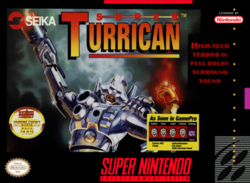
Super Turrican (SNES, 1993): The Freeze Ray and Mode 7
Super Turrican on the SNES (Factor 5 / Seika, 1993).
Super Turrican was Factor 5's first SNES entry and their first major test of Turrican
design without Trenz. The studio added the Freeze Ray - a new weapon that encased enemies
in ice, allowing their frozen forms to be used as platforms or shattered for power-up drops.
The mechanic added a tactical puzzle dimension absent from the C64/Amiga games, rewarding
patience in combat rather than pure aggression.
Factor 5 deployed the SNES's Mode 7 capability for specific sequences, rotating the
play-field to suggest depth in a way the Amiga versions could not match. The SNES version
was shorter and more linear than the original series - a deliberate console-market choice -
but maintained the visual variety and weapon-management design that defined the franchise.
Hulsbeck's soundtrack, adapted for the SNES SPC700 sound chip, retained the epic quality
of the Amiga compositions within the console's different tonal palette.
"With the SNES we had the Mode 7 chip and hardware sprite scaling that the Amiga
didn't have. We wanted to use every capability of the hardware to show that Turrican
could look as good or better on console as it had on computer."
- Julian Eggebrecht, Factor 5, speaking to GamesTM magazine (2004)
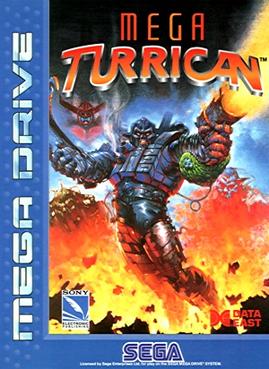
Mega Turrican (Mega Drive, 1994): The Grappling Hook Gambit
Mega Turrican on the Mega Drive / Genesis (Factor 5 / Data East, 1994), released as Turrican 3 in Europe.
Mega Turrican - released as Turrican 3: Payment Day in European markets - was Factor 5's
most ambitious console Turrican and the game that most directly extended the core design
with a structural new mechanic: the grappling hook. Pressing a button while jumping deployed
a wire that latched to environmental anchor points, allowing the hero to swing across chasms
and reach platforms previously inaccessible. The mechanic required Factor 5 to design specific
environmental structures to accommodate it, and the result felt more physically integrated
than most Turrican additions.
The Mega Drive's Yamaha YM2612 FM synthesis chip gave Hulsbeck's score a distinctly
different character from either the SID, the Paula, or the SNES SPC700. The FM timbre -
bright, slightly metallic, with a characteristic sustain envelope - suited the game's
more aggressive visual design. The Mega Drive version pushed the console's sprite hardware
aggressively, maintaining visual density and scrolling smoothness comparable to the
best technical showcases of the platform's life.
Mega Turrican received strong critical reception, with Mean Machines Sega (93%), GameFan,
and Electronic Gaming Monthly all placing it among the better action games of the Mega Drive
library. The grappling hook mechanic was widely praised as the most successful franchise
addition since the original power-up wheel.
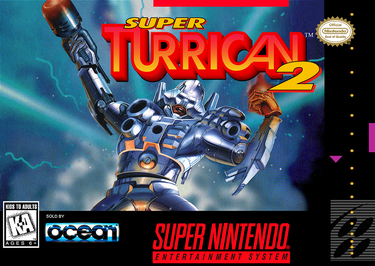
Super Turrican 2 (SNES, 1995): The Cinematic Final Chapter
Super Turrican 2 (Factor 5 / Nintendo, 1995) - Factor 5's most polished and visually ambitious Turrican.
Super Turrican 2 was the last Turrican game for nearly two decades and Factor 5's most
technically accomplished SNES title. More linear than its predecessors - a deliberate
design choice toward narrative coherence over exploration - it compensated with substantially
larger and more elaborate boss encounters, cinematic set-piece sequences, and Hulsbeck's
finest SNES composition work.
The game's visual ambition was matched by its audio. Hulsbeck's SNES score for Super
Turrican 2 is frequently cited as among the best soundtrack work on the platform, ranking
alongside Koji Kondo's work on Super Mario World and Yasunori Mitsuda's Chrono Trigger
score in critical retrospectives of SNES composition. Physical cartridges became expensive
collector's items; Super Turrican 2 was included in the Turrican Flashback compilation
(2021, ININ Games) that made the series accessible to new audiences on PlayStation and Switch.