Extended analysis of Thalion's five most significant titles - the games that define the studio's legacy.
Lionheart (1993)
Lionheart (1993) - Thalion Software for the Amiga
Released in 1993 for the Amiga, Lionheart is a side-scrolling action platformer in which
you play Valdyn - a warrior cursed by the sorcerer Mages to walk the world half-man,
half-beast. The premise is simple enough, and nearly beside the point. This game is famous
for one thing above all others: the finest pixel art ever produced on the Amiga. Everything
else - the combat, the music, the production quality - is also extraordinary. The visuals
are what stopped people in their tracks when Lionheart appeared. See the full
catalogue entry for platform and release details.
The Pixel Art That Redefined the Platform
Henk Nieborg is the name that comes up first and
most often in any discussion of Lionheart. He joined Thalion specifically to produce the
game's graphics, and what he delivered is without parallel in 16-bit software. Every sprite
is hand-drawn at a level of detail that surprises artists encountering it for the first time:
the way Valdyn's cloak responds to movement, the telegraphed weight of every enemy attack,
the textural variety of each background surface. These were not happy accidents of a talented
hand - they reflect a methodical approach to animation that treated each frame as a
compositional problem to solve.
The background artwork compounds the effect. Lionheart layers multiple parallax planes at
different speeds, creating a sense of genuine environmental depth without any hardware
feature specifically designed for the purpose. Nieborg controlled the palette with
discipline unusual for the genre - thirty-two colours deployed with the economy of an
oil painter rather than the exuberance of someone testing limits. The result looks
more like illustration than game graphics.
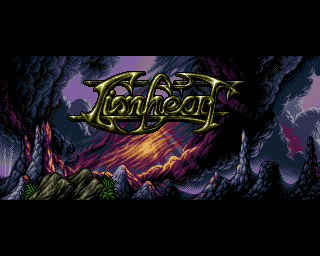
Lionheart in motion - the multi-plane parallax scrolling that defined the standard for Amiga platformers.
Thirteen Months at Thalion
Lionheart was built in a studio that was already changing. By 1993 Thalion was facing the
financial pressures that would close it within months, and several key staff had already
given notice. Jochen Hippel left Thalion in 1993,
making his Lionheart score his last Thalion composition - a fact that gives the soundtrack
a weight it might not otherwise carry. He composed using TFMX, the format he had developed
and refined across the studio's catalogue. The title theme and level music for Lionheart
are commonly cited as his best Thalion work. See the
music page for a full account of Hippel's
contribution.
Harder Than It Looks, Better Than It Should Be
The gameplay underneath the presentation is a demanding action platformer in the arcade
tradition. Valdyn's move set includes a sword attack, a shield parry, and a ranged
projectile - simple enough individually, but the game is built around punishing enemy
patterns that require mastering all three. Lives are finite and continues scarce. Checkpoints
exist but progress between them feels earned rather than given.
The movement physics are precise and responsive in a way that makes the difficulty feel
fair. You die in Lionheart because you made a mistake, not because the controls let you
down. The game trusts the player to learn its systems and apply them under pressure - a
confidence that not all platformers of the era shared. The
catalogue entry covers the Amiga release in full.
Thirty-Two Colours, Dozens of Layers
The Amiga's custom chip set was capable of thirty-two simultaneous colours in its standard
display mode. Nieborg used all of them and found ways to make them feel like more. The
multi-layer parallax scrolling required careful management of the blitter chip - the
Amiga's dedicated hardware for moving blocks of memory, which Nieborg and the development
team pushed to its operational limits. The smooth, continuous background motion at the
frame rates Lionheart achieves represents a level of hardware knowledge that separates
the demoscene-trained developers from the rest.
The sprite work itself is technically unusual. Character animations run at frame rates
higher than most Amiga games of the period, giving movement a fluidity that reads
immediately as different from contemporaries. The technical foundation under Nieborg's
art is not incidental to the visual quality - it is what makes the art possible.
The Scores That Said Everything
"Lionheart is quite simply the most beautiful game I have ever seen on the Amiga.
Nieborg's sprites are so good they make you stop playing just to watch them. The
animation is flawless - every movement is perfect. Combined with Hippel's score,
which is equally jaw-dropping, this is a game you have to own."
The critical reaction to Lionheart in 1993 was immediate and unanimous. Amiga Power,
which was notoriously selective with its scores, gave it 96%. CU Amiga followed at 91%.
The One Amiga at 90%. The reviews do not disagree on the graphics. They do not hedge.
The same words - flawless, unprecedented, unreachable - appear across publications.
See the reviews page for the full critical record.
The Benchmark Nobody Has Equalled
Lionheart appeared at the end of Thalion's commercial life, which means it carried no
sequel. Nieborg left Thalion in 1993 along with Hippel and several other key staff. The
game was not followed up. What remains is a single, complete thing - one of the most
technically accomplished platformers ever made for 16-bit hardware, released in the
closing months of the era it defined.
Nieborg continued working in games after Thalion, contributing to titles across multiple
platforms, and is still active in the industry. His Lionheart work is how most people
outside the demoscene know his name. The people page
covers his full biography.
Ambermoon (1993)
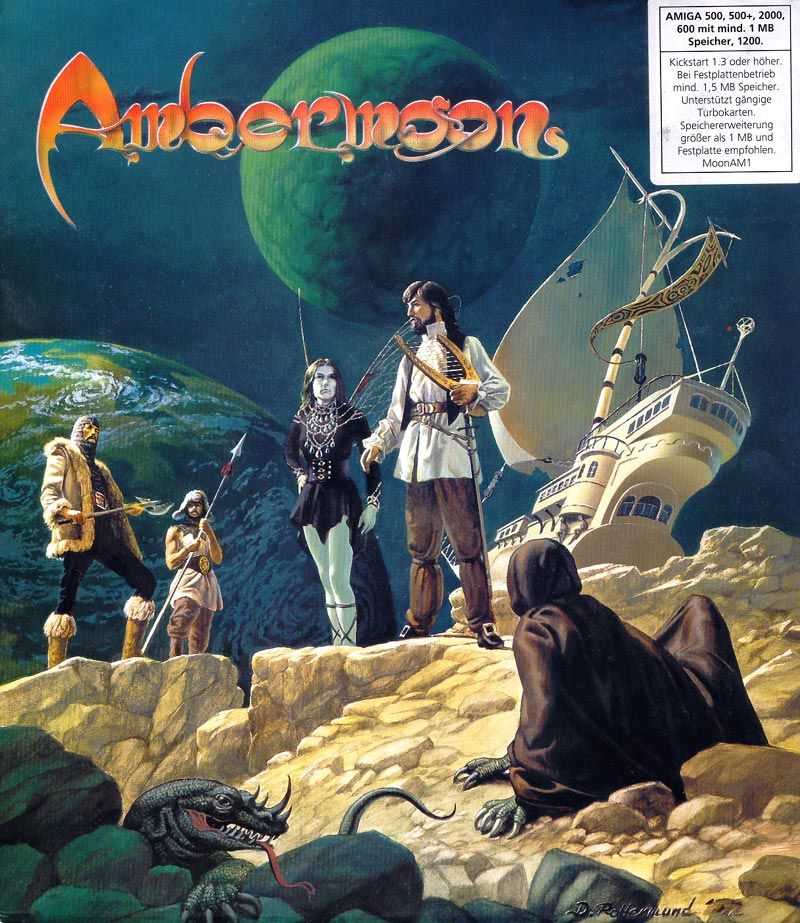
Ambermoon (1993) - Thalion Software
If Lionheart is Thalion's sensory peak, Ambermoon is their intellectual one. Released in
the same year - 1993 - Ambermoon set out to achieve something no European developer had
managed on 16-bit hardware: a fully realised fantasy world with seamless transitions
between overhead outdoor exploration, town interaction, and first-person 3-D dungeon
crawling, all on a standard Amiga 500. It achieved it. See the
catalogue entry for platform and release details.
The Sequel That Had to Be Bigger
Ambermoon followed Amberstar (1992), Thalion's first
Amber RPG, which had already pushed the Amiga's RPG capabilities. The brief for Ambermoon was
to do more in every direction: a larger world, deeper narrative, better graphics, and a
technical achievement at the engine level that Amberstar had not attempted. Programmers
Matthias Steinwachs and Werner Fuchs built the engine from the ground up. The 3-D dungeon
renderer - running at playable frame rates on a stock A500 with 512KB of chip RAM - is
the result of optimisation decisions that developers examining the source code three
decades later have found consistently surprising.
The world of Lyramion is large and internally coherent. Towns have personalities and
narrative roles. The story - a quest to find scattered pieces of the Amber artefact - is
the most developed narrative Thalion ever wrote into a game. Characters have histories.
Dialogue has weight. The scale is what you notice first when you start, and the
quality of what fills that scale is what keeps you playing.
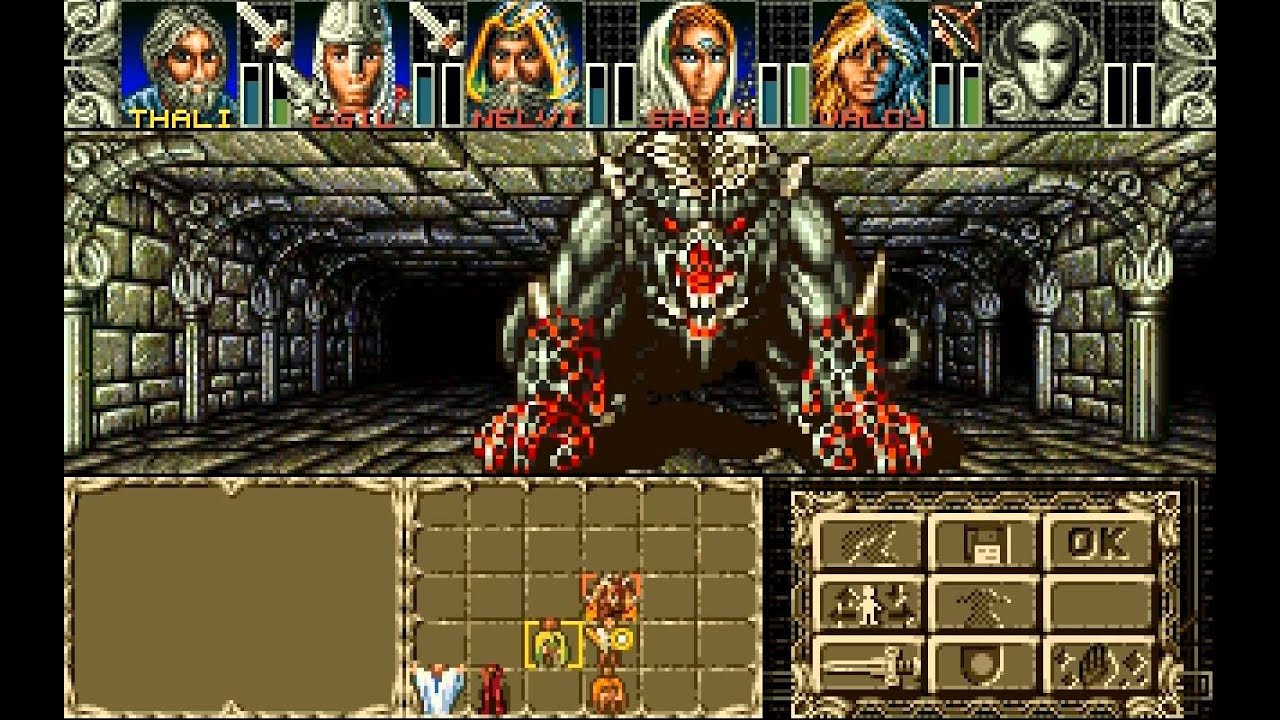
Ambermoon's overhead world map - the outdoor exploration layer that transitions seamlessly into towns and dungeons.
A World That Loads Without Stopping
The defining technical and design achievement of Ambermoon is the seamlessness of its
world. In 1993, transitions between game modes - outdoor to indoor, map to dungeon -
typically involved visible loading breaks. Ambermoon has none. Walking from an outdoor
landscape into a town, and from a town into a first-person 3-D dungeon, happens without
interruption. The world feels continuous because the engine was built to make it so.
The RPG systems underneath this technical foundation are substantial. Combat is
turn-based and tactical. Character progression spans multiple attributes and skill
areas. The dungeon environments are not just technically impressive - they are
designed with the variety and purpose of a game that understands what makes dungeon
crawling rewarding: changing light conditions, environmental puzzles, enemy placement
that rewards exploration rather than punishing it.
Fitting a 3-D Engine Into 512KB
The first-person dungeon renderer in Ambermoon is the piece that surprises developers
most when they study the source code. Achieving smooth, navigable 3-D environments
on an Amiga 500 with standard chip RAM required careful memory management, tight
rendering loops, and a depth-sorting approach that made the most of the blitter.
The result is not technically perfect - there are frame-rate concessions in complex
scenes - but it is playable, navigable, and visually clear in a way that other
Amiga 3-D attempts of the period did not always manage.
The Ambition the Critics Could See
"Ambermoon is the most ambitious RPG we have reviewed on the Amiga. The seamless
transition from overhead exploration to first-person 3-D dungeons - without loading,
without compromise - is a technical achievement that puts every other Amiga RPG to
shame. The world is large, the story engaging, and the score by Hippel magnificent."
Ambermoon received strong reviews in 1993, with Amiga Power at 89% and CU Amiga at 87%.
The criticism that appeared - the game's difficulty level in places, some pacing issues
in the mid-section - did not diminish the consensus that Thalion had produced something
exceptional. The score by Jochen Hippel was
separately noted in most reviews as among his best Thalion work. See the
music page for Hippel's Ambermoon compositions.
Source Code, Thirty Years On
In 2023 - thirty years after release - the source code and assets for Ambermoon were
released publicly, documented by intelligent-artifice.com. Developers and historians
studying the codebase have been consistently struck by the engineering choices that
made the game's performance possible. The release also allowed the community to
understand the technical decisions behind the game's seeming impossibilities.
Matthias Steinwachs, working under the name Pyrdacor, has led an open-source remake
of Ambermoon at ambermoon.net that
brings the RPG to modern systems. The remake is actively maintained and has a community
of players. See the modern page for the full picture of
Ambermoon's preservation and continuation. The
Amberstar entry covers the 1992 predecessor.
Wings of Death (1990)
Wings of Death (1990) - Thalion Software for Amiga and Atari ST
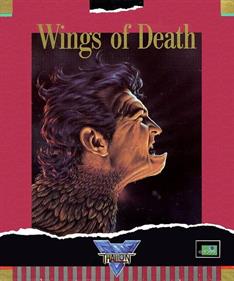
Wings of Death was the game that announced Thalion as a serious force in European Amiga
development. Released in 1990 - the year of the studio's first major creative statement -
it is a vertical scrolling shoot-em-up that the studio executed with the technical
polish and visual authority that became their calling card. The game has aged well. The
lasting legacy, discussed and shared across the Amiga community ever since, is
Jochen Hippel's TFMX soundtrack. See the
catalogue entry for platform details.
Thalion's First Statement
Wings of Death appeared in 1990, the same year as Dragonflight - Thalion releasing a
vertical shmup and a full RPG in the same window, demonstrating from the outset that
the studio was not limiting itself to any single genre or audience. The game was
developed on both the Amiga and Atari ST simultaneously, a technical challenge that
required platform-specific optimisation rather than a straight port.
The development team brought demoscene techniques to a commercial release - a practice
that characterised Thalion's output across its catalogue. Erik Simon, co-founder and
former member of The Exceptions on the Atari ST, set the technical standard from the
start. The smooth sprite handling and fluid scrolling in Wings of Death reflect a
team that had already pushed hardware to its limits in non-commercial contexts before
turning that skill to games. See the people page for the
full studio roster.
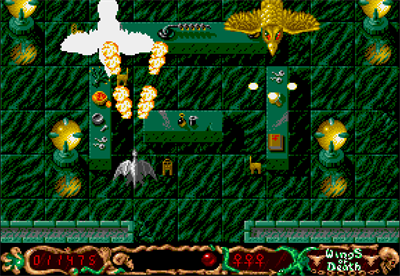
Wings of Death in play - dense enemy formations and the smooth scrolling that defined the Amiga shmup standard in 1990.
Pattern, Rhythm, Pressure
Wings of Death is a vertical shmup in the established mould - a lone fighter moving
through waves of increasingly dense enemy formations, collecting power-ups, managing
lives and continues. The game does not reinvent the genre. What it does is execute
its chosen form with unusual consistency and craft.
The scrolling is smooth without the frame-rate concessions common in contemporaries.
Enemy patterns are designed to be learned rather than survived at random - the game
rewards players who recognise formations and position accordingly. The power-up
system offers enough variety to support different approaches without becoming
overwhelming. This is a well-made shmup, and the music is what transforms it into
something more.
The Score That Defined the Release
Jochen Hippel's TFMX soundtrack for Wings of Death is the element most discussed in
retrospective coverage of the game, and not without reason. The driving, melodic score
achieves a sense of forward momentum that integrates with the gameplay rather than
running alongside it. The title theme is immediately recognisable within the Amiga
music community; the level themes maintain character and energy through extended play
without the repetition fatigue that afflicts lesser game scores of the period.
Hippel's TFMX format allowed him to control the music's dynamics and arrangement in
real time - responding to game events in ways that simpler music playback systems
could not. The result is a soundtrack that feels composed for the game rather than
applied to it. See the music page for
a full account of Hippel's Wings of Death score.
The Music That Sold the Game
"Wings of Death is the best vertical shmup on the Amiga and one of the best games
Thalion have made. The graphics are excellent, the gameplay demanding, and Jochen
Hippel's music is quite simply the best thing about any Amiga game we've reviewed
this year. Buy it."
The One Amiga, Issue 24, 1990 - Wings of Death review (88%)
The 1990 reviews gave Wings of Death 88% in The One Amiga and 86% in Amiga Power.
The scores reflected a game that delivered on its genre promises with technical
authority and a memorable soundtrack - Hippel's score earned separate mention in
almost every review the game received. See the
reviews page for the full critical record.
The Score People Still Listen To
Wings of Death is still played and discussed in the Amiga community - the shmup
format holds up, the music more so. Hippel's score has been arranged, remixed, and
covered many times in the decades since release. It appears regularly on lists of
the finest Amiga music produced during the platform's active commercial life.
For the Amiga shmup format specifically, Wings of Death set a standard in 1990 that
later titles addressed but rarely exceeded. The combination of technical solidity,
gameplay craft, and Hippel's soundtrack produced a complete package that the genre
rarely equalled.
No Second Prize (1992)
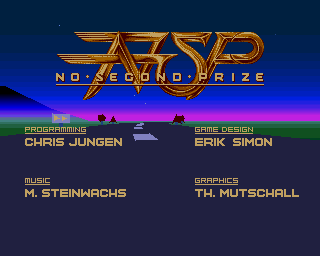
No Second Prize in play - polygon 3-D motorcycle racing on the Amiga 500, running at frame rates that contemporary reviewers described as impossible.
No Second Prize belongs to a different tradition from Thalion's RPG and platformer output.
It is a pure simulation: a 3-D motorcycle racing game that achieved in 1992 what reviewers
genuinely could not quite believe - smooth, fluid polygon rendering on a stock Amiga 500,
at frame rates that made it playable. The game is the work of one programmer,
Matthias Steinwachs, and the engine he
built for it is one of the most discussed technical achievements of the 16-bit era.
See the catalogue entry for release details.
One Programmer, One Impossible Brief
The brief for No Second Prize required producing a 3-D motorcycle racing simulation that
could run at playable frame rates on the standard Amiga 500 hardware configuration -
a machine with a 7MHz 68000 processor, no floating-point unit, and 512KB of chip RAM.
No dedicated 3-D hardware existed on the platform. Everything had to be done in software,
by the CPU, in real time.
Matthias Steinwachs achieved this through polygon rendering techniques that minimised
the computational cost of each frame. The engine uses a fixed-perspective projection
that reduces the depth-sorting problem to a manageable scale, combined with careful
optimisation of the rendering loop that avoids expensive calculations wherever possible.
The result is a game that runs faster than a reading of the hardware specifications
would suggest possible.
Lean Into the Bike, Race the Clock
The gameplay of No Second Prize is direct and demanding. You race against the clock
across a series of circuits, controlling the lean and speed of a motorcycle through
corners, hairpins, and straights. The physics model is simplified compared to a full
simulation but captures the essential feel of weight and momentum - you lean into
corners, brake for tight turns, and accelerate out of bends rather than just steering
a vehicle from above.
The handling model rewards practice. The game does not hold the player's hand or
provide forgiving racing lines - learning the circuits and finding the optimal
approach to each corner is the game's actual content. The AI opponents are well-paced
and consistent in a way that makes the racing feel genuinely competitive rather than
mechanically arranged. This is a racing game that wants to be taken seriously.
Polygon Racing at 25 Frames on a Stock A500
The engine's specific achievement was maintaining playable frame rates while rendering
a fully 3-D environment from a first-person perspective. In 1992, on the Amiga, this
was not common. Competing 3-D racing games on the platform typically compromised on
frame rate, resolution, or the complexity of the rendered environment. No Second Prize
did not obviously compromise on any of these, producing smooth motion that reviewers
described in superlatives because that was the appropriate response.
Ninety-Four and Nothing More to Say
"We genuinely don't understand how Matthias Steinwachs has done this. Smooth,
fluid 3-D motorcycle racing on a standard A500. Not slow, not jerky - actually
smooth. This is black magic and we want to know the trick. Until then, the score
is 94% and there's nothing more to say."
Amiga Power, Issue 16, 1992 - No Second Prize review (94%)
Amiga Power's 94% was extraordinary for a magazine that was notoriously difficult to
impress. CU Amiga followed at 89%. The reviews are unanimous on one point: the engine
is the story. The quality of the racing underneath it was also noted and praised, but
the technical achievement was what stopped reviewers. See the
reviews page for the complete critical record.
The Programmer's Programmer's Game
No Second Prize is remembered in the Amiga community primarily as a technical achievement,
which somewhat obscures how good it is to play. The racing is genuinely enjoyable. The
circuits are well-designed. The motorcycle physics feel right. What the game lacks is the
emotional dimension that Lionheart or Ambermoon carry - it is a simulation, not a
world - but within its chosen form it is complete.
The engine Steinwachs built for No Second Prize informed his later work on Ambermoon's
3-D dungeon renderer, which is a different technical problem but draws on the same
optimisation-first approach. Both games demonstrate that Thalion's technical ambition
was distributed across the studio rather than concentrated in one area.
Dragonflight (1990)
Dragonflight was Thalion's first serious attempt at the RPG format that would eventually
produce Ambermoon. Released in 1990 - the same year as Wings of Death - it is set in
the world of Droon and follows a hero's quest to save a dying land. The game blends
overhead map exploration with real-time flight sequences on dragonback, giving it a
distinctive identity among the RPGs of its era. It appeared on Amiga, Atari ST, and
PC DOS - see the catalogue entry for the full
release record.
The Blueprint for Everything That Followed
Dragonflight was Thalion learning in public. The studio had the demoscene technical
foundation in place and the ambition to build large games, but the RPG format was new
territory. The world of Droon is large by 1990 standards - multiple regions, a populated
cast, a narrative that spans the full arc of play. The design ambitions were real and
were mostly realised.
The lessons the team absorbed making Dragonflight fed directly into
Amberstar (1992) and then into
Ambermoon (1993). The RPG world-building skills
that Ambermoon displays - coherent geography, purposeful narrative, integration of
different gameplay modes - began here. Dragonflight is the proof-of-concept that
gave Thalion the confidence to scale up.
Two Modes, One World
The core design of Dragonflight separates between overhead map exploration and
real-time flight sequences on dragonback - a structural choice that gives the game
its identity and its challenge. The overhead mode handles towns, dungeons, and character
interaction in the tradition of Western RPGs of the period. The flight sequences are
different: real-time, action-driven, requiring a different set of skills from the
player.
The integration of the two modes is not always seamless - the transition between them
requires adjustment - but the flight sequences provide a genuine change of pace and
the sense that the world has a dimension beyond what the overhead view can show. The
Jochen Hippel score gives the world
atmospheric depth that ties the different modes together.
A Large World on Limited Hardware
Building a large RPG world across Amiga, Atari ST, and PC DOS required the kind of
cross-platform discipline that Thalion had developed from the studio's demoscene roots.
Each platform received an appropriately optimised version rather than a
lowest-common-denominator port. The Amiga version makes use of the platform's colour
capabilities; the ST version runs within that hardware's more limited colour range.
The world design itself is substantial. Multiple regions with their own visual identities,
a cast of characters with narrative roles, and enough quest density to sustain an RPG
of the period's expected length. The pixel art is competent without reaching the heights
that Lionheart would later achieve - Dragonflight was produced before Henk Nieborg joined
the studio.
The Foundation Stone of Thalion RPGs
"Dragonflight is an impressive achievement for a studio releasing its first large RPG.
The flight sequences add something genuinely unusual to the genre formula, and the world
of Droon has the scale and coherence that the best RPGs require. Hippel's score is,
as always, excellent. This is Thalion announcing that they can make serious games."
CU Amiga, 1990 - Dragonflight review
Dragonflight received positive coverage on release as a solid debut RPG from a studio
that had already demonstrated technical ability in other genres. The critical consensus
recognised the game's ambitions and its execution of them, with particular note given
to the flight sequences as a distinguishing element. In retrospect, the game's most
important function was to prove internally and externally that Thalion could sustain
a large RPG - preparation for Amberstar and then Ambermoon.
Where the Amber Series Began
Looking at Dragonflight now, its primary interest is as the first step in a sequence
that runs through Amberstar to Ambermoon. The world-building skills developed here,
the technical challenges overcome in building a cross-platform RPG, and the narrative
approach that the team refined across three subsequent titles - all of it begins with
Droon. The flight sequences did not survive into the Amber series, but the RPG
architecture that underlies them did.
For the Jochen Hippel discography, Dragonflight
is one of his earliest Thalion compositions and already shows the melodic confidence
that his later TFMX work would amplify. The
music page covers his Dragonflight
score in full.
Thalion Lives!
You typed the magic word. The demoscene never truly dies - and neither does Thalion's legacy.