The Flagship Games
Extended coverage of Lords of Midnight and Midwinter - the two titles that define Singleton's legacy. See the games catalogue for the full list.
The Lords of Midnight
ZX Spectrum, 1984 - Beyond Software - Mike Singleton (solo)
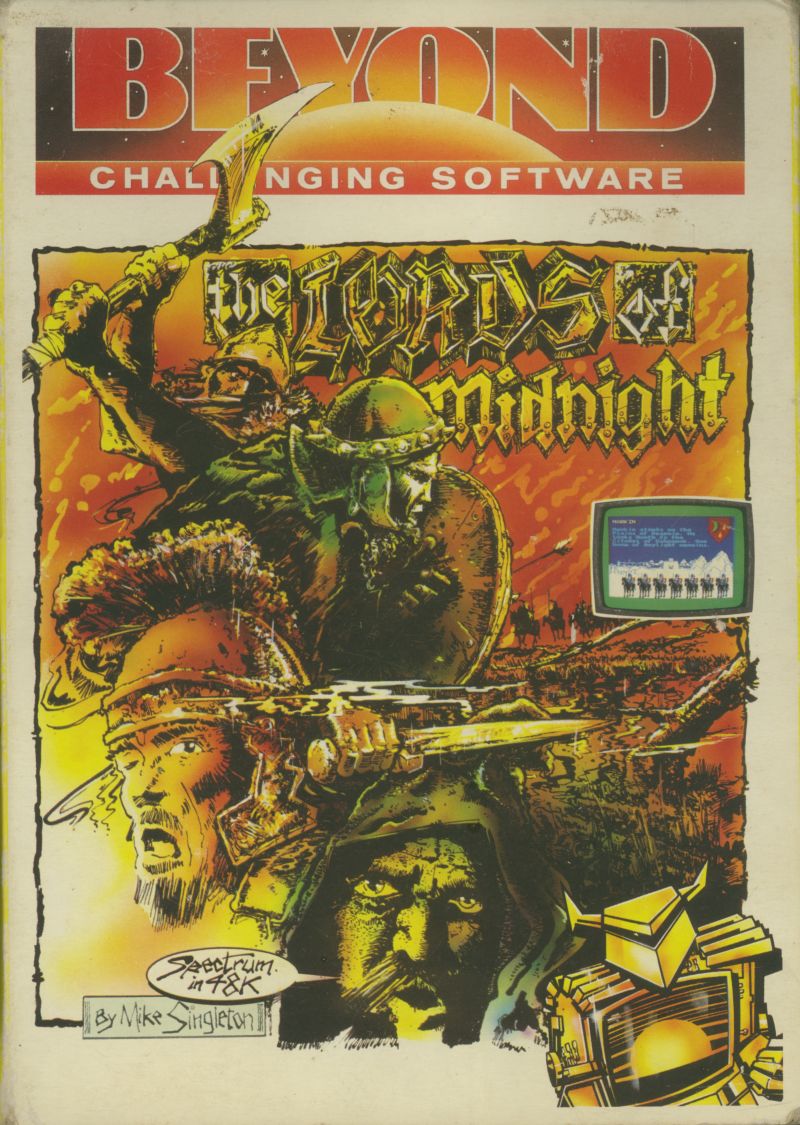
The Game That Began at a Betting Shop
In 1984, The Lords of Midnight arrived on ZX Spectrum and did something no previous home computer game had achieved: it presented an epic fantasy war across a navigable first-person world of more than 4,000 locations, with over 100 playable characters and a tactical depth that blurred the line between strategy game and interactive novel. It was designed, programmed, illustrated, and novelised by a single person in approximately seven months.
That person was thirty-three years old and had spent the previous decade teaching English on Merseyside. The game he made would win the Golden Joystick Award for Best Strategy Game of the Year, receive a 10/10 from Crash magazine, and be voted the seventh-best ZX Spectrum game of all time in a 2004 reader poll. It would also become the foundation for one of the most distinctive bodies of work in early British games development.
Rendering a World in Layers
From September to December 1983, Singleton developed the technique that made the game possible: "landscaping," a system of pre-scaled, billboarded sprite images arranged in perspective layers to simulate three-dimensional space. Mountains, forests, towers, and castle walls were represented as fixed-size graphics placed at specific depth positions in each viewport. Eight directional views at each of 4,000+ locations produced 32,000 distinct panoramic scenes - all within 48,000 bytes of RAM, with a Z80 processor running at 3.5 MHz.
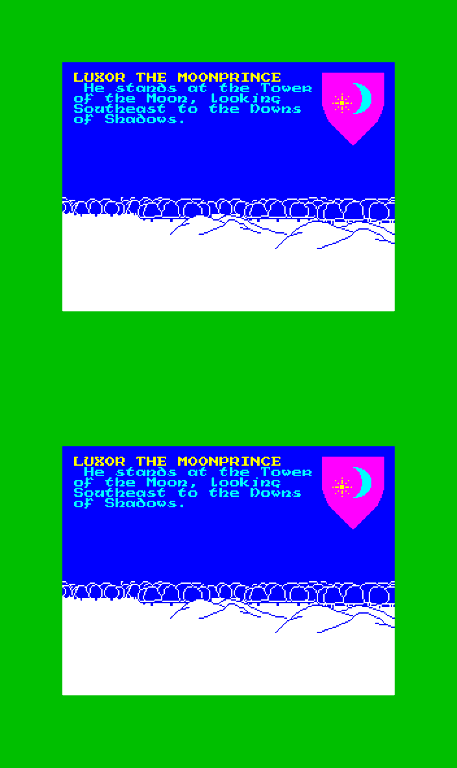
The architecture was as important as the rendering. The game's world was not a drawn map but a data structure - a network of locations, each with neighbours in eight compass directions and attributes describing what terrain features were visible from each angle. Singleton built his world by placing objects into this network, testing the result from inside the engine, and iterating until the geography felt coherent. It was world-building as database design.
The Feeling of Command
Lords of Midnight is, technically, both a wargame and a text adventure. Players manage multiple lords simultaneously, moving them across the map day by day, recruiting allies, positioning armies, and seeking the Ice Crown. The strategy layer is genuine: armies matter, lords have morale and courage, alliances shift. But Singleton layered a narrative dimension over this by grounding every action in the first-person viewport. Moving Luxor the Moonprince north from the Plains of Corelay to the Tower of Gloom is not just a strategic decision - it is a journey, rendered in the game's distinctive panoramic style.
This fusion of epic scope with intimate viewpoint was new. Wargames had maps; adventures had rooms. Lords of Midnight had a world. You could choose to win it through military conquest or through Morkin's quest to destroy the Ice Crown - two different games occupying the same geography, simultaneously playable.
"one of the greatest, but overlooked games designers of all time."
Chris Wild, developer of the 2013-2014 Lords of Midnight remake, on Mike Singleton - thelordsofmidnight.com
The Numbers Critics Kept Citing
Crash magazine: 10/10. "Truly an epic game in every sense of the word; it represents a major breakthrough in home computing entertainment." Voted Best Adventure Game of the Year by Crash readers. Zzap!64 covered the Commodore 64 port in its debut issue (May 1985): 91%, "a must for adventurers and strategists alike." The Golden Joystick Awards gave it Best Strategy Game of the Year. Your Sinclair's 2004 readers poll placed it seventh-best Spectrum game of all time.
These are reviews from the moment of release and from the subsequent forty years. The game has maintained its reputation because its achievement is legible to anyone who tries it: you understand, almost immediately, what Singleton did and how unlikely it was that he managed it.
What It Built On
Doomdark's Revenge (1985) expanded the world to 6,000 locations and added a more complex alliance system. A planned third game, Eye of the Moon, was announced in the Doomdark's Revenge manual but cancelled due to publisher disputes over which platforms it should target. The Lords of Midnight universe did not return until The Citadel (1995) on DOS.
The modern version of both games - remade by Chris Wild for iOS, Android, and desktop platforms in 2013-2014 - is available free on GOG.com and represents the easiest way to experience Singleton's world today. See how to play for full details.
Lords of Midnight - Commodore 64 longplay (MontyMole1976). More videos in the video collection.
Midwinter
Atari ST, 1989; Amiga and PC/DOS, 1990 - MicroProse (Rainbird) - Maelstrom Games
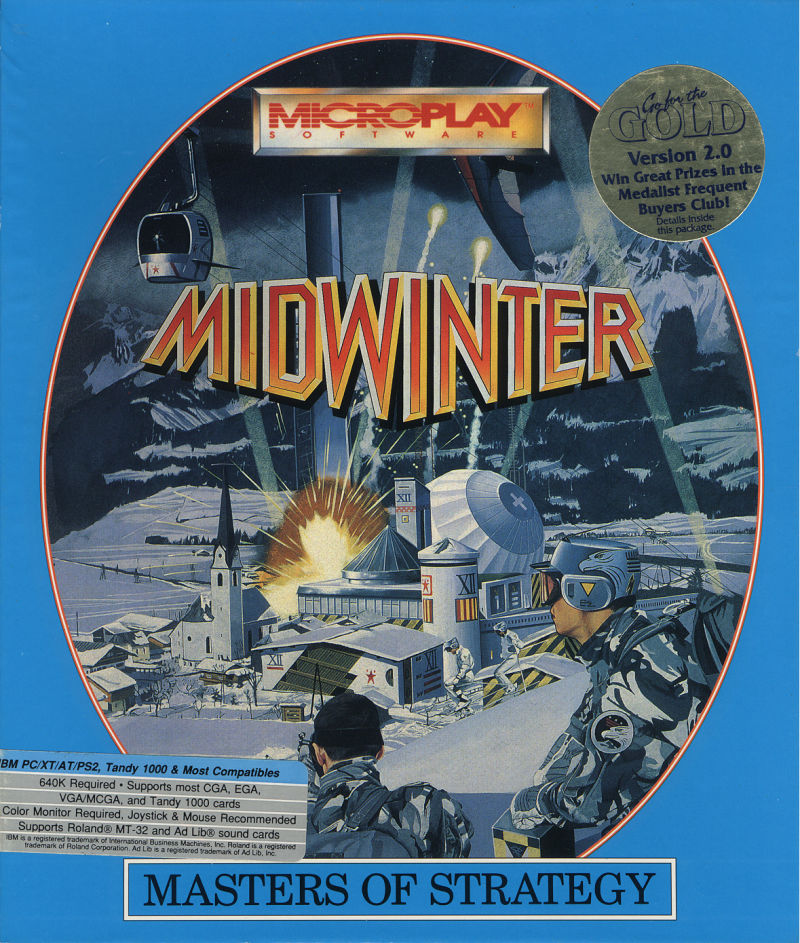
The Island That Took Four Years
By the time Midwinter appeared on the Atari ST in 1989, Singleton had shifted register entirely. The ZX Spectrum's constraints - 48KB, monochrome, binary black and white terrain - were gone. In their place: a fractal-generated island of 160,000 square kilometres, rendered in real-time 3D on hardware that was, in 1989, only beginning to be understood by developers who had grown up with 8-bit machines.
The setting is 2099 A.D. A new Ice Age has struck. General Masters, an opportunist, is moving across the island of Midwinter with an army. Captain John Stark - the player's character - must stop him. The method: not frontal assault but guerrilla warfare. Recruit allies by finding them on the map, winning their trust, and activating them as additional playable characters. Coordinate missions across multiple agents simultaneously. Blow up fuel depots, ambush convoys, cut supply lines. Win the island back one village at a time.
Skiing Between Missions
What distinguished Midwinter mechanically was how characters moved. On skis, on a snow cat, in a hang-glider, on foot - each mode of travel had different speed, noise signature, and interaction with the terrain. A character skiing through pine forest was slower but harder to detect than one crossing open snowfield. Hang-gliders gave speed but no cover. Snow cats could carry multiple people but their engine noise was audible at range.
Movement was first-person. The 3D island rendered in real-time as you skied, the terrain rising and falling, forests appearing as clusters of vertical sprites. Combat was handled in a separate action mode. The switch between the strategic overview - assigning missions, tracking multiple agents - and the first-person ski traverse created a rhythm unlike any game before it.
What the Atari ST Made Possible
The Atari ST in 1989 had a 68000 processor, up to 4MB of RAM, and a colour palette significantly richer than the ZX Spectrum. Singleton's team at Maelstrom - Dave Gautrey and George Williamson on ST and Amiga programming, Chris Pink on solid objects code, Pete Barnett on graphics and map design - used this headroom to render terrain geometry in real-time rather than from pre-computed sprites.
The result was a different kind of presence from Lords of Midnight's landscaping. Where Midnight's engine created depth through layer illusion, Midwinter's 3D actually moved - the horizon tilted as you climbed hills, trees passed at realistic perspective speed, buildings resolved from pixels to structures as you approached. In 1989, this was not common. It was rare.
"The moving horses came from the betting game on the PET. In fact I took the graphics from Muybridge's photographs of horses - they must be the oldest computer graphics about!"
Mike Singleton, on the origins of his graphics approach - The Digital Antiquarian (filfre.net), January 2014
What the Critics Said, and What They Missed
The review scores were exceptional. Zzap!64: 97%, Gold Medal. CU Amiga: 96%, CU Super Star. Amiga Computing: 96%. The Games Machine: 94%. Amiga Format: 92%, Amiga Format Gold. Eurogamer's later retrospective called it "a unique creature; a transitional specimen between eras of game design."
What critics often noted - and some struggled with - was the game's deliberate pace. Midwinter was not immediately gratifying. Recruiting allies took time. Missions failed. Supply lines needed patience to disrupt. The game rewarded players who thought in terms of coordinated campaigns rather than individual heroics. This was a game designed by someone shaped by postal wargaming and strategic board games, not by arcade culture.
Where It Fits in the Timeline
Midwinter sits between eras. It is too early to be considered a proper open-world game - the genre's conventions did not exist yet - and too late to be an 8-bit curiosity. It is one of those games that belongs to a specific period of transition, when hardware had improved faster than the industry's language for describing what it could do.
Midwinter II: Flames of Freedom (1991) continued the experiment in a spy-thriller register. See the full catalogue for ratings and platform details on both Midwinter games.
Midwinter (Amiga) Let's Play - Gaming Jay. See also the Midwinter Atari ST footage.