The skunkworks sequel that saved a franchise. The SNES reinvention that launched a sub-series.
Two games. Two eras. One continuous argument about what a Mega Man game can be.
The Game
Why Mega Man 2?
Released on December 24, 1988 in Japan as Rockman 2: Dr. Wily no Nazo and in North America in June 1989,
Mega Man 2 is the best-selling and most critically acclaimed entry in the classic series, having sold over 1.5 million
copies worldwide on the NES alone. Its robot master roster - eight characters with interlocking weapon weaknesses -
is the archetype against which all subsequent classic-series entries are measured. Takashi Tateishi's OST is the
reference point for NES music composition. The Wily Stage 1 theme is among the most recognised pieces of video game music
in history.
This deep dive examines the development backstory, the robot master design system, the OST in technical and aesthetic
detail, how the game plays and why the design holds up, what critics made of it in 1989, and the cultural legacy
that extends to a famous Japanese fan song recorded two decades after the game's release.
See also: full game catalogue, Keiji Inafune and the development team,
and Tateishi's complete OST analysis.
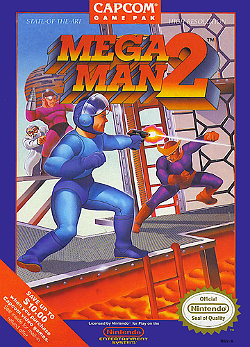
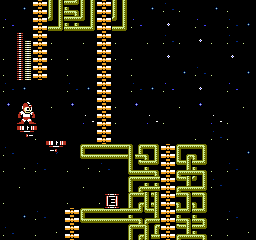
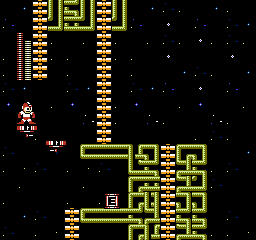
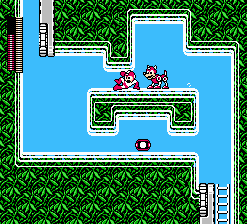
Mega Man 2 - North American box art, 1989. The cover that fixed the series' identity after MM1's infamous alternative.Mega Man 2 NES gameplay - a platform stage corridor, characteristic of the precise jump-timing design throughout the game
Development
The Skunkworks Story
Mega Man 1 shipped in December 1987 to modest sales - the series was not the commercial priority that Capcom
needed to justify an immediate sequel. Some accounts suggest the company considered ending the series after MM1.
A small development team, passionate about the concept and unconvinced the series had been given a fair chance,
began working on Mega Man 2 outside their official project assignments - during lunch breaks, evenings,
and weekends.
Wikipedia's Mega Man 2 development section, citing developer interviews, notes that the team "worked on it in
addition to their normal workloads" with the director acknowledging that "many team members worked on the game
voluntarily." When the prototype was complete, Capcom approved it for release. The game's commercial success
vindicated the team's belief in the series.
The team expanded the robot master roster from six to eight, giving the stage select screen its iconic 8-panel
grid layout. They introduced Energy Tanks (E-Tanks) as consumable health restoratives, broadening accessibility
without reducing challenge. The password system was overhauled with a 40-dot code that could encode progress
through the game's stages and weapon acquisitions.
The participatory approach to boss design - a fan contest in the late 1980s, before internet crowdsourcing -
created a direct connection between Capcom's audience and the game's creative output. The eight winning robot
masters shaped every subsequent classic-series entry's design language.
Mega Man 2 - the title screen that opens on Dr. Wily's silhouette before the 8-panel stage selectDr. Wily's Castle - the series' signature endgame fortress, requiring all acquired weapons before the credits roll
Gameplay
Eight Doors, Your Choice
The stage select screen is MM2's first revelation. Eight panels, eight robot masters, no forced order. Unlike most
NES action games of 1988, which marched players through levels in sequence, Mega Man 2 presents its challenge as
a decision. The choice of which master to fight first carries consequences: Metal Man's Metal Blade, once acquired,
is effective against five other masters. Experienced players know Metal Man is the correct first answer. New players
won't know this yet, and the game doesn't tell them.
The core combat is a run-and-gun loop: move through a themed stage, defeat enemies with the Mega Buster or special
weapons, manage weapon energy, reach the master, and learn their pattern. Each master fight is a puzzle with a
solution. Bubble Man falls in three hits with Metal Blade. Air Man is straightforward with Leaf Shield and punishing
without it. Quick Man's laser traps require memorisation before pattern recognition becomes possible.
Energy Tanks (E-Tanks), introduced in MM2, let players carry up to four emergency health restores. This is a
conscious accessibility design that does not compromise the game's challenge - the masters and Wily stages remain
demanding regardless - but creates a satisfying risk-reward dynamic. Each E-Tank represents a safety net with a
finite cost: once used, it's gone until a new game.
The Wily Castle stages form the game's second half. Four consecutive stages, building to the Wily Machine boss
and a final encounter. Each Wily stage tests weapons acquired from the robot masters: Crash Bomber is required
to open certain walls, Item-2 (a jet-powered flying platform) is needed for vertical traversal in others.
The design is closed - every weapon acquired in the first half has a use before the credits roll.
Three traversal tools - Item-1 (a platform that climbs walls), Item-2 (a jet platform), and Item-3 (a temporary
stepping platform) - are earned mid-game. Their presence acknowledges that stage design sometimes requires tools
beyond what basic jumping provides, and that giving players specialised solutions for specific obstacles creates
a more satisfying design than making every surface uniformly jumpable.
Boss Analysis
The Eight Robot Masters
Each card below uses CSS custom property weapon-colour theming.
Recommended defeat order follows the standard weapon dependency chain.
Air Man's stage - high-altitude platforms and the infamous tornado gauntletMetal Man's stage - a mechanical factory environment; defeat him first for the Metal Blade
Weapon Dependency Chain
Metal Man → Metal Blade → Bubble Man
Bubble Man → Bubble Lead → Heat Man
Heat Man → Atomic Fire → Wood Man
Wood Man → Leaf Shield → Air Man
Air Man → Air Shooter → Crash Man
Crash Man → Crash Bomber → Flash Man
Flash Man → Time Stopper → Quick Man
Quick Man → Quick Boomerang → Metal Man
⚙
Metal Man
Weapon: Metal Blade
Weakness: Metal Blade (self), Quick Boomerang
Defeat first - his weapon damages 5 of 8 masters
🌀
Air Man
Weapon: Air Shooter
Weakness: Leaf Shield
4th recommended. "Air Man ga Taosenai!"
🪨
Bubble Man
Weapon: Bubble Lead
Weakness: Metal Blade
2nd recommended - weak to Metal Blade
⚡
Quick Man
Weapon: Quick Boomerang
Weakness: Time Stopper
7th recommended - notoriously fast laser traps
💥
Crash Man
Weapon: Crash Bomber
Weakness: Air Shooter
5th recommended - weak to Air Shooter
✨
Flash Man
Weapon: Time Stopper
Weakness: Crash Bomber
6th recommended - freezes time across the room
🔥
Heat Man
Weapon: Atomic Fire
Weakness: Bubble Lead
3rd recommended - weak to Bubble Lead
🌿
Wood Man
Weapon: Leaf Shield
Weakness: Atomic Fire, Metal Blade
3.5th - fan-submitted contest design
Technical Achievement
Forty Dots, Eight Doors, One Chain
The weapon dependency chain is MM2's central design achievement. Eight robot masters form a directed cycle where each
master's acquired weapon is effective against another specific master. No master is a dead end in the chain.
The chain is not strictly required - any master can be defeated with only the Mega Buster and sufficient skill -
but following it reduces the game to a manageable challenge and rewards knowledge without punishing ignorance.
The password system improved substantially on MM1's six-letter code. MM2's 40-dot grid can encode progress through
all eight master stages plus four energy tank slots, allowing players to return to any mid-game state. For a game
designed to be paused, resumed, and discussed at school the next day, this was a meaningful feature. The password
is communicated through a grid of filled circles on a 5x8 layout - unusual in an era of simple alphanumeric codes.
Tateishi and the 2A03
The Mega Man 2 OST, composed entirely by Takashi Tateishi using the NES's 2A03 sound chip, is a landmark of video game music.
It operates within the chip's five audio channels: two pulse wave generators (producing square-wave tones used for melody and counter-melody),
one triangle wave generator (used for bass lines), one noise channel (for percussion and effects), and one DPCM channel
(Delta Pulse Code Modulation, used here for sampled drum hits in certain tracks). Tateishi's compositions favour longer
phrase structures and more harmonic development than Manami Matsumae's MM1 OST, lending a more cinematic quality
to the boss and Wily stage themes. For a complete analysis of the OST, see the music page.
Wily Stage 1 - Technical Analysis
The Wily Stage 1 theme is Tateishi's masterwork within the MM2 OST. Its structure:
Lead Melody (Pulse 1): An 8-bar theme built on a I-III-VI-VII-I harmonic movement,
creating urgent forward motion. The phrase is short enough to be immediately memorable yet complex enough to reward repeated listening.
Counter-Melody (Pulse 2): A secondary pulse channel provides harmonic interest against the lead,
creating a sense of orchestral fullness within the chip's constraints.
Walking Bass (Triangle): The triangle channel anchors the harmonic progression with a walking bass line
that propels forward motion - the characteristic "Wily's Castle" drive.
Bridge Section: After the main theme, the composition shifts to a contrasting bridge, providing
variety across the typically long Wily Castle stages.
Tateishi has described the Wily stages as the emotional climax of the game - the point where players needed to
feel the weight of storming an impossible fortress. His musical brief to himself was something urgent and driving
but ultimately hopeful: the player is losing ground but not yet beaten. The Wily Stage 1 theme delivers on that
in four notes before the melody even resolves.
Per-Stage Theme Design
Each robot master stage theme in MM2 is calibrated to the master's personality and environment:
Metal Man Stage: Mechanical, rhythmic, industrial - conveying a factory environment.
Air Man Stage: Sweeping and open, with wide melodic intervals evoking sky and wind.
Bubble Man Stage: Flowing, slightly underwater in feel, with longer sustained tones.
Quick Man Stage: The fastest-tempo theme in the OST, matching the stage's relentless laser traps.
Heat Man Stage: Percussive and urgent, with the noise channel driving a hot, pressured atmosphere.
Wood Man Stage: The most melodically gentle, evoking forest and foliage against the game's harder electronic textures.
Reception
What 1989 Made of It
Mega Man 2 released in Japan on December 24, 1988 - Christmas Eve - and reached North America in June 1989.
Japanese contemporary reception was strong: Famitsu covered MM2 prominently, noting the expanded roster, improved
password system, and Tateishi's OST as clear improvements over Mega Man 1. The game's Christmas Eve release date
positioned it as a holiday centrepiece in Japan's retail calendar.
North American reception was similarly positive. Nintendo Power, the dominant gaming publication for the NES
audience, gave it extensive coverage and strong scores. Electronic Gaming Monthly praised the game's design
as a significant step up from the original. The consensus among publications that covered it in 1989 was that
Mega Man 2 was among the best action games on the NES.
Sales reflected that reception. MM2 sold over 1.5 million copies worldwide on the NES - approximately three to
five times the first game's total - making it the best-selling game in the classic series. This commercial success
was the direct justification for Capcom commissioning Mega Man 3, and for the series continuing through the NES
lifespan to Mega Man 6 in 1993.
Retrospective critical consensus has been even stronger than contemporary reviews. The game appears in multiple
"greatest games ever made" lists from publications including GameFAQs community rankings, Famitsu retrospectives,
and genre-specific NES game rankings. Among NES-era action-platformers, only Super Mario Bros. 3 appears more
frequently alongside it in best-of rankings.
Legacy
Every Classic Sequel Borrowed the Blueprint
Mega Man 2 set every convention the classic series followed through Mega Man 6. Eight robot masters, a stage-select
grid, E-Tanks, a Wily Castle finale with multiple stages, and a weapon dependency chain - all introduced or
standardised by MM2. Mega Man 3 added Rush (the robotic dog) and slide mechanics, but the fundamental design
template remained MM2's. Mega Man 4 added the Mega Buster charge shot. MM5 added Beat. MM6 added the Jet and
Power adapters. Each game added to a foundation that MM2 poured.
The franchise's commercial viability from 1988 through 1993 - through five more NES entries and five Game Boy
games - was built on the goodwill and template MM2 established. Without its sales figures, the NES series
likely ends at Mega Man 2.
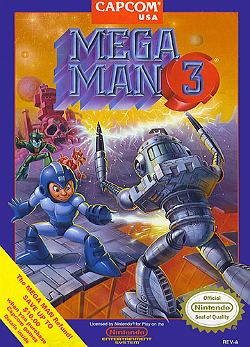
Mega Man 3 (1990) - the first sequel to build directly on MM2's eight-master template, adding Rush the robotic dog and the slide mechanicMega Man 3 gameplay - the slide (first introduced here) gave Mega Man a close-range dodge that carried through MM4-6
Air Man ga Taosenai
Air Man ga Taosenai (エアーマンが倒せない - "I Can't Defeat Air Man") is a Japanese fan song that became a cultural
phenomenon in 2007-2008 on Nico Nico Douga, Japan's equivalent of early YouTube. The song documents, in comic and
self-aware terms, the experience of a player unable to defeat Mega Man 2's Air Man using only the default Mega Buster.
Air Man is genuinely difficult to defeat without the correct weapon (Leaf Shield, obtained from Wood Man).
His Air Shooter attack fills the screen with tornados that are hard to dodge without precise vertical positioning.
The song captures the frustration of players who knew the solution intellectually but couldn't execute it
under pressure. Its existence - a fan song about a single robot master's difficulty recorded nearly 20 years
after the game's release - demonstrates the extraordinary longevity of MM2's design in Japanese gaming culture.
"He's up there, his arms are spinning, and I just can't figure it out. I've memorised the pattern but my hands betray me.
I can't defeat Air Man."
- Air Man ga Taosenai, Japanese fan song lyrics (translated), Nico Nico Douga, 2008
The song spawned dozens of covers and instrumental arrangements, appeared in fan animation, and was referenced in
mainstream Japanese gaming media. Wikipedia documents the song's cultural reach. The phenomenon demonstrates
that Air Man's difficulty - the gulf between "solved" (use Leaf Shield, three hits) and "unsolved" (Mega Buster
only, genuinely hard) - was felt viscerally by Japanese players for a generation.
Mega Man 2 was re-released on Virtual Console (Wii, 3DS, Wii U), included in the Mega Man Legacy Collection
(2015, PS4/Xbox One/3DS/PC) and the Nintendo Switch version (2018). Each re-release introduced the game to a
new generation. The Legacy Collection's museum mode preserved developer materials, concept art, and series
history alongside the game itself. The game is regularly played at Games Done Quick charity events in the any%
and 100% categories.
Second Flagship
Mega Man X
SNES, 1993 (Japan) / 1994 (North America). The reinvention.
The Game
Blue, Still, But Not the Same Game
Mega Man X (Rockman X in Japan) arrived on the Super Nintendo in December 1993 in Japan and January 1994 in North
America - six years and six NES games after the original. It was not a sequel in the narrative sense. It was a
reboot with a darker premise: a world of reploids (robots capable of free will) gone maverick, a war between
humanity's Maverick Hunters and Sigma's rogue army, and an "X" unit who differs from the classic robot masters
by possessing genuine capacity for moral decision-making. The game is set more than 100 years after the original
Mega Man's timeline.
Keiji Inafune conceived Mega Man X as the Mega Man experience rebuilt from scratch for SNES hardware - same
fundamental idea, different everything else. The result pushed the character, the genre, and the hardware's
capabilities simultaneously. X is among the landmark SNES games. See the people page
for the full creative team, and the game catalogue for the complete X sub-series.
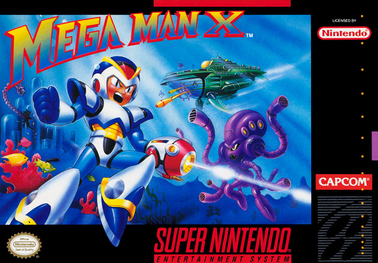
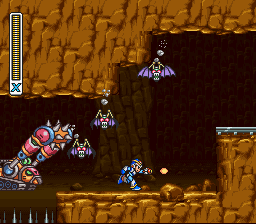
Mega Man X - North American SNES box art, 1994. The design signals the tonal shift: more angular, more urgent, darker.Mega Man X gameplay (Armadillo stage) - parallax scrolling and detailed backgrounds that the NES could not have rendered
Development
Built for a New Machine
Mega Man X was developed by Capcom under director Yoshinori Takenaka - the same director who oversaw Mega Man 2 -
with Keiji Inafune as character designer and producer. Development began in 1992 and shipped in Japan in December
1993. The team's goal was to use SNES capabilities - the 65816 CPU, Mode 7, and the Sony SPC700 sound chip -
to create a Mega Man experience that felt genuinely new rather than a graphically upgraded port of the NES formula.
The design philosophy changed fundamentally from the classic series. X was given a wall-climb ability not present
in any classic Mega Man, a dash (activated by double-tapping or foot armor), and a chargeable X Buster that could
hold two charged shots simultaneously with the arm upgrade. The Maverick bosses replaced the "robot masters" label
with an updated aesthetic: these are reploids with animal themes (Armored Armadillo, Chill Penguin, Storm Eagle,
Spark Mandrill) rather than elemental robots, and their stages reflect a more detailed visual aesthetic than the NES permitted.
The darker narrative tone was deliberate. The classic series' robot masters were defeated, their weapons absorbed,
and the game ended with Dr. Wily's apparent defeat - a cycle repeated across six NES games. Mega Man X introduced
moral ambiguity: X questions whether he should fight at all, what it means to have free will, and whether the
reploids turning maverick are truly evil or simply confused. This thematic layer was new for the franchise and
for action platformers of the era.
Gameplay
Earned, Not Given
Where classic Mega Man gives players the same Mega Buster throughout the game, Mega Man X's X Buster can be
upgraded. Armor capsules, hidden throughout stages (left by Dr. Light in holographic form), grant upgrades to X's
helmet, body, arm, and feet - each with functional consequences that change how the game plays. The foot armor
enables dashing. The arm armor upgrades the X Buster to hold two charged shots simultaneously. The body armor
reduces damage taken. The helmet armor destroys certain ceiling obstacles. Players who find all four armor pieces
have a meaningfully different gameplay experience from those who don't.
Wall-jumping is available from the start, and dashing unlocks with the foot armor early in the game. These expand
the movement vocabulary fundamentally: a player can wall-jump up a vertical shaft, dash under projectiles, or
dash-jump to extend horizontal range in ways the NES games never allowed. Stage design is built around this
expanded moveset - sections that seem impassable without the armor are designed to remain completable (with
greater difficulty) even without upgrades.
The eight Maverick stages follow the same non-linear template as classic Mega Man: select any order, defeat the
Maverick, unlock their weapon. Weapon dependencies are less strict than in MM2 - most stages have clear advantages
from the correct weapon but few absolute requirements. The design rewards knowledge without absolutely punishing
ignorance.
Sigma's fortress stages form the second half, with four stages and a series of boss encounters that reference
all eight Mavericks before the Sigma fight. The game's difficulty curve is steeper than the classic series but
more forgiving than the NES games' sometimes arbitrary challenge spikes.
Technical Achievement
What the SPC700 Gave the Soundtrack
The SNES's Sony SPC700 sound chip gave Mega Man X's composers - Setsuo Yamamoto, Makoto Tomozawa, and Yuki Iwai -
an audio palette dramatically expanded from the NES 2A03. The SPC700 could play 8 simultaneous ADPCM channels
of sampled audio: actual instrument samples rather than synthesized waveforms. The result is a soundtrack that
sounds closer to a rock band than NES bleeps while retaining the energy of the classic series' compositions.
Spark Mandrill's stage theme, in particular, became a defining piece of SNES-era game music.
The SNES CPU allowed for larger sprite sizes, more detailed backgrounds, and parallax scrolling that creates
genuine depth throughout the game. Sigma's final stage uses visual effects - transparency effects and layered
backgrounds - that the NES could not have rendered. The Mode 7 effect, used briefly in the opening Vile
encounter for a pseudo-3D camera angle, was a SNES signature feature used judiciously rather than as a gimmick.
The armor capsule upgrade system introduced a form of non-linear progression that went beyond the weapon dependency
chain. Players who explore and find capsules earlier unlock a meaningfully easier game. Players who reach Sigma's
fortress without finding them face the same levels with higher difficulty. The system rewards thorough exploration
rather than just correct boss order, expanding the design vocabulary beyond MM2's template.
Reception
Critics in 1994 Were Ready for It
Mega Man X released in North America in January 1994 to strong contemporary reviews. Electronic Gaming Monthly
awarded it scores in the 8-9 range, praising the SNES upgrade in every category - visuals, sound, and gameplay depth.
GamePro gave it a near-perfect score, highlighting the wall-climbing and dash mechanics as genuinely new contributions
to the action-platformer genre. Nintendo Power covered it extensively and gave it high reader and editor scores.
The game sold over 1 million copies in North America alone, making it one of the best-selling SNES action games.
Japanese reception was similarly strong, with Famitsu's four-reviewer score placing it among the top SNES action
titles of its release window. The combination of strong sales and critical reception immediately greenlighted
Mega Man X2, which shipped less than a year later.
Retrospective reviews have been consistently high. IGN rated the Virtual Console release 9/10. Nintendo Life
awarded it 10/10. The game appears in most major "best SNES games" and "best Mega Man games" retrospective lists.
Among players who have experienced both the classic series and the X sub-series, Mega Man X is frequently ranked
above Mega Man 2 as the superior game - a judgment that reflects how completely the SNES redesign succeeded.
Legacy
Six More Games and a Sub-Series That Outlasted the NES Originals
Mega Man X launched a sub-series that ran for eight main entries: X through X8 (1993-2004), plus the X Command
Mission spinoff. X2 and X3 added the Cx4 custom chip for enhanced graphical effects. X4 moved to PlayStation
with full voice acting and animated cutscenes. X5 and X6 continued on PlayStation. X7 attempted a partial 3D
transition before X8 returned to 2D. The sub-series outlasted the classic NES series by over a decade.
The "X" design formula - upgradeable armor, wall-jumping, non-linear capsule discovery, more complex narrative -
influenced action platformers broadly. The armor upgrade system, where hidden upgrades meaningfully change how
a character moves and fights, appears in a direct design lineage that includes numerous subsequent action games.
The concept of teaching movement through environment rather than text instruction, pioneered in the intro stage,
became standard practice in the genre.
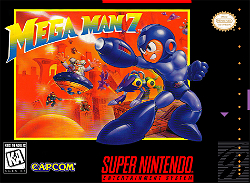
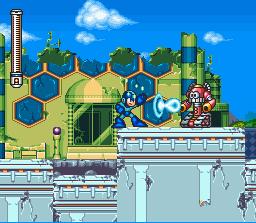
Mega Man 7 (1995, SNES) - Capcom brought the classic series to SNES in MM7's unique visual style, released after Mega Man X proved the SNES platformer audienceMega Man 7 gameplay - the classic series on SNES used larger sprites and more detailed environments than the NES originals
The X series received its own Legacy Collections in 2018: Mega Man X Legacy Collection 1 (X1-X4) and Collection 2
(X5-X8), repackaging the entire sub-series for PS4, Xbox One, Switch, and PC. X1 is the entry point recommended
by both collections' promotional materials and by the speedrunning and fan communities. The game is regularly
played at Games Done Quick charity events.
"X is what Mega Man becomes when you ask what the character is capable of, rather than what the hardware will allow.
The original Mega Man was defined by NES constraints. X was defined by the question: if those constraints were removed,
what would Mega Man want to do?"
- Keiji Inafune, Mega Man 25th Anniversary retrospective, Capcom, 2012