Flagship Games
The Freescape titles that defined home 3D gaming. Full editorial on Driller and Castle Master. For the complete game list, see Games. For box art and screenshots, visit the Gallery.
Driller
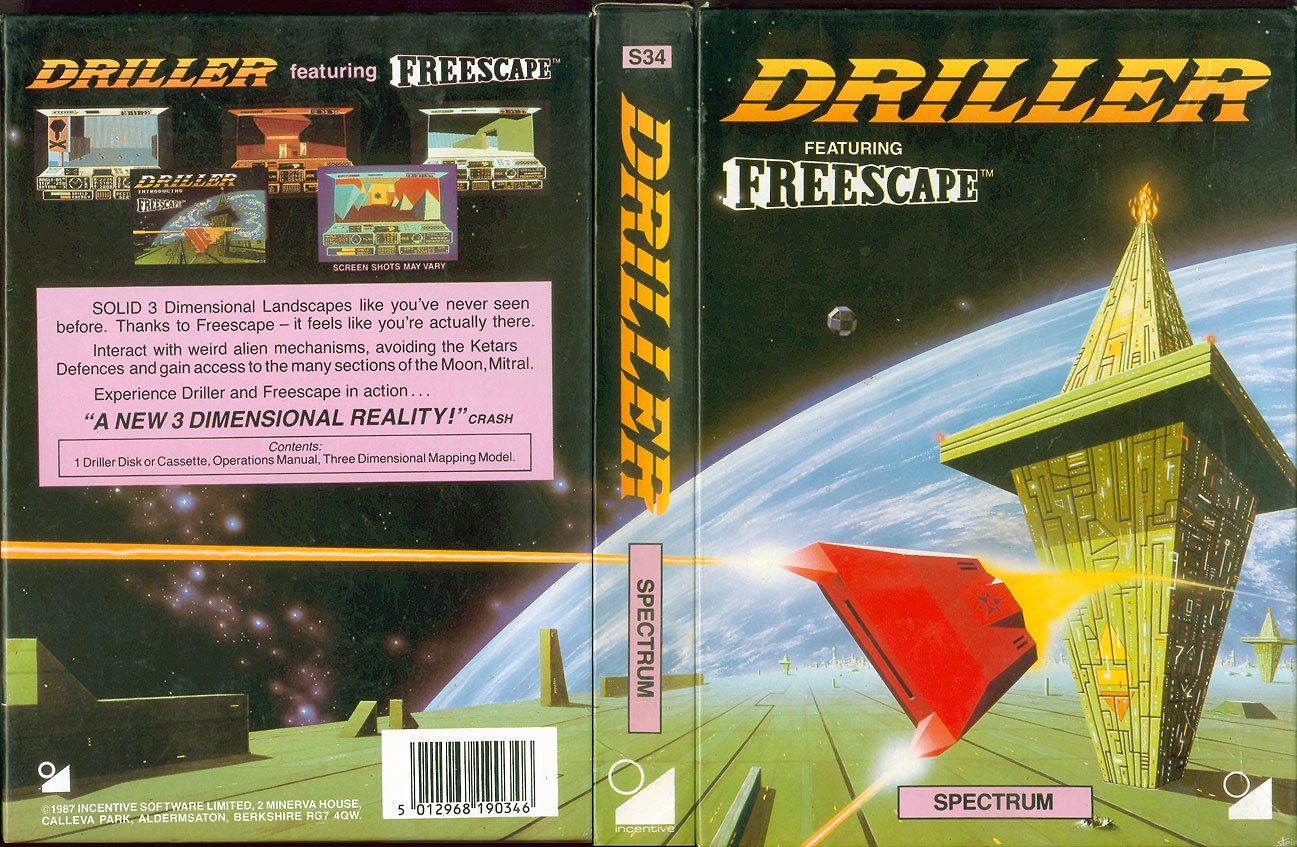
The Game That Did Not Exist Yet
When Driller was released in March 1987, reviewers had no adequate vocabulary for it. The usual shorthand of platform games, shoot-em-ups, and adventure games did not apply. Incentive Software had produced something genuinely unprecedented: a fully navigable three-dimensional world rendered with hidden-surface removal in real time on hardware with 48 kilobytes of RAM. The UK charts had never seen a 3D game before. Within weeks, Driller was at number one.
The premise was science fiction in the most functional sense. The player is dispatched to Evath's moon, which is riddled with unstable gas pockets that will explode catastrophically without intervention. The task is to drill capping devices into each pocket before the timer runs out. There is a threat, a tool, and a world to navigate. The fiction serves the mechanics: everything in Driller exists to justify moving through a three-dimensional space and solving spatial puzzles within it.
Written in Integer Arithmetic at 3.5 MHz
The technical achievement of Driller is best understood by considering what it required the ZX Spectrum to do. Hidden-surface removal - determining which faces of 3D geometry are visible and which are occluded - typically requires floating-point arithmetic and significant memory bandwidth. The Spectrum had neither. Chris Andrew implemented the entire rendering pipeline in integer arithmetic on a Z80 processor running at 3.5 MHz.
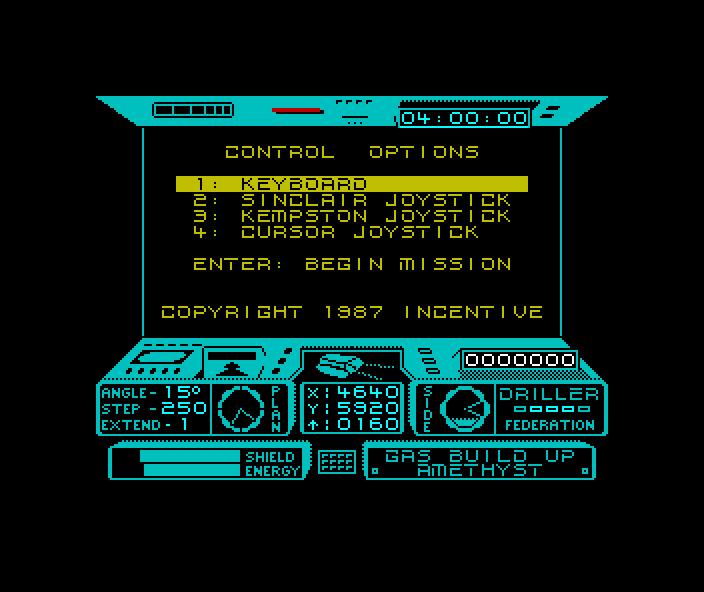
The spatial partitioning approach was elegant in its simplicity: the world was divided into discrete cells, and only the current cell and its immediate neighbours were rendered at any given time. This kept the polygon count within what the Z80 could process in an acceptable frame time - typically 3-5 frames per second on the Spectrum, somewhat faster on the Amstrad CPC's faster Z80 variant. The partition boundaries were carefully designed to avoid visible pop-in: rooms connected to corridors connected to outdoor areas in ways that felt natural rather than loading-screen-obvious.
"The biggest challenge was making it work on the Spectrum at all. You're doing floating point in Z80 assembler and you need to finish a frame before the user gives up waiting." Chris Andrew, Retro Gamer issue 97, interview on the development of Freescape and Driller
Navigation as the Mechanic
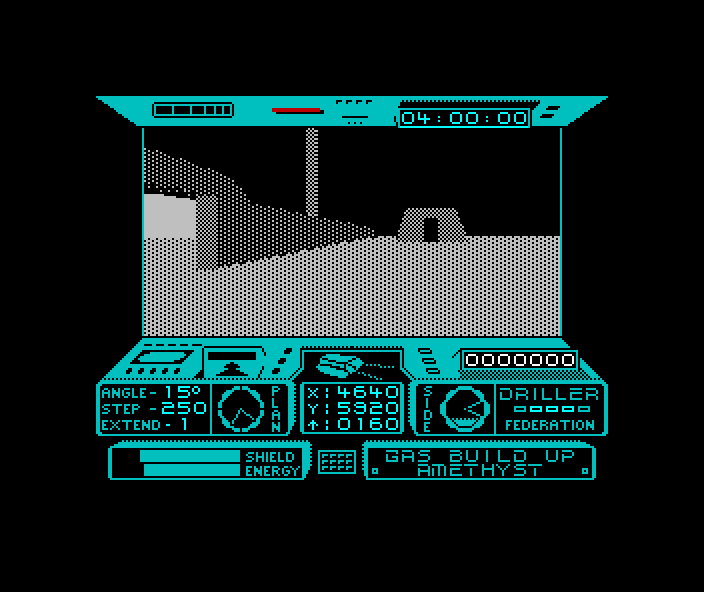
Playing Driller is unlike playing any game that came before it on home computers. The fundamental activity is orientation - understanding where you are in a three-dimensional space, how to get to where you need to be, and what the instruments in your vehicle are telling you about the environment. The game provides a compass and an energy reading, but no map. Players had to create their own maps, either mentally or on paper.
The drilling mechanic itself is straightforward: position the vehicle over a gas vent, deploy the drill, wait for the capping to complete. What makes it work is the three-dimensional pathfinding required to reach the vents. The moon's surface is not flat - it has raised sections, depressions, and structures that block direct routes. Getting from one sector to another requires understanding the topology of the world, not just following a path.
What Reviewers Missed and What They Got Right
The contemporary reviews of Driller struggled with the frame rate. Sinclair User gave it 88%, noting both the technical achievement and the slow update speed as genuine limitations. Your Sinclair was more enthusiastic, recognising that what Driller had done was categorically new regardless of the processing cost. Zzap!64 reviewed the Commodore 64 version and was generous, identifying the game as a new class of software.
What the reviews mostly did not engage with was the cognitive novelty of the experience. Driller asked players to do something they had never done before in a home computer game: build and maintain a three-dimensional mental model of an environment they could not see all at once, update that model as they moved through it, and use that model to plan routes and solve spatial problems. This was not a skill players had or lacked - it was a new demand that the game itself taught.
"Driller is unlike anything we've seen before. The technology is impressive; the game itself is compelling in a way that takes time to understand. It rewards players who engage with it seriously." Sinclair User, review of Driller, March 1987
Forty Years and Not Yet Matched on This Hardware
No ZX Spectrum game released before Driller attempted what it achieved. No game released immediately after it matched it. The Freescape engine was licenced to other developers and produced the sequels and expansions that followed, but the original Driller remained the clearest demonstration of what the engine could do: a complete world, built from scratch, in which the player was alone with the geometry and the problem. For the full game catalogue including Driller, see Games. For screenshots from multiple platforms, visit the Gallery.
Driller running on ZX Spectrum - the world that changed British gaming in 1987.
Castle Master
Three Years of Engine Maturity in One Game
By the time Castle Master reached players in 1990, the Freescape engine had been through three major commercial titles and numerous platform conversions. The codebase was mature, the optimisations were well-understood, and the team had learned what players expected from a Freescape game. Castle Master applied all of that accumulated experience to the most ambitious world Incentive had built: a complete castle, exterior and interior, populated with enemies, puzzles, and a locked-room mystery at its heart.
The framing was simple: a princess is held prisoner in the castle keep by an unnamed supernatural entity. The player, in the role of a warrior or witch (the player's choice of avatar provided minor gameplay differences), must navigate the castle, defeat or avoid the enemies within, and reach the princess. The keep is locked. The keys to reach it are distributed through the castle's rooms, guarded by the ghosts that inhabit it.
Architecture as Puzzle
Castle Master's genius was in the match between its architectural setting and its puzzle design. A space station or ancient pyramid forces the designer to invent the spatial language from scratch. A castle is a building type that players already understand: it has walls, towers, gates, courtyards, stairways, and halls. The player comes with expectations about how space is organised in a castle, and the game can either satisfy or subvert those expectations as the design requires.
The result was Incentive's most navigable world. Players could orient themselves by the castle's features - the keep was always the highest point, the moat defined the perimeter, the great hall was identifiable by its arched ceiling. The 3D geometry served the architecture rather than being arbitrary. When a puzzle required finding a room on the upper floor, the player knew how to get to the upper floor because castles have upper floors accessed by stairs and they are generally where you would expect them to be.
What the Engine Could Do in Three Years
The technical difference between Driller and Castle Master reflects three years of optimisation and a hardware base that had also evolved. The Amiga and Atari ST versions of Castle Master used solid-fill polygon rendering rather than wireframe, giving the castle a genuine sense of mass and enclosure. The Amiga's Paula chip provided richer audio than the Spectrum's beeper. The DOS version ran on hardware considerably more powerful than the 8-bit machines of 1987.
On the 8-bit platforms - particularly the ZX Spectrum - Castle Master was still wireframe, but the wireframe had become denser and more detailed than Driller's relatively sparse geometry. The castle's architectural complexity pushed the engine further than the earlier games had. The result was a slower frame rate on the Spectrum, but a richer visual environment than any previous Freescape title.
"Castle Master showed what Freescape could do when you gave it a setting that players already understood. The castle was familiar - and that familiarity made the exploration feel natural in a way the earlier games hadn't quite achieved." Retro Gamer retrospective on Freescape, issue 154
Critics Who Changed Their Mind Later
Castle Master received strong reviews on release. Amiga Power gave it 86%, noting the improved visuals over previous Freescape titles and the coherent puzzle design. The Spectrum conversion was reviewed more cautiously - the slower frame rate was a genuine limitation - but even the 8-bit reviews acknowledged that the game was technically impressive and the world design was Incentive's best.
The game's reputation has grown since release rather than faded. Retrospective coverage consistently identifies Castle Master as the peak of the Freescape series: the point where the engine's maturity, the design team's accumulated knowledge, and a setting well-suited to the technology all came together. Players who returned to it for modern retrospectives often commented that the game's spatial coherence held up in ways that other early 3D games did not.
Where Castle Master Stands Now
Castle Master II: The Crypt followed almost immediately, adding the underground portion of the castle to the explorable world. It was included in compilation releases and later became freely available. Together, the two games represent the complete Freescape experience as Incentive intended it.
For modern players, Castle Master remains playable through emulation on all original platforms and via the Freescape-compatible reimplementations in the modern scene. The spatial navigation skills it demands have not been devalued by time. A player who has never touched a Freescape game may struggle initially with the frame rate and the navigation - but those who engage with it seriously report the same quality that reviewers identified in 1990: a game that teaches its own spatial logic and rewards mastery of it.
For the modern scene around Freescape, including remakes and 3D Construction Kit projects, see the Modern Scene page. For Freescape-related links, communities, and archives, visit Resources.
"We learned from every game we made. By Castle Master we knew the engine well enough to let the world design breathe - to make a space that felt like it had a reason to exist beyond the game mechanics." Incentive Software interview, Amstrad Action, 1990
Castle Master on Amiga - Freescape at its visual peak in 1990.
- [1] Chris Andrew, Retro Gamer issue 97 - interview covering the development of Freescape and Driller
- [2] Sinclair User, March 1987 - original Driller review
- [3] Amiga Power, 1990 - Castle Master review
- [4] Retro Gamer issue 154 - Freescape retrospective feature
- [5] Amstrad Action, 1990 - Incentive Software interview