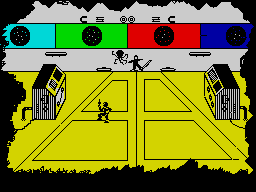
Zzoom
A naval combat game released in 1982. The player controls a boat engaged in sea combat, navigating and attacking enemy vessels. Part of the productive opening year that included Arcadia.
Twelve released titles, two unfinished Megagames, and a hardware peripheral that never made it to market.
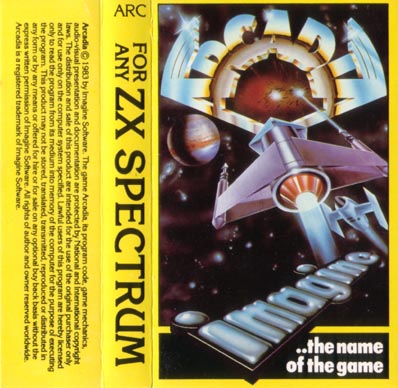
Imagine's breakout title and their biggest commercial hit. A Galaxian-style multi-wave shoot-em-up that reportedly sold over 100,000 copies. Multiple waves of increasingly aggressive alien formations on 16K of Spectrum memory.
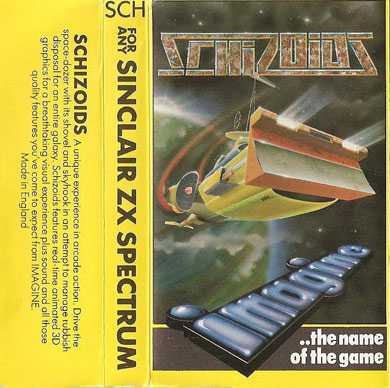
One of Imagine's earliest titles, released in 1982 as the company was finding its feet on the ZX Spectrum. Part of the initial wave that established the Imagine brand alongside Cosmic Cruiser and Zzoom.
An early space shooter from Imagine's 1982 launch period. Helped establish the company's presence on the ZX Spectrum market during the platform's first year.
A naval combat game released in 1982. The player controls a boat engaged in sea combat, navigating and attacking enemy vessels. Part of the productive opening year that included Arcadia.
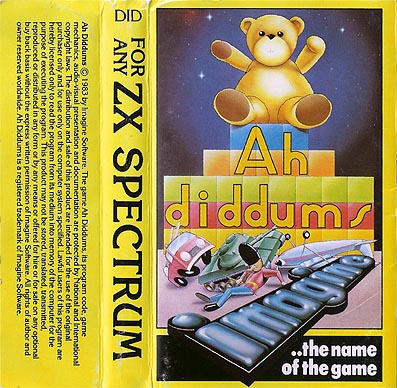
A platform game in which the player guides a character upward through a series of levels, jumping through openings in moving horizontal barriers. Simple mechanics executed cleanly for the Spectrum hardware.
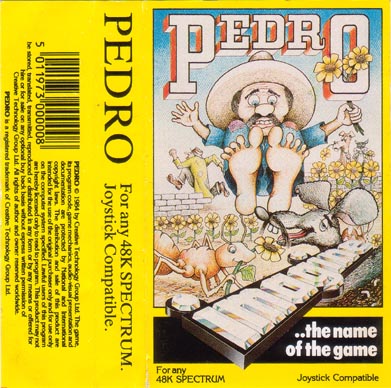
One of the earliest real-time strategy wargames on the ZX Spectrum. Players command infantry, tanks, and artillery units while managing supply lines. Notably serious in tone compared to Imagine's other 1983 output.
A platformer with an unusual premise: a teddy bear navigating a dream world to find its toys. The cartoonish subject matter contrasted with the complexity of the level design. Showed Imagine's range beyond pure arcade shooting.
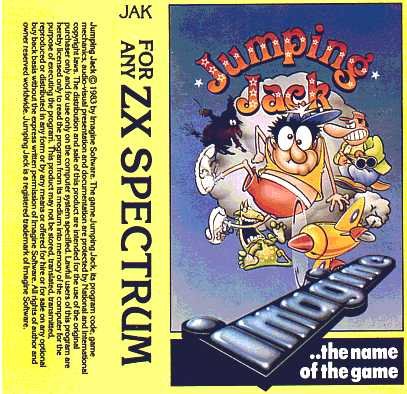
Platform game in which the player guides Jack through a series of floors pierced by holes, jumping through gaps while avoiding enemies. Published in Imagine's debut year alongside Arcadia, demonstrating the company's early breadth of output.
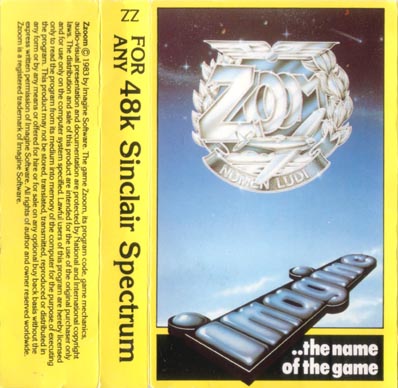
Shoot-em-up with a vertically scrolling perspective, putting the player in a fast-moving craft attacking enemies and obstacles. One of several 1982 Imagine releases that established the company's early arcade credentials.
Two-player competitive game in which each player controls a character attempting to gather dots while impeding the other. One of the earliest Imagine releases; representative of the company's 1982 output before they settled into their characteristic premium-arcade style.
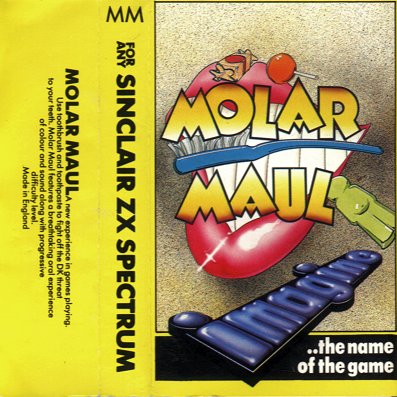
Dental-themed action game in which bacteria attacking teeth must be repelled. An unusual entry in the Imagine catalogue by virtue of its subject matter, reflecting the company's occasional willingness to take on unusual themes alongside their arcade and action output.
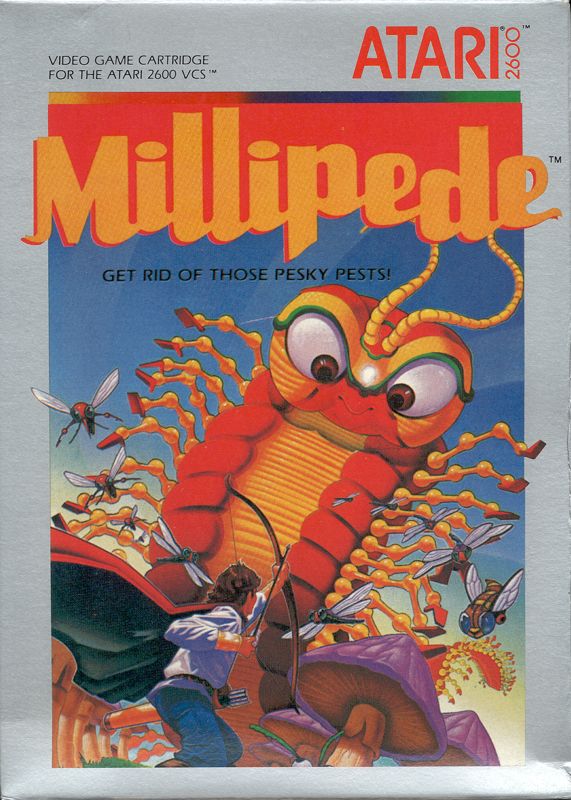
A dentist-themed arcade game in which the player combats tooth decay in an oversized mouth. One of the more eccentric titles in Imagine's catalogue - inventive subject matter that demonstrated a willingness to try unusual premises.
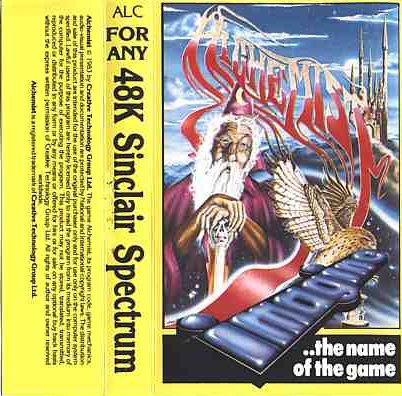
An arcade adventure in which a wizard protagonist can transform into an eagle. Exploration of a castle environment required both combat reflexes and navigation strategy. One of Imagine's most technically accomplished titles, earning strong reviews in Crash Magazine and Sinclair User.
A platformer released in 1983. Part of the productive middle period of Imagine's output when the company was releasing regularly and maintaining its presence in the ZX Spectrum software charts.
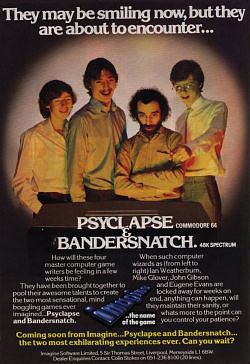
The first of the two Megagames. An action adventure developed by Ian Hetherington, intended to ship at £39.95 with a hardware RAM peripheral. Never completed before the company collapsed. The code was later reworked by Psygnosis as "Brataccas" (1985).
The second Megagame, developed by a separate internal team. Described in period press as arcade-style. Announced alongside Bandersnatch at £39.95 with hardware peripheral requirement. Left almost no trace after the collapse - its code and design materials have not surfaced publicly.
Imagine Software was primarily a ZX Spectrum publisher. The Spectrum was their natural home and the platform where their catalogue is most complete. C64 ports were produced for their most successful titles - Arcadia and Alchemist received Commodore 64 versions that found their own audiences on that platform.
The Megagames were announced for ZX Spectrum specifically, augmented by the planned hardware peripheral. No confirmed multi-platform plans existed before the collapse ended all development. Imagine did not survive to see the Commodore Amiga or Atari ST.
Bandersnatch and Psyclapse - announced 1983-1984 at £39.95 each, bundled with a hardware peripheral, and destined never to ship. Bandersnatch was later reworked by Psygnosis as "Brataccas" (1985). Psyclapse vanished almost without trace.
You typed IMAGINE. Well done.