Three games that defined the Digital Illusions era: the pinball trilogy that rewrote
what an Amiga could simulate, and the platformer that proved they could do anything.
The Ball That Obeyed Physics
Pinball Dreams arrived in 1992 and did
something no Amiga game had managed convincingly before: it made a ball feel real.
Not animated, not approximated - real. The ball rolled with weight, bounced with
energy loss, and drained with the inevitability of gravity. Four tables. Four
soundtracks. And a physics engine built by four demosceners who understood, at a
hardware level, exactly what the Amiga could do if you pushed it.
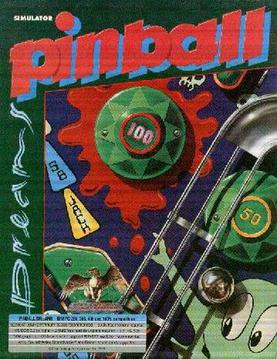
Pinball Dreams box art, Amiga version - 21st Century Entertainment, 1992
Two Years in a Summer Cabin, Then a Sales Pitch in London
The game’s origin story is almost too neat to be true, but the founders told it
themselves in a Swedish television interview: the idea for a scrolling pinball simulation
came during a summer in a cabin, among four friends who had spent years in the Amiga
demoscene pushing hardware further than its designers intended. They wanted to make
something more ambitious than demos. Pinball, they decided, was the hardest thing
they could attempt - because it required physics that felt correct rather than physics
that merely looked plausible.
We got an idea in a summer cabin and wanted to do something more advanced than what we were doing.
Digital Illusions founder, Swedish television interview (c. 1993); YouTube archive: 58PEOIJ3_s8
The development consumed nearly three years. When it was done, the team took the game
to the London games fair - and came home without a publishing deal. Undeterred, they
returned the following year with a more organised approach: advance letters, demo
versions sent ahead. This time, 21st Century Entertainment signed them. The rest
followed quickly.
Scrolling Tables and Steel Flippers
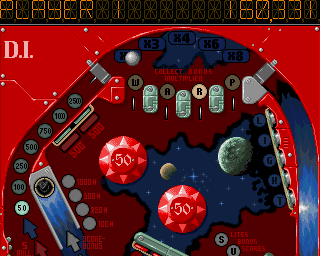
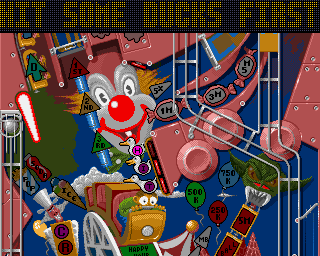
The four tables - Steel Wheel, Ignition, Nightmare, and Beat Box - each present a
distinct mechanical and audiovisual world. Steel Wheel is industrial chrome. Ignition
burns with rocket imagery. Nightmare leans into expressionist darkness. Beat Box
turns the table into a percussion instrument, with bumpers and targets that trigger
musical samples alongside Olof Gustafsson’s
Protracker score.
The scrolling was the headline innovation for players who encountered the game in
1992: the camera follows the ball up and down the table, keeping it in frame through
ramp shots and plunger launches. This sounds simple now. In 1992, on an Amiga running
at 7.09 MHz with 512KB of Chip RAM, it was a statement.
The physics model deserves its own paragraph. Ball weight, flipper inertia, bumper
elasticity, and drain probability all behave consistently from shot to shot. The game
does not cheat. A ball launched at the same angle with the same flipper speed will
follow the same arc. This repeatability is what separates a simulation from an
animation - and what made Pinball Dreams the standard by which every subsequent
Amiga pinball game was judged.
Four Channels Doing the Work of Twelve
The Amiga’s Paula chip provided four 8-bit audio channels sampled at up to 28 kHz.
Every Amiga game had exactly the same hardware to work with. What differed was what
composers chose to do with it. Olof Gustafsson (Blaizer) chose to treat each channel
as part of a live arrangement rather than a static loop - the Beat Box table’s score
in particular functions as interactive music, where the player’s actions trigger
sample triggers that layer into the background composition.
The custom chip architecture was exploited systematically: Paula handled audio and
disk DMA, Agnus managed blitter operations for moving the ball sprite and scrolling
the playfield, and Denise controlled display output. The physics calculation ran on
the 68000 CPU with the custom chips handling graphics and audio independently,
so the simulation never competed with the presentation for processor time.
The Amiga Press Took Notice
The contemporary critical reception was strong across the board. Amiga magazines
that had reviewed dozens of pinball games found themselves writing reviews that
acknowledged they had not seen anything like it. The physics and the music together
created a product that felt categorically different from what had come before.
The game sold well enough to justify an immediate sequel - and for 21st Century
Entertainment, that sequel would be the product that made their company.
For full period review scores and text from CU Amiga and Amiga Power, see
the Reviews page.
The Blueprint That Held for Three Games
Pinball Dreams established every structural element of the trilogy: the four-table
format, the scrolling camera, the Protracker MOD soundtrack by Blaizer, the clean
geometric aesthetic, and the commitment to physics over visual spectacle. Pinball
Fantasies and Pinball Illusions both refined this template but never discarded it.
The studio found their form on the first attempt.
The game’s influence extended beyond Digital Illusions. Subsequent Amiga pinball
titles from other developers attempted to match the physics and scrolling camera.
Most fell short. The engine that Blaizer, Goofy, Animal, and SinCos built
in Växjö remained the technical standard for Amiga pinball simulation through
the end of the platform’s commercial life.
You should know the limits - otherwise they come to you and say you can't do that. You have to adapt to them. But it's fun.
Olof Gustafsson (Blaizer), discussing hardware constraints; Swedish television interview (c. 1993); YouTube archive: 58PEOIJ3_s8
Pinball Fantasies was released in
the same year as Pinball Dreams - 1992 - and is widely considered the stronger
game. Where Dreams established the template, Fantasies refined every element.
The physics model was smoother. The four new tables were more inventive and more
distinct from one another. Olof Gustafsson’s
compositions were more ambitious. The game achieved what very few sequels do:
it made its predecessor feel like a proof of concept.
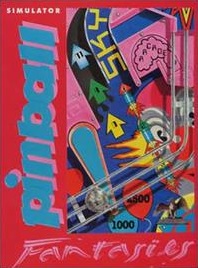
Pinball Fantasies box art, Amiga version - 21st Century Entertainment, 1992
Same Engine, Rethought From the Tables Up
The production timeline for Pinball Fantasies was compressed by the existence of the
Dreams engine and by the team’s growing confidence in what the hardware could do.
They had spent years learning what the Amiga’s custom chips would and would not allow;
by the time Fantasies was in development, that knowledge was institutional.
The founders were explicit about this learning curve in interviews. The first game
took longest because they were discovering constraints as they hit them. Later
projects moved faster because the team had internalised where the hardware’s limits
actually were, as opposed to where they feared they might be.
Well, if you already made a game before, it takes about a year. The first game always takes longer. But then you learn what to avoid and how to make things.
Digital Illusions founder, on production pace; Swedish television interview (c. 1993); YouTube archive: 58PEOIJ3_s8
Four Worlds With No Words
Partyland delivers fairground energy through dense bumper clusters and rapid-fire
targets. Speed Devils runs hot with a motorsport theme that communicates itself
entirely through table geometry and Blaizer’s propulsive soundtrack. Billion Dollar
Gameshow wrings satirical excess from game-show iconography, with the table layout
itself functioning as a visual punchline. Stones ‘n’ Bones closes the set with
a rock and roll swagger that gives the multiball sequences a natural crescendo.
None of this world-building uses cutscenes, text, or narrative. The theme is in
the flipper positions, the ramp angles, the bumper density, and the colour palette.
This is environmental design through mechanical decision-making - every element
of each table communicates something about the world it represents. It is a more
sophisticated design approach than it appears, because the constraints are so tight:
a pinball table has a fixed set of components, and yet each Fantasies table feels
categorically different from the others.
Ported to Everything, Compromised by None
The multi-platform reach of Pinball Fantasies is remarkable for an early 1990s
production. The original Amiga version was the definitive one - running at full
resolution with Paula audio and the complete Protracker soundtrack - but the DOS
port captured the physics accurately enough to satisfy players who had no access
to an Amiga. The Super Nintendo port, arriving in 1994, adapted the game to a
platform with fundamentally different audio hardware and a different controller,
and the result remained recognisably the same game.
A long time - the music for one game can take up to a year, depending how much there is to do. One game may contain 14 or 15 tunes and 200 sound effects. One sound effect can take 3 hours.
Olof Gustafsson (Blaizer), on composing game music; Swedish television interview (c. 1993); YouTube archive: 58PEOIJ3_s8
Critics Agreed, Then the Ports Found a New Audience
Contemporary Amiga press coverage of Pinball Fantasies positioned it as an
improvement on an already excellent game - the highest possible assessment for a
sequel. The specific tables drew praise for their design variety; reviewers who
had covered Pinball Dreams recognised that the Fantasies tables pushed the concept
further in each direction simultaneously. For period review scores and text, see
the Reviews page.
The SNES release brought a second wave of critical coverage in the console press,
which encountered the game as a self-contained product rather than as a sequel.
Reviews on that platform consistently praised the physics and noted that the
game felt unlike the pinball simulations native to console gaming. This is because
it was - it was an Amiga simulation running on different hardware.
The One Everyone Recommends First
Ask any longtime Amiga owner which Digital Illusions game to play first, and the
answer is almost always Pinball Fantasies. Not because Dreams is inferior, but
because Fantasies is more complete - more table variety, more ambitious music,
more refined physics, and a wider difficulty curve that makes the first table
immediately accessible while keeping the final one genuinely challenging.
Pinball Fantasies is also the game most often cited in retrospective coverage of
the Amiga era as a whole - it appears in lists of essential Amiga titles and
in discussions of what the platform achieved at its best. Thirty-plus years on,
it plays exactly as it did in 1992: the physics have not aged, because physics
does not age. See the Play page for emulator and
Internet Archive options.
Benefactor (1994) was Digital Illusions’
deliberate departure from the pinball trilogy. Published by Psygnosis - a company
whose track record on Amiga was as strong as any publisher in the market - Benefactor
placed the player in the role of a rescuer navigating more than 60 increasingly
complex levels to recover stranded workers. It was a puzzle-platformer with action
elements: the kind of game that rewarded observation and route planning as much as
execution.
That the studio could make this game at all - and make it well - was not obvious
from the outside. They were known for pinball. Benefactor was proof that the
demoscene precision they had applied to physics simulations was a general-purpose
capability, not a niche one.
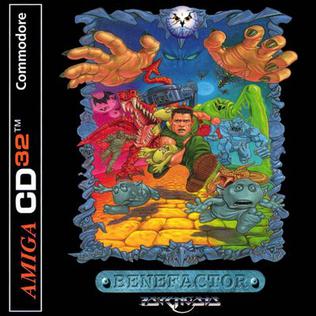
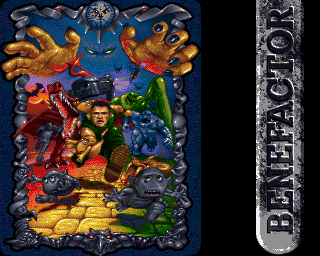
Benefactor box art, Amiga version - Psygnosis, 1994
Psygnosis, Platformers, and a Team That Had Proved Itself
By 1993, Digital Illusions had released two pinball games that the Amiga press had
received enthusiastically. 21st Century Entertainment had published both. The decision
to sign Benefactor with Psygnosis was a step up in publisher prestige - Psygnosis
were responsible for Lemmings, Shadow of the Beast, and Hired Guns, among others.
Their involvement signalled that the industry had noticed what Digital Illusions
were capable of beyond their original genre.
A Swedish television crew filmed the team at work in Gothenburg in the early stages
of Benefactor’s production - programming, illustration, and composition all happening
in the same space. The portrait of the studio at work makes clear how self-contained
the operation was: the same four people who had built the physics engine for Pinball
Dreams were now building level geometry for a platformer. Everything from code to
art to music was produced in-house.
Yes, from idea to a final copy.
Digital Illusions founder, on the team’s end-to-end production approach; Swedish television interview (c. 1993); YouTube archive: 58PEOIJ3_s8
Plan Twice, Move Once
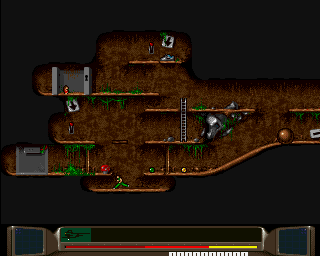
Benefactor’s 60-plus levels are built on a consistent mechanical grammar: switches
open doors, lifts move on cycles, enemies patrol fixed routes, and the workers you
are rescuing follow the player when triggered. The challenge escalates through
combinatorial complexity rather than through reaction-time demands. A player who
takes five seconds to study a new level layout before moving will solve it faster
than one who rushes in.
This design approach - patience rewarded, observation valued - was consistent with
the studio’s background. Demo scene programming required understanding a system
completely before attempting to exploit it. Benefactor’s levels work the same way:
the solution is always present in the room, waiting to be recognised.
Pixel-Perfect by Design
The control system is the game’s most discussed technical attribute. The character
responds immediately and exactly to input: there is no momentum carry, no input
buffer delay, no imprecision in jump height or movement arc. This fidelity was
not accidental - it was a requirement for a game built around level puzzles where
a missed ledge or a mistimed jump means restarting a carefully constructed route.
The same hardware discipline that produced Pinball Dreams’ physics engine produced
Benefactor’s control scheme. The demoscene instinct to minimise overhead and maximise
responsiveness translated directly into a platformer that felt like it was executing
the player’s intentions rather than interpreting them. For a studio with no prior
platformer experience, this was a significant achievement.
Eighty-Seven Percent
CU Amiga awarded Benefactor 87% in their July 1994 review - a strong score for a
game from a studio whose previous work was in a completely different genre. The
reviewers highlighted the level design and control precision as the game’s defining
qualities, and noted that the difficulty curve was well-judged: challenging without
being punishing in the early stages, genuinely difficult by the later levels. For
the full review context and additional period coverage, see
the Reviews page.
The Psygnosis distribution network gave Benefactor wider shelf presence than either
pinball game had enjoyed. It reached markets across Europe that 21st Century
Entertainment had not prioritised, and the CD32 version - with Walterstad’s
extended soundtrack - was positioned as a showcase title for Commodore’s last
console hardware.
The Pivot That Made Everything Else Possible
Benefactor demonstrated that Digital Illusions could design and ship a product in
a genre they had not previously worked in, and do it at a level that satisfied both
the press and a major publisher. This credibility was essential for what came next.
After Benefactor and the final pinball game, Pinball Illusions (1995), the studio
began transitioning toward 3D development, racing games, and ultimately the
trajectory that would produce RalliSport Challenge and Battlefield 1942. The
version of Digital Illusions that became DICE was built on the foundation that
Benefactor helped establish: a studio that could be trusted to deliver in any genre,
on any hardware, without supervision. See the History page
for the full studio arc, and People for the founders
who carried that capability across thirty years of game development.