Editorial deep dives into five games that defined Delphine Software's legacy. Browse the full catalogue for platform details and release history across all titles.
Flagship Deep Dives
Another World
Éric Chahi / 1991 / Amiga, DOS, Mega Drive, SNES
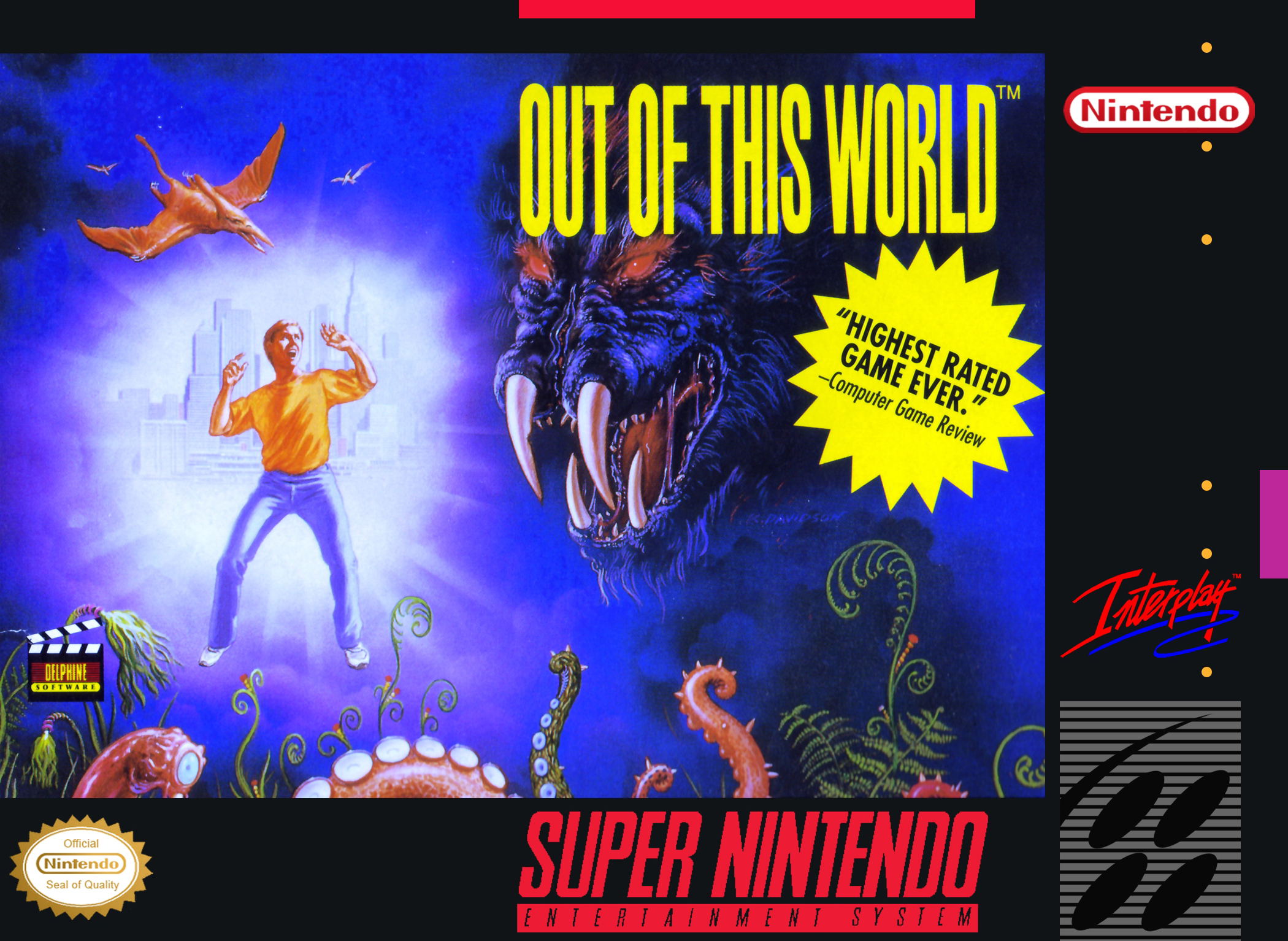
SNES / Mega Drive North American release, published by Interplay as Out of This World.
Another World - released as Out of This World in North America and Outer World in parts of Europe - arrived in 1991 as something the medium had never quite seen before. Éric Chahi spent two years building it almost entirely alone, writing assembly language code for the Amiga while simultaneously designing every level, animating every character, and directing every cinematic sequence. The result was a game that felt less like software and more like a short film dropped into the player's hands.
There is no HUD. No score counter. No tutorial dialogue. The game opens with a particle accelerator experiment gone wrong, physicist Lester Knight Chaykin teleported to an alien world in seconds of wordless, disorienting cinema. The player simply wakes up in water, swims, almost drowns, and begins. What follows is approximately two hours of play - or many more, across deaths too numerous to count - that centres on the unlikely friendship between Lester and an alien warrior, communicated entirely through gesture and context.
Two Years in a Rented Room in Colmar
Chahi began Another World in 1989 while employed at Delphine as a programmer on Future Wars. He started the project privately, working evenings in his apartment. Delphine's management - notably president Paul de Senneville - recognised what he was building and gave him the room to continue. The arrangement was unusual: a junior programmer effectively designing a solo game within the studio's structure, with studio resources available but no mandated team.
The development timeline ran two years. Chahi's method was iterative and instinct-driven: he built the polygon rendering engine first, then designed levels directly in that engine, then animated, then wrote the game logic. He had no designer spec, no game design document in any formal sense. The game's structure - brief scenes, each a tight puzzle of timing and observation, connected by polygon cutscenes of identical technical quality to the gameplay - emerged from this process of direct making.
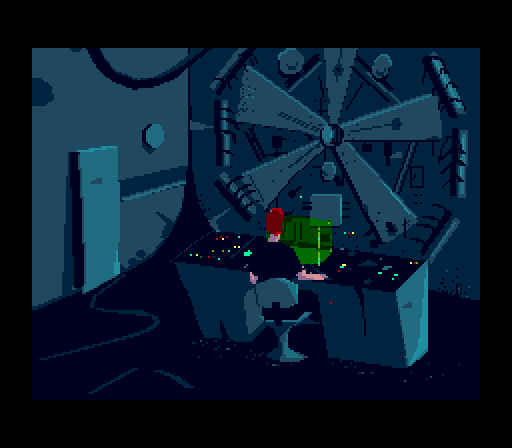
The opening sequence: Lester at his holographic workstation. Within seconds, the experiment goes wrong and he is transported. There is no explanation.
"The game had to feel like waking up in a nightmare. You don't understand the rules. You don't know what kills you. You learn everything through dying, and each death teaches you something you couldn't have known before."
Another World's structure was radical for 1991. The game divides into distinct scenes, each presenting a problem that cannot be understood without dying first. The opening swim through the alien lagoon teaches the threat of the tentacle creature through instant death. The cage escape teaches the guard's patrol timing by first getting caught. The laser shoot-out teaches trajectory and timing through repeated failure.
This design philosophy - that the player learns through repetition of well-defined, short sequences - was not unique, but its integration with a film-like presentation was. Each scene felt authored: framed deliberately, timed precisely, rewarding attention in the way a film rewards attention. The combat system, built around a laser pistol with three modes (single shot, shield, super shot), was genuinely mechanical, requiring both timing and spatial positioning. Modern players sometimes describe it as a quick-time event game, which misses the point: the reflexes required are real, and the sense of discovery when a sequence finally clicks is something pure.
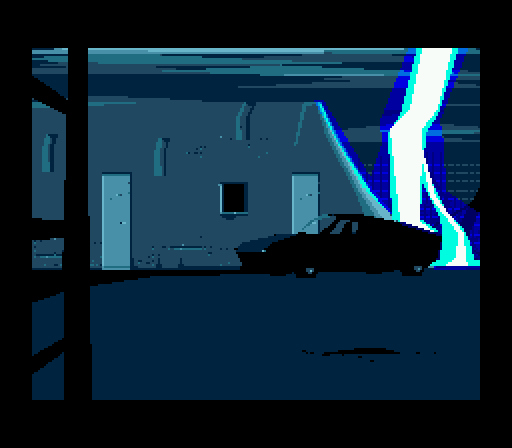
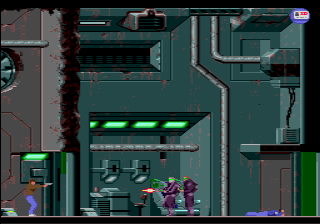
The laboratory exterior in the opening minutes. The polygon engine creates tension through shape and silhouette rather than detail.
No Sprite in Sight
The technical centrepiece of Another World was Chahi's use of filled vector polygons to represent characters and environments. Where most games of 1991 used sprites - bitmapped images translated and occasionally flipped - Another World's world was built from geometric shapes rendered in real time. This allowed smooth animation at a resolution and frame rate that bitmap sprites of comparable complexity could not achieve on the same hardware.
The technique was visually striking: bold outlines, flat colour fills, and movement that looked genuinely rotoscoped even though no actual rotoscoping was used. Chahi achieved the fluid character motion through careful keyframe animation of the polygons themselves, studying human movement reference and translating it into geometric abstraction. The result ran efficiently on the Amiga 500, the baseline hardware, because polygon rendering at the scale used required less memory bandwidth than equivalent sprite animation.
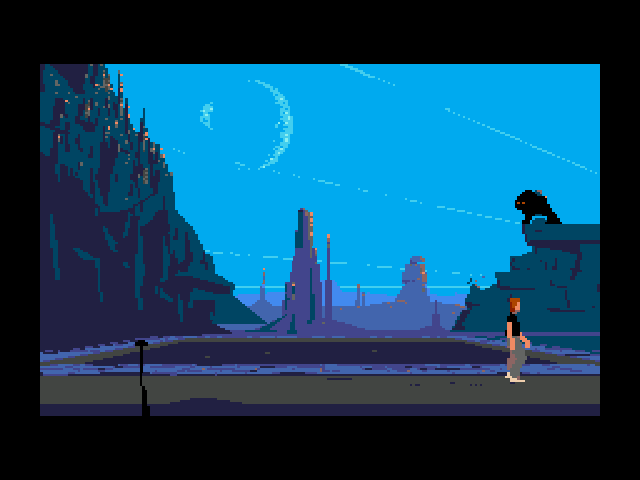
The outdoor sections use the polygon engine to create environments that feel alien without relying on conventional game imagery.
What the Critics Heard First
The Amiga version launched in late 1991 to reviews that bordered on disbelief. Amiga Power awarded 95%, describing it as "the most cinematic game ever made." The One gave it 95% and cited the polygon animation as a genuine technical leap. Joystick in France, Chahi's home market, gave it 97% and described it as a new category of software. The American release under the Out of This World title found a different but equally enthusiastic audience.
The game sold over a million copies across platforms - extraordinary for a European title of the era, and more extraordinary for a game that made no concessions to accessibility or convention. There was no way to know if a door would kill you without opening it. There was no map. The game assumed you were paying attention and had the patience to die repeatedly in pursuit of what came next.
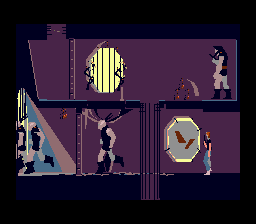
The prison section. The relationship with Buddy — the alien warrior who becomes Lester's companion — is established here, communicated entirely through animation and context.
The Blueprint Everyone Borrowed From
Jordan Mechner, creator of Prince of Persia, cited Another World alongside Flashback as a direct influence on his subsequent work. The founders of Playdead - creators of Limbo (2010) and Inside (2016) - have named it as formative; the silent, wordless storytelling of both games is directly traceable to what Chahi built in 1991. Ico (2001) and Shadow of the Colossus (2005) from Team Ico represent another lineage that begins here.
The Museum of Modern Art in New York added Another World to its permanent collection in 2012, one of fourteen games so honoured in the initial acquisition. The 20th Anniversary Edition (2011), produced by Chahi and DotEmu, added a remastered graphical mode while preserving the original pixel-perfect version. For more on rereleases, see Modern. To play it today, see Play. The game's music by Jean-François Freitas is discussed on the Music page.
Another World: 20th Anniversary Edition - Official Trailer (DotEmu, 2013)
Flashback: The Quest for Identity
Paul Cuisset / 1992 / Mega Drive, Amiga, DOS, SNES
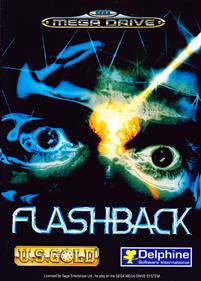
European Mega Drive release. The box art's running figure is characteristic: Flashback is defined by the quality of its movement.
Flashback: The Quest for Identity arrived in 1992 carrying a weight that would have broken most development teams: it was the follow-up, from within the same studio, to Another World. Paul Cuisset had watched Éric Chahi build that game. He understood what it meant, and he understood that his own title would be measured against it. He chose a different problem to solve - not cinema through abstraction, but cinema through physical conviction. Where Another World was a two-hour short film, Flashback was a full-length feature with proper game systems underneath.
Conrad B. Hart wakes in a jungle with no memory and a holographic message from himself. What follows is a science-fiction action-adventure in the tradition of Philip K. Dick: questions of identity, corporate conspiracy, and the nature of humanity explored through a game of platforming, shooting, and careful resource management. The influences are worn openly - Total Recall, Blade Runner, They Live - but the synthesis is unmistakably Cuisset's own.
The Man Who Filmed Himself Walking
Cuisset's approach to animation differed from Chahi's. Where Chahi built the polygon engine from mathematical principles and animated geometrically, Cuisset used reference footage of human movement - filming himself and colleagues walking, running, rolling, and falling - to derive the keyframes for Conrad's motion. The technique was similar in spirit to rotoscoping but applied to a sprite-based system, producing movement with a weight and inertia that no contemporary European game had achieved on 16-bit hardware.
The Mega Drive version is considered definitive: its four-megabyte cartridge allowed more music tracks than the Amiga floppy version, and the control pad suited the demanding movement system. The Amiga version has its own advocates - Raphaël Gesqua's Amiga score is exceptional - but the Mega Drive release brought the game to its largest audience.
"I filmed myself walking, running, rolling, and then used that footage as the reference for every frame of Conrad's movement. The goal was simple: make the player believe they were controlling a real person. If Conrad moved like a real person moves, everything else - the world, the danger, the story - would follow."
Paul Cuisset, Retro Gamer issue 43, 2007
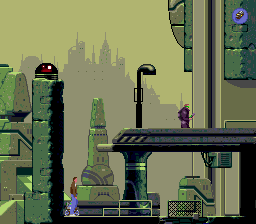
New Washington: the game's urban sections contrast with the jungle opening, showcasing the Virtual Theatre engine's environmental range.
Every Move Has Weight
Conrad can run, walk carefully, roll forward, fire while rolling, draw his weapon from holster, vault over edges, and interact with objects - each action fluid, each with genuine commitment. A roll-and-fire sequence requires both timing and spatial awareness; pulling it off in a firefight feels earned in a way that modern games rarely achieve. The movement system has real inertia: Conrad takes a moment to stop, a moment to start, and the player learns to work with that rather than against it.
The structure is part action-platformer, part adventure game. Missions require collecting items, speaking to NPCs, and solving environmental puzzles as well as combat. The teleporter system between levels adds a logistics layer that makes the world feel consequential. A game show sequence in the New Washington section - where Conrad earns money by performing stunts - is unlike anything in its competition: an aside that trusts the player's patience for something strange.
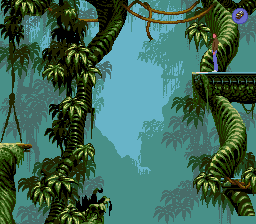
The jungle opening. Conrad wakes with no memory. The level design establishes the movement system before the plot asks anything of the player.
The 1993 Guinness Entry
Flashback sold over two million copies across all platforms, entering the Guinness Book of Records as the best-selling French game of all time. It reached markets in Japan - unusual for a Western title of the era - and became one of the defining games of the 16-bit period in Britain, France, and the United States simultaneously. Amiga magazine The One gave it 92%, CU Amiga 92%, and Joystick in France 96%. The Mega Drive version earned comparable marks across specialist press.
Contemporary reviewers focused on the animation above all else: it was simply not what 16-bit hardware was supposed to produce. The comparison to Another World was inevitable - both games appeared in Delphine's catalogue, and both represented the same argument about what games could do - but critics recognised Flashback's different register. It was longer, more conventionally playable, and more narratively ambitious in the science-fiction sense.
Combat involves position, timing, and switching between weapon modes. The shield ability creates tactical choices absent from most contemporaries.
What Two Million Copies Bought
Flashback's influence has been diffuse but real. The movement system - specifically the commitment to animation weight and physical consequence - informed a generation of action-platformer designers who were playing the game at formative ages in the early 1990s. The science-fiction narrative structure, with its amnesia hook and conspiracy plot, appears throughout 1990s gaming in ways that suggest either direct influence or a shared reading list.
Two remakes testify to its continued recognition: the 2013 Ubisoft-published version by Vector Cell, and Microids' 2018 25th Anniversary remaster. Neither fully captured the original's physical authority, but both represent serious attempts, and both suggest that the gap between the original and its successors is itself instructive - demonstrating just how specific and deliberate Cuisset's achievement was. See Modern and Play for remaster details. The Amiga score by Raphaël Gesqua is archived separately.
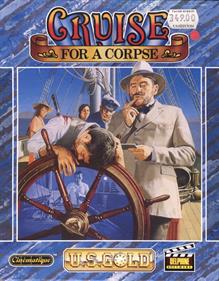
The European box art establishes the 1930s setting immediately. Niklos Karaboudjan's yacht, the murder scene, and a cast of eight suspects.
Released in the same year as Another World, Cruise for a Corpse is the Delphine title most unlike its celebrated siblings. Where Another World and Flashback pursue cinema through movement and action, Cruise pursues it through atmosphere, social observation, and the pleasures of the whodunit. It was, and remains, one of the most distinctive adventure games of the early 1990s - and one of the least imitated.
Set aboard the luxury yacht of shipping magnate Niklos Karaboudjan in the 1930s, the game opens with the host's murder. You play Raoul Dusentier, a young detective invited aboard as a guest, now pressed into service to solve the crime before the yacht docks. Thirty rooms, eight suspects, and a clock running against you.
Agatha Christie Meets the Virtual Theatre
Cuisset built Cruise on the Virtual Theatre engine he had originally developed for Future Wars - the same architectural foundation that would later underpin Operation Stealth. But for Cruise, he pushed the engine's character simulation to a new level of density. Each of the eight suspects has a timed schedule that runs continuously through the in-game day, moving them through the ship's spaces regardless of what the player is doing. Clues become available only when Raoul is in the right place at the right moment to observe or overhear.
The design required a significant expansion of the engine's character management system. In Future Wars, the characters whose schedules mattered were few and their interactions scripted. In Cruise, eight characters with distinct motivations, alibis, and secrets needed to inhabit the same 30-room space with enough internal logic that their contradictions, when exposed by the player, felt earned rather than arbitrary. Cuisset spent considerable development time on what amounted to a primitive AI scheduling system.
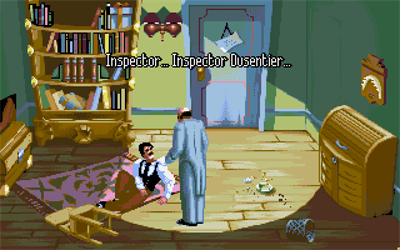
A stateroom interior. The game's 30 rooms each feel distinct, and the characters who move through them feel genuinely present.
"The game plays like a board game more than a traditional adventure. There are real constraints - time runs, characters move, clues expire. We wanted the player to feel the pressure of a real investigation, not the comfort of a puzzle box where everything waits for you."
Paul Cuisset, interviewed in Amiga Joker, November 1991
The Clock That Changes Everything
What distinguishes Cruise for a Corpse mechanically is its real-time structure. The in-game day is divided into phases, and as time passes, suspects' locations change, new clues become available, and some evidence disappears. The player cannot simply exhaust every room at leisure - they need to be somewhere specific when a particular suspect is there, and to have gathered certain information beforehand to recognise the significance of what they observe.
This design creates a tension absent from point-and-click contemporaries. In LucasArts games - the other dominant adventure tradition of 1991 - there is no failure state, no time pressure, and no information that expires. In Cruise, inattention costs you. Miss the conversation in the dining room because you were searching a stateroom at the wrong time, and the information is gone. The game does not tell you what you missed. It simply moves on.
Character interaction. Each suspect has distinct dialogue and distinct reactions to being questioned at different points in the investigation.
Ninety Percent in a Year That Included Another World
Cruise for a Corpse received strong critical notices on release. CU Amiga awarded 90% and praised the atmosphere and the real-time character system. Amiga Power gave it 87% and noted the contrast with both LucasArts' comedic style and the pure action of Delphine's other 1991 release. The game was reviewed in the shadow of Another World, which made its own quieter virtues harder to perceive - but those virtues are real.
The 1930s setting, the European taste for the whodunit as a serious literary form, and Cuisset's commitment to simulating rather than merely staging the mystery - these combined to make something that had no real comparator in 1991 and has had few since. The closest analogue is Sherlock Holmes games from Frogwares, which appeared more than a decade later, and the DNA from Cruise to that tradition is traceable if not documented.
The Adventure Delphine Didn't Repeat
Cuisset never returned to the real-time mystery format. Flashback came next, and the commercial and critical pressure of that project's success shaped the studio's output through the mid-1990s. Cruise for a Corpse remains a one-off: a game that solved a specific problem - how to make the player feel like an investigator rather than a puzzle-solver - with a clarity that deserved imitation and received very little.
For platform availability and preservation options, see Catalogue and Resources. The game's music by Raphaël Gesqua is discussed separately. Cuisset's biography and his other work are on the People page.
Operation Stealth
Paul Cuisset / 1990 / Amiga, Atari ST, DOS
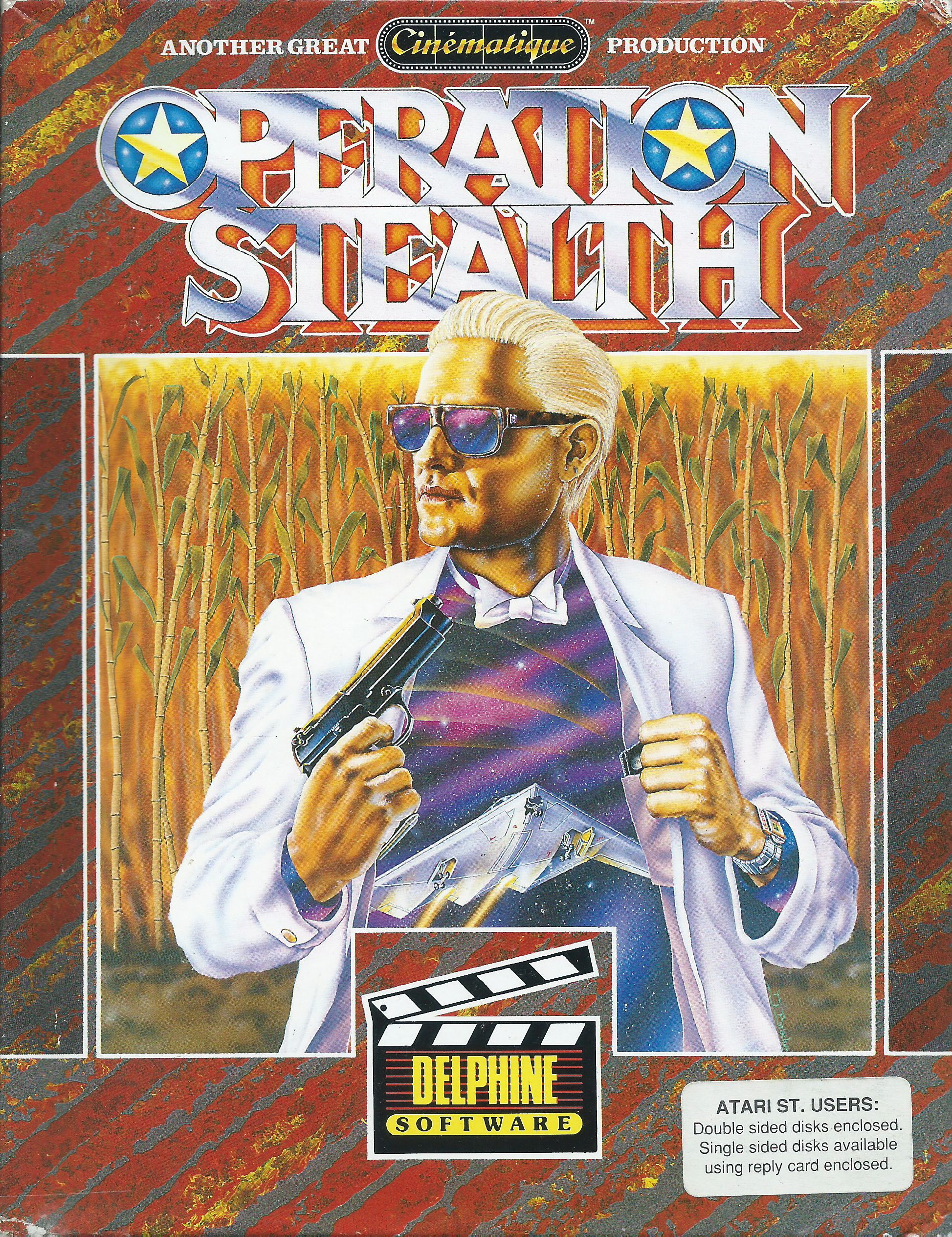
European release as Operation Stealth. The American version shipped as James Bond: The Stealth Affair under license from Glidrose Productions.
Operation Stealth occupies a specific position in the Delphine chronology: the game that proved the Virtual Theatre engine could sustain a serious commercial release, that Cuisset could build at scale, and that Delphine could compete visually with any studio on the Amiga. Released in 1990, a year before Another World announced the studio to the world, it is the moment the studio's aesthetic ambitions became technically credible.
The game's publishing history is stranger than the game itself. Developed as an original spy thriller titled Operation Stealth, it was licensed to U.S. Gold for American distribution under the James Bond banner - becoming James Bond: The Stealth Affair - with character names and references grafted onto a design that had nothing to do with the Bond franchise. The result is a game that works better without the license than with it, and the original title is the one to seek.
The Bond License Nobody Asked For
Cuisset's original spy protagonist - CIA agent John Glames, tasked with recovering a stolen stealth aircraft from Central America - had been developed without reference to Bond. The Virtual Theatre engine was designed to handle cinematic movement across varied environments, and the spy thriller genre suited that ambition: airports, embassy buildings, jungle locations, and submarine bases each offered distinct visual registers that showcased the engine's flexibility.
The James Bond license was a commercial decision made at the distribution stage, not a creative one. U.S. Gold saw an Amiga spy game of unusually high visual quality and acquired the rights to rebrand it. The resulting American version retains all of Cuisset's design while replacing character names and adding superficial Bond references. European players who encountered the original were playing a more coherent game, free from the incongruity of a Bond who does not behave like Bond.
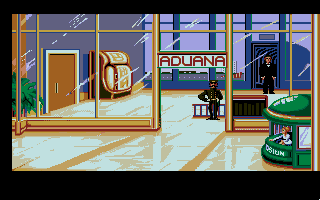
Airport customs interior. The Virtual Theatre engine renders the space with a level of architectural detail unusual for 1990.
"The ambition was always to make a spy game that felt like watching a film. The locations had to be believable - an airport that looked like an airport, an embassy that looked like an embassy. The technology existed to do it. We just had to use it with enough care."
Paul Cuisset, Games Machine interview, Autumn 1990
LucasArts Logic with European Obstinacy
As an adventure game, Operation Stealth sits in the point-and-click tradition that LucasArts was defining simultaneously in America, but with a distinctly European puzzle design sensibility. The solutions tend toward the lateral and occasionally arbitrary. Objects combine in ways that require imagination rather than logic. Some dead-ends are real - save-scumming is not merely a convenience but a necessity. This was not unusual for 1990, and it is worth noting (as a historical fact, not a criticism) that the game's difficulty curve reflects its era accurately.
What distinguishes the gameplay from contemporaries is the movement system. Glames navigates the game world with the same fluid, proportionally correct animation that Cuisset had pioneered in Future Wars, here refined and extended. Walking through an airport terminal or down an embassy corridor, the character feels physically present in a way that LucasArts' simplified sprite characters of the same period did not. The engine's investment in animation communicates world quality even when the puzzle design falters.
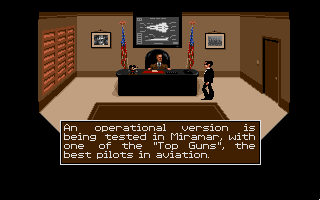
Office briefing interior. The game visits airports, embassies, jungle bases, and submarine facilities - each rendered to the same architectural detail.
The Most Handsome Amiga Game of 1990
Contemporary reviews agreed that Operation Stealth was visually exceptional. The One Amiga gave it 91% and singled out the animation as the finest character movement on the Amiga to that point. Amiga Format awarded 88% and noted the authentic-feeling environments as a step beyond anything the adventure genre had achieved. French press gave it comparably high marks, recognising the studio's progress from Future Wars and anticipating what might come next.
The game sold well enough to secure Delphine's finances for the crucial period in which Éric Chahi was completing Another World. In that sense, its commercial performance directly enabled what came next - making it, in practical terms, the financial foundation of Delphine's most celebrated period.
The Foundation Beneath the Masterworks
Operation Stealth's primary legacy is technical and institutional: it demonstrated that the Virtual Theatre engine was a serious commercial platform, capable of sustaining a full adventure game of competitive visual quality. That proof of concept - built on the engine Cuisset had first deployed in Future Wars - enabled the confidence to attempt Cruise for a Corpse the following year. Three games, one engine, three distinct genres.
Players interested in the game's place in the catalogue can find platform details in Catalogue. The engine's journey from Future Wars through Stealth to Cruise is discussed further in the History section. Audio preservation links are on the Music page.
Future Wars
Paul Cuisset / 1989 / Amiga, Atari ST, DOS
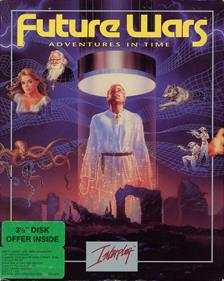
North American box art (Interplay). The game visits medieval France, the far future, and prehistoric Earth within a single engine.
Future Wars was Delphine's commercial breakthrough and the title that established both the studio's reputation and its technical foundation. Released in 1989, it was the first major application of the Virtual Theatre engine that Paul Cuisset had been building essentially from scratch. It demonstrated that a small French studio could produce adventure games competitive with the best American developers in both visual quality and mechanical coherence.
The premise is science-fiction: an incompetent window cleaner discovers a time machine hidden in a building he is supposed to be cleaning, and is drawn into a war between humanity and an alien race called the Crughons that spans multiple historical periods. The protagonist's ordinariness is unusual - not a hero, not a detective, just a man caught in the wrong place at the wrong moment - and the game treats this with a consistent dry humour that offsets its science-fiction ambitions.
Building the Engine That Would Define a Studio
Cuisset had joined Delphine in the late 1980s with a specific idea: that adventure games could use fully animated, proportionally correct character sprites to create environments that felt inhabited rather than illustrated. The dominant adventure game visual approach of the period - whether LucasArts' cartoon aesthetic or Sierra's smaller sprites - assumed character animation as an afterthought. Cuisset built the Virtual Theatre engine to make animation the primary technical commitment, with everything else following from that.
The development of Future Wars was thus as much an engine development project as a game project. Cuisset and his small team were building the technology simultaneously with the content. The game's structure - contemporary setting, then medieval France, then the far future, then prehistoric Earth - was partly a design decision and partly a testing methodology: each new environment validated a different aspect of the engine's capacity to render varied backgrounds with consistent character animation quality.
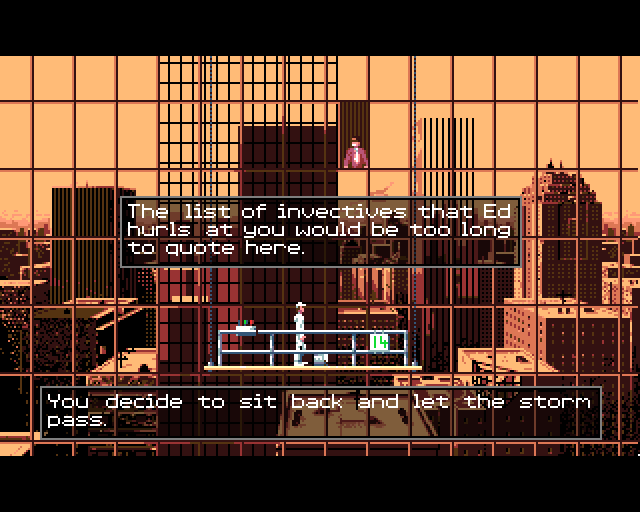
The contemporary setting. A window cleaner on a skyscraper - the engine was required to make the mundane feel as convincing as the exotic.
"I wanted characters who moved like people, in spaces that felt like real spaces. That was the whole problem I was trying to solve. Everything else in the game - the story, the puzzles, the time travel - was built around that one ambition."
Paul Cuisset, interview in Amiga Joker, December 1989
Sierra Logic with Continental Texture
As a point-and-click adventure, Future Wars shows the influence of Sierra's design vocabulary - particularly the verb-and-object interaction model and the willingness to include dead-ends and instant-death situations that require saves. The puzzle design ranges from satisfying to arbitrary in the manner of 1989 adventure games generally. What distinguishes the game is not the puzzle logic but the environmental texture: the way each historical period feels like a distinct visual world rather than a palette swap.
The medieval section, with its castle interiors and costumed characters, and the prehistoric section, with its primitive vegetation and cave dwellings, each demanded different things from the engine. That all three look credible - that the character animations carry the same weight in each - is the game's quiet technical achievement. Players who found the puzzle design opaque still noted the visual consistency as something unusual.
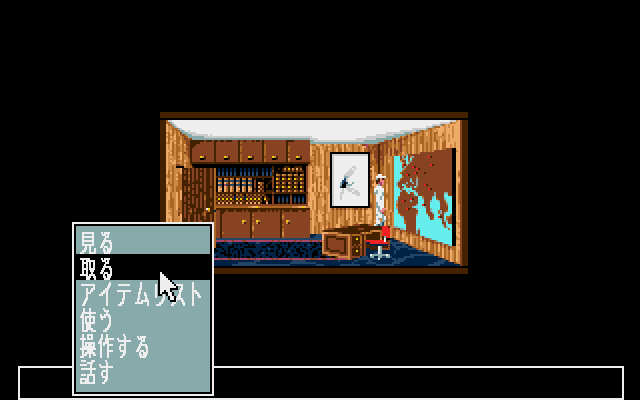
The engine's architectural flexibility: the same character animation system rendering across three distinct historical settings within a single game. (Japanese localisation.)
The Critics Who Noticed the Animation First
Contemporary reviews consistently led with the animation. The One Amiga gave it 88% and described the character movement as the finest seen in an Amiga adventure game. Amiga Format awarded 85% and specifically cited the proportionally correct sprites as an advance over LucasArts and Sierra's visual standards. French press - Tilt, Joystick - gave it strong marks and positioned Delphine as a studio to watch.
The game sold well enough to secure Delphine's finances and establish Cuisset's credibility within the studio. It placed Delphine on the map in the UK and German markets where Amiga gaming was concentrated. For a first commercial release of this ambition, the reception was exactly what was needed: solid, respected, and noticed by the right people.
The Engine That Built Three Masterworks
Future Wars' legacy is primarily the engine it introduced. The Virtual Theatre system that debuted here went directly into Operation Stealth (1990), Cruise for a Corpse (1991), and then, in evolved form, into the movement system Cuisset built for Flashback (1992). Four games, across three years, from a single architectural decision made in 1988. The lineage is direct and traceable: without the investment in character animation that Future Wars required, none of what followed would have been possible.
The game also established Delphine's working culture: a small team, a strong technical foundation, and the willingness to commit resources to visual ambition before commercial validation. That culture produced Another World and Flashback. Future Wars is where it began. For platform availability, see Catalogue. For preservation options, see Resources and Play.