Sixteen years of cinematic games, from a small French town to the world.
Delphine Software History
1988 — The Founding
Delphine Software International was founded in 1988 in Bourges, a quiet city in central
France perhaps better known for its Gothic cathedral than its technology industry. The
company was established by Paul de Senneville, a music publisher who
provided the early financing, alongside a core of young developers hungry to make
something new. From the start, the studio's ambitions were cinematic rather than merely
ludic — they wanted games that felt like experiences.
The company took its name from the French given name Delphine, and its early
releases targeted the booming home microcomputer market: Amiga, Atari ST, and DOS.
Their first titles established adventure games as the studio's natural home, even before
the concept of "cinematic" game design had a name.
1989–1990 — First Steps: Future Wars and Operation Stealth
Future Wars (1989), designed by Paul Cuisset, was Delphine's
commercial breakthrough: a point-and-click adventure set across multiple time periods,
powered by the studio's proprietary Virtual Theatre engine. The engine allowed smooth
character animation on the Amiga and Atari ST, a genuine innovation at the time.
Future Wars showed that a small French team could compete with the American
giants of adventure gaming.
Operation Stealth (1990) followed — a globe-trotting spy thriller
published in some territories as James Bond: The Stealth Affair under license.
The James Bond branding was later dropped from most releases, but the game's
smooth animation and sophisticated plotting established the studio's voice.
1991 — Another World Changes Everything
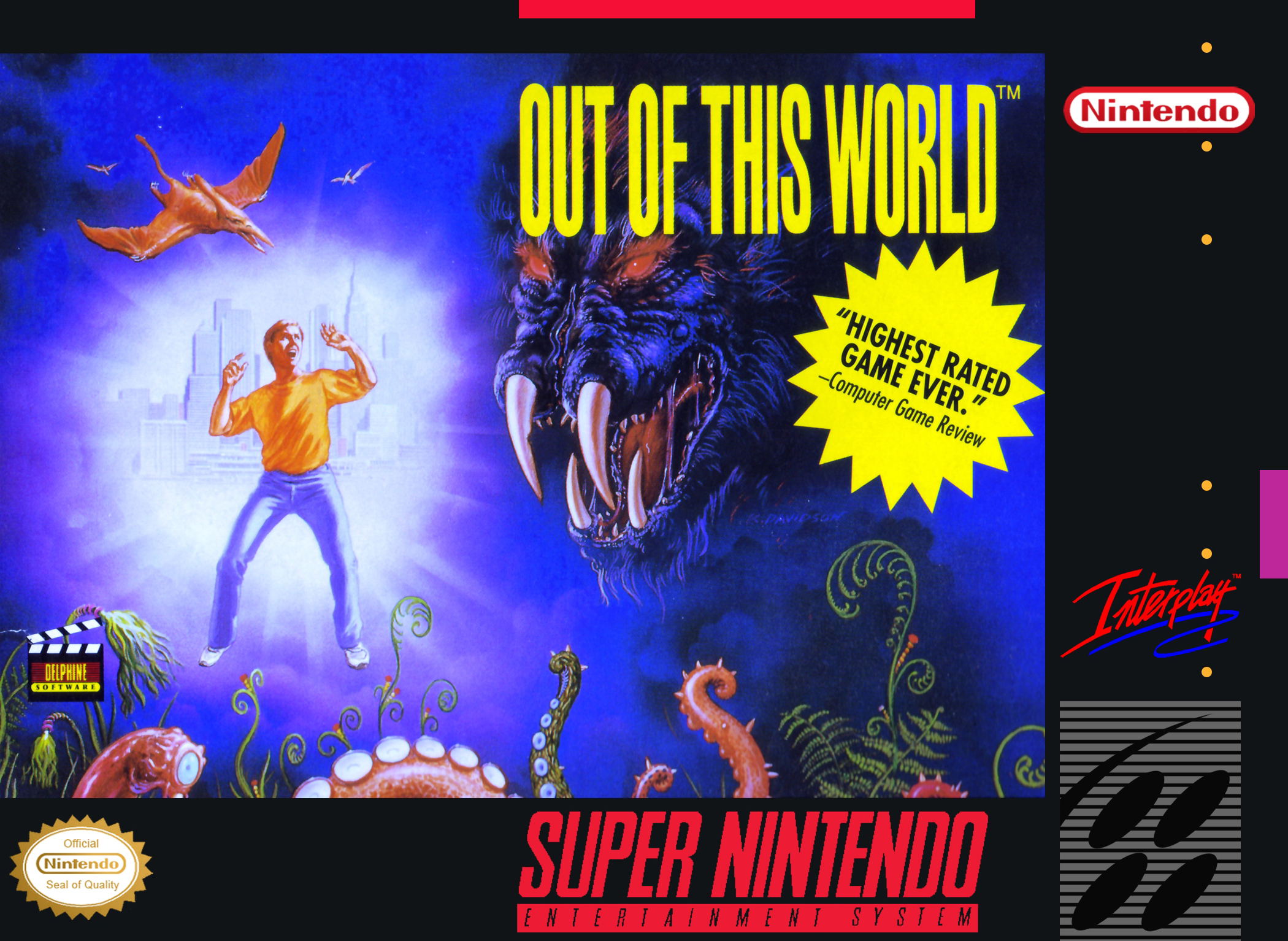
Out of This World — North America
Nothing Delphine had done before prepared the world for Another World.
Éric Chahi spent two years building the game almost entirely alone,
pioneering the use of rotoscoped polygonal animation to create smooth, lifelike movement.
The game had no HUD, no score, no traditional tutorial — just a particle accelerator
accident, an alien planet, and a partnership forged in silence.
Critics were stunned. Amiga magazines awarded marks approaching perfection. The American
market, where the game was published as Out of This World, discovered it
with equal astonishment. Another World went on to influence a generation of
developers, from Jordan Mechner to the creators of Limbo and Inside.
Cruise for a Corpse also arrived in 1991: a 1930s murder mystery with
real-time day simulation and a cast of suspects whose schedules changed with every playthrough.
1992 — Flashback and the Studio's Peak
Flashback — Mega Drive
Flashback: The Quest for Identity was Paul Cuisset's masterwork and Delphine's
commercial pinnacle. Released on the Mega Drive, Amiga, DOS, and SNES, it sold over two
million copies worldwide — extraordinary numbers for a European developer of the era.
The game combined fluid rotoscoped movement (Cuisset had studied Chahi's technique closely)
with a Philip K. Dick-flavoured narrative of memory loss, corporate conspiracy, and identity.
Raphaël Gesqua's Amiga score — moody, atmospheric, unmistakably French —
became inseparable from the game's identity. Flashback appeared in the
Guinness Book of Records as one of the best-selling video games of its era.
1993–1995 — Ambition and the 3D Pivot
Following Flashback's success, Delphine attempted several ambitious projects.
Shaq Fu (1994), co-developed with Tiertex and published by Electronic Arts,
became an infamous misstep — a celebrity fighting game that satisfied neither
critics nor fans. It remains one of gaming's most notorious licensed titles.
More ambitious was Fade to Black (1995), a 3D sequel to Flashback that placed
Conrad B. Hart in a fully three-dimensional world. The technology was impressive for 1995,
but the transition from 2D to 3D stripped away much of what made Flashback beloved.
Critics were divided; sales were disappointing.
1997–2004 — Racing Pivot and Closure
Moto Racer (1997) marked Delphine's unexpected pivot to racing games. Critically
acclaimed and commercially successful, it demonstrated the studio could reinvent itself.
Sequels followed, and the franchise kept Delphine alive through the PlayStation era.
Éric Chahi had departed after Another World, eventually going on to create
Heart of Darkness at Amazing Studio and later From Dust at Ubisoft.
Paul Cuisset, too, moved on. By the early 2000s, Delphine was a different company,
struggling to find its footing in a changing market.
Delphine Software International ceased operations in 2004. The studio that had shown
the world what games could be — stark, strange, beautiful, European — was gone.
Its legacy endures in every game that reaches for cinema rather than spectacle.
Legacy
The influence of Delphine's peak output is impossible to overstate. Another World
remains a set text in discussions of games as art. Flashback is cited by
developers of Hollow Knight, Dead Cells, and dozens of other modern
action-platformers. The Virtual Theatre engine was years ahead of its time.
Both flagship titles have been remastered and re-released multiple times, finding new
audiences on every platform. That a studio that existed for just sixteen years continues
to be discussed, analysed, and loved is testament to how clearly Delphine Software
saw what games could be.
See Modern for remasters and remakes, or
Play to find out how to experience these games today.