The Boulder Behind You
Rick Dangerous arrived in 1989 as an unashamed love letter to Indiana Jones - specifically the opening sequence of Raiders of the Lost Ark, in which the hero sprints from a rolling boulder through a collapsing temple. Players guided Rick, a British adventurer in a pith helmet, through five increasingly elaborate deathtrap environments: South American jungle, Egyptian pyramid, Schwarzendumpf Castle, a missile base, and a climactic boss encounter. Published by Firebird Software and later by MicroStyle, the game appeared on seven platforms and established Core Design as a studio with a distinctive voice in British gaming.
Two Programmers and an Indiana Jones Fixation
Rick Dangerous was developed by a small core team. Simon Phipps served as lead programmer and artist, bringing in Stuart Gregg to share the programming load. Terry Lloyd contributed additional artwork. The game was built in assembly language to squeeze responsive character movement and trap logic across the target platforms, each of which required its own adaptation. The 16-bit Amiga and Atari ST versions offered the fullest visual experience; the C64 version gained its own legendary soundtrack from Dave Pridmore, whose SID compositions - indexed as HVSC entry 83 in the High Voltage SID Collection - became the definitive audio companion to Rick’s adventures for many players on that platform.
Die, Learn, Try Again
Rick Dangerous was, by design, a game of trial and error. Enemies materialised from behind walls without warning. Traps - pressure pads, spears, falling blocks - detonated on first contact, offering no preview of their presence or timing. The boulder that opens the South American level must be memorised to survive: its path, its speed, the precise moment to dodge into an alcove. The game asked players not to react but to learn, accumulate knowledge through death, and apply it on the next attempt.
Rick carried a gun, a supply of bombs, and a stick. The stick - used to trigger traps from a safe distance - gave the game its tactical dimension. A player who rushed through a corridor would die on the first trap; a player who probed carefully with the stick might survive. The inventory was limited, demanding careful resource management across five lengthy levels. Lives were finite. The game took no prisoners and offered no apology for its difficulty.
Seven Platforms from One Concept
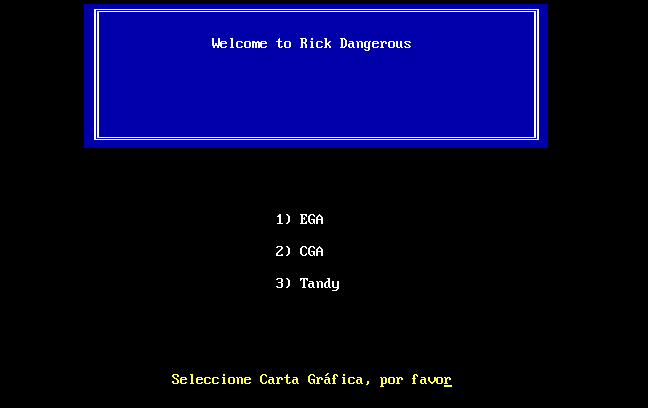
The simultaneous seven-platform release of Rick Dangerous was an early demonstration of Core Design’s commercial ambition. The Amiga and Atari ST versions shared a visual approach; the C64 version was reworked to fit within that platform’s tighter specifications while retaining the trap-based gameplay intact. The ZX Spectrum, Amstrad CPC, and Acorn Archimedes versions each required further adaptation. The MS-DOS version appeared alongside the 16-bit releases. Managing seven simultaneous codebases in 1989 was a logistical challenge that smaller studios frequently avoided - Core Design did not.
“Rick Dangerous is demanding, inventive, and consistently surprising - an action-adventure that earns its difficulty through clever level architecture rather than arbitrary cruelty. Core Design have produced something genuinely special.” Zzap!64, issue 51, July 1989 (Gold Medal)
Ninety-Three Percent and a Death Cry
Contemporary reception was strong across most platforms. Zzap!64 awarded a Gold Medal and rated the game highly, praising the level design and addictive quality. Amiga Power and ACE both noted Rick Dangerous as one of the strongest action-adventure releases of the year on their respective platforms. The game sold well enough across its first year to make a sequel commercially inevitable, and Rick Dangerous 2 followed in 1990, published by Microprose, extending the formula to even more elaborate deathtrap environments.
Rick Is Still Dead (and That Is the Point)
Rick Dangerous has never been officially remastered or revived. The game exists in its original platform versions - available through Internet Archive emulation and the usual ROM preservation channels. Its absence from modern storefronts is partly a rights question (Firebird, MicroStyle, and Core Design are all defunct) and partly a question of audience: the trial-and-error design philosophy that made Rick Dangerous what it is belongs to a specific moment in home computer gaming, before save states and checkpoints softened the learning curve.
For retrospective documentary coverage of the game and its development, Simon Phipps appeared in The Making of Rick Dangerous - available on YouTube - discussing the game’s creation in detail. It is the closest thing to a primary source on the early Core Design period. The full catalogue entry, including platform notes and box art, is in the Games Catalogue. Dave Pridmore’s C64 SID score is covered on the Music page.