Chrono Trigger
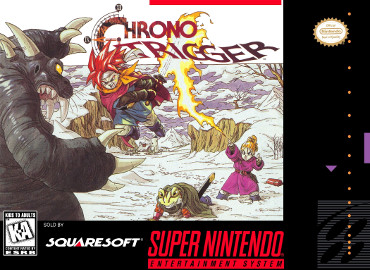
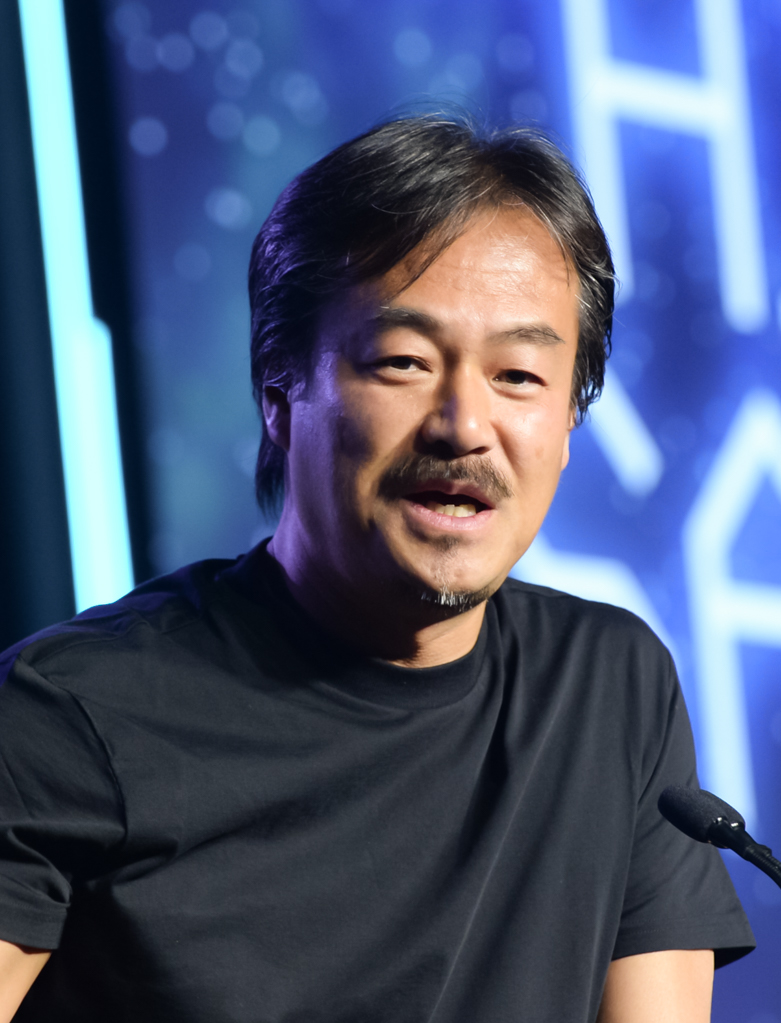
Chrono Trigger is a Japanese role-playing game developed and published by Square for the Super Nintendo Entertainment System. It was created by a collaboration so unlikely it was called the Dream Project before anyone had decided what it would make: Hironobu Sakaguchi, creator of Final Fantasy; Yuji Horii, creator of Dragon Quest; and Akira Toriyama, artist of Dragon Ball. Their music was composed by 22-year-old Yasunori Mitsuda, who demanded the assignment or would resign, then wrote 54 of the game’s 64 tracks from a hospital bed after working himself into collapse.
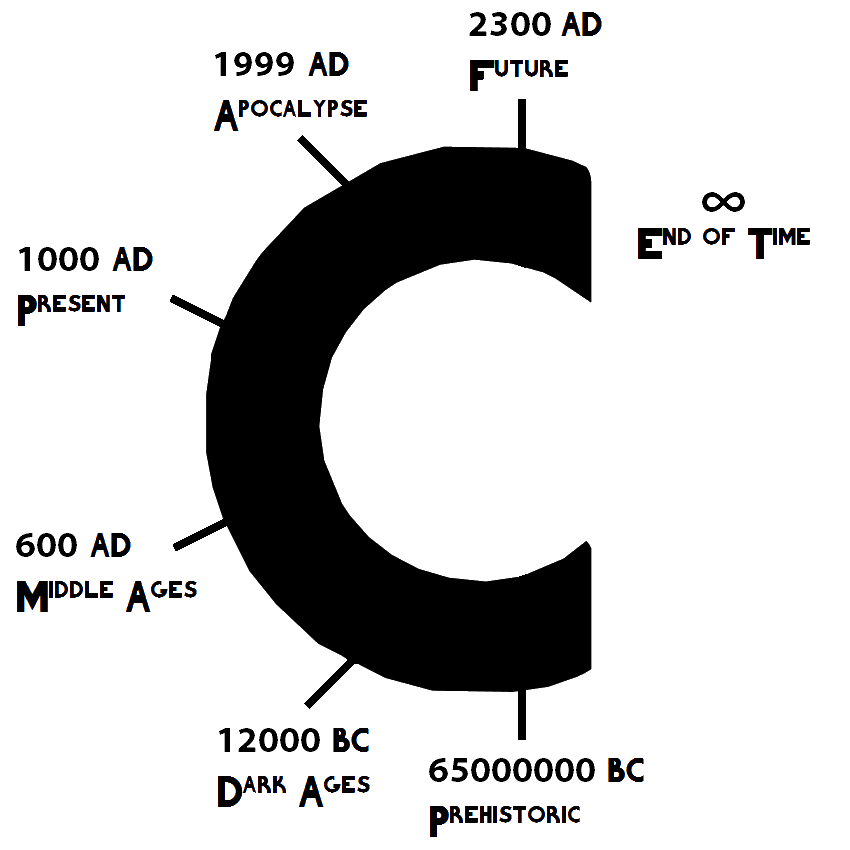
The game follows Crono, a young man from Truce Village in 1000 AD, drawn into a time-travelling adventure spanning six distinct eras from 65,000,000 BC to the End of Time. Its central question: can the party prevent Lavos, an alien parasite that has been feeding on the planet for 65 million years, from destroying the world on 13 July 1999? The answer depends entirely on the player - thirteen distinct endings wait depending on when and how Lavos is confronted.
Three decades after its release, Chrono Trigger remains in the first rank of every serious critical assessment of the greatest games ever made. It earned this through genuine innovation: the Active Time Battle system refined to its peak, enemies visible on field maps rather than randomly encountered, dual-tech and triple-tech combination attacks, a multiple-endings system of unprecedented sophistication, and a New Game+ mode that invited players to explore every branching path. No single feature made it a classic. The combination did.
The Dream Project
The genesis of Chrono Trigger was partly accidental. In 1992, a gathering at Square brought together Sakaguchi with Horii and Toriyama - three creators who had worked in adjacent fields but never made a single game together. The conversation that emerged was simple: what would each of them most want to play? The answer combined their strengths, and development began in earnest in 1993.
The project required extraordinary coordination. Toriyama designed characters and the visual language of each era. Horii wrote the scenario - a time travel structure requiring every change in one era to have traceable consequences in others. A forest planted in 600 AD stands ancient in 1000 AD. A character introduced as a child in the Middle Ages reappears as an elderly mentor in the Present. The consistency of this causal chain was tested manually across every timeline, and the final scenario holds.
Yasunori Mitsuda joined Square in 1992 as a sound programmer. He confronted Sakaguchi directly, telling him he would quit if not allowed to compose. Sakaguchi agreed. Mitsuda worked through what can only be described as self-destruction - overwork so sustained it hospitalised him with stomach ulcers. From his hospital bed, he continued. He composed 54 of the game’s 64 tracks. Nobuo Uematsu completed the remaining ten.
For the full production history - the Dream Team formation, the team structure, and the two years of development - see the History page.
I told Sakaguchi-san I would die before I submitted bad music. I nearly meant it literally. I was hospitalised. But I was composing in the hospital. The music mattered more than the warning signs.
- Yasunori Mitsuda
The Gameplay Loop
Chrono Trigger uses the Active Time Battle system originally designed by Hiroyuki Ito for Final Fantasy IV, but here refined to a peak it never quite reached elsewhere. Combat is turn-based but time-governed: each character has a gauge that fills in real time, and acting before it fills is impossible. This creates genuine tension without the paralysis of pure real-time systems - the player must think, but cannot dwell indefinitely.
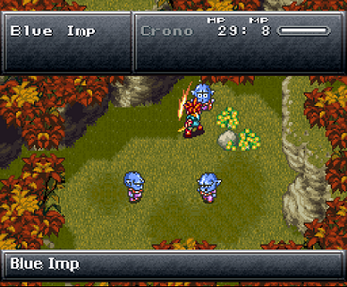
What makes the combat distinctive is spatial. Enemies are not abstract data - they occupy positions on the battle field visible during fights, and area-effect attacks hit multiple enemies shown on that field simultaneously. A fire sword swing hits the left cluster; a water magic cone hits the right. Party positioning is not decorative. It affects which attacks can hit how many targets.
Dual Techs and Triple Techs are the system’s peak. Most RPGs give each character an individual ability set and leave combination to the player’s imagination. Chrono Trigger makes those combinations real: Crono and Marle perform Aura Whirl together, Crono and Frog execute X-Strike, the entire party can perform Omega Flare or Delta Force. Each combination requires specific characters to be present, rewards learning the party dynamics, and makes every lineup feel mechanically distinct rather than cosmetically different.
Outside combat, enemies are visible on field maps and can be avoided or lured into unfavourable positions. Random encounters - the invisible ambushes that defined the genre standard since Dragon Quest in 1986 - were deliberately eliminated. This decision respects the player’s time and makes exploration genuinely pleasurable. A dungeon can be navigated. Progress is not eroded by attrition.
The time travel structure is not merely narrative - it is mechanical. The party moves between eras via Gates (natural rifts in time) and the Epoch (a time machine acquired mid-game). Actions in one era change others: a side quest in 600 AD affects what can be found in 1000 AD. The Robo character, an android from 2300 AD, can be left in 600 AD to tend a forest for 400 years; he is waiting in 1000 AD when the party arrives, aged but present, the forest behind him enormous. This kind of cause-and-effect is woven through the entire game.
What It Did That Others Did Not
Chrono Trigger arrived in 1995 with a cluster of innovations that contemporaries had not attempted and that the genre was slow to absorb. Three stand apart.
Multiple endings driven by the player’s choices. Earlier RPGs had endings; some had branching paths. Chrono Trigger had thirteen distinct conclusions, each triggered by confronting Lavos at a different moment under different conditions. The player’s journey - not just their final decision - determined what kind of world they were saving. The branching structure required the game to track not just narrative progress but the precise combination of conditions present at the moment of Lavos’s defeat.
New Game+. No major console RPG before Chrono Trigger had offered the ability to carry a completed game’s character progression into a fresh playthrough. New Game+ was not a bonus feature - it was architecturally necessary. Without it, reaching all thirteen endings would require multiple complete replays from scratch. New Game+ made the multiple-ending system accessible and invented a mechanic that RPGs would adopt as a standard for the following decade.
No random encounters. Every enemy in the game is visible on the field map. Players can choose engagement, avoid enemies when grinding is unnecessary, or lure specific enemies into positions that trigger area attacks. The invisible random encounter was not a design limitation - it was the genre norm, inherited from tabletop and preserved unquestioned for nearly a decade. Chrono Trigger discarded it and demonstrated what exploration felt like without it.
Beyond these three, the game’s technical achievement on SNES hardware is substantial. The Mode 7 sequences - including the Epoch’s time travel animations - push the console to its limits. Toriyama’s character designs translated from manga illustration to pixel art with extraordinary fidelity, maintaining personality and silhouette readability at tiny sprite sizes. The six time periods each required distinct tile sets, enemy designs, and musical identities, all produced within the storage constraints of a single SNES cartridge.
We wanted the player to feel that their choices mattered - not just at the end, but throughout. Thirteen endings was not a gimmick. It was a statement about what games could be.
- Hironobu Sakaguchi
How the World Received It
Chrono Trigger was a commercial and critical success from day one in Japan, where it debuted on 11 March 1995 and reached the top of sales charts immediately. Japanese gaming publications were emphatic: Famitsu awarded it 38 out of 40, placing it among the highest-rated games in the magazine’s history to that point. The combination of the Dream Team’s names on the packaging created extraordinary anticipation, and the game delivered on it.
The North American release on 22 August 1995 received equally strong notices. Electronic Gaming Monthly awarded it high marks and singled out the multiple-endings system as a breakthrough for player agency in the genre. Nintendo Power called it one of the finest RPGs on the platform, noting the elimination of random encounters as a quality-of-life advance the genre had needed. The consensus among specialist press was that the game set a new standard for the JRPG on console hardware.
Contemporary players responded to the music with particular intensity. Yasunori Mitsuda’s score generated fan correspondence and discussion at a volume unusual for game soundtracks in 1995. “Corridors of Time” and “Schala’s Theme” were cited repeatedly as compositions that transcended the genre’s typical accompaniment role - music that defined the emotional register of entire sections of the game.
The game sold over 2.65 million copies on the SNES. On the PlayStation port in 1999 and the Nintendo DS port in 2008, it attracted new audiences and received renewed critical attention confirming its status. The PC release in 2018 was marred by a technically poor conversion, later patched, but even that did not diminish the underlying game’s reputation.
All 13 Endings
Chrono Trigger delivers thirteen distinct endings, each triggered by defeating Lavos at a different point in the game or under specific conditions. The endings range from the true ending - a triumphant farewell - to comedic developer cameos, bittersweet resolutions, and haunting glimpses of what might have been. New Game+ exists specifically to let players reach every ending.
Beyond Time
True ending - defeat Lavos after reviving Crono, all side quests resolved. The most complete farewell.
Reunion
New Game+ ending - complete the game normally in a second playthrough. Crono and friends return home.
The Dream Project
New Game+ - defeat Lavos immediately from the title screen via the first time gate. Developer cameo ending.
The Successor of Guardia
Defeat Lavos during the Ocean Palace sequence, before acquiring the Epoch.
Good Night
Defeat Lavos in the Ocean Palace with a revived Crono but without fully completing the scenario.
The Legendary Hero
Defeat Lavos in the Middle Ages era before retrieving the Masamune or saving the Queen.
The Unknown Past
Defeat Lavos after arriving in 65,000,000 BC but before certain key events in that era.
People of the Times
Defeat Lavos mid-game, after Crono’s trial but before the Ocean Palace incident.
The Oath
Defeat Lavos after Crono has died but before his resurrection at Death Peak.
Dino Age
Defeat Lavos before the pivotal events of the 65,000,000 BC era are fully resolved.
What the Prophet Seeks
Defeat Lavos in the Kingdom of Zeal before the full Antiquity storyline is completed.
Memory Lane
New Game+ - defeat Lavos in an early window of the second playthrough.
Dark Ages
New Game+ - defeat Lavos at a specific point in Antiquity during a second playthrough.
Seven Playable Characters
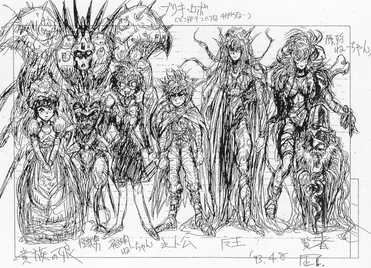
Chrono Trigger’s seven party members are among the most distinctive in JRPG history. Each is drawn from a different era, each carries a distinct narrative arc, and each was designed by Akira Toriyama with the principle that personality should be legible from the silhouette alone. For full profiles of the creators behind them, see the People page.
Crono
Silent protagonist. Red-haired swordsman from Truce, 1000 AD. The player’s canvas.
Marle
Princess Nadia. Impulsive, warm, crossbow-wielding. Escaping her royal life at the Millennial Fair.
Lucca
Inventor and mechanical genius. Crono’s childhood friend. One of gaming’s earliest female scientist characters.
Robo
R-66Y. Deactivated robot found in 2300 AD. Warm despite mechanical origins. Plants a forest across 400 years.
Frog
Glenn, knight transformed by Magus’s curse. Guardian of the Masamune. Speaks in archaic register - dignified, melancholy.
Ayla
Chieftain of the Ioka tribe, 65,000,000 BC. Apex physical fighter. The only party member without magic.
Magus
The dark wizard. Janus, Schala’s brother, sent through time and grown into vengeance. Optional party member.
Lavos
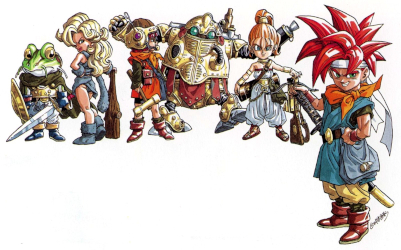
Lavos is the antagonist at the centre of Chrono Trigger’s narrative - an alien parasite that fell to Earth from space in 65,000,000 BC, buried itself in the planet’s core, and spent 65 million years feeding on the planet’s energy and genetic information. On 13 July 1999, it emerges, destroying human civilisation and reducing Earth to the ruined wasteland the party witnesses in 2300 AD.
The design of Lavos is one of Toriyama’s most ambitious. Its outer shell suggests both a sea creature and a meteor - organic spines covering a domed body that communicates scale and fundamental wrongness. Its true inner form is more mechanical and alien, implying that the outer shell is an adaptation rather than its original body. The final confrontation takes place inside Lavos, where the party battles a core that mimics the attacks of every boss they have defeated during the game.
Lavos does not act as a conventional RPG antagonist. It has no dialogue, no stated motive, and no response to the heroes. It simply feeds. The horror of Lavos is not malevolence but indifference - a being so far beyond human scale that humanity is simply a resource rather than an adversary.
Lavos was a design challenge - how do you make something feel genuinely alien? I went with organic forms mixed with mechanical ones, trying to make something that looked like it came from somewhere else entirely.
- Akira Toriyama
What the Game Established
Chrono Trigger sold over 2.65 million copies on the SNES and has been ported to PlayStation, Nintendo DS, iOS, Android, and PC. It remains, in virtually every major critical ranking, among the top three JRPGs ever made and frequently the first or second. Its innovations - New Game+, visible enemies, multiple endings, dual-tech and triple-tech combination attacks - shaped the genre for a decade after its release.
The direct sequel, Chrono Cross (1999), was developed by Masato Kato and a different team, with a story set on a parallel-world island 20 years after Chrono Trigger. It won critical praise in its own right but told a largely separate story with different characters. Chrono Trigger’s party never reunited for another game.
Mitsuda’s career was launched by the score. His subsequent works - Xenogears (1998), Chrono Cross (1999), Xenosaga (2002) - built directly on the foundation Chrono Trigger established, and he has spoken in virtually every interview about how the assignment shaped his understanding of what game music can do. At 22 years old, composing from a hospital bed, he produced what many consider the greatest soundtrack in JRPG history.
Toriyama, Horii, and Sakaguchi never worked together again. Chrono Trigger is the only product of the Dream Project. That singularity is part of its power - a collaboration that could not be repeated, a game that sits alone in the record. Thirty years on, new players continue to find it and understand why it endures.
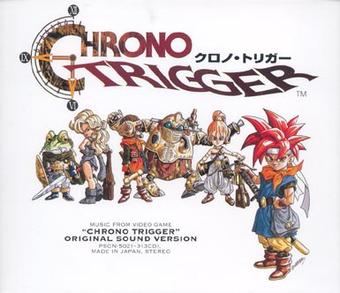
Mitsuda nearly worked himself to death on that score. The music is extraordinary. I sometimes feel guilty that he suffered for it, and then I hear it and I understand why he pushed that hard.
- Hironobu Sakaguchi