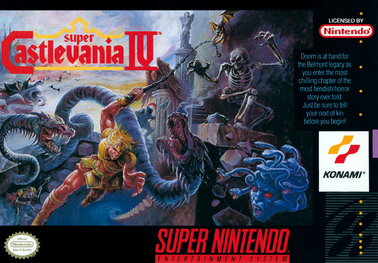

The SNES Launches. Simon Arrives.
Super Castlevania IV arrived with the Super Nintendo in 1991 as a statement of intent.
Where other launch titles showed what the hardware could do, Super Castlevania IV
showed what it felt like to actually play on superior hardware. It was gothic
horror running at a depth and detail that no 8-bit machine could match, and it set an
immediate standard that the series would spend the decade chasing.
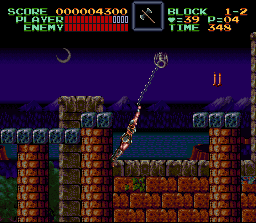
The expanded whip mechanic - swing in 8 directions, use the whip as a grappling hook,
hold it rigid against walls to deflect projectiles - transformed combat from a careful
dash-and-strike rhythm into flowing, expressive play. After five years of the Belmont
family locked into the punishing stair-step of the NES era, this felt like liberation.
See the full games catalogue and creator profiles
for broader series context.

A Remake Disguised as a Sequel
The original Castlevania was the work of Hitoshi Akamatsu, a young Konami developer
who built his horror action game on a love of pulp cinema and Universal monster movies.
By 1989, with the Super Famicom in development, Akamatsu had moved to Konami’s arcade
division. The responsibility for the first SNES Castlevania was handed to Masahiro Ueno,
a relatively unproven programmer whose prior game credits were modest.
Ueno’s approach was deliberate and clear-eyed: he was a fan of the original game
specifically, not the series as a whole. Rather than continue Castlevania III’s
branching-path experiments, he chose to remake the original game from scratch for
16-bit hardware. In Japan, Konami was transparent about this - the title was simply
Akumajô Dracula, marketed as a back-to-basics reimagining. Western
markets received the rather more misleading “Super Castlevania IV”, a
name that implied sequel when the game was actually a high-fidelity retelling of
Simon’s first hunt.
The SNES launch window shaped every design decision. Konami wanted a game that
demonstrated what the new console could do. There was, as retrospective accounts note,
a real desire to use every new feature the hardware allowed - the result was a game
that doubled as a technical showroom, its Mode 7 levels and DSP-driven audio existing
as much to impress as to challenge.
“Both the visuals and the music were made by people who consciously wanted
to do something cinematic.”
Hitoshi Akamatsu, creator of the original Akumajô Dracula, in conversations
recounted by a colleague in a 2019 Twitter thread; quoted in Slope’s Game Room:
The Complete History of Castlevania (YouTube, 2023)
Eleven Stages Through Dracula’s Dominion
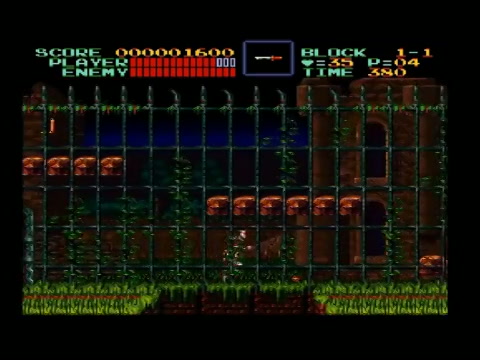
The 11-stage journey through Dracula’s castle, his grounds, the surrounding village,
and the crypts beneath was a masterclass in environmental storytelling. Ueno’s team
used the architectural logic of a real haunted castle - ballrooms, towers, dungeons, moats -
to create a world that felt coherent and inhabited. For the first time in the series, the
backgrounds were detailed enough that no imagination was required to read the darkness of
Dracula’s domain.
Stage
Location
Notable Feature
1
Transylvania Village & Outskirts
Opening theme ‘Dracula’s Castle’; introduces whip grappling mechanic
2
Castle Entrance & Moat
Rising water sequence; gothic bridge section
3
Underground Caverns & Swamp
Upward-scrolling platforming; bat swarms
4
The Treasury
Chandelier sequence; tight enemy placement requiring full whip control
5
The Rotating Room
Mode 7 rotates the entire level while Simon navigates it
6
Clock Tower
Classic Castlevania boss gauntlet; pendulum mechanics
7-8
Bone Corridor & Crypt
Skeleton enemies, elaborate environmental traps
9
The Laboratory
Frankenstein aesthetic; one of the game’s most intensive combat sections
10
Inner Tower
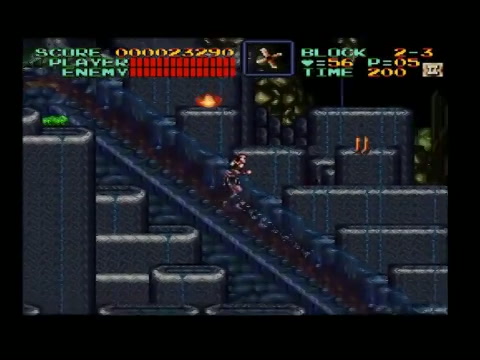
Ascending staircase gauntlet with escalating enemy patterns
11
Dracula’s Chamber
Multi-phase Dracula boss fight; the game’s climax
Eight Directions and a Grappling Hook
In the NES era, the Vampire Killer was a blunt instrument: four directions, precise range,
no room for improvisation. Super Castlevania IV changed everything. Simon can swing his whip
in all 8 compass directions, wrap it around hooks to swing across gaps, and hold it extended
to bat away projectiles. This single design decision transformed the entire vocabulary of
the game.
The larger Simon sprite came with the longer whip, and critics noted that this made the
game substantially more accessible than its predecessors. Those Medusa heads that had
plagued players for five years - floating at odd angles, spawning endlessly - could now
be whipped from below or above before they closed in. Ueno’s intent was a Castlevania
anyone could finish with dedication, without removing the challenge of the final stages.
- 360-degree whip control - swing in 8 directions
- Whip-grappling on ceiling hooks for traversal
- Rigid whip stance to deflect enemy projectiles
- Whip as momentum tool on rotating platforms
- Sub-weapons on a dedicated button - no more accidental throws on stairs
Super Castlevania IV arrived with the Super Nintendo in 1991 as a statement of intent. Where other launch titles showed what the hardware could do, Super Castlevania IV showed what it felt like to actually play on superior hardware. It was gothic horror running at a depth and detail that no 8-bit machine could match, and it set an immediate standard that the series would spend the decade chasing.
The expanded whip mechanic - swing in 8 directions, use the whip as a grappling hook, hold it rigid against walls to deflect projectiles - transformed combat from a careful dash-and-strike rhythm into flowing, expressive play. After five years of the Belmont family locked into the punishing stair-step of the NES era, this felt like liberation. See the full games catalogue and creator profiles for broader series context.
The original Castlevania was the work of Hitoshi Akamatsu, a young Konami developer who built his horror action game on a love of pulp cinema and Universal monster movies. By 1989, with the Super Famicom in development, Akamatsu had moved to Konami’s arcade division. The responsibility for the first SNES Castlevania was handed to Masahiro Ueno, a relatively unproven programmer whose prior game credits were modest.
Ueno’s approach was deliberate and clear-eyed: he was a fan of the original game specifically, not the series as a whole. Rather than continue Castlevania III’s branching-path experiments, he chose to remake the original game from scratch for 16-bit hardware. In Japan, Konami was transparent about this - the title was simply Akumajô Dracula, marketed as a back-to-basics reimagining. Western markets received the rather more misleading “Super Castlevania IV”, a name that implied sequel when the game was actually a high-fidelity retelling of Simon’s first hunt.
The SNES launch window shaped every design decision. Konami wanted a game that demonstrated what the new console could do. There was, as retrospective accounts note, a real desire to use every new feature the hardware allowed - the result was a game that doubled as a technical showroom, its Mode 7 levels and DSP-driven audio existing as much to impress as to challenge.
“Both the visuals and the music were made by people who consciously wanted to do something cinematic.”
Hitoshi Akamatsu, creator of the original Akumajô Dracula, in conversations recounted by a colleague in a 2019 Twitter thread; quoted in Slope’s Game Room: The Complete History of Castlevania (YouTube, 2023)The 11-stage journey through Dracula’s castle, his grounds, the surrounding village, and the crypts beneath was a masterclass in environmental storytelling. Ueno’s team used the architectural logic of a real haunted castle - ballrooms, towers, dungeons, moats - to create a world that felt coherent and inhabited. For the first time in the series, the backgrounds were detailed enough that no imagination was required to read the darkness of Dracula’s domain.
| Stage | Location | Notable Feature |
|---|---|---|
| 1 | Transylvania Village & Outskirts | Opening theme ‘Dracula’s Castle’; introduces whip grappling mechanic |
| 2 | Castle Entrance & Moat | Rising water sequence; gothic bridge section |
| 3 | Underground Caverns & Swamp | Upward-scrolling platforming; bat swarms |
| 4 | The Treasury | Chandelier sequence; tight enemy placement requiring full whip control |
| 5 | The Rotating Room | Mode 7 rotates the entire level while Simon navigates it |
| 6 | Clock Tower | Classic Castlevania boss gauntlet; pendulum mechanics |
| 7-8 | Bone Corridor & Crypt | Skeleton enemies, elaborate environmental traps |
| 9 | The Laboratory | Frankenstein aesthetic; one of the game’s most intensive combat sections |
| 10 | Inner Tower | Ascending staircase gauntlet with escalating enemy patterns |
| 11 | Dracula’s Chamber | Multi-phase Dracula boss fight; the game’s climax |
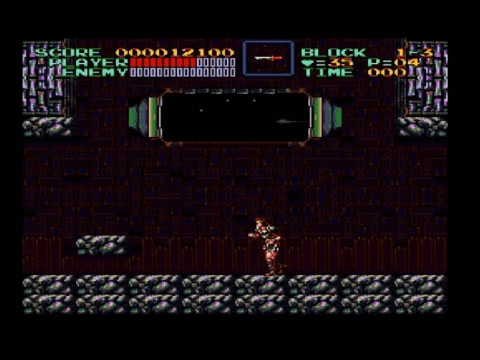
In the NES era, the Vampire Killer was a blunt instrument: four directions, precise range, no room for improvisation. Super Castlevania IV changed everything. Simon can swing his whip in all 8 compass directions, wrap it around hooks to swing across gaps, and hold it extended to bat away projectiles. This single design decision transformed the entire vocabulary of the game.
The larger Simon sprite came with the longer whip, and critics noted that this made the game substantially more accessible than its predecessors. Those Medusa heads that had plagued players for five years - floating at odd angles, spawning endlessly - could now be whipped from below or above before they closed in. Ueno’s intent was a Castlevania anyone could finish with dedication, without removing the challenge of the final stages.
- 360-degree whip control - swing in 8 directions
- Whip-grappling on ceiling hooks for traversal
- Rigid whip stance to deflect enemy projectiles
- Whip as momentum tool on rotating platforms
- Sub-weapons on a dedicated button - no more accidental throws on stairs
Super Castlevania IV - Full Game Longplay (4K60fps)
What the SPC700 Made Possible
The SNES audio chip - Sony’s SPC700 - gave composers Masanori Adachi and Taro Kudo tools that no 8-bit machine had offered: 64KB of sample RAM, eight channels, and a DSP with hardware reverb. That reverb effect gave the music a damp, echoing quality perfectly suited to stone corridors and centuries-old crypt. Every room felt like it had acoustics.
The opening Dracula’s Castle theme builds from silence into full gothic grandeur over a five-note motif that became the series’ most recognisable cue. The waltz Rondo brings macabre elegance to the ballroom sequences. Simon Belmont’s Theme drives the action with propulsive percussion. Together they form a unified soundscape that is as much a part of the game’s identity as the whip.
The Mode 7 rotating room (Stage 5) represented a separate kind of technical ambition. The effect - the entire level tilting and rotating as Simon navigates it - was a genuine showcase of the SNES graphics chip’s ability to perform affine transformations on tile maps in real time. Whether that technique served the gameplay or merely demonstrated the hardware is still argued; at launch, it stopped players in their tracks.
Nintendo Power Ran Out of Superlatives
On release, Super Castlevania IV was acclaimed across the board. Nintendo Power gave it as close to a perfect score as the magazine had awarded any game at that point, and dedicated coverage that dwelt specifically on the visual leap from the NES era. Other publications focused on the whip redesign and the Mode 7 sequences as proof that 16-bit gaming was a genuine generational step rather than a marketing exercise.
Sales estimates vary - Konami has never published exact figures - but the figure most commonly cited is somewhere between 500,000 and one million copies worldwide. Given how scarce the SNES itself was in its first year, those numbers represent an extraordinary attach rate. Many more players encountered the game through rentals or a friend’s console than through their own copy; its cultural footprint was larger than its sales alone.
The High Watermark the Series Never Quite Matched
Masahiro Ueno’s success on Super Castlevania IV led directly to his promotion into a managerial role at Konami. He never returned to direct game development. Without his involvement, the game never received a true follow-up in its style, and in retrospect it occupies a strange position in the series timeline: a masterpiece of the classic Castlevania formula that became an evolutionary dead end the moment it was finished.
The series pivoted sharply with Symphony of the Night in 1997, trading linear stages for open-world castle exploration, action-RPG progression, and Koji Igarashi’s production fingerprints. That game birthed the “Metroidvania” genre and is rightly celebrated, but it rendered the whip-based, stage-by-stage structure of Super Castlevania IV a historical artefact rather than a foundation to build on.
Among players who prefer the classical approach - deliberate movement, precise combat, no experience points or equipment to fall back on - Super Castlevania IV is consistently rated the pinnacle of the form. It routinely appears in top-ten SNES lists more than three decades after release. The Vampire Killer has never swung with this much range, in this many directions, in a game built with this much craft.
Explore the full series history to see how Castlevania evolved after Super Castlevania IV, and the people page for profiles of Adachi, Kudo, and the composers who defined the SNES era.