A little running man, a jungle, and 4 kilobytes of ROM.
How David Crane built one of the greatest video games ever made
on hardware never designed for it.
4M+Copies sold
64Weeks at #1
255Unique screens
4KBTotal ROM
The Running Man
The story of Pitfall! begins not with a game concept but with a technical achievement.
Around 1979–1980, David Crane developed a technique for displaying a realistic animated
running figure on the Atari 2600 hardware - smooth, multi-frame, convincingly human.
This was something far beyond what contemporary games showed.
The “little running man” prototype sat unused for approximately two years as Crane worked
on other projects, including Grand Prix - where he first used wheel animation - searching
for the right game concept to justify the technique.
The design came in minutes. Other Activision programmers told Crane the sprite he had
created was too complex to fit in a real game - effectively challenging him to prove otherwise.
Crane has described what happened next at the GDC 2011 Classic Game Postmortem.
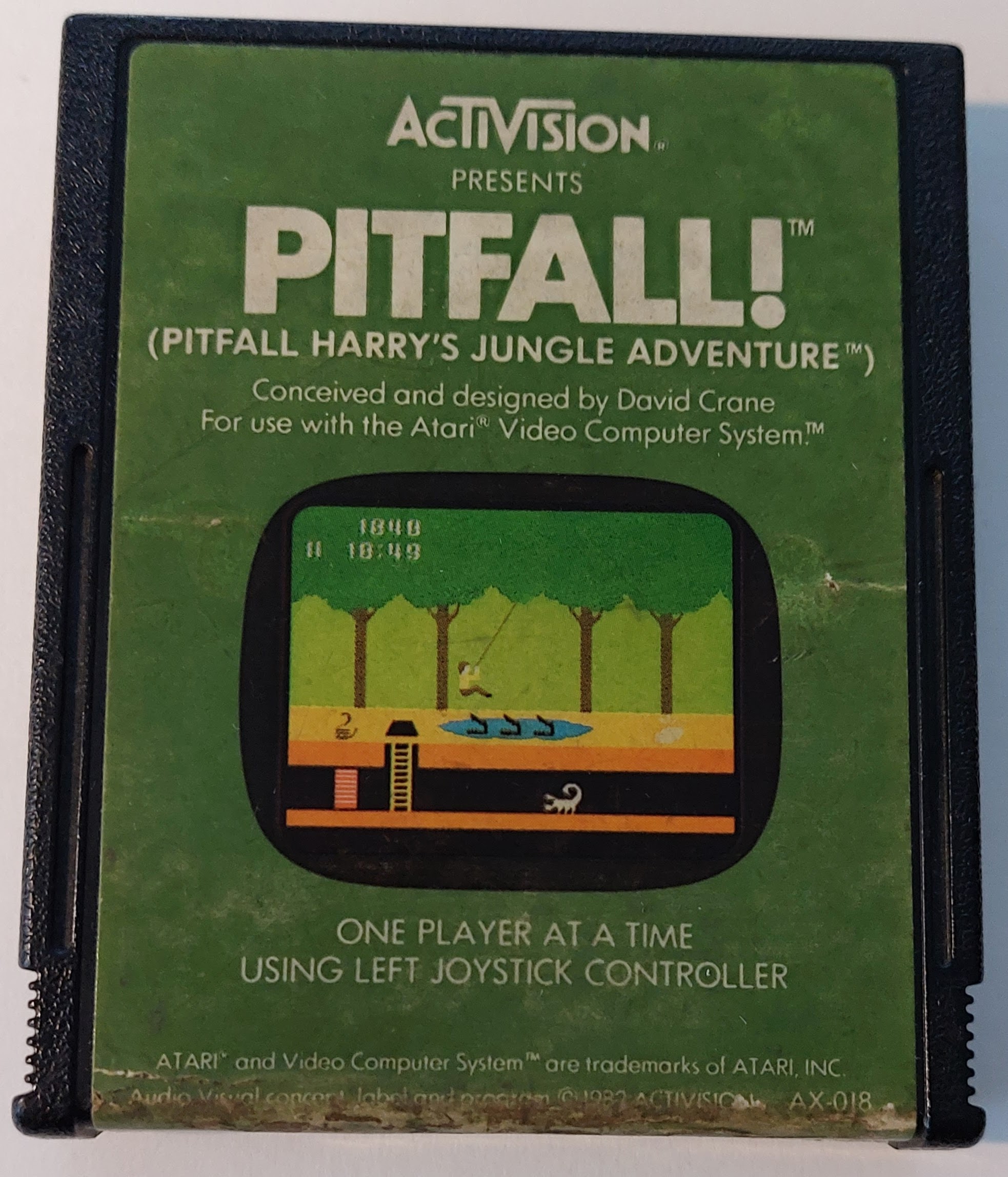
The Pitfall! cartridge. The Explorer’s Club patch - one of the program’s most iconic rewards - required reaching 20,000 points.
“I sat down with a blank sheet of paper and drew a little running man, looked at it, and said,
‘Well, he’s running, so let’s give him a path to run on… let’s put the path through a jungle…’
In literally 10 minutes, or 15 minutes max, I had the design document. That’s it! About 1,000 hours
of programming later, the game was complete.”
— David Crane, GDC 2011 Classic Game Postmortem: PITFALL!
The game was developed under the working titles “Jungle Runner” and briefly
“Zulu Gold” before the name Pitfall! was finalised. The exclamation mark
was Crane’s - a declarative confidence in what the game was.
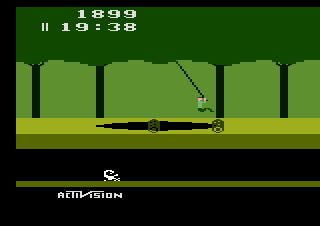
Pitfall! gameplay - the above-ground jungle world. Each screen was generated by an 8-bit polynomial counter, not stored in ROM.
Scorpions, Crocodiles, and Twenty Minutes to Glory
Pitfall Harry runs left or right through a jungle, moving between 255 discrete screens.
The objective: collect all 32 treasures scattered across the world within
20 minutes. The score begins at 20,000 points and counts up when treasures
are collected; contact with hazards costs points rather than lives.
Each screen contains one or more hazard types from a fixed set: scorpions
(stationary, must be jumped), rolling logs (jump timing or crouch to pass),
tar pits (slow Harry but do not kill), open pits with
crocodile mouths snapping at the top, and fire. Vine ropes hang at intervals,
allowing Harry to swing over multi-cell hazards — the vine-swinging moment is the game’s
signature.
Treasures vary in value: money bags (2,000 points), silver bars (3,000), gold bars (4,000),
and diamond rings (5,000). Collecting every treasure without any penalty deductions yields
the maximum possible score — an achievement rare enough to have its own dedicated
Activision patch.
Pitfall Harry navigating the jungle surface. The score counts down from 20,000 when hazards are contacted; treasure adds to it. The 20-minute timer makes every routing decision matter.
The world has two layers: the above-ground jungle and
underground passages. Descending a ladder brings Harry into the tunnels,
where he can move right and emerge three screens further along the surface — a shortcut
system that rewards players who learn the underground routing. Crocodile pits above-ground
become passable underground via a tunnel section requiring precise timing between the snapping
jaws of three sequential croc heads.
Harry has three lives. Falling into a pit or being bitten by a crocodile
costs a life; other hazards subtract points only. The loss of a life resets Harry to the
previous screen, costing time and routing momentum. Expert players developed routes that
minimised above-ground hazard exposure by using underground bypasses to skip the most
dangerous sequences.
Crane has spoken in interviews about the game’s difficulty philosophy: Pitfall! was designed so
that every death felt like the player’s fault, not the game’s. Getting the vine swing wrong
and falling into the pit was not a failure of design — it was a failure of execution. Players
always felt they could have done better, which kept them coming back.
Procedural Screen Generation
Pitfall! contains 255 unique screens (some sources say 256, but screen 0 and
screen 255 connect to create a looping 255-screen world). These screens are not stored
individually in ROM. Instead, they are generated in real-time using a
pseudo-random number generator (polynomial counter) based on an 8-bit seed counter
that increments or decrements as the player moves between screens.
The 8 bits of the counter determine all visual and gameplay elements of each screen:
Background colour and pattern
Tree placement and type
Ground surface texture
Obstacle type (scorpions, rolling logs, fire, pits with crocodiles, tar pits)
Treasure placement
This algorithmic approach allowed all 255 screens - comprising both an above-ground world
(the jungle surface) and a below-ground world (labyrinthine passages), connected at ladder
points - to occupy fewer than 50 bytes of ROM. This is one of the earliest
and most impressive uses of procedural generation in video game history.
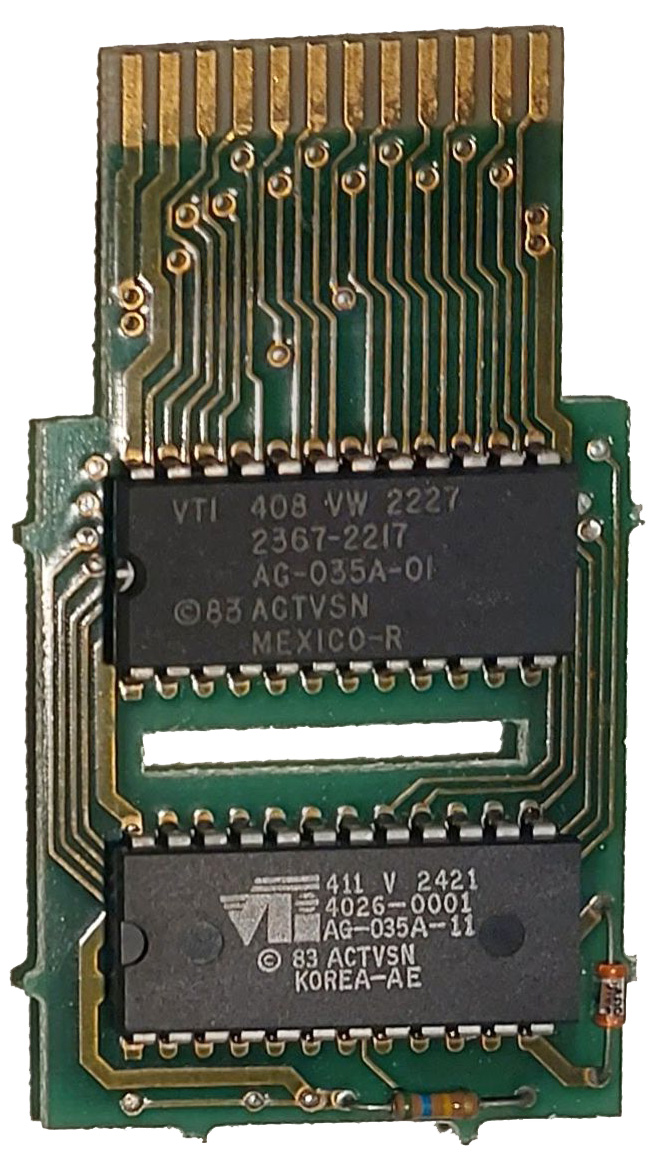
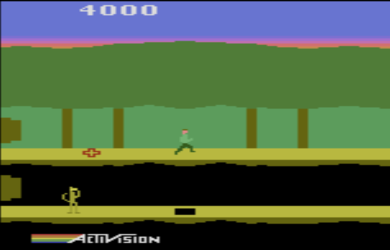
Pitfall II’s PCB - the DPC co-processor chip is visible. Crane designed the chip for the sequel after finding the base 2600 hardware insufficient for his musical and graphical ambitions.Pitfall II: Lost Caverns (1984) - the custom DPC chip enabled music playback and enhanced graphics impossible on standard 2600 silicon.
Racing the Beam: 4K ROM Constraints
The Atari 2600 used a MOS 6507 CPU (a cost-reduced 6502 variant),
128 bytes of RAM, and a 4-kilobyte ROM limit for cartridges.
The graphics chip - the TIA (Television Interface Adaptor) - had no frame buffer.
It generated video output one scanline at a time, directly synchronised with the CRT television’s
electron beam. This technique, popularised in Nick Montfort and Ian Bogost’s book
Racing the Beam, defined every creative constraint Crane worked within.
The TIA could display:
One background playfield (40 pixels wide, mirrored or copied)
Two player sprites (8 pixels wide)
Two missiles (1 pixel each)
One ball object (1–8 pixels)
Every frame of animation in every 2600 game had to be constructed from these five objects,
updated scanline by scanline in real-time 6507 code. Pitfall! achieved multi-coloured sprites
and non-flickering animation through extremely tight timing code that repositioned hardware
objects mid-scanline - a technique that required hand-optimised assembly with cycle-accurate timing.
In the GDC 2011 postmortem, Crane explained the central design constraint: the TIA was not built
for hardware side-scrolling. His solution was the discrete-screen world — jump to the next
screen, and the hardware redraws everything from scratch. The 255 screens were all generated from
an 8-bit counter. Players had no idea the screens were generated rather than stored.
Pitfall! notably used a flip-screen approach rather than true hardware side-scrolling
(the TIA was not designed for scrolling). Each screen change is a discrete jump to a new generated
screen, giving the illusion of a vast side-scrolling world despite the hardware limitation.
Sales, Awards, and Cultural Impact
Pitfall! sold 1 million copies within its first year (1982) and spent
64 consecutive weeks at the top of Billboard’s Top Video Games chart.
Approximately 3.5 million copies by 1984 on the Atari 2600; over
4 million copies of the Atari 2600 version by 2008; over
5 million copies across all versions by 1998.
It remains the second best-selling Atari 2600 game of all time, behind Pac-Man.
The game was ported to ColecoVision, Intellivision, Commodore 64, Apple II, MSX,
Atari 5200, Atari 8-bit computers, and others - with each platform receiving adaptations
of varying fidelity.
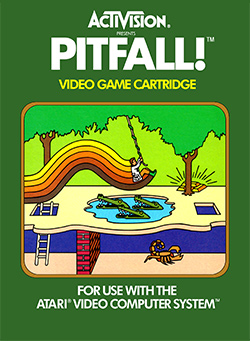
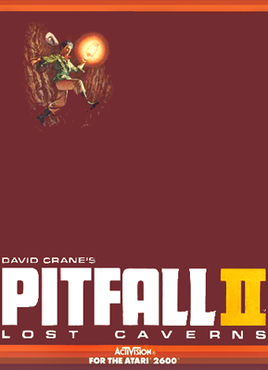
Pitfall! original box art, 1982. The jungle illustration would become one of the most recognisable images in early home gaming.Pitfall II: Lost Caverns box art, 1984. The DPC chip made it one of the most technically sophisticated 2600 cartridges ever produced.
David Crane’s GDC 2011 Classic Game Postmortem
Pitfall! Classic Game Postmortem - David Crane (GDC 2011)
The approximately 38-minute GDC 2011 presentation. Crane covers the running man origin, the 10-minute design document, procedural generation, the 4K ROM constraints, and the game’s legacy. Essential viewing for anyone interested in how great games are made under impossible constraints.
Crane has argued that the 4KB constraint was ultimately what made Pitfall! great. With unlimited
memory, he would have stored 255 individual screens manually. Instead, he had to find a procedural
algorithm — and that algorithm produced a more varied, more replayable world than any
hand-crafted level sequence could have been.