Long-form editorial on three titles that defined what US Gold published and why it mattered.
Commando
Arcade 1985C64 1985Amiga / ST / SpectrumCapcom
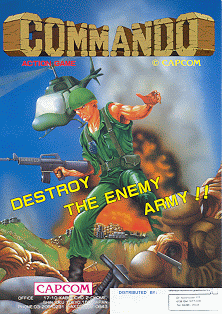
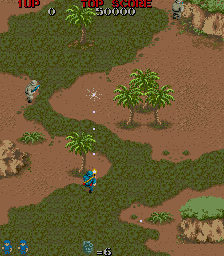
Commando arcade promotional flyer (Capcom, 1985). Sgt. Super Joe alone against the entire enemy army - the design brief in one image.Commando arcade gameplay. The vertical scroll is relentless - the player moves north at the game's pace, not their own.
One Gun Against the Entire Enemy Army
Commando is a 1985 Capcom arcade game. The player controls Sgt. Super Joe - alone,
lightly armed, advancing northward through an enemy-held jungle as waves of soldiers,
vehicles and fortifications try to stop him. The premise was not original. The execution was.
Released in arcades in 1985, Commando established a template for the vertically scrolling
military action game that Capcom and its competitors would iterate on for years.
Ghost 'n Goblins, released the same year, showed Capcom exploring adjacent genres.
But Commando's particular combination of relentless pressure, precise grenade throws and
punishing checkpoint design made it one of the most-played cabinets of 1985-86.
How a C64 Programmer Made the Music More Famous Than the Game
The C64 version published by Elite Systems in 1985 is where Commando's reputation in
Britain really starts. Not for the gameplay - though the conversion was capable - but for
the music. Rob Hubbard's SID soundtrack for Commando became one of the most downloaded
tunes in the history of the High Voltage SID Collection. It is still cited as one of the
finest examples of what the C64's sound hardware could do in the hands of a genuine composer.
The music mattered commercially too. In a crowded conversion market where multiple
titles competed for the same shelf space, Hubbard's soundtrack gave the Elite C64
version a distinguishing quality that reviewers noted repeatedly. Zzap!64 gave it
a Golden Joystick nomination specifically citing the music.
What You Actually Do - Two Minutes and a Grenade
Commando is simpler than it looks. The player moves Sgt. Joe upward at the game's
relentless pace - the scrolling cannot be stopped, only managed. A rifle fires straight
up. Grenades arc in a fixed parabola and must be aimed by positioning Joe relative to
the target. Enemy soldiers approach from all angles; some rush directly, others take
cover behind walls and trenches that require grenade lobbing to clear.
The loop is tight: move north, eliminate threats as fast as they appear, conserve grenades
for fortified positions, reach the checkpoint at the level end. There are four stages in the
original arcade; home conversions varied. The difficulty rises sharply and does not relent.
Players who survived to the later stages in 1985 were genuinely skilled.
A Genre Template in a Single Cabinet
Commando's design influence is hard to overstate in its immediate context. The vertical
shooter - a genre popularised by Xevious and Vanguard in the early 1980s - was primarily
a vehicle genre. Commando moved the format onto foot soldiers and gave the player a physically
vulnerable protagonist who could hide behind objects. That distinction, simple as it sounds,
created a different relationship with the screen.
SNK's Ikari Warriors (1986) and Mercs (1990, Capcom) both follow directly from the
Commando template. US Gold published Commando home versions after Elite's C64 release,
extending the game's European market reach through the late 1980s. The game is in the
catalogue with full platform listing.
Critics Who Heard the Music and Stayed for the Game
Zzap!64 gave the Elite C64 conversion a strong review in 1985, citing the arcade
accuracy and praising the Hubbard soundtrack at length. The Amiga version, arriving
later, received more measured coverage - by then the hardware had advanced beyond what
the conversion showed. Spectrum coverage was positive, noting the fast gameplay even
on the slower hardware.
The contemporary consensus was that Commando was an excellent arcade conversion in an
era when excellent arcade conversions were genuinely difficult to achieve. The C64 version
in particular holds its reputation. It is not as technically ambitious as some later
Capcom conversions but it understood what needed to survive the translation.
Still in the Reference Library
Commando is not a game that gets remade or reissued with any regularity. It does not
have the cultural profile of Street Fighter II or the cult status of Ghouls 'n Ghosts.
What it has is a clean, durable design - a game you can describe in two sentences and
explain to anyone. The Hubbard C64 soundtrack keeps it in circulation in SID music
communities thirty years later. For US Gold, it was part of a catalogue strategy rather
than a flagship statement. The flagship game came later.
"The SID chip had three voices and a noise channel, and within those constraints you could either play it safe or push it. Commando was me pushing it."
Rob Hubbard, composer of the C64 Commando soundtrack - multiple interviews, HVSC documentation
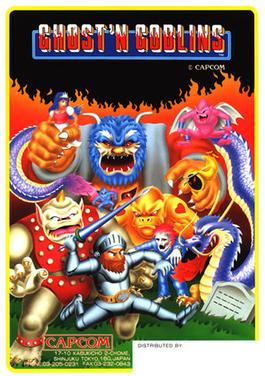
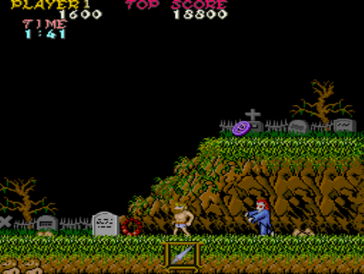
Ghosts 'n Goblins (1985) - Tokuro Fujiwara's first Arthur game and direct predecessor to Ghouls 'n Ghosts. US Gold published both series on European home computers.Ghosts 'n Goblins arcade gameplay. The graveyard opening stage - Arthur armoured, one hit from underpants, surrounded. Ghouls 'n Ghosts refined every element of this formula.
Arthur's Armour and the Game That Punished You Twice
Ghouls 'n Ghosts is a 1988 Capcom arcade game designed by Tokuro Fujiwara, the director
who had also made Ghost 'n Goblins three years earlier. Arthur, the armoured knight, must
fight through graveyards, castle battlements and hellish landscapes to rescue his beloved
from the demon king Loki. The setup is almost parodically simple. The game underneath is anything but.
The US Gold home computer versions - Amiga, Atari ST, C64 and ZX Spectrum - were
converted by Software Creations and published in 1989. The Amiga version is the most
technically accomplished of the home computer ports and the one that has shaped the game's
reputation in European gaming memory. See the catalogue page
for full platform and release details.
The Cruel Logic of Dying in Your Underwear
Arthur starts each life in full armour. One hit removes the armour. A second hit kills him
and resets to the last checkpoint - or, in the original arcade, costs another credit. The
armourless Arthur, reduced to his white underpants, is not just a visual gag. It is a
mechanical statement: the game is watching for the moment your confidence outstrips your competence.
The ground drops golden armour containers semi-randomly. Picking one up restores the armour.
There is also a golden armour variant unlocked by specific play conditions that gives Arthur
a more powerful weapon set. Getting the golden armour is not incidental - in the arcade version
it is required to progress past a certain point. Completing the game once only reveals an
ending telling you to play again. The true ending requires a complete second run.
Eight Buttons' Worth of Pressure
Ghouls 'n Ghosts gives Arthur a lance or other weapon to throw horizontally, and the ability
to throw diagonally upward and downward while jumping. The throwing arc is fixed - you cannot
adjust it mid-throw. Enemy patterns are memorised rather than read in real time. The game
is a memory test dressed as an action game.
Fujiwara understood pacing in a way that less skilled designers did not. The graveyard
opening level is demanding but learnable. The later levels front-load enemies in tight
spaces that require specific approaches. The final approach to Loki requires both knowledge
and execution. The home computer versions preserve this structure, though the C64 and
Spectrum versions compress the level geometry to fit their hardware constraints.
What Software Creations Did With Capcom's Blueprint
Software Creations was a Manchester-based studio that handled a significant portion of US
Gold's Capcom conversion work. For Ghouls 'n Ghosts, they managed a creditable Amiga
conversion that preserved the essential difficulty and atmosphere of the arcade original.
The scrolling is smooth on the Amiga; the sprite work, while smaller than the arcade,
is recognisably correct.
The C64 version made harder compromises. Colour limitations on the C64 meant some of
the atmospheric background variation was reduced. The gameplay remained faithful, which
was the right priority. A Ghouls 'n Ghosts that looked like the arcade but played
differently would have been the wrong tradeoff.
"Ghosts 'n Goblins and Ghouls 'n Ghosts - I wanted to make games where you feel constant pressure. The player should never feel safe."
Tokuro Fujiwara, designer at Capcom - various Japanese gaming press interviews, via shmuplations.com
The Press Called It Savage, Then Called It Great
Contemporary reviews of the Amiga version were positive overall but consistent in noting
the difficulty. CU Amiga and Amiga Format both highlighted the punishing two-life-to-death
mechanic and the checkpoint system. The consensus was that the game rewarded persistence
and was better than it first appeared - the standard verdict on games that are genuinely
hard rather than merely unfair.
Retrospective coverage has been kinder. Ghouls 'n Ghosts is consistently cited as one
of the stronger Capcom conversion projects in the US Gold catalogue - evidence that the
conversion pipeline they had established with Software Creations could produce quality
work under commercial deadlines.
Harder to Find, Better Than Remembered
Ghouls 'n Ghosts on home computers is not widely discussed today in the way the arcade
version is. The SNES version, published by Capcom directly in Japan, has a higher profile.
The US Gold home computer ports occupy a different position in the history: evidence of
what British and European players were playing on their home hardware in 1989-90, and
of how the conversion industry had matured since the more uneven early-1980s output.
The game is in the catalogue with full platform details.
The documentary context is covered on the history page.
Gauntlet
Arcade 1985C64 1986Amiga / ST / SpectrumGolden Joystick 1986
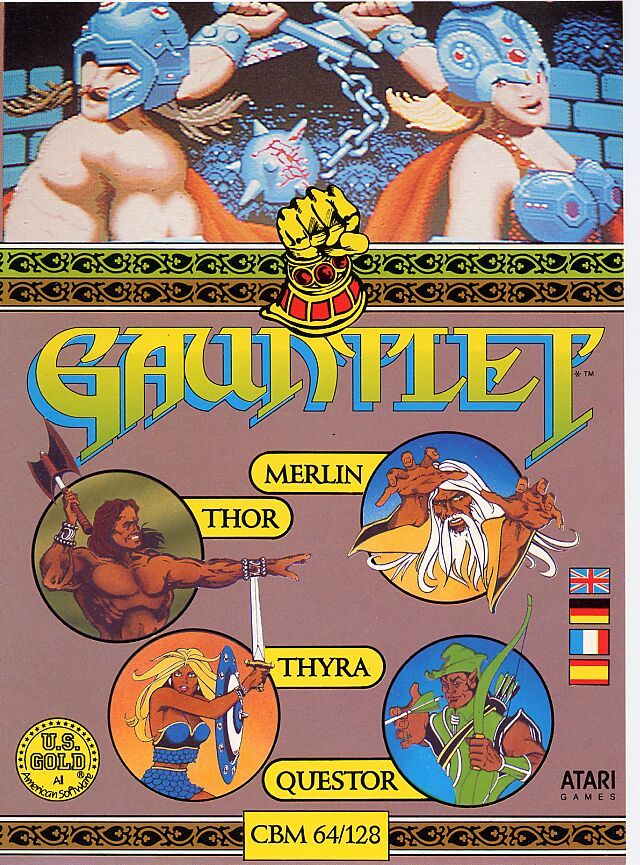
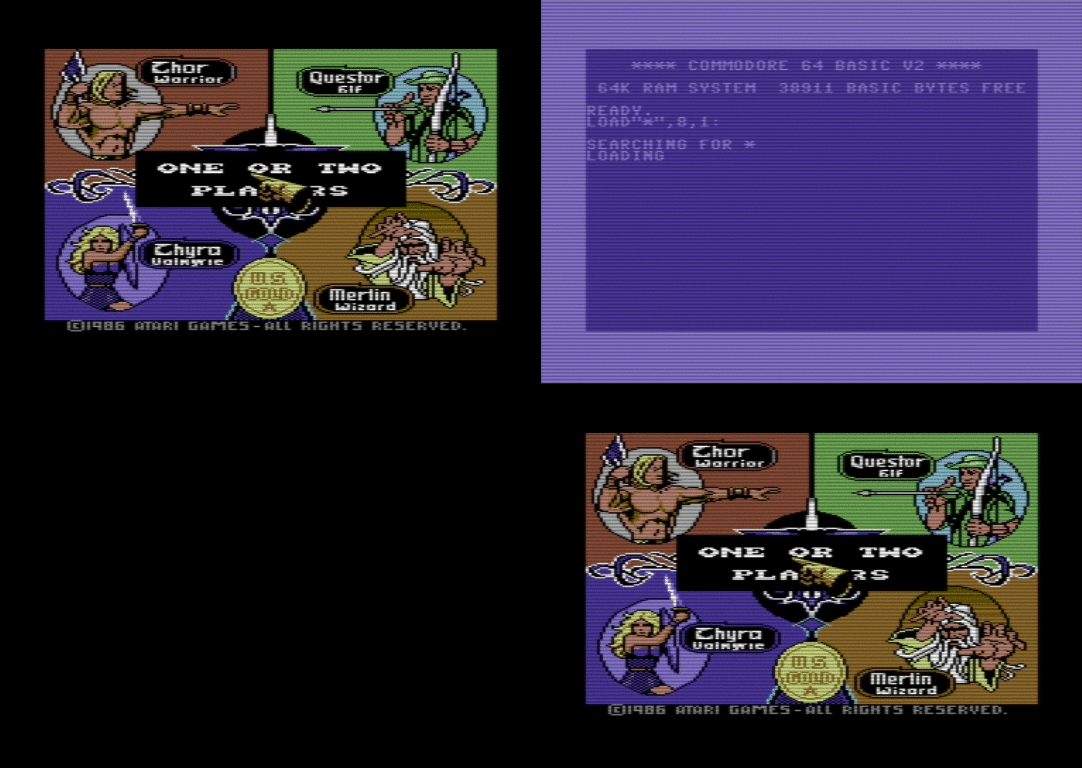
Gauntlet C64/128 release, US Gold / Atari Games. The UK box featured all four character classes - Thor, Merlin, Thyra, Questor - and the Atari Games logo alongside the US Gold badge.Gauntlet arcade gameplay. Up to four players simultaneously, colour-coded, fighting through procedurally arranged dungeon rooms under constant enemy pressure.The overhead dungeon view that became Gauntlet's visual signature. Enemies spawn from generators marked on screen - destroying the generator stops the flow.
A Queue for Four Credits and a Cabinet That Never Emptied
Gauntlet is a 1985 Atari Games arcade release. Four players - the Warrior, the Valkyrie,
the Wizard and the Elf - move simultaneously through dungeon mazes, fighting ghosts, grunts,
demons and the things that keep spawning them. Health drains constantly. Standing still is
a decision to die slightly more slowly. The arcade cabinet had four simultaneous joystick
positions and took four sets of coins per play session.
US Gold acquired the European publishing rights for the home computer conversions. The
Gremlin Graphics conversion team built the C64, Amiga, Atari ST and ZX Spectrum versions.
In the UK, the game won the British Golden Joystick Award for Game of the Year in 1986 -
a remarkable result for an arcade conversion in a year of strong competition.
Four Players, One Machine, and the Problem Gremlin Had to Solve
The arcade Gauntlet was designed around simultaneous four-player play - not two players
alternating, not co-op in the sense of taking turns, but four people on screen at once,
competing for food pickups and arguing about who should open the door. Home computers
had one joystick port as standard. Two was unusual. Four was architecturally impossible
without third-party hardware.
Gremlin Graphics adapted the design for single-player and two-player configurations.
The Amiga conversion maintained the dungeon structure and the health-drain mechanic.
What it lost was the specific chaos of four simultaneous players - the food theft,
the accidental blocking, the moment someone opened a door into a ghost room and blamed
everyone else. The solo experience is a different game, still good, but different in kind.
Keys, Food, Generators - What You Actually Do
Each Gauntlet dungeon level contains a mix of objectives: find the exit, collect food
to maintain health, gather treasure for points, retrieve keys to unlock doors, and optionally
destroy enemy generators to stop the spawn rate. The balance between these tasks, under
time pressure imposed by draining health, defines the game.
Projectile weapons fire in the direction of movement. Melee attacks are available but
dangerous. Each character class has different health pools, attack speeds and movement
rates. Thor hits hard and moves slowly. The Elf moves fast but is fragile. These asymmetries
matter in the arcade with four players; they matter differently in single-player where
character choice becomes a strategic decision made at the start.
What Gremlin Built and What the Reviewers Said About It
The Amiga version of Gauntlet, converted by Gremlin Graphics for US Gold, was reviewed
positively across the UK games press. CU Amiga and Amiga Format both noted that the
dungeon atmosphere had survived the translation - the darkness, the generator-spawn
pressure, the urgency of the health counter. The reduced player count was acknowledged
without being treated as a fatal flaw.
The C64 version received strong coverage in Zzap!64, where the conversion was praised
for its arcade accuracy within the hardware limitations. The Spectrum version attracted
some criticism for colour handling but was considered a faithful conversion of the gameplay
structure. All versions shared the characteristic that made Gauntlet compelling: the game
did not pause to let the player think.
"Gauntlet was the game that proved you could put four joysticks on one cabinet and people would use all four at the same time. That had never worked before."
Ed Logg, lead designer at Atari Games - various retrospective interviews on Gauntlet's development, 2010s
The Golden Joystick and What It Meant for US Gold
Winning the 1986 British Golden Joystick Award for Game of the Year was commercially
significant for US Gold. The award was reader-voted - it reflected what British players
were actually playing and rating, not editorial selection. A Golden Joystick win in that
era appeared on box art, in advertising and in retail display material. It was the closest
thing British home computing had to a mainstream quality signal.
For US Gold, the award validated the Gremlin conversion and the licensing strategy that
had brought Atari Games' catalogue to European home computers. Gauntlet's success
strengthened the argument for acquiring further arcade licences - which led directly
to the Capcom deal two years later.
The Foundation That Street Fighter II Would Complete
Gauntlet's place in the US Gold story is as the first proof of a publishing model. Before
Gauntlet, US Gold had produced competent catalogue titles. Gauntlet demonstrated that a
major arcade licence, converted to a high standard by a capable third-party studio, could
win the biggest UK award and sustain commercial momentum for two or more years. That
demonstration shaped everything that followed: the Capcom deal, the Ghouls 'n Ghosts and
Strider conversions, and ultimately the moment in 1992 when Street Fighter II made every
other home computer release look small.
The game is in the catalogue with full platform listing.
Gauntlet arcade longplay (1985). The original four-player Atari Games cabinet that US Gold licensed for European home computer release.
Street Fighter II
Arcade 1991Amiga 1992SNES 1992Atari ST / DOSDefining Title
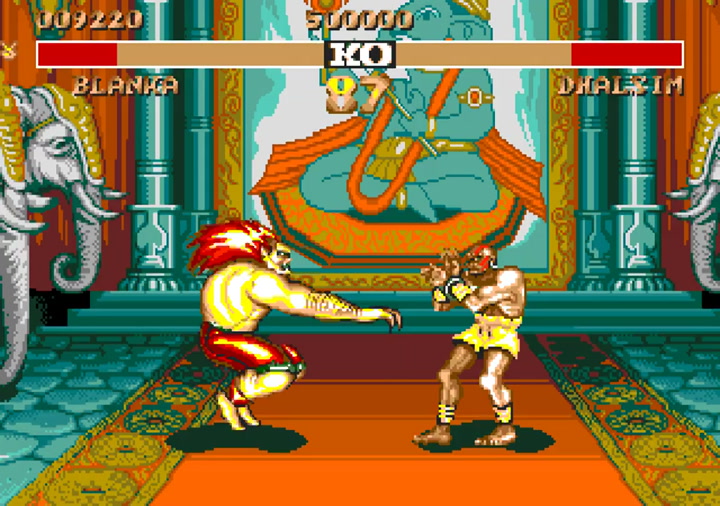
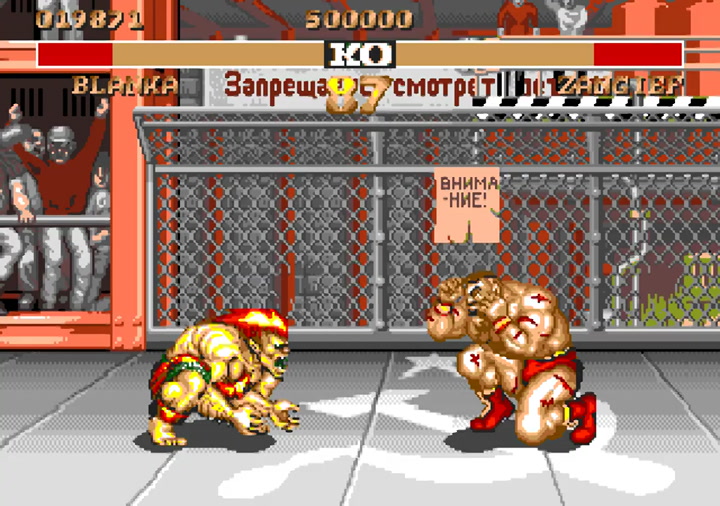
Street Fighter II Amiga version, 1992. Tiertex conversion. The combat fundamentals survived the hardware translation.Amiga version fight. The six-button arcade layout was adapted for joystick play with modifier inputs.Atari ST release. The Tiertex conversion ran on ST hardware comparably to the Amiga port.Title or character screen from the US Gold Amiga release. The presentation was intact if the animation was reduced.
The Game That Made a Queue Outside Boots
Street Fighter II: The World Warrior arrived in Capcom's arcades in 1991. By the time
US Gold published the European Amiga version in 1992, the game had already moved over
6 million SNES cartridges globally - the fastest-selling console game in history at
that point. British players who had seen the SNES version at a friend's house or in
a magazine preview knew exactly what they were buying. The pre-order queues outside
game shops overnight were unlike anything British home computer retail had experienced.
US Gold had secured European home computer rights to Street Fighter II in 1991.
The SNES European publication was also US Gold's responsibility. In market terms,
US Gold owned the Street Fighter II moment in Britain in a way that few publishers
have ever owned a single title. See the catalogue and
history page for context.
Inventing the One-on-One Fighting Game as a Commercial Genre
Street Fighter II did not invent the one-on-one fighting game - Data East's Karate
Champ (1984) and the original Street Fighter (1987) predate it. What Street Fighter II
invented was the one-on-one fighting game as a mass-market commercial phenomenon.
The design brought together elements that had existed separately but never combined
at this quality level: a roster of eight visually distinct fighters with genuinely
different move sets; special moves requiring input sequences (not just button presses);
a two-player competitive mode balanced well enough that high-level play emerged naturally;
and character sprites large enough to read as individual people rather than icons.
"Street Fighter II may look like a sequel to Street Fighter, but we actually challenged ourselves to create a new genre."
Yoshiki Okamoto, producer at Capcom - Gamest magazine, 1991, via shmuplations.com
What Tiertex Had to Do and What They Left Out
Tiertex Design Studios built the Amiga, Atari ST and DOS versions under commercial
and technical pressure. The SNES had custom graphics hardware running a version of
Street Fighter II that Capcom had developed specifically for that platform. The Amiga
and Atari ST had generalist hardware from the mid-1980s, designed before Street Fighter
II existed as a concept.
The Tiertex conversion launched with a reduced character roster compared to the arcade
original. The SNES version included all eight fighters plus the four boss characters.
The Amiga version launched with eight playable characters but the animation was compressed:
fewer frames per action, reduced idle animation, cut-down hit and win sequences. The
game played. The game was Street Fighter II. But the craft detail that Capcom's own
SNES team had preserved was not there.
Character art panel from the Atari ST version. The visual design translated cleanly even where the animation was compressed.
Why It Still Sold Everything in the Shop
The commercial result was unambiguous. Street Fighter II on Amiga was the fastest-selling
home computer title in the UK in 1992. The pre-orders were fulfilled; the follow-up
batches sold out in the first week. Players who had never considered paying fifteen
pounds for a game paid it for this one.
The critics who noted the animation reduction were correct. They were also writing
for players who had a point of comparison - who had seen the SNES version or knew
the arcade. The majority of buyers were playing Street Fighter II on home hardware
for the first time, at full price, and found it delivered what mattered: the characters,
the moves, the two-player competition. For that audience, the Tiertex version was
exactly what they needed.
The Blueprint That Produced a Decade of Imitators
Street Fighter II's influence on games design is structural rather than cosmetic.
The fighting game genre it established - roster of distinct characters, special move
inputs, two-player competitive balance - became the template for Mortal Kombat (1992),
Killer Instinct (1994), Virtua Fighter (1993) and dozens of lesser titles. Capcom
itself produced Super Street Fighter II (1993), Street Fighter Alpha (1995) and
Street Fighter III (1997) in direct succession.
For US Gold, Street Fighter II was both the peak and a preview of difficulty to come.
The market for home computer software was contracting as console hardware improved.
The Amiga and Atari ST versions that had made Street Fighter II a publishing success
would be the last generation of home computer conversions for which there was a large,
enthusiastic buying public.
The full company history is on the history page. The game
is in the catalogue. The people page
covers the Tiertex team and their work across the Capcom catalogue.
Street Fighter II Amiga longplay (1992). The Tiertex conversion - all eight fighters, the reduced animation, and the competition mode that British players queued overnight to play.
The Street Fighter II Moment
Type USGOLD anywhere on this site to unlock this. 1992. Pre-order queues. British gaming's first midnight launch. You were there.