The founders, the converters, and the studio that outlasted the company.
Founders and Key Contributors
US Gold's history is inseparable from the people who built it. Geoff and Anne Brown created the
structural conditions - the distribution network, the licensing relationships, the Birmingham
operation - that made everything else possible. The Tiertex team converted the Capcom catalogue
into something playable on machines it was never designed for.
Geoff Brown
Co-founder and Managing Director, 1984-1996
Geoff Brown co-founded US Gold in Birmingham in 1984 alongside his wife Anne. He ran the
company as Managing Director throughout its independent life and was the driving force behind
its licensing strategy. The decision to pursue American software licences while competitors
focused on domestic development was Brown's call, and it defined the company's first decade.
Brown was also the architect of the Capcom relationship. The 1988 deal - which brought
Bionic Commando, Ghouls 'n Ghosts, Strider and the rest of the Capcom arcade catalogue
to European home computers - was negotiated during a period when Capcom had no established
European publishing infrastructure. US Gold's combination of distribution reach and retail
relationships made it the logical partner.
Brown managed the CentreGold plc parent company through to the 1996 Eidos acquisition.
He is documented in Kim Justice's 2016 US Gold documentary, which remains the best
primary source on his account of the company's history. See the history page
for the full company narrative.
Anne Brown
Co-founder, 1984-1996
Anne Brown co-founded US Gold with her husband Geoff in Witton, Birmingham in 1984.
The company ran in parallel with CentreSoft, the distribution business the Browns had
already established, and Anne's involvement in the operational side of both companies
gave US Gold its structural backbone.
The decision to run a publishing house and a distribution company simultaneously - with
the same principals controlling both - gave US Gold advantages in retail placement and
cash flow that purely independent publishers could not match. Anne Brown's contribution
to building and maintaining that structure is an underappreciated part of the company's success.
Tiertex Design Studios
Key converter, 1989-1993
Tiertex Design Studios was the Manchester-based development house responsible for some
of the most important and most criticised conversions in US Gold's catalogue. Their work
on the Capcom titles for Amiga, Atari ST and DOS - including Street Fighter II in 1992 -
defined how millions of European players first experienced those games.
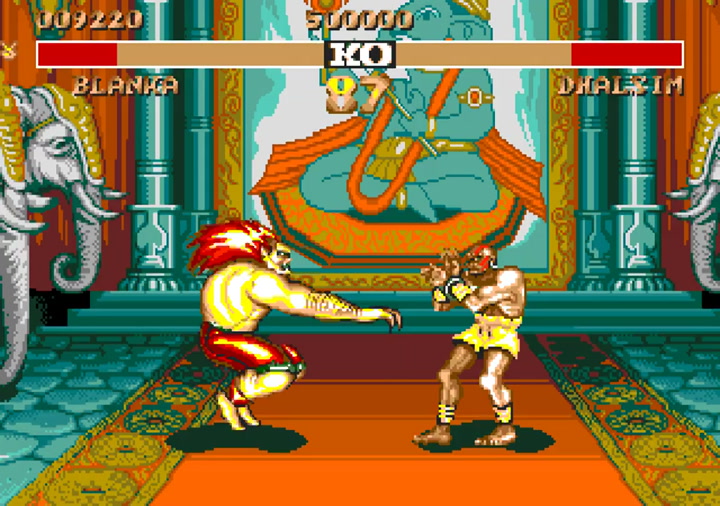
The Street Fighter II conversion for Amiga and Atari ST was Tiertex's defining project.
Commercially it was a runaway success. Critically it was more complicated: Amiga Power
and other period magazines noted missing playable characters and reduced animation compared
to the SNES version US Gold had also published in Europe. The Tiertex version had fewer
characters and shorter animation sequences than Capcom's own SNES development.
Tiertex's conversion approach was constrained by hardware - the Amiga and Atari ST
had a fraction of the SNES's dedicated graphics bandwidth - but the team was also
working to a commercial deadline that prioritised getting the product to market
alongside the SNES release. The result was a game that sold in extraordinary numbers
while generating genuine debate about what a conversion owed to the source material.
Read the full analysis on the flagship page.