The Defining Games
Two games that show exactly what Treasure was and why it mattered: the polarity game and the debut that announced the studio to the world.
Ikaruga
2001 arcade (Naomi) / 2003 GameCube - designed and programmed by Hiroshi Iuchi
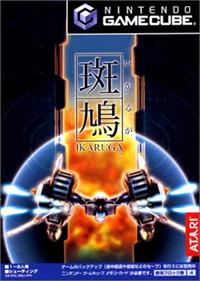
Ikaruga is a vertical shoot-'em-up in five chapters. The player's ship can switch between two polarities at will - black or white. Bullets of your current polarity are absorbed and build a special weapon; bullets of the opposite polarity deal damage. Each enemy has a fixed polarity; deal double damage to your opposite colour. These three rules constitute the entire game.
It reached Japanese arcades on December 20, 2001 on Sega Naomi hardware. The GameCube version released January 16, 2003 in Japan, June 27, 2003 in Europe, and September 23, 2003 in North America via Atari. Steam followed in February 2014; Nintendo Switch in May 2018. It is one of the most formally precise games ever made - the kind of game that can be explained in two sentences but takes months to genuinely understand.
The Rule That Grew From Silhouette Mirage
Hiroshi Iuchi had been working with binary attribute systems since Silhouette Mirage (Saturn, 1997), a game where player characters had two distinct attributes - Silhouette and Mirage - that determined which attacks could harm them and which weapons would work against enemies. That game's attribute system was complex by design, with multiple categories layered on top of each other. Ikaruga was a deliberate reduction: one attribute, two states, three mechanical consequences.
By 2001, Iuchi had been at Treasure for four years, having directed and programmed Radiant Silvergun (Saturn, 1998) in the intervening period. He proposed the polarity-switching shooter to Treasure president Masato Maegawa, and designed and programmed it largely as a solo project. The arcade hardware ran on Naomi, sharing its architecture with the Dreamcast, which gave the eventual GameCube port a direct technical foundation. The development was unusually focused: one designer, one concept, no feature expansion.
"The concept came from wanting players to feel like they could become part of the bullet patterns. Absorbing fire is not just a defensive move - it is a way of reading the enemy's rhythm and becoming synchronised with it."
Hiroshi Iuchi, GDC 2009 "The Making of Ikaruga"
Eight Seconds to Understand, A Lifetime to Chain
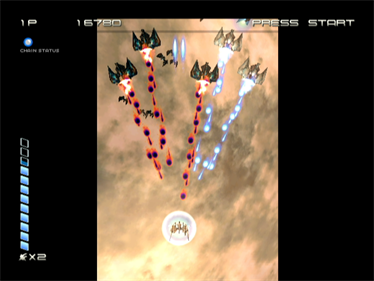
The mechanic is learnable in the first level: switch polarity, absorb same-colour bullets, shoot opposite-colour enemies for double damage. The depth emerges through the chain scoring system. To build a chain, destroy three consecutive enemies of the same polarity in groups of three. Maintain that sequence without breaking it across an entire chapter to earn maximum chain points. Achieve it across all five chapters to reach S-rank.
S-rank transforms the game entirely. Every enemy is fixed in position and polarity; every bullet pattern is predetermined. An S-rank run is not improvised - it is an exact sequence of polarity switches memorised in advance, then executed under the pressure of live bullet patterns. The game has a finite optimal path through every chapter, and finding it takes months. Players who can complete a full S-rank run without dying have memorised the game as thoroughly as a chess opening, except the "opening" runs for approximately twenty-five minutes.
In two-player co-op, the game reveals itself as something closer to a puzzle. Optimal play requires both players to coordinate their polarity switches: one absorbs while the other attacks, covering both polarities simultaneously. A single screen can be cleared with near-perfect efficiency if both players synchronise. The co-op mode suggests the game's underlying nature - beneath the bullet patterns is a game about coordination and shared pattern recognition.
One Switch, Three Layers of Consequence
Ikaruga's design economy is its primary technical achievement: one additional input (the polarity switch button) produces three distinct mechanical effects - absorption, damage doubling, and chain scoring. These effects connect to each other. Absorption builds the homing laser charge; the chain system depends on polarity management; double damage rewards reading the screen correctly. Nothing is wasted and nothing is decorative.
The visual design enforces this economy. Enemies and bullets are always black or white; backgrounds are intricate but neutral, designed to recede rather than compete. The ship's colour changes visibly when you switch polarity. At any moment, the player knows everything they need to know about the game state - there is no hidden information, no random element, no luck. The game's extreme difficulty is a function of its complete legibility: you can always see exactly what is about to kill you.
Iuchi composed the music himself. Each chapter has its own sonic identity, with the score shifting register as foreground complexity rises. The audio and visual design work together as a single system - the spare palette, the composed score, the clean information design all serve the same goal of sustaining concentration through demanding play.
Edge Gave It Nine Out of Ten
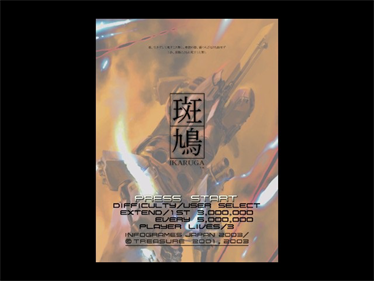
Edge magazine awarded the GameCube version 9/10 at Western release, calling it one of the finest shoot-'em-ups ever made. Famitsu scored it highly at Japanese GameCube launch. The critical consensus across all territories was consistent: the mechanic was elegant, the difficulty curve was severe, and players who persisted consistently ranked it among the finest games on any platform they had encountered it on.
The game did not sell in large numbers. Atari's North American distribution for the GameCube version was limited, and the GameCube's overall market position in 2003 restricted reach. The audience who found it was enthusiastic beyond proportion to its commercial footprint. Import communities had already covered the Japanese release; dedicated players had documented chain strategies before the Western version shipped.
The Steam release in 2014 recirculated the critical conversation to an audience unfamiliar with the GameCube era. The Nintendo Switch release in 2018 added portable play, which suited the game's five-chapter structure for short sessions. Across all platforms and re-releases, the critical standing has only strengthened. It is regularly cited alongside Radiant Silvergun, DoDonPachi, and Battle Garegga as one of the shoot-'em-up genre's formal peaks.
The Absorption Mechanic Nobody Has Improved On
Ikaruga's influence on subsequent shoot-'em-up design has been measurable and ongoing. The absorption mechanic - turning incoming fire into a resource rather than a hazard - has appeared in many games in the years since. None have matched the integration of Ikaruga's implementation, where absorption works simultaneously as defence, resource generation, and scoring multiplier, all from the same input.
The game represents the endpoint of Iuchi's three-game binary-attribute arc: Silhouette Mirage (1997) introduced attribute switching as a weapon choice; Radiant Silvergun (1998) replaced it with a weapon combination system built on shot types; Ikaruga distilled the entire lineage to a single binary input. The three games form one of the most coherent design progressions in the genre's history - and the arc ended exactly where it needed to. Iuchi has not attempted a fourth iteration.
The chain scoring system has influenced score-attack design in subsequent shooters. The two-player co-op's coordinated polarity mechanic has become a reference point for cooperative shmup design. For a game made by a solo designer on arcade hardware in 2001, the influence has been disproportionate to its commercial scale.
See the full catalogue entry and platform availability at Games. Read about Iuchi's design trajectory on the People page. See the game in motion on the Videos page.
Gunstar Heroes
1993 Mega Drive - directed by Masato Maegawa - the game that announced Treasure to the world
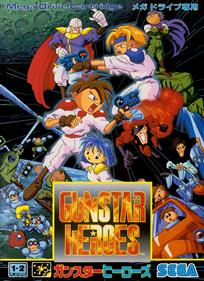
Gunstar Heroes was Treasure's debut - the first game from a team that had left Konami specifically to make this kind of action game. It arrived in September 1993 fully formed: a two-player run-and-gun of kinetic energy and technical ambition, with a combinable weapon system, physics-driven bosses, and visual effects the Mega Drive was not marketed as capable of producing. Nothing else on the platform played like it. Nothing else looked like it either.
Published by Sega in Japan and North America, and December 1993 in Europe, the game sold modestly but was received by critics and the growing import community as an immediate achievement. It established the template Treasure would use across the next decade: dense action, expressive boss design, tight systems that reward mastery, and a refusal to pad the experience with content that did not earn its place.
Fourteen Months After Leaving Konami
Masato Maegawa led the founding group out of Konami in October 1992. The team had worked on action games there, contributing to titles in the Contra/Probotector series, and they left not because of financial disagreement but because of creative constraint. The games they wanted to make required decisions that committee approval and conservative release schedules would not permit. Treasure was founded to make those decisions autonomously.
Gunstar Heroes was the immediate product of that autonomy. Maegawa directed the project; the team of roughly eight people built it in approximately fourteen months. Sega came on board as publisher, an arrangement that gave Treasure hardware access and distribution while maintaining creative control - a partnership that would produce several of Treasure's best early titles. The development moved quickly: the team knew exactly what they wanted to make and how to make it, having spent years working in the genre they were now designing for without restriction.
"We had been making action games at Konami, and we had a very clear idea of what was possible on the hardware. When we founded Treasure, we finally had the chance to build the game we had been imagining. Gunstar Heroes was the answer to the question we had been asking ourselves for years."
Masato Maegawa, Sega Magazine interview (1994)
Point, Shoot, Combine, Repeat at Sixty Frames
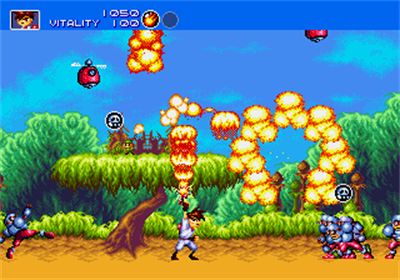
The weapon system is the game's design engine. Four base weapon types - Homing, Lightning, Force, and Chaser - can be equipped one in each hand. Equip the same type in both to get the Fixed variant, maximum power in a focused pattern. Combine two different types for a Combined variant, lower power but a unique behaviour. The sixteen possible combinations are not equal: some are efficient for particular enemy types, some are tactically flexible, and some are powerful enough to trivialise sections. Finding your preferred loadout is part of the game.
The bosses are the showpiece. Each is a physics problem: limbs detach and reattach, forms transform at health thresholds, attack patterns change with each transformation. The player must read the pattern, adapt to the new form, and continue under fire throughout. The mid-game encounter Seven Force has seven distinct forms - seven attack patterns, seven visual states, triggered sequentially as health falls. The game does not pause between forms; you adapt at pace. This density of boss design was technically demanding for a 1993 Mega Drive title, and it remains a high-water mark for the run-and-gun genre's boss craft.
Two-player co-op adds a cooperative dimension that most run-and-guns of the period did not: the two characters fight independently, with each player managing their own weapon loadout, positioning, and boss targeting. The screen is dense enough that effective co-op requires communication. Unlike games that split the screen or reduce difficulty for two players, Gunstar Heroes runs the same encounters at the same speed for two players - which either makes things easier or twice as chaotic, depending on coordination.
Scaling Sprites the Mega Drive Was Not Supposed to Scale
The Mega Drive's hardware did not include dedicated sprite scaling or rotation capabilities. The visual effects in Gunstar Heroes - bosses growing and shrinking as health changed, the slot machine sequence, the geometric transformations of certain boss forms - were achieved through careful programming of the platform's tile-based rendering system. The team's background in Konami action game development gave them deep knowledge of the hardware's actual capabilities rather than its documented specifications.
The game ran at sixty frames per second through the most crowded screen states. Boss encounters that filled the screen with moving sprites, bullet patterns, and environmental effects maintained framerate without compromise. This was not a given for Mega Drive games; many action titles of the period showed slowdown under similar loads. The team's performance work was precise enough to approach the hardware ceiling without exceeding it.
Thirty-Three From Famitsu and Full Marks From the West
Famitsu awarded Gunstar Heroes 33/40 at Japanese launch - a strong score for a debut title from an unknown studio. Western coverage was equally positive: Electronic Gaming Monthly gave high marks and specifically noted the game's technical accomplishments on Mega Drive hardware. For a first game from a team with no prior commercial track record, the critical reception was unusually strong.
The commercial outcome was modest. Treasure was a boutique studio by design, and Gunstar Heroes sold at the volume appropriate to its distribution and marketing. But the critical record established the studio's reputation in Japan and among Western import communities immediately. Every subsequent Treasure game was reviewed with the understanding that this team was capable of extraordinary things - a reputation built in a single release.
The First Game Treasure Made Is Still the Best Introduction
Gunstar Heroes defined the vocabulary Treasure would use for the next decade. The dense boss encounters with multiple forms, the combinable weapon systems, the two-player co-op as a feature rather than an afterthought, the commitment to technical performance and the refusal to pad with filler - all of these returned across subsequent titles in different forms. Treasure never made a direct sequel to Gunstar Heroes; the studio's principle was that each game would be different. But the design principles of the debut ran through every game that followed.
The game is available on Steam via Sega Genesis Classics and on Nintendo Switch Online via the Mega Drive library - a new generation of players encounters it regularly, and it continues to hold its value. Speedrun communities have documented the weapon combination mathematics exhaustively. Boss design references in contemporary action game development frequently cite Seven Force as a model for escalating boss encounters.
The full catalogue, including the 2007 Virtual Console re-release and the complete platform history, is at the Games page. The team behind the studio - Maegawa, the founding programmers, and the composers who defined the Treasure sound - are covered on the People page.