Editorial dives into four defining Team17 games. Each article covers six areas: hook, development, gameplay, technical achievement, reception, and legacy.
Alien Breed is where Team17 made its argument. Released in 1991 as the studio's commercial
debut, it arrived as a top-down corridor shooter designed to do one thing with conviction:
make the player feel hunted. Inspired by James Cameron's Aliens, it brought to
the Amiga platform something most contemporary software failed to achieve - a consistent
atmosphere maintained across an entire game campaign. This was not a tech demo or a
genre exercise. It was a designed experience with a specific mood, and for a first
commercial game from a small Wakefield team in 1991, that was unusual.
Wakefield's First Strike
Team17 was incorporated on 7 December 1990 from the merger of 17-Bit Software
and development collective Team 7. 17-Bit had been run by Martyn Brown and Andreas
Tadic as a Wakefield-based public domain library; Team 7 brought the programming
and development capability. The merged studio's first commercial release had to prove
the merger was worth making.
Alien Breed was built in-house: Rico Holmes handled art and programming, Allister
Brimble composed the soundtrack, and Brown shaped the production philosophy. The
concept drew on the team's shared enthusiasm for corridor shooters like Gauntlet
and their love of the Aliens franchise. The brief was to make something polished
enough to stand out in a market full of rushed commodity software. Brown's guiding
principle was what the team called the "Seal of Quality" — a standard every
Team17 release would meet before shipping.
"We wanted every game with a Team17 seal on it to clear a bar. We weren't interested in
shipping something just to get something out. Alien Breed was our answer to what that
bar looked like."
Top-down corridor gameplay — the tile-based level design gives each room a functional menace
The loop is elegant in its pressure: navigate dark facility corridors, collect keycards
to open doors, manage ammunition, buy upgrades at terminals, and reach the exit. The
terminal system gives the game an economic tension that most contemporaries lacked.
At each purchase point you choose between survival now (ammo, health) and progression
later (the right key to reach the exit). Credits are never plentiful enough to cover
everything, so every purchase is a real decision.
The aliens come in escalating numbers. The corridors ensure you can rarely clear a safe
zone — there is always another spawn point around the next bend. As levels progress,
the alien count rises and the available exit routes narrow. The difficulty curve is steep
but fair: if you die, it is because of a decision made under pressure, not because the
game cheated.
Four Channels, Maximum Menace
The Amiga's Paula chip provided four independent audio channels. Allister Brimble's
OctaMED compositions built atmosphere by layering percussion, bass, and melodic
elements in ways that pushed the four-channel ceiling. The soundtrack does not try
to be music you would listen to separately - it is functional atmosphere, calibrated
to keep the player in a state of pressure. The tile-based level rendering was fast
and consistent throughout the campaign, with no slowdown in the most crowded rooms.
For OCS/ECS hardware (the Amiga 500 and 600), this was technically confident work.
The art direction by Rico Holmes established a visual grammar of rust-coloured
corridors, alien spawn indicators, and consistent lighting cues. This grammar is
applied without variation across the full game. Coherence of that kind —
where every room feels like it belongs to the same world — was not the norm
in Amiga commercial games of 1991.
Noticed by the Right People
Amiga Power reviewed Alien Breed as a notable debut, praising the atmospheric
corridor design and the audio as stand-out achievements. The game sold well
enough in its initial release window to confirm that Team17's quality standard
had commercial value. By 1993, Team17 would claim approximately 90% of their
releases had reached number one in the Amiga charts - a statistic documented
by gamepressure.com's "Masters of Amiga" editorial. Alien Breed was the
foundation that record was built on.
Eight Games Across Two Decades
The franchise moved quickly after the 1991 original. Alien Breed Special Edition 92
(1992) enhanced the original with additional levels and was distributed via coverdisk.
Alien Breed II: The Horror Continues (1993) expanded the level count with AGA-enhanced
versions for the Amiga 1200. Alien Breed: Tower Assault (1994) introduced non-linear
level structure. The 3D entries — Alien Breed 3D (1995) and Alien Breed 3D II:
The Killing Grounds (1996) — used AGA hardware to move the franchise into
first-person territory as a direct response to Doom.
In 2009-2010, Team17 released an episodic HD remake trilogy for Xbox Live Arcade
and iOS, bringing the franchise to an audience that had never seen the Amiga original.
The full series — eight entries across three decades — is documented at
the catalogue. For Brimble's original soundtracks,
see the music page.
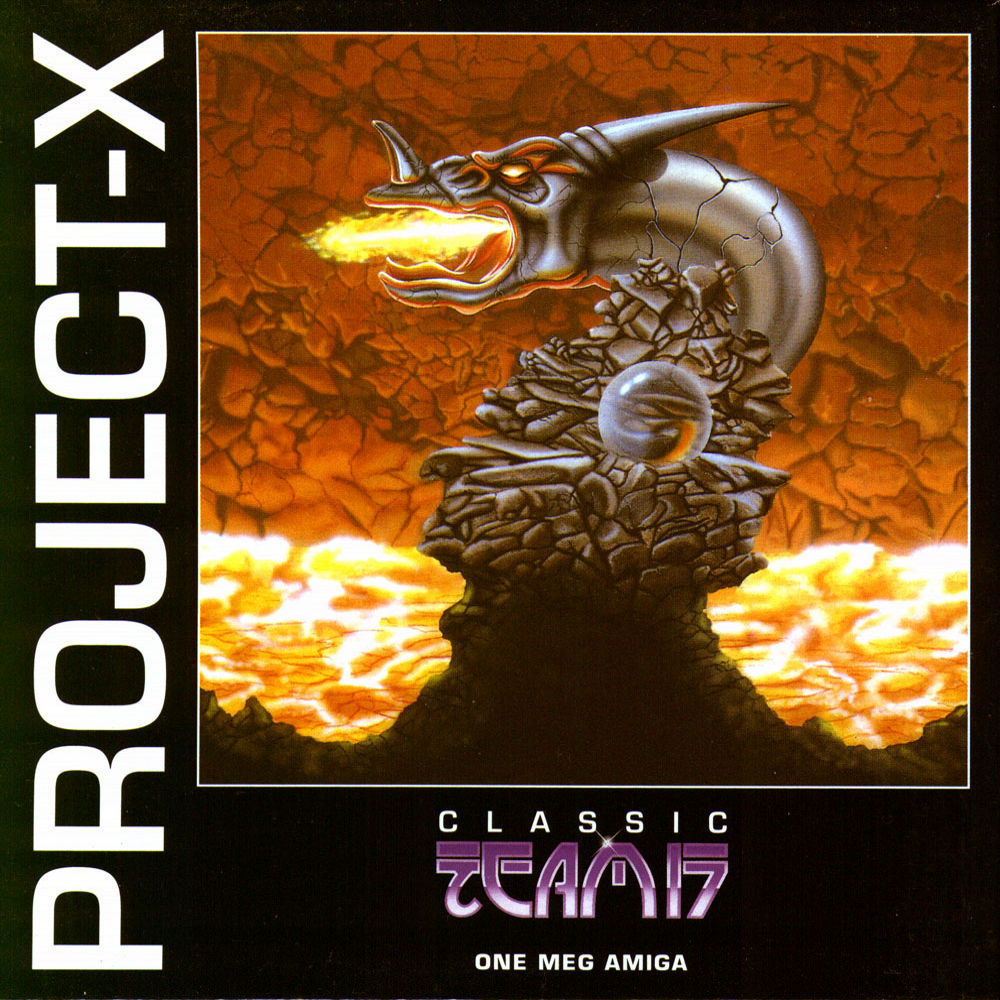
Project-X launched in 1992 as Team17's answer to the Japanese horizontal scrolling
shooters that dominated arcade halls — R-Type, Gradius, Darius. On OCS Amiga
hardware, smooth horizontal scrolling with multiple sprite layers was hard to achieve
without compromising visual quality or frame rate. Project-X achieved both. That
combination made it immediately the benchmark for the genre on Amiga, and its
reputation as a technical showcase has held across decades of retrospective analysis.
The Shooter That Proved the Hardware
Like Alien Breed, Project-X was built in-house at Team17, with Rico Holmes leading
art and programming and Allister Brimble composing. The team had proven with Alien
Breed that disciplined development produced polished results in the top-down action
genre. Project-X was the test of whether that discipline extended to horizontal
scrolling — a more technically demanding requirement on OCS hardware.
The game was made at a point when Japanese arcade shooters were the genre's
reference points. Matching that level of visual spectacle on home hardware meant
managing the Amiga's sprite and blitter systems carefully — careful enough that
contemporary reviewers described the result as the definitive Amiga scrolling shooter.
The Special Edition 92 re-release added further content and was distributed via
coverdisk, establishing the enhanced-re-release distribution pattern that Team17
would use across multiple titles.
"With Project-X I wanted the music to drive the pace — it is a very mechanical
game, rhythmic, and the soundtrack needed to match that energy. OctaMED gave me more
channels than ProTracker, which meant I could build the layers properly."
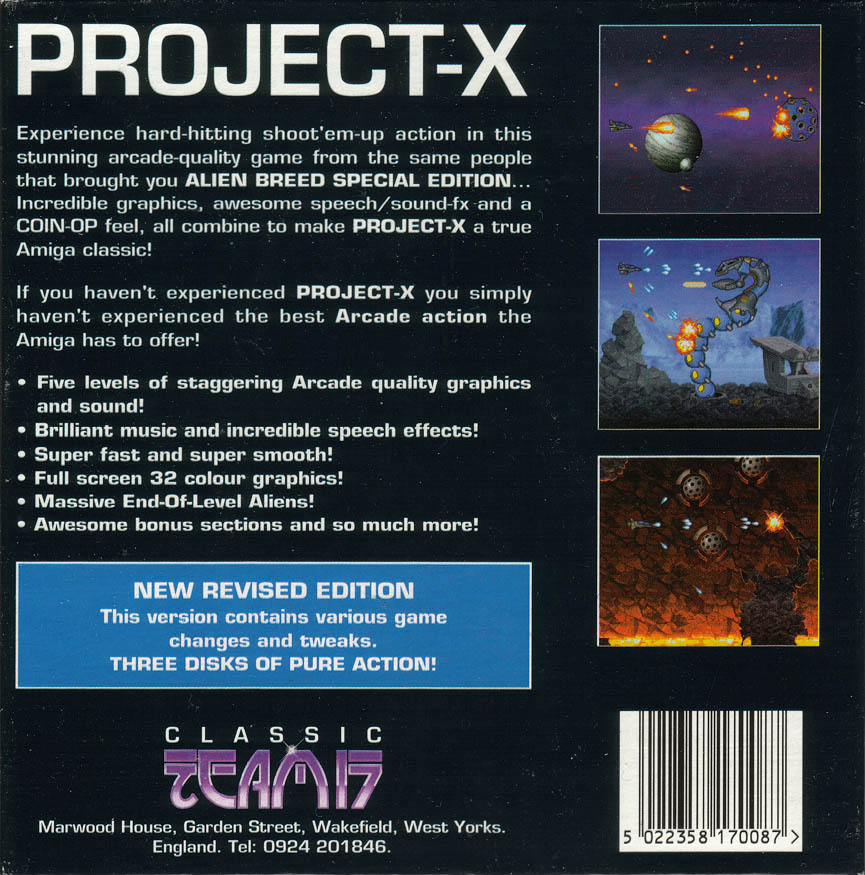
Project-X Special Edition 92 — box rear with gameplay screenshots
The weapon system works on a chain: your starting firepower extends with each
upgrade collected, branching from a basic shot into spread fire, charged beams,
and additional firing options around the ship. Losing a life resets the chain,
creating genuine stakes for survival. The choice of which power-up to prioritise
when multiple are available adds a secondary decision layer under fire.
The horizontal levels scroll through multiple parallax layers — background,
mid-ground, and foreground obstacles — at independent scroll speeds. The effect
is convincing physical depth at the game's full frame rate. Boss encounters end each
zone: large, patterned, and designed to require the accumulated power-up chain to
defeat efficiently. First attempts typically fail; subsequent attempts, with the
pattern learned, are satisfying.
Three Layers, Fifty Sprites, No Slowdown
Project-X maintains three independent parallax scrolling layers on OCS hardware
simultaneously, updating them while processing enemy movement and collision across
a screen populated with up to fifty sprites. The Amiga 500 ran this on a 7.16 MHz
processor with no hardware acceleration beyond the OCS chip set. The game maintains
its frame rate throughout. This was technical discipline applied at assembly level,
and the result was noticed: contemporary reviews specifically cited the consistency
as remarkable given the hardware constraints.
Top of the Genre in 1992
Project-X was reviewed as the leading Amiga horizontal shooter of 1992 by the major
Amiga publications. Amiga Power cited the smooth scrolling and weapon system as the
genre's current benchmark. The Special Edition 92 extended the game's commercial life
and introduced it via coverdisk to an audience larger than the retail channel alone
could reach. At a point when the Amiga software market was intensely competitive
— Body Blows was released the same year — Project-X held its position as the
technical showcase for the scrolling shooter genre.
The Benchmark Others Measured Against
Subsequent Amiga scrolling shooters were reviewed in explicit comparison to Project-X.
Apidya (1992, Kaiko) and Banshee (1994, DMA Design / Ocean) were both measured against
it by reviewers. The Special Edition re-release model that Team17 refined with Project-X
was applied across their catalogue as a reliable way to extend the commercial life of
a strong title. See the catalogue entry for
full version and platform history. For Brimble's soundtrack,
visit the music page.
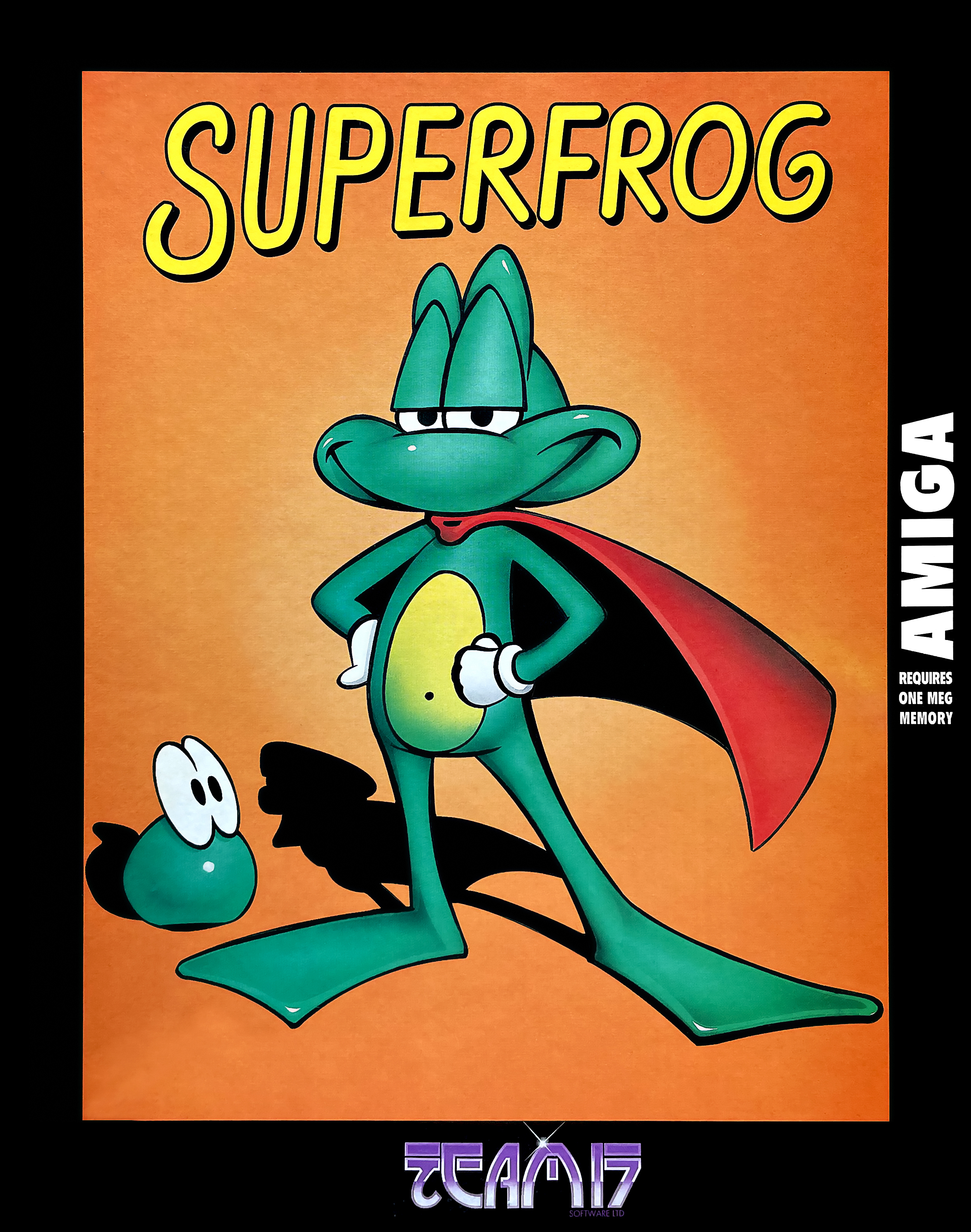
Superfrog (1993) arrived positioned as Team17's answer to Sonic the Hedgehog. That
framing, fair or not, has followed the game since its release. The comparison is
inevitable: fast movement, a mascot character, bright environmental design, competitive
release timing. The comparison understates what Superfrog actually is: a well-designed
platformer with genuine character, a soundtrack by Allister Brimble that stands as some
of his best work, and a speedrun community that remains active three decades later.
Team17 Builds a Mascot
Team17's reputation in 1992 was built on dark action games. Alien Breed's science
fiction menace and Project-X's mechanical intensity were the studio's signatures.
Superfrog required a different register entirely: bright colours, a likeable character,
comic-book energy. The studio took the same development discipline applied to their
action titles and directed it toward a genre they had not previously built in.
The six themed worlds — each with a distinctive visual palette and environmental
mechanics — required broader art direction than anything Team17 had previously
attempted. Brimble's soundtrack was composed in a deliberately accessible style, distinct
from the atmospheric tension of his Alien Breed and Project-X work. The brief was to
make the best Amiga platform game that had ever been made.
"Superfrog needed something completely different from Alien Breed. The whole point was
brightness and accessibility — immediately likeable. I had to think differently about
what the music was doing for the player."
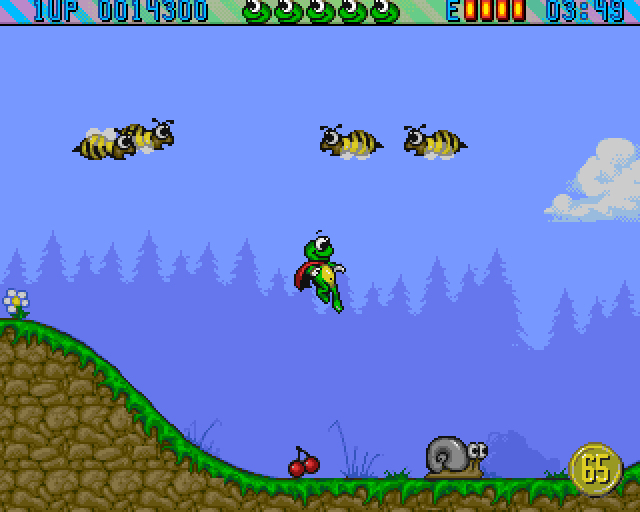
Superfrog — Amiga gameplay; the large sprite and fast scrolling were technically demanding on OCS hardware
Superfrog moves faster than visual clarity always allows — at full momentum,
the level design passes quickly enough that anticipating hazards becomes necessary.
The six worlds are built with secrets throughout: hidden coin caches, bonus-stage
triggers, and shortcuts that reward repeated playthroughs. Coins collected unlock
bonus rounds with prize-wheel mechanics that add a casual engagement layer for
players not hunting optimal routes.
The difficulty calibration across the six worlds is precise. Early levels are generous,
with clear paths and readable enemy placement. Later levels introduce timing-dependent
platforming and environmental hazards that require both pattern knowledge and reflexes.
The transition from accessible to testing feels designed rather than accidental —
the same kind of deliberate difficulty curve that characterised the Alien Breed series.
Smooth Scrolling Where It Counted
Platform games on OCS/ECS Amiga hardware faced a specific technical problem: the
hardware's scrolling support was optimised for background planes, not for fast
full-screen movement with a large foreground sprite at the centre. The Amiga's
blitter chip handled sprite drawing but required careful management to avoid tearing
and judder that affected less optimised platform games. Superfrog achieved smooth
horizontal and vertical scrolling with a large, characterfully animated frog sprite,
at consistent frame rates across all six worlds and at the fast movement speeds
the game required.
The Amiga's Closest Answer to Sonic
Amiga Power reviewed Superfrog as the leading Amiga platform game of 1993, specifically
citing it as the most credible response to the console platformers Amiga owners compared
their machine against. The CD32 version, released alongside Commodore's new console,
showcased the AGA chipset's enhanced colour palette. Multiple reviews cited Brimble's
music as a specific stand-out — accessible and catchy in ways the studio's previous
soundtracks had deliberately avoided.
Still Running: Speedrunners, HD, and Bandcamp
Superfrog's longevity extends well past the Amiga era. The speedrun community emerged
organically from players who found that the game's tight level design rewarded
optimised routing. The 2013 HD remake by Team17 on iOS, Android, and Steam updated
the graphics while retaining the original level design — a decision that preserved
the source material rather than reimagining it. Allister Brimble released the original
soundtrack on Bandcamp — see the music page
for links. For CD32 and release history, see the
catalogue entry. Retrospective reviews are
collected on the reviews page.
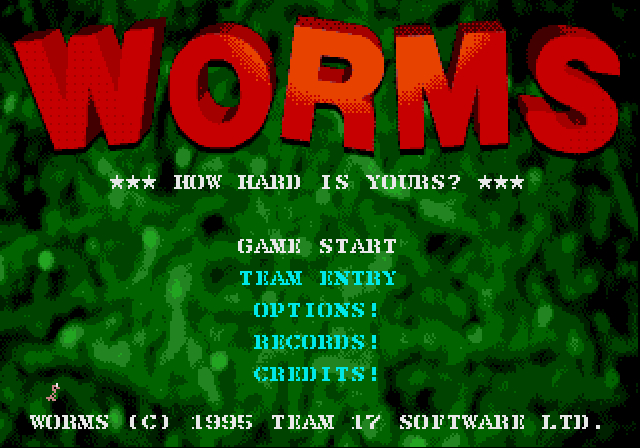
Worms — 1995 cover art; Andy Davidson's prototype became Team17's biggest crossover hit
Worms (1995) is the game that changed everything for Team17. Not just commercially
— though the commercial result was unlike anything the studio had previously
experienced — but structurally. It broke every pattern the studio had established:
dark palette replaced by bright cartoon, intensity replaced by comedy, single-genre
expertise replaced by a game type Team17 had never attempted. It was also genuinely
funny, which was not something the studio had previously prioritised. And it was
the first time Team17 had taken an external concept and made it their own.
A BBC Competition and a One-Man Prototype
Andy Davidson, a programmer from Barry in Wales, created the original Worms prototype
on his own time. He submitted it to a BBC Acorn User computer games competition. After
seeing a Team17 advertisement in a magazine, Davidson sent them a demonstration disk.
Team17 recognised the concept's potential and signed him for commercial development.
The commercial expansion from Davidson's prototype was substantial. Weapon variety
increased significantly, multiplayer infrastructure was built for multi-platform
release, Bjørn Lynne composed a soundtrack calibrated to the game's absurdist
energy, the worm characters received full articulated animation, and the procedural
level generation was refined into a production-quality system. Davidson's prototype had
the concept; Team17 built the game. The collaboration that produced the 1995 release
is covered in more depth on the interviews page.
"I called the prototype Total Wormage. I sent Team17 a disk because I'd seen their
ad in a magazine. The idea was worms with weapons on a landscape you could blow up —
kind of cartoon violence with ammunition and tactics."
Andy Davidson, speaking on the Worms origin story in documented interview accounts
Thirty Seconds to Aim, a Landscape to Destroy
Worms 1995 — the destructible landscape changes tactically with every explosion
Each Worms turn is a tactical problem: where is the enemy, how far are they, what
wind is doing to projectile arcs, what weapons are available, and how does the terrain
between positions affect the shot geometry. The Bazooka fires in a wind-affected
parabola. The Ninja Rope lets you reposition but costs the same turn as firing.
The Sheep runs until it hits something. The Holy Hand Grenade counts down before
detonating with a wide blast radius. Precise execution is satisfying; miscalculating
wind and missing a careful Bazooka shot is comic.
The terrain is fully destructible. Every explosion carves into the landscape, permanently
changing the tactical situation. A level that begins as connected platforms becomes,
over an extended match, a series of islands with widening gaps. The strategic problem
evolves with the terrain. A single well-placed Armageddon weapon can reshape the
landscape entirely. This combination of planning, execution, and physics comedy made
Worms uniquely replayable across session after session.
Worms 1995 — multi-worm matches on procedurally generated terrain; no two games play out identically
Procedural Terrain and Physics Comedy
Worms generates its combat landscapes procedurally, creating a unique tactical
environment for each match. The terrain destruction physics — where explosion
radius and shape determine how the landscape is carved — had to be fast enough
not to interrupt match pacing while being precise enough to make tactical implications
clear. On Amiga, the landscape was stored as a bitmap modified on each explosion.
The CD32 and PlayStation versions added CD audio, expanding the soundtrack's range
beyond what the Amiga Paula chip allowed. Bjørn Lynne's compositions —
cheerful, slightly anarchic, perfectly calibrated to the game's absurdist premise
— were a deliberate contrast to the dark MOD soundtracks of Team17's earlier
work. Hear the Worms soundtrack on the music page.
"When we saw Andy's prototype, we knew what it was immediately. The concept was
completely formed — it just needed to be built properly at production scale.
That was the simplest decision we ever made."
Team17 management, Team17 "100 Games" retrospective blog, Part 3, team17.com
The Crossover Nobody Predicted
Worms was reviewed as the best Amiga game of 1995 by multiple publications. Its
multi-platform release schedule was unprecedented for a Team17 title: Amiga original,
then DOS, PlayStation, Saturn, Game Boy, and SNES. Each platform's specialist press
reviewed it positively. PC Gamer UK gave it an exceptional score. The game sold
globally at scales that dwarfed Team17's previous releases. By the end of 1995,
Worms had made Team17 an internationally known studio with revenue that funded
everything that followed.
Thirty Years and Still Running
The Worms franchise has produced over thirty sequels. Worms 2 (1997) expanded the
weapon roster. Worms Armageddon (1999) — widely considered the series peak for
competitive depth — became the standard against which all subsequent Worms games
were measured. Worms World Party (2001), Worms 3D (2003), Worms: Open Warfare
(2006), and Worms Reloaded (2010) each extended the franchise across new platforms.
Mobile entries from 2009 onward brought the game to smartphones. Worms Rumble (2020)
introduced a real-time battle royale format as a parallel branch of the series.
Without Worms, Team17 could not have sustained the studio through the Amiga market's
collapse in the mid-to-late 1990s. The franchise funded the studio's transition to
multi-platform publishing that continues to the present day. The original concept
— worms, weapons, destructible terrain, turns — has proved extraordinarily
durable across hardware generations. The full Worms series listing is at the
catalogue; the franchise's modern history is
on the modern page.