Bubble Bobble
Fukio "MTJ" Mitsuji's 100-level masterpiece - designed in 1986 with a mechanical elegance that defined an era and launched a franchise still active today.
Bubble Bobble Overview
Released by Taito in 1986, Bubble Bobble is one of the finest single-screen platformers ever made. Designed by Fukio "MTJ" Mitsuji, it built 100 levels of mounting complexity around the simplest possible premise - trap enemies in bubbles, then pop them. Thirty-eight years after its release, new players still discover its secrets for the first time. Full game details are on the games catalogue; the designers who built it are on the people page.
The Game That Refused to Be Simple
In 1986, Taito was already one of Japan's most successful arcade companies. Space Invaders had made the firm a global name and a serious commercial force. But the person who would define the company's next chapter was not a seasoned veteran. Fukio Mitsuji was a young designer with a specific conviction: that arcade games had become too hostile, too punishing, too intent on consuming credits rather than rewarding skill.
Mitsuji wanted to make a game that felt warm. The characters he created - Bub and Bob, the dragon brothers - were small, round, and impossible not to root for. The central action, blowing bubbles to trap enemies and then floating through the screen collecting food bonuses, carried none of the aggression of contemporary shooters. The score went up, the enemies grew harder, but the tone remained playful, almost gentle. That was entirely deliberate.
What made Bubble Bobble extraordinary was that Mitsuji had not sacrificed depth for warmth. Beneath its appealing surface was a game of considerable complexity - one designed to reveal itself gradually, rewarding curiosity and persistence in ways that pure difficulty never could. The dual-track design, immediate fun layered over hidden depth, was the game's defining achievement. It arrived fully formed from Mitsuji's first concept and never wavered across 100 levels of implementation.
One Mechanic, a Hundred Rooms
The core loop of Bubble Bobble could not be simpler: blow a bubble to encase an enemy, then pop the bubble by touching it. The enemy disappears, and the food bonuses it leaves behind add to the score. Clear every enemy from a single-screen level and advance to the next. One hundred levels stand between the player and the ending.
That simplicity, however, is a framework rather than a ceiling. Bubbles can be used as temporary platforms - blowing one and then jumping onto it allows players to reach areas of the screen that would otherwise be inaccessible. The trajectory of a bubble after it is blown can be influenced by the player's position and timing. Enemies that escape from a bubble before it is popped become faster and more dangerous. Certain enemy types require the bubble to burst at a specific moment to avoid releasing a harder variant. Each of these systems is introduced through play rather than instruction, emerging from experimentation and failure.
The two-player cooperative mode is the game's most generous design decision. Unlike many two-player arcade games that simply put two sprites on the same screen, Bubble Bobble's co-op creates genuine interdependence. Players can pop each other's bubbles to create chain reactions, use each other as platforms, and must coordinate their approach to each increasingly dangerous room. The game rewards this partnership directly: the true final boss, and the true ending, are only accessible in two-player mode. A player working alone cannot see the whole game.
The music, composed by Tadashi Kimijima, is one of the most effective pieces of arcade sound design the medium has produced. The main theme - a brief, instantly recognisable loop - is so associated with the game that it functions almost as a trademark, returning in every subsequent franchise entry. Its most important function is emotional: the brightness and repetition of the melody signal that the game is fundamentally benign, that failure is temporary, that the next credit will go better. This tonal calibration was not accidental.
Hidden Depths in Plain Sight
Bubble Bobble's technical and design achievements are most visible in what players cannot easily see. The level architecture across 100 stages is carefully graduated: early levels are spacious, with enemy patterns that can be resolved by simple reactions. Later levels compress the playfield, increase enemy density, and introduce configurations that punish predictable strategies - but only after players have developed enough skill to adapt rather than be eliminated.
The hidden item system is more elaborate than most players ever discover. Particular actions on specific levels trigger the appearance of rare items with unusual effects. Popping multiple enemies simultaneously with a single bubble creates chain reactions that spawn bonus food. Not taking damage on a level produces different bonuses to dying. Collecting specific items on specific levels in the right order unlocks hidden content that extends the replayability of the game far beyond what its surface suggests. None of this is explained. All of it is intentional.
The secret within the secret is the "Super Game," accessible only if a particular combination of items has been collected over the course of a full playthrough. The Super Game features different enemy distributions and faster pacing throughout, functioning as a second complete game hidden inside the first - a reward for the player committed enough to understand the system Mitsuji had built. This layered architecture, visible face and hidden face, is the clearest expression of his design philosophy.
Critics Called It Compulsive. Players Kept Calling It Back.
Bubble Bobble arrived in arcades in 1986 and quickly established itself as one of the most popular titles of the year - not through spectacle or technical bravado, but through the pull of its gameplay loop. Arcades that installed it reported strong credit-per-hour performance sustained over weeks rather than the short initial spike typical of games that wore off quickly.
Home computer conversions followed in 1987 and 1988. The Commodore 64 version, published by Firebird, drew an enthusiastic reception from Zzap!64 magazine - one of the most authoritative voices on C64 software at the time - which noted the addictive quality of the two-player mode and praised the accurate conversion of the arcade original's gameplay. The ZX Spectrum version earned a Crash Smash from Crash! magazine, the publication's highest designation, in recognition of what their reviewers found:
"The game is utterly compulsive whether played alone or with a friend - Crash Smash."
Crash! magazine, ZX Spectrum review - 1987
The Amiga version, published the same year, was regarded by Amiga-specific press as one of the most faithful home conversions of any arcade title released that year - capturing the original's speed, colour depth, and animation quality with minimal compromise. The NES conversion introduced Bub and Bob to North American audiences who had no arcade access to the original, building a new fanbase for the franchise on a platform with entirely different demographics from the home computer market.
Conversions of varying fidelity appeared on the ZX Spectrum, Amstrad CPC, Atari ST, MSX, and many other platforms of the era. The quality variation across these ports reflects the diversity of the home computing landscape rather than any fault in the source material - on every platform that received a competent conversion, Bubble Bobble found an audience and held it.
The Franchise Fukio Built
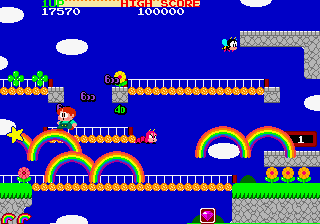
Fukio Mitsuji designed his immediate follow-up to Bubble Bobble the following year. Rainbow Islands: The Story of Bubble Bobble 2 (1987) returned Bub to his human form and replaced the bubble mechanic with rainbow bridges that functioned simultaneously as platforms and projectile weapons. Visually richer than its predecessor, with seven distinct island worlds each themed around a different classic Taito game, Rainbow Islands matched the original's mechanical depth while presenting a substantially different play experience. The Amiga version is widely cited as one of the finest home computer conversions of the decade. All franchise titles are in the games catalogue.
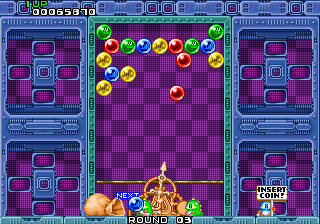
The most commercially significant extension of the concept arrived in 1994. Puzzle Bobble, also known as Bust-A-Move in Western markets, stripped away the platform elements and rebuilt the design as a pure puzzle game - a shooter in which coloured bubbles are fired upward to match and eliminate clusters of the same colour. The result became one of the most broadly distributed puzzle game franchises in the history of the medium, appearing on every gaming platform from Neo Geo to mobile phones to Nintendo Switch.
Bubble Bobble Part 2 (1993), Bubble Symphony (1994), Bubble Memories (1996), and numerous other sequels extended the franchise across three decades of arcade and console gaming. Taito released Bubble Bobble 4 Friends for Nintendo Switch in 2019 - the first true mainline sequel in over twenty years. Puzzle Bobble Everybubble! arrived in 2023, continuing a franchise now in its fourth decade of active releases.
Fukio Mitsuji died in 2003. The characters he designed - Bub and Bob, the round dragon brothers of the 1986 arcade - have outlived him by more than twenty years and continue to appear in new games. Bubble Bobble endures not as a curio of arcade history but as active proof that warmth, elegance, and hidden depth make things that last. The full profile of Mitsuji and Space Invaders creator Tomohiro Nishikado is on the people page.