NES, 1989. Developer: Sunsoft. Composer: Naoki Kodaka.
Five stages. Five masterpieces. One Gotham.
“Batman NES doesn't just have a good soundtrack - it has a vocabulary.
Every stage theme is a distinct emotional argument for the city it depicts.”
Five Stages Between Batman and the Joker
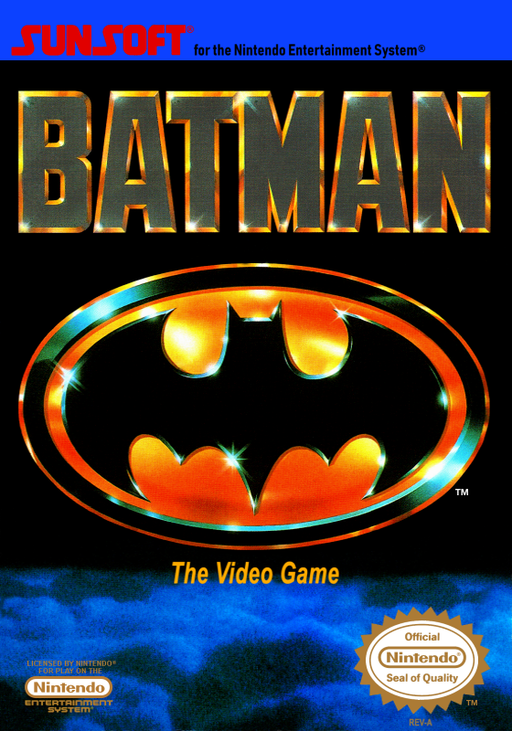
Batman: The Video Game (NES, 1989) is a side-scrolling action platformer
developed and published by Sunsoft under licence from DC Comics and Warner Bros.,
timed to coincide with Tim Burton's 1989 Batman film. Five stages separate Batman
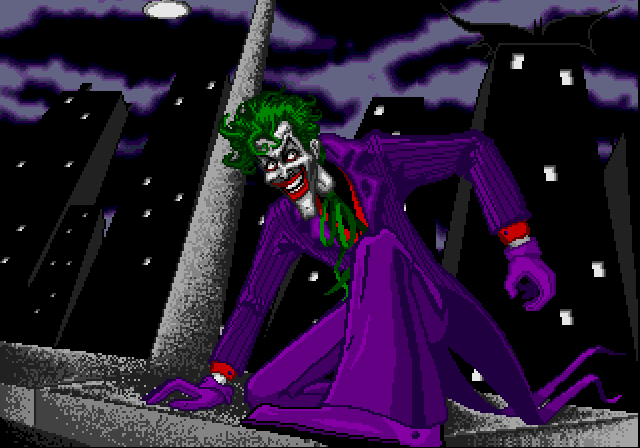
from his confrontation with the Joker in the bell tower of Gotham Cathedral -
each one distinct in design, palette, and the Naoki Kodaka theme that defines it.
The game matters for three reasons that compound each other. First, its soundtrack
is among the finest ever composed for the NES hardware. Second, its visual design
captures the Tim Burton film's Gotham atmosphere with remarkable fidelity. Third,
its gameplay - centred on a wall-jump mechanic that was unusual in 1989 - is
technically demanding in ways that reward mastery rather than punish the player
for failing to develop it. Together these qualities made Batman NES a landmark
in what a licensed game could achieve. See the full
games catalogue for Sunsoft's complete NES output.
A Licensed Game Built to Outlast the Licence
Sunsoft obtained the licence to develop a Batman game tied to the 1989 Tim Burton
film, with a release window tightly aligned to the film's promotional cycle.
The game was developed entirely in-house - an unusual choice for a licensed title
in an era when publishers commonly farmed adaptations to third-party studios to
meet film release dates. Sunsoft chose to build it themselves.
The result shows what that decision cost in production pressure and what it
delivered in creative coherence. The game's visual language is consistent
throughout: dark blue-black backgrounds, silhouetted Gotham architecture, and a
colour discipline that never breaks the nocturnal atmosphere the film established.
A studio more distant from the creative brief might have shipped something louder
and less considered.
What is striking about the game's villain roster is how freely it diverges from
the film. Batman faces Killer Moth, KGBeast, Maxie Zeus, Deadshot, Heat Wave,
and the Electrocutioner in addition to the Joker - DC villain choices that expand
beyond the film's narrative rather than recreating it. This gave the game a sense
of the wider Batman universe and reduced its dependence on recreating specific
film sequences.
The game became Sunsoft's international commercial breakthrough, establishing the
studio in North American and European markets in a way that earlier NES titles
had not. The Batman licence was the vehicle; the game itself was the argument
that Sunsoft deserved the attention it received.
Longplay
Batman NES (1989) - Full Longplay
Complete playthrough with all five stages - Kodaka's score heard in context from opening to Joker finale.
Walls Are the Game's Secret Third Axis
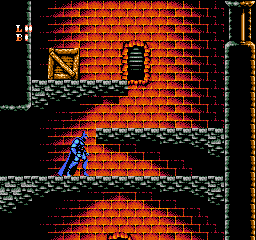
Batman NES is a side-scrolling action platformer, but the wall-jump mechanic
transforms its geometry from two dimensions to two-and-a-half. Batman can
spring off vertical surfaces, ascending shafts and crossing gaps that would
otherwise be impassable - but only if the timing is precise. A mistimed
wall-jump sends Batman falling rather than rising.
The game provides three selectable sub-weapons: the batarang, the batdisk,
and the batpoon, all of which are powered by a limited ammunition cartridge
system. Players must choose when to deploy sub-weapons versus the unlimited
punch-kick combo. Boss encounters are demanding enough that entering them with
low sub-weapon stocks is a significant disadvantage.
Enemy placement in Batman NES is aggressive and deliberate. Projectiles fire
from off-screen in patterns that require memorisation rather than reaction.
There are no continues by default, and lives are not generously distributed.
The design philosophy is consistent with Sunsoft's general NES output of this
period - games built for repeated play and gradual mastery rather than
first-session completion.
The boss at the end of each stage represents the game's difficulty spikes.
The final Joker encounter requires managing multiple simultaneous mechanics
in a confined space. Players who have mastered the wall-jump and sub-weapon
management find the boss sequence tense but achievable; players who have not
often find it genuinely impassable.
What Kodaka Did with Five Channels
The Ricoh 2A03 is the NES's combined CPU and audio processing unit. Its five
audio channels - two pulse waves, one triangle wave, one noise channel, one
DMC sample channel - define the sonic palette available to all NES composers.
Constraints are identical for everyone. What separates composers is how they
exploit them.
Kodaka's Batman NES score demonstrates four distinctive 2A03 decisions that
are studied in NES chiptune communities:
Triangle Channel Bass: Rather than using the triangle channel for melodic lines, Kodaka consistently assigns it to the bass register - a deeply resonant walking bass that anchors the harmony and provides rhythmic momentum. The triangle channel's fixed volume makes it unsuitable for expressive melodic use but ideal for bass. This is technically straightforward but compositionally sophisticated.
Pulse Wave Counterpoint: The two pulse channels carry the main melody and a counter-melody in two-voice counterpoint derived from classical baroque practice. The interplay between the voices creates harmonic richness that partially compensates for the limited channel count.
Noise Channel Restraint: Unlike many NES composers who use the noise channel aggressively for percussion, Kodaka employs it with unusual subtlety in Batman. The percussion textures sit low in the mix, creating space for the melodic channels - a mixing decision made in the composition itself.
Pitch Bend Effects: Rapid pitch modulation on the pulse channels simulates vibrato and bending effects. Kodaka uses these sparingly but effectively to emphasise key melodic moments in the stage themes.
Beyond the audio, Batman NES demonstrates careful sprite management. Batman's
protagonist sprite is larger and more detailed than was typical for NES
platform characters of the period. Sunsoft achieved this by combining multiple
hardware sprites to compose Batman's figure, managing the NES's eight-sprites-
per-scanline limit to minimise flicker. The bat-signal logo on Batman's chest
is rendered as part of the sprite composition with unusual clarity.
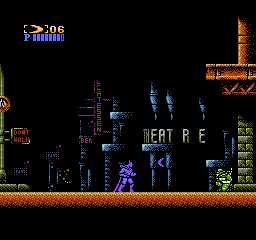
The game's visual palette - predominantly dark blue and grey for backgrounds,
with orange and yellow used sparingly for fire and energy - is a deliberate
aesthetic choice. Many NES games of the period used bright, varied palettes to
compensate for the hardware's limitations. Sunsoft's decision to work within a
restricted nocturnal palette contributes significantly to Gotham's visual
consistency throughout all five stages.
Batman NES OST - Track Listing
Title (0:37)
Opening / Credit Roll (0:47)
Demo (0:23)
Stage 1 / Stage 5 (1:08)
Stage 2 (1:00)
Stage 3 (1:03)
Stage 4 (2:02)
Boss (1:10)
Ending (0:40)
Death (0:03)
Game Over (0:39)
For the full composer profile and a track-by-track analysis of Kodaka's NES
output, see the Music section.
Critics Approved; Time Agreed
Batman NES was received positively by the contemporary gaming press on its
1989 release. Electronic Gaming Monthly's four reviewers gave the game
individual scores of 8, 8, 8, and 9 out of 10, with the highest individual
score going to the game's audio-visual presentation. Nintendo Power's coverage
was enthusiastic, emphasising the game's fidelity to the Tim Burton film's
atmosphere and its high production values relative to licensed NES games of
the period.
The contemporary review consensus was that Batman NES was among the finest
licensed games on the NES - better than the platform average for adaptations,
and distinguished by its soundtrack in a way that most licensed games were not.
This is not a retroactive reappraisal; it was the consensus position at release.
Electronic Gaming Monthly's four reviewers scored Batman (NES) 8, 8, 8, and 9
out of 10 on release in 1989. The highest individual score went to the game's
audio-visual presentation. Their aggregate placed it among the highest-rated
licensed NES games reviewed that year.
- Electronic Gaming Monthly, 1989
What has changed since 1989 is the context around the game rather than the
assessment of it. As the NES library has been catalogued and analysed by retro
gaming communities over three decades, Batman NES has consistently ranked near
the top of discussions about NES soundtracks - often placed alongside works by
Koji Kondo, Hirokazu Tanaka, and the Mega Man composers. This degree of
retroactive recognition is unusual for a licensed game and speaks to how
significantly Kodaka's work transcends its commercial origin.
The Soundtrack That Outlived the Licence
Batman NES's legacy is disproportionate to its original commercial context.
The game sold well and was reviewed positively, but has grown substantially
in reputation as the NES library has been exhaustively documented by retro
gaming communities over three decades.
Its soundtrack is the primary driver of this legacy. Naoki Kodaka's score is
regularly discussed alongside works by Koji Kondo (Super Mario Bros, The
Legend of Zelda), Hirokazu Tanaka (Metroid), and the composers of the Mega
Man series. The presence of a licensed Sunsoft game in these conversations
measures how significantly Kodaka's work transcends its commercial context.
For Sunsoft's wider story, Batman NES represents the proof of concept for
the studio's NES golden period: that a mid-tier Japanese publisher working
within strict hardware constraints and a commercial licence brief could
produce work of genuine artistic merit. Blaster Master and Journey to Silius
confirmed the argument; Batman made it first.
Batman NES is what a licensed game looks like when the development team
treats the licence as an opportunity rather than a constraint - when the
composer writes for the hardware rather than against it, and when the level
designers understand that difficulty and atmosphere are not opposites.
- NESdev forums retrospective thread, cited in multiple community analyses
The Batman NES game is available via Nintendo Switch Online's NES library,
giving new players access to the original hardware experience. Explore all
of Sunsoft's NES output in the Games catalogue,
and read about the composer who defined the studio's sound in the
People section.
Deep Dive
Blaster Master
NES, 1988. Developer: Sunsoft. Composers: Naoki Kodaka & Nobuyuki Hara.
One tank. Eight underground worlds. Over a million copies sold.
The Tank That Drives on Walls
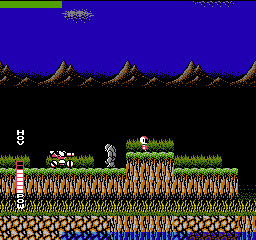
Blaster Master (NES, 1988) is a side-scrolling action game in which
the player pilots SOPHIA III, a tank that can drive across walls and ceilings,
through eight underground areas populated with alien mutants. When the tank
cannot proceed, the pilot exits on foot for top-down sections that reward
exploration and provide power-ups for the vehicle.
The dual-mode structure was genuinely unusual in 1988. Combining a side-
scrolling vehicle game with overhead on-foot exploration in a single title,
with a shared upgrade economy linking both modes, gave Blaster Master a scope
that most NES action games of the period did not attempt. It sold over one
million copies in North America alone, making it one of Sunsoft's commercially
successful NES titles.
The game is also a significant entry in Naoki Kodaka and Nobuyuki Hara's
compositional output - each of the eight underground areas has its own theme,
and the Area 1 theme in particular has become one of the most recognisable
pieces of NES music in the medium's history. For more on Kodaka's work,
see the Music section.
Two Stories for the Price of One Tank
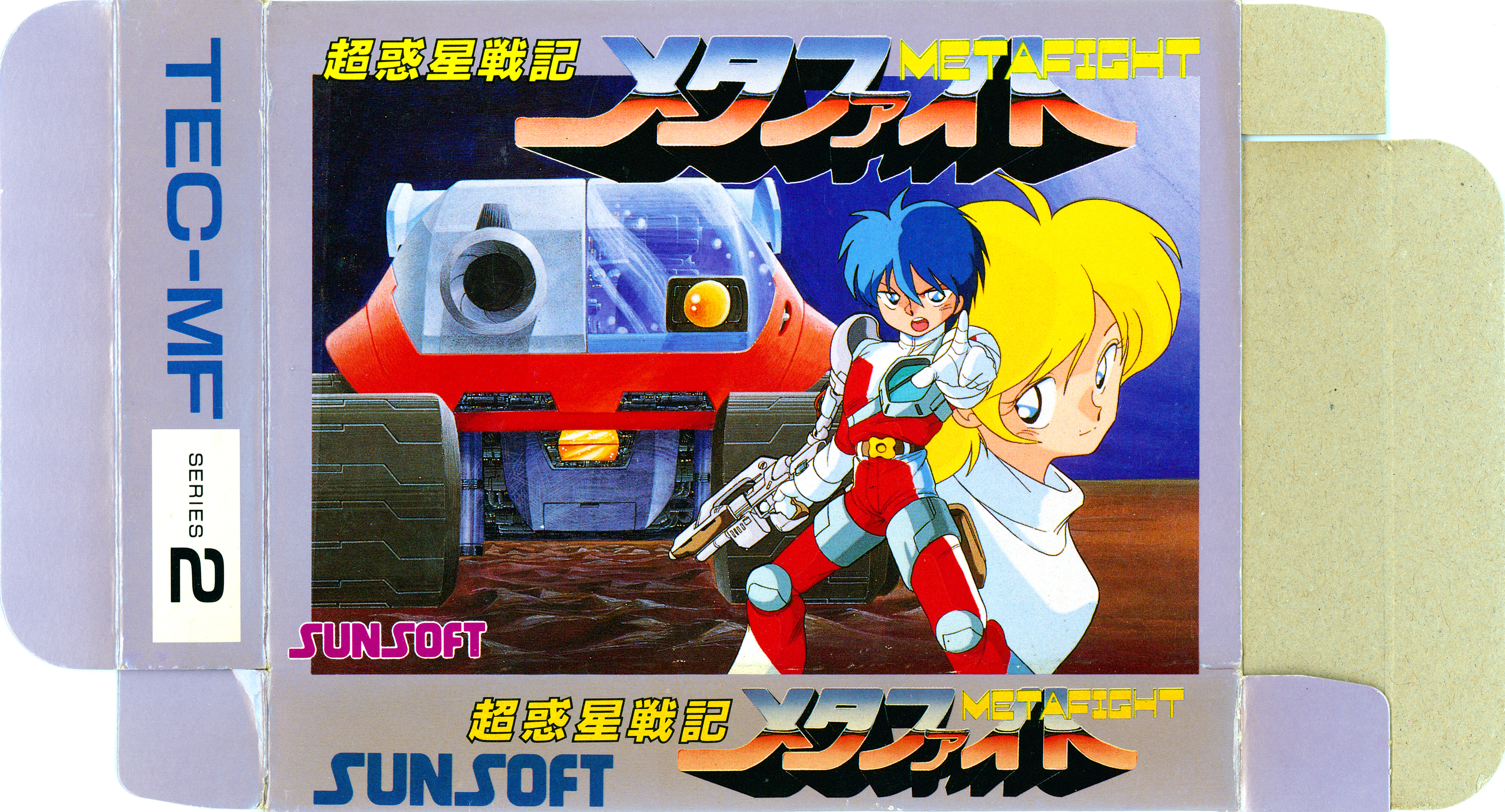
Blaster Master was released in Japan in 1988 as
Chō Wakusei Senki Metafight (Super Planetary War Records: Metafight).
The Japanese game presents a science-fiction conflict against a Mutant Alliance
from the planet Ragnaros, with the pilot commanding SOPHIA III in a coordinated
military operation. It is a serious sci-fi game.
The North American release, localised by Sunsoft and distributed through
Sunsoft of America, received a completely different narrative. In the NA
version, a boy named Jason chases his pet frog Fred down a hole, discovers
a tank, and follows the frog into underground tunnels inhabited by alien
mutants. The gameplay is identical; the framing has nothing in common with
the Japanese original. The NA manual's story has become something of a
legend in gaming history - an extreme example of localisation invention.
The game was developed at Sunsoft during what is now recognised as the
company's golden period - the same years that produced Batman NES, Journey
to Silius, and Fester's Quest. The compositional ambition of the Blaster
Master OST, with distinct themes for each of the eight areas, suggests a
development environment that was willing to invest significantly in audio.
Side-Scrolling, Overhead, and Ceiling Physics
Blaster Master alternates between two gameplay modes without breaking the
world's continuity. In the primary side-scrolling mode, the player controls
SOPHIA III - a tank equipped with a forward gun, a homing missile, and the
ability to drive on vertical surfaces and ceilings. Wall and ceiling driving
is not a special move; it is a physics property of the vehicle that can be
used at any moment, opening traversal options that would be unavailable in
standard platformer physics.
When the player exits the tank, the game switches to a top-down overhead
view. On foot, the pilot can enter doors, destroy enemy generators that
block progress, and find power-up items that upgrade SOPHIA III's capabilities.
The overhead sections are designed to reward careful exploration - some
power-ups are well-hidden, and the enemy density in boss rooms requires
resource management developed during the tank sections.
The eight underground areas are structured with loose non-linearity.
Players can access areas in different orders depending on which upgrades
they have acquired. This gives Blaster Master a scope that contemporary
NES action games rarely matched - exploration is meaningful because backtracking
with new abilities opens previously inaccessible routes.
OST Showcase
Blaster Master (NES, 1988) - Full Soundtrack
Eight area themes by Kodaka and Hara, each one a distinct character portrait of the underground environment it accompanies.
Eight Area Themes for Eight Underground Worlds
The most distinctive technical achievement in Blaster Master's audio is the
decision to give each of the game's eight areas its own theme rather than
recycling music. Most NES action games of 1988 used a smaller set of tracks
across multiple stages; providing eight distinct area themes required a
substantially larger compositional investment from Kodaka and Hara.
The Area 1 theme - the first music the player hears as they enter the
underground - has become one of the defining pieces of NES music. Its
driving pulse-wave melody and propulsive rhythm establish the game's
tone within seconds. The Area 2 theme takes a more atmospheric approach;
Area 3 introduces melodic complexity that contrasts with the earlier
urgency. Each area sounds like a different environment rather than a
variation on a single template.
Technically, Blaster Master also demonstrated competent dual-mode
implementation at a time when switching between side-scrolling and
overhead gameplay within a single game was uncommon. The transitions
are seamless at the hardware level - the game pauses briefly to load
the new view mode, but the player's position and state carry between
modes without disruption.
SOPHIA III's wall and ceiling physics required custom sprite handling
to maintain visual coherence as the tank's orientation changes. A tank
driving on the underside of a ceiling must look like it belongs there.
Sunsoft's sprite work achieves this - SOPHIA III reads as a physical
object in all orientations rather than a sprite rotating around a fixed
centre point.
Best in Class, 1988
Blaster Master received strong critical recognition on its 1988 release.
Electronic Gaming Monthly awarded the game its Best NES/Famicom Game
distinction for 1988, citing the dual-mode gameplay and the area-specific
soundtrack as exceptional for the platform. The commercial response matched
the critical assessment: over one million copies sold in North America
alone made Blaster Master one of Sunsoft's most successful NES titles.
Electronic Gaming Monthly named Blaster Master its Best NES/Famicom Game
for 1988, recognising the dual-mode gameplay and Kodaka and Hara's
area-specific soundtrack as technically and artistically exceptional for
the platform.
- Electronic Gaming Monthly, 1988 Year-End Awards
Nintendo Power's coverage of Blaster Master was extensive, reflecting
the game's commercial performance and its appeal to players who wanted
a longer, more explorative experience than most NES action games offered.
The complexity of the dual-mode structure gave the game review depth
that straightforward action titles could not match.
Retroactive community assessment of Blaster Master has been consistently
strong. The game appears regularly in ranked lists of the finest NES
games, almost always in the top tier of action-platformer discussions.
Its dual-mode structure is recognised as ahead of its time; its soundtrack
is cited alongside Batman NES and Journey to Silius as the defining
examples of Kodaka's NES compositional voice.
Blaster Master Zero Proves the Formula Still Works
Blaster Master's most direct legacy came in 2017, when developer Inti Creates
released Blaster Master Zero for Nintendo Switch and PC - a reimagining
of the original game that retained the dual-mode structure and area-based
progression while updating the presentation and expanding the narrative.
Inti Creates built two further sequels in the Zero series, demonstrating
that the 1988 formula remained commercially viable nearly thirty years later.
The original Blaster Master NES is available through Nintendo Switch Online's
NES library. Its presence there alongside titles from Nintendo's own
development output reflects the game's standing as a genuine classic of
the platform rather than a notable third-party title of historical interest.
For Sunsoft, Blaster Master confirmed what Batman NES had suggested: that
the studio could produce work of significant creative and commercial quality
when given the freedom to develop original or near-original concepts. The
game's dual-mode structure and compositional ambition were uniquely
Sunsoft's - no other publisher delivered the same combination at the same
quality level in 1988. That remained true for the entire NES generation.
Explore Sunsoft's complete NES output in the
Games catalogue, or read about the composers
behind both titles in the People section.