How a bedroom programmer’s pitch to Nintendo became a revolutionary coprocessor,
a landmark game, and a franchise spanning thirty years.
The Argonaut Pitch — 1990
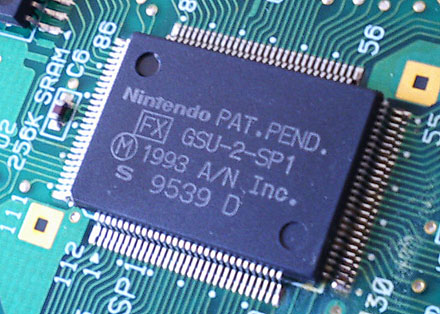
The Super FX GSU-2 chip — the successor to the original MARIO chip
The story of Star Fox begins with Jez San, founder of Argonaut Software, arriving uninvited
at Nintendo of America’s offices in Redmond, Washington. San had designed a custom
coprocessor that could render real-time 3D polygons on the Game Boy — hardware that
Nintendo’s engineers had assumed was impossible on the portable’s limited
specifications. The demonstration impressed enough people at Nintendo that San was flown
to Kyoto to present to the senior engineering team.
Nintendo’s engineers recognised that the Game Boy prototype was too limited to
showcase the technology properly. The real opportunity was the Super Nintendo — a
more capable machine that still could not produce real-time 3D polygon graphics without
hardware assistance. Nintendo commissioned Argonaut to co-design a production chip for
the SNES, capable of the mathematical operations required for 3D rendering. The project
began in 1990 with the chip and the game being developed simultaneously.
“We arrived at Nintendo and said, ‘We’ve got this chip that does
3D.’ They said, ‘We’ve got this game called Star Fox.’
And that was that.”
— Jez San, Argonaut Software founder
Super FX Chip Development — 1990–1993
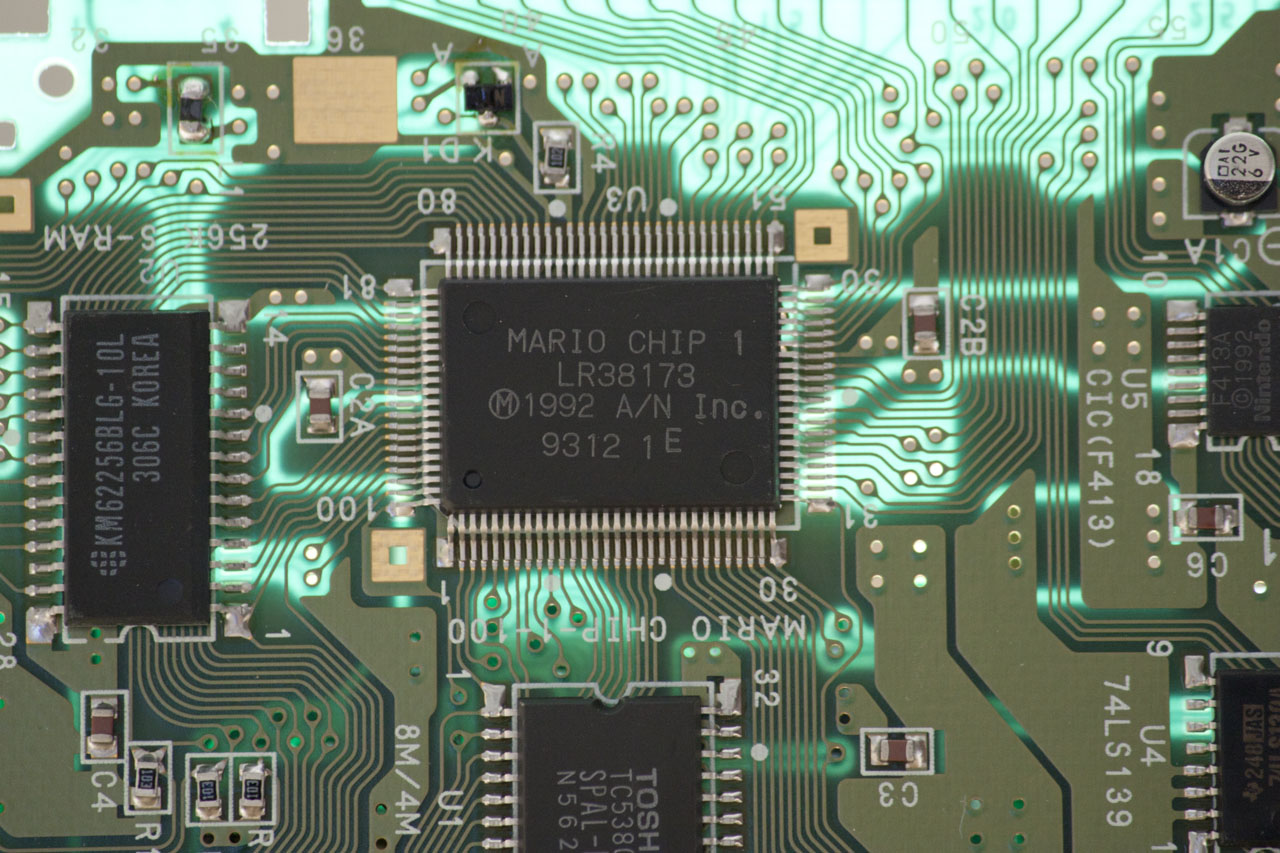
The MARIO Chip 1 (GSU-1) inside a PAL Starwing cartridge
Argonaut assembled a hardware team led by Ben Cheese and Robert Aitken to design the
chip that would become the Super FX GSU-1. The coprocessor ran at 10.5 MHz —
a dedicated RISC processor embedded directly in the SNES cartridge. Rather than
supplementing the SNES CPU, the Super FX chip effectively replaced it for graphical
calculations: the SNES main processor was reduced to handling input and audio while
the Super FX chip calculated every polygon position and rendered every frame.
On the software side, a teenage Dylan Cuthbert was selected by San to lead game
development. Cuthbert relocated to Nintendo’s Kyoto offices and spent nearly
two years working alongside Nintendo EAD, learning Japanese and building the 3D engine
that would run on the new chip. Shigeru Miyamoto oversaw the creative direction,
designing the anthropomorphic animal characters — drawing on the kitsune fox
imagery at Fushimi Inari-taisha shrine near his childhood home.
“The MARIO chip name was deliberate misdirection. If anyone heard ‘MARIO chip’
they’d assume it was something to do with the Mario games, not realise we were
building something completely new.”
— Jez San, on the chip’s code name
The Super FX chip: how a cartridge coprocessor made real-time 3D possible on the SNES
Star Fox Launches — 1993
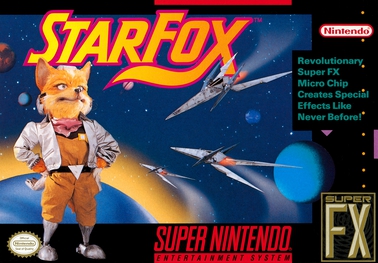
Star Fox — SNES North American box art (1993)
Star Fox launched in Japan on 21 February 1993 as “Star Fox” and in North
America on 1 August 1993. In PAL regions (Europe, Australia, UK), it was sold as
“Starwing” — a name Nintendo invented to avoid a trademark conflict
with a German tabletop game that already bore the Star Fox name.
The critical and commercial response was immediate. Reviewers consistently cited the
3D polygon graphics as unlike anything available on home hardware. Nintendo Power awarded
the game its first-ever perfect score. The technical achievement drove sales: a game
that proved the SNES could produce real-time 3D given the right hardware assistance.
The Super FX chip went on to power five more SNES titles, including Stunt Race FX
and Vortex.
Star Fox 2: The Cancelled Sequel — 1996
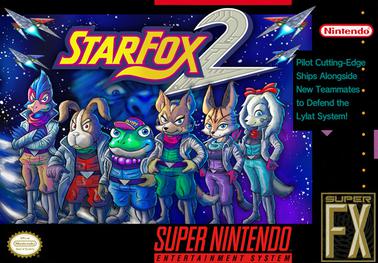
Star Fox 2 — officially released via SNES Classic Edition (2017)
Star Fox 2 was one of gaming history’s most famous cancelled games. Developed
by Argonaut and Nintendo EAD using the upgraded Super FX GSU-2 chip (running at
21 MHz — double the original), the sequel added a real-time strategic
layer: enemy ships could attack Corneria while the player was engaged elsewhere,
players could switch between Arwing and Landmaster tank mid-mission, and two new
female pilots were introduced.
The game was approximately 99% complete when Nintendo president Hiroshi Yamauchi
made the decision to cancel it. The stated reason: Sega’s Saturn and Sony’s
PlayStation had reset audience expectations for 3D graphics with titles like Virtua
Fighter 2, and a SNES game — however technically accomplished — would
face unfavourable comparisons. The game remained officially unreleased for 21 years.
An unfinished ROM leaked online in 1997 and was played by fans throughout the 2000s.
Star Fox 2’s first official release came in 2017 as part of the SNES Classic
Edition — the only title in that collection that had never previously been
commercially available.