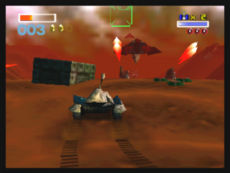
From the polygon breakthrough of 1993 to the voice-acted rail shooter that defined the N64
era - and the cancelled sequel that took 21 years to reach players.
Each game in the Star Fox line asked a different question of its hardware.
Star Fox (SNES, 1993)
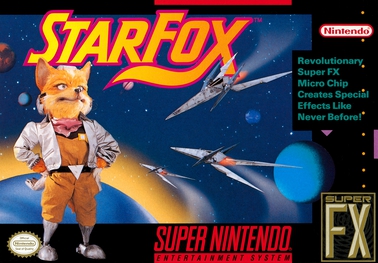
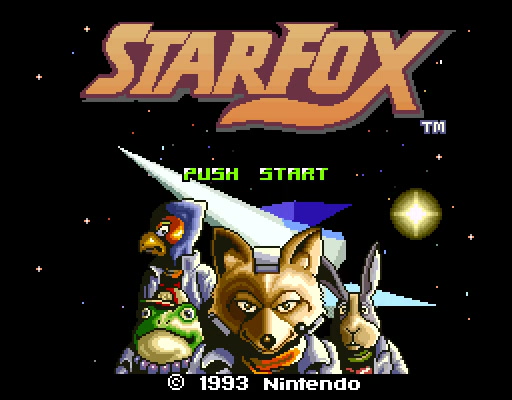
Star Fox - SNES (1993) · Nintendo EAD / Argonaut Software
Star Fox launched in February 1993 in Japan (as Starwing in Europe due to a German
trademark conflict) as proof that a home console could render real-time 3D polygon
graphics without tricks, smoke, or mirrors. A rail shooter set in the Lylat System,
it tasked Fox McCloud and his mercenary team with repelling an invasion by the
exiled scientist Andross. The game existed because Nintendo agreed to put a
separate processor in the cartridge - and that decision rewrote what home console
hardware was understood to be capable of.
A Pitch, a Chip, and Seventeen Months
In 1990, Jez San - founder of Argonaut Software and a self-taught hardware designer
- arrived at Nintendo’s Kyoto headquarters without an appointment to show
Shigeru Miyamoto a real-time 3D demonstration running on an ARM2 processor.
San had designed the chip prototype himself. Miyamoto was impressed enough to
propose a deal: Argonaut would design a dedicated 3D coprocessor for the SNES,
Nintendo would fund it, and the first game built on it would come from the
two studios working together.
The chip design work fell to Ben Cheese and Robert Aitken at Argonaut, who built
the GSU-1 (Graphics Support Unit 1) from scratch. The software fell to Dylan
Cuthbert, who was 17 when he joined the project and wrote the 3D engine that the
Super FX chip ran. Cuthbert worked at Nintendo’s offices in Kyoto for extended
periods during development, which was unusual enough in 1991 that Nintendo put the
team up in an apartment and handled the logistics of having a British teenager
living in Japan for months at a stretch.
“I was 17 when I wrote the first engine for Star Fox. I wrote it in assembler
because there was no other way to get the performance we needed. Every polygon
routine was hand-optimised.”
— Dylan Cuthbert, Retro Gamer Issue 68, 2009, on writing the Star Fox 3D engine
The character design came from Miyamoto drawing fox figures inspired by the stone
fox statues at Fushimi Inari-taisha, the Shinto shrine near his childhood home in
Sonobe, Kyoto Prefecture. Miyamoto has discussed this origin in multiple interviews,
noting that he wanted the team to feel like specific personalities rather than
generic space marines. The full cast - Fox McCloud, Falco Lombardi, Peppy Hare,
and Slippy Toad - were designed simultaneously and given contrasting
temperaments to give players someone to identify with on each run.
The Chip Inside the Cartridge
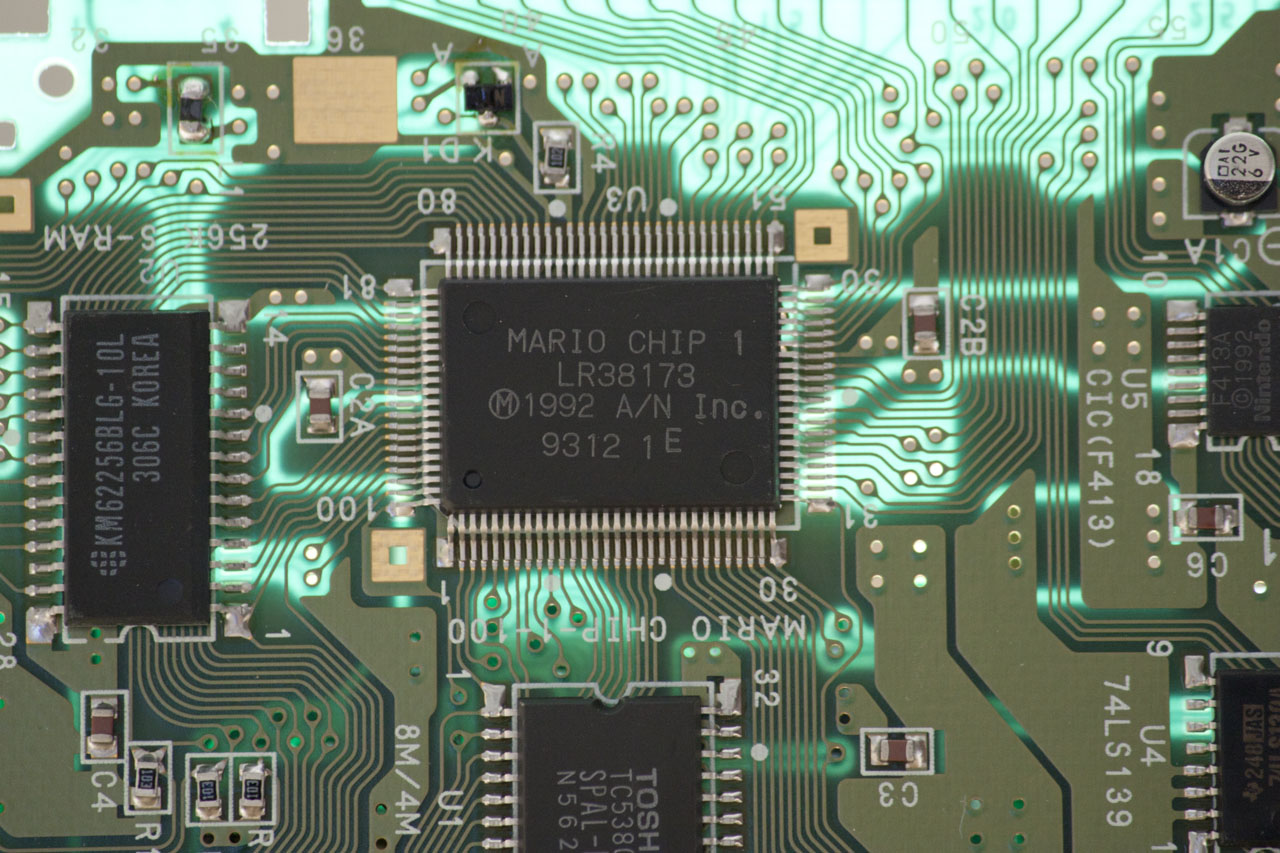
The Super FX chip ran at 10.5 MHz and functioned as a dedicated RISC
coprocessor embedded directly in the cartridge. It received polygon coordinates
from the game engine, performed the matrix transformations required to project
them onto the screen, and wrote the results into a frame buffer that the SNES
then read as video output. The SNES CPU - a 3.58 MHz Ricoh 5A22 - was
effectively demoted to an input-handler and audio scheduler while the Super FX
chip ran the entire game.
Chip Name
Super FX (MARIO Chip 1 / GSU-1)
Clock Speed
10.5 MHz
Architecture
RISC coprocessor - cartridge-embedded
Polygons per Frame
~80-100 (scene-dependent)
Frame Rate
10-20 fps (variable)
Audio
8-channel SNES SPC700 (Hirasawa)
The MARIO Chip 1 (GSU-1) inside a PAL Starwing cartridge - the hardware that made Star Fox possible
Cuthbert’s decisions about what to render as solid polygons and what to
represent as wireframes were practical engineering choices as much as aesthetic
ones. The wireframe enemies and distant terrain were direct consequences of
keeping the frame rate playable within the polygon budget. At roughly 80-100
polygons per frame, every object on screen had been budgeted to the vertex.
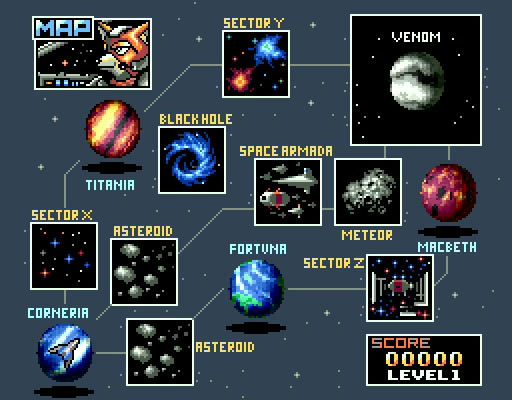
Three Routes Through the Lylat System
Star Fox structures its campaign as three branching routes - each starting
from Corneria and ending at Venom, home of the tyrant Andross. Routes were
selected at the start of the game and could not be changed mid-playthrough.
Route 1 provided seven missions at accessible difficulty; Route 3 presented
the densest enemy formations and demanded mastery of every system the game used.
Route 1 - Easy
1
Corneria
2
Sector Y
3
Meteo
4
Fortuna
5
Sector X
6
Macbeth
7
Venom
Route 3 - Hard
1
Corneria
2
Sector Y
3
Titania
4
Sector Z
5
Macbeth
6
Area 6
7
Venom
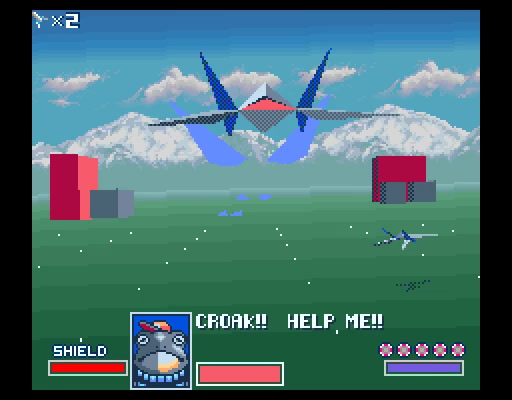
Corneria opens every route with an atmospheric dogfight
introducing all core Arwing mechanics: laser fire, barrel rolls (which deflect
incoming projectiles), boost and brake, and the wingman radio system. The
first boss - Granga, a giant bipedal walker - establishes the template for the
rest of the game: destroy the boss to advance, but protect your wingmen to
maintain their survival for subsequent missions.
Corneria - the opening mission, introducing Arwing combat over the Lylat capital city
Meteo is the game’s first environment demanding constant
evasion alongside combat. Asteroids cannot be shot and will destroy the Arwing
on contact - the player must navigate the rotating field using boost, brake, and
barrel rolls while maintaining offensive fire against enemies emerging from
the debris.
Meteo - the asteroid belt. Rotating debris demands constant evasion alongside combat.
Macbeth is the franchise’s most memorable surface mission:
a rail run over an industrial munitions planet beside a moving train. Players who
hit eight trackside switches can divert the train into a buffer before it reaches
the weapons depot - ending the level with a massive explosion and a score bonus.
Missing the switches leads to a conventional boss fight instead.
Area 6 (Route 3 only) is the definitive space combat gauntlet:
Andross’s primary fleet staging area, with the densest enemy formations
in the game. Surviving it leads directly to the Route 3 Venom approach and
Andross’s true form.
A boss encounter in deep space - massive wireframe mechanoids are a visual trademark of the 1993 original
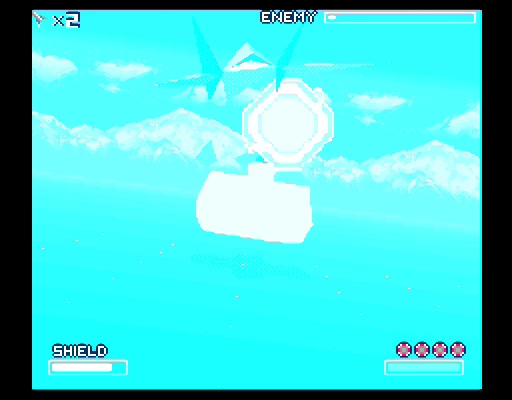
Andross: The Final Form Changes Everything
Andross is a former Cornerian scientist exiled to Venom for conducting biological
experiments that threatened Corneria City. From Venom, he built a military empire
and launched the invasion the Star Fox team is commissioned to stop. His
character design - a giant disembodied ape head and hands - was unprecedented
in the 3D gaming landscape of 1993.
The game presents two versions of Andross depending on the route taken to reach
Venom. Routes 1 and 2 confront Fox with a mechanical construct - an enormous face
that attacks with suction and explosive cube projectiles. Route 3 reveals
Andross’s biological true self: a disembodied brain with mechanical eyes,
representing his survival beyond exile through the corruption of his own body.
Completing Route 3 is the game’s true ending.
Venom - Andross’s toxic home planet and the final destination of all three routes
Critics Didn’t Know Where to Put It
Star Fox landed in North America in August 1993 and immediately created a problem
for reviewers: they had no comparative framework. Nintendo Power gave it 4.75 out
of 5, describing it as “the most impressive 3D game ever released for a home
system.” Electronic Gaming Monthly awarded it 8, 8, 9, and 9 across its
four reviewers, with the dissenting scores reflecting uncertainty about replay
value rather than technical doubt.
The common thread across 1993 reviews was astonishment. Most publications led
with the technology before getting to the game underneath it. The SNES was
assumed to be a 2D machine - Star Fox was filed mentally as a one-off novelty
rather than a new direction, and some reviewers wrote it up as such. In
retrospect, those reviews underestimated what the Super FX meant: it was not
a trick but an architecture that would appear in seven more SNES titles.
“When we saw the final game running on SNES hardware, even we couldn’t
quite believe it. The chip was doing exactly what we designed it to do - but
seeing the Arwing fly through Corneria on a TV that was supposed to be a
16-bit machine was genuinely surreal.”
— Jez San, Eurogamer retrospective on Star Fox and the Super FX chip, 2011
What the Super FX Unlocked
Star Fox sold over 4 million copies worldwide and proved the concept of the
cartridge coprocessor definitively. Nintendo used the Super FX architecture in
six subsequent SNES titles, including Stunt Race FX, Yoshi’s Island (which
used the chip for sprite scaling rather than 3D), and Doom. Each use found a
different application for the same underlying hardware approach: custom silicon
in the cartridge solving a problem the base console could not.
More importantly, Star Fox demonstrated that a home audience would buy a 3D game
even when the output was flat-shaded polygons at 15 frames per second. That
finding accelerated every subsequent conversation about what Nintendo should build
next - and those conversations led directly to the Nintendo 64. The franchise
itself continued through Star Fox 64, with later entries on GameCube, DS, Wii,
3DS, and Wii U. None of them fully recaptured the technical audacity of the
original, which was built simultaneously with the hardware that ran it.
Gameplay and Documentation
Star Fox SNES - full longplay (all three routes)
Super FX chip: how the cartridge coprocessor worked
Star Fox 2 (SNES, 1995 / 2017)
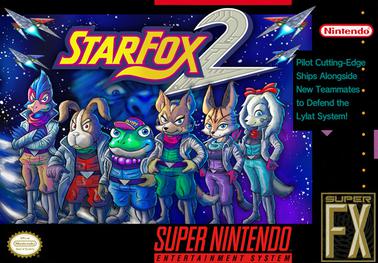
Star Fox 2 - officially released as part of the SNES Classic Edition in 2017, 21 years after its completion
Star Fox 2 was finished. The ROM was tested. The game was ready to ship.
Nintendo cancelled it in 1995, after the PlayStation and Saturn had demonstrated
what CD-based 3D gaming could look like - and Sega was preparing 3D titles that
made the SNES Super FX library look dated. Nintendo chose not to ship a game
that might undercut the case for the Nintendo 64. The Star Fox team’s
most ambitious SNES work sat unreleased for 21 years.
Better Hardware, More Ambitious Design
Star Fox 2 used the GSU-2 chip running at 21 MHz - double the speed of
the GSU-1. Dylan Cuthbert returned as the primary engineer, with the additional
capability allowing significantly more complex geometry, faster scene transitions,
and the real-time strategic overlay that was the game’s central new idea.
The game was developed from 1993 to 1995 by Argonaut and Nintendo, with the
expanded chip budget enabling features the original Star Fox could not have
supported. Two new playable pilots - Miyu and Fay - joined the existing team,
each with slightly different Arwing handling characteristics. Landmaster tank
and Blue Marine submarine transformations could be activated mid-mission, adding
surface and underwater combat to the rail-shooting core.
Chip
Super FX 2 (GSU-2)
Clock Speed
21 MHz
New Pilots
Miyu (lynx), Fay (poodle)
New Vehicles
Landmaster tank, Blue Marine
Multiplayer
Two-player simultaneous
Official Release
September 2017 (SNES Classic)
Strategy Layer on Top of a Rail Shooter
The design leap in Star Fox 2 was structural rather than technical. Where the
original game presented a fixed-sequence rail shooter with branching routes, Star
Fox 2 added a real-time strategic layer: a mission map showing the full Lylat
System, with enemy capital ships advancing toward Corneria while the player was
engaged in combat elsewhere. The player chose which missions to take based on
the current threat level - let too many enemy ships through and Corneria would
take damage it could not recover from.
This meant every playthrough created a different sequence of missions depending
on where threats materialised. The on-rails combat was the same as the original,
but the decision of which threat to address first gave the game a strategic dimension
that the 1993 game had deliberately avoided. Players who wanted the simpler
experience could focus on missions; players who engaged with the strategic layer
got something closer to a real-time strategy game with shooting sequences embedded.
A Sealed Chapter, Finally Opened
Star Fox 2’s 2017 release on the SNES Classic Edition confirmed what
the leaked ROM had suggested but not settled: the game was complete, functional,
and better than its cancellation implied. The strategic map, the two-player mode,
the expanded roster - all of it worked. Players who had spent years with the ROM
finally had an official release to compare against.
“Star Fox 2 was cancelled because of the competitive pressure at the time -
Nintendo wanted to focus attention on the N64 rather than show that the SNES
still had capability. It was a business decision, not a quality decision.”
— Jez San, Retro Gamer Issue 68, 2009, on the Star Fox 2 cancellation
The cancellation made the case, ironically, for the Star Fox team’s skill:
the game was finished to shipping quality in 1995, sat untouched for 22 years,
and released without significant modification. For players encountering it in
2017, the real surprise was not that it worked - but that it felt ahead of its
intended era. The strategic layer the game introduced would not appear in another
Star Fox title until Star Fox Command in 2006.
Star Fox 64 (Nintendo 64, 1997)
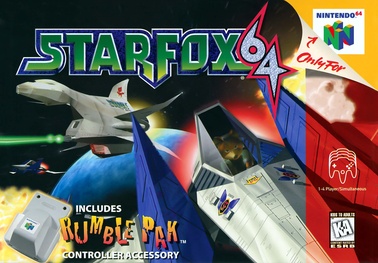
Star Fox 64 - Nintendo 64 (1997) · Nintendo EAD
Star Fox 64 is not a sequel to Star Fox. It is a complete rebuild - a retelling
of the same story on hardware that could render it the way the 1993 team had
originally imagined it. Released in April 1997 in Japan and June 1997 in North
America, it came with the Rumble Pak accessory bundled in the box and featured
voice acting throughout the campaign. Both were firsts for Nintendo.
Nintendo’s Own Team, Fresh Start
Argonaut Software was not involved in Star Fox 64. Nintendo EAD - the internal
team that had overseen the original - took full ownership of the sequel, with
Shigeru Miyamoto and Takao Shimizu as producers. The separation was deliberate:
the N64 was powerful enough that Nintendo did not need Argonaut’s hardware
expertise, and the creative direction needed to evolve beyond the constraints
of the Super FX era.
Development ran from 1995 to 1997 and involved significant expansion of the
Lylat System map. The original game’s 22 stages across three routes were
replaced with a branching structure across multiple planets, with medal challenges
(kill quotas per stage) providing a reason to replay routes after completing the
game. The voice acting - recorded in English for the North American market and
re-voiced for Japanese release - was written to match the character personalities
established in the original game’s manual and marketing.
Star Fox 64 in combat - the N64 hardware allowed significantly more geometry and detail than the Super FX original
Fox! Use the Boost to Get Through!
The gameplay loop of Star Fox 64 shares its core structure with the original:
on-rails corridor sections with branching paths decided by performance and
route-splitting moments. The additions distinguish it substantially. All-Range
Mode - deployed in specific boss battles - switched the game from rail shooter
to fully free-roaming space combat, requiring players to pursue enemies and
protect targets rather than just survive a gauntlet.
The medal system rewarded total enemies destroyed per stage, with medals
unlocking Expert mode - a harder difficulty with doubled enemy aggression.
Players who earned medals on all stages could unlock the Expert mode campaign,
which replayed the entire game with significantly elevated challenge.
The result was a structure that served casual players (finish the campaign
on any route) and completionists (collect all medals, unlock Expert, beat
that too) in the same package.
Wingman commands expanded substantially from the original: players could now
give active instructions to Falco, Slippy, and Peppy, order them to cover
specific positions, and save them from attacking enemies mid-mission. The radio
communication system provided personality throughout - Peppy’s tactical
advice, Falco’s complaints about being outperformed, Slippy’s
panicked calls for help became the texture of the game’s identity.
First Pak, First Voice
Star Fox 64 shipped bundled with the Rumble Pak, making it the first cartridge
game to use Nintendo’s force-feedback accessory (the N64 version of Wave
Race 64 had used it previously in Japan via a different distribution route, but
Star Fox 64 was the Rumble Pak’s global introduction). The pak connected
to the N64 controller’s expansion port and vibrated on hits, explosions,
and laser fire - the first time a home console controller had communicated
physical impact as a standard feature.
The voice acting was similarly notable. Where the original Star Fox communicated
character through radio text and the player’s manual, Star Fox 64 put
Peppy, Falco, Slippy, and Andross in the player’s ear throughout every
mission. The decision required Nintendo to hire voice actors, write full scripts,
and record sessions in both English and Japanese - a production overhead the
company had not previously applied to action games.
Platform
Nintendo 64
First Use
Rumble Pak (cartridge game, worldwide)
Voice Acting
Full campaign, English and Japanese
Routes
Multiple branching paths, 15 stages
Medal System
Kill quotas unlock Expert mode
Sales
3.45 million (North America)
Critics Unanimous for Once
Star Fox 64 received some of the strongest reviews of the N64’s first
two years. Nintendo Power gave it a 9.1 and placed it in the top tier of the
console’s library at that point. Electronic Gaming Monthly scored it
9.5, 8.5, 9, and 9 - the first time an EGM multi-reviewer panel had converged
that closely on a Nintendo action title. GameSpot gave it 9.2.
The critical consensus centred on three things: the Rumble Pak integration
feeling genuinely new, the branching campaign providing substantial replay value,
and the voice acting landing the character personalities in a way that the
original’s text boxes had not. Criticisms were largely about length - the
game’s main campaign could be completed in around two hours on the easy
route, and reviewers who had paid full price for a rail shooter wrote about value
for money as sharply as they had in 1993.
“With Star Fox 64, we wanted to show people what Star Fox could really be
when you didn’t have to fight the hardware. The N64 let us think about
design instead of polygons.”
— Shigeru Miyamoto, producer, Nintendo Power interview, 1997, issue 97
Every Sequel Has Been Chasing This One
Star Fox 64 was remade for Nintendo 3DS in 2011 as Star Fox 64 3D, using
the handheld’s stereoscopic display and gyroscope controls. The port was
faithful - critics who compared the two versions noted that the original’s
design was tight enough that adding graphical fidelity revealed no underlying
weaknesses in structure. In Europe and Australia, Star Fox 64 was released as
Lylat Wars; the 3DS version retained the Lylat Wars title in PAL territories.
The game’s influence on subsequent Star Fox entries is most visible by
its absence. Star Fox Adventures (2002), Star Fox Assault (2005), Star Fox
Command (2006), and Star Fox Zero (2016) each attempted a different structural
variation - open-world adventure, third-person shooter, strategy-shooter,
dual-screen split. None achieved the critical standing of Star Fox 64, and
each returned to elements of it as a reference point. The rail shooter format,
the medal system, the wingman dynamic, and the voice-acted banter
remain the franchise’s spine in how it is remembered and discussed.