Flagship Title · 1996 – 2000

Metal Slug

The most densely animated 2D game ever made. A deep dive into sprite art, stage design, and the philosophy behind the series.

Nazca Corporation — 1996

Metal Slug was developed by Nazca Corporation - a team of former Irem employees who had worked on Gunforce and In the Hunt. SNK published the first game in 1996, and subsequently acquired Nazca outright. The team brought with them an obsessive commitment to hand-drawn sprite animation that would define the series across its first three entries.

The original Metal Slug (1996) was immediately recognisable as something different. Where other run-and-gun games of the era used minimal animation frames to convey character movement, Metal Slug employed what appeared to be an exhaustive cycle of hand-drawn frames for every action, reaction, and incidental event. Soldiers stumbled, panicked, and surrendered with individual personality. Explosions billowed with multiple layers. The title tank - the SV-001, the “Metal Slug” - deformed and shook with vehicle physics drawn frame by frame.

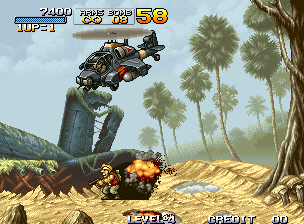
Metal Slug (1996) - arcade screenshot showing the SV-001 Metal Slug tank in combat
Metal Slug (1996) - the SV-001 tank that gave the series its name. Every suspension bounce is individually drawn.

Animation Density

The defining characteristic of the Metal Slug series is its animation frame density. To understand what made this unusual, consider that a typical SNES or Mega Drive action game might allocate 4–8 frames per animation state for a character. The most lavishly animated games of the 16-bit era - Aladdin (Virgin, Mega Drive), Donkey Kong Country - were celebrated for hitting 20–30 frames in some sequences.

Metal Slug’s Marco Rossi walking animation uses approximately 12 frames - straightforward by the series’ own standards. But the enemy soldiers react to being shot with 15+ frame panic/death sequences; the Metal Slug tank enters and exits with multi-stage deformation animations; environment elements (palm trees, barrels, foliage) have their own idle and destruction cycles. The game’s total sprite frame count across all characters and objects runs into the thousands.

Metal Slug 3 (2000) expanded this to a degree that remains unmatched in 2D game history. The final boss sequence alone deploys an estimated 500+ individually drawn frames. The zombie transformation sequence introduces new animation states that exist only for a brief in-game event, representing hours of artist time for seconds of gameplay.

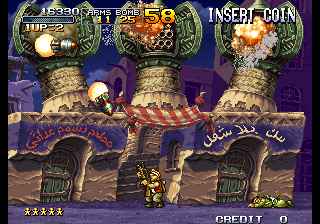
Metal Slug 2 (1998) - arcade screenshot showing alien enemies and character in combat
Metal Slug 2 (1998) - introduced alien enemies, each with complex idle and attack animations.
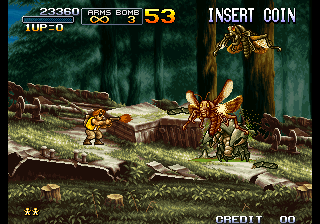
Metal Slug 3 (2000) - arcade screenshot showing the dense sprite work and boss sequences the series is known for
Metal Slug 3 (2000) - widely cited as the most densely animated 2D game ever made, with an estimated 12,000+ unique sprite frames.

Stage Design & Vehicle Mechanics

Metal Slug stages are structured around a principle of escalating density: early areas establish the baseline threat level, mid-stage sections introduce new enemy types and environmental hazards, and boss encounters recontextualise everything the player has learned. This structure is consistent across all three Nazca entries and was sophisticated relative to the genre standard of the era.

The vehicle mechanics are the series’ second defining contribution. The Metal Slug tank is not simply a power-up - it is a physics object with weight, momentum, and vulnerability. The tank can be destroyed, its treads shot off, its gun barrel damaged. Enemies react to the tank differently from the player character, creating tactical decisions about when to fight on foot versus in armour. Later vehicles (the camel, the elephant, the submarine) each introduced new movement physics with individually drawn animation states.

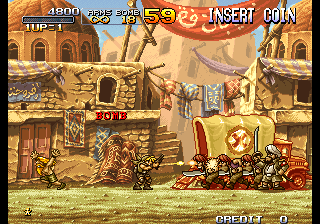
Metal Slug X (1999) - arcade screenshot showing the expanded vehicle roster including camel and elephant
Metal Slug X (1999) - an enhanced revision of Metal Slug 2 that introduced new vehicles (camel, elephant, submarine), each with individually drawn physics and animation states.

“We drew every frame by hand. We never thought about shortcuts. We just kept drawing until it felt right.”

— Nazca Corporation sprite artist, interview circa 1997

See the Animation

Metal Slug 3 - Full Longplay

Complete longplay of Metal Slug 3 (2000), showcasing the final boss sequence and the full range of sprite animation the Nazca/SNK team produced.