The Story

History

How a semiconductor company and a software house built the console that beat everyone — then watched the world catch up. 1987 → Japan dominance → CD-ROM → the West.

Timeline

1985

The Partnership Forms

NEC and Hudson Soft begin joint development of what will become the PC Engine. NEC provides hardware engineering; Hudson provides the CPU and software expertise.

1987

Japan Launch

PC Engine launches in Japan on 30 October 1987. Smallest console ever made at launch. The HuC6280 CPU and the TurboGrafx display chip deliver unprecedented graphics.

1988

R-Type & Dominance

R-Type (PC Engine, 1988) demonstrates the platform’s technical superiority. The console outsells the Famicom in Japan and beats the Mega Drive to market by two years.

1988

CD-ROM² Launches

The PC Engine CD-ROM² expansion unit launches in December 1988 — the world’s first console CD-ROM add-on. It transforms the platform’s capabilities overnight.

1989

Ys I & II on CD

Ys I & II debuts on PC Engine CD-ROM². Full voice acting, redbook audio, and two complete RPGs on a single CD demonstrate the format’s transformative potential.

1989

TurboGrafx-16 West

NEC Technologies launches the TurboGrafx-16 in North America in August 1989. Marketing challenges and limited software library hamper Western uptake despite superior hardware.

1990

SuperGrafx

The PC Engine SuperGrafx launches in Japan with enhanced hardware. Only five games ever exploit its expanded capabilities; the standard PC Engine remains the dominant platform.

1991

PC Engine Duo

The PC Engine Duo combines console and CD-ROM unit into a single machine. Hugely popular in Japan, it reinvigorates the platform heading into its golden CD-ROM era.

1993

Rondo of Blood

Castlevania: Rondo of Blood launches exclusively for PC Engine CD-ROM in Japan. One of the greatest action games ever made, it remained Japan-exclusive until 2007.

1994+

Legacy

Production winds down as PlayStation and Saturn arrive. The PC Engine’s library — over 700 titles — remains one of the most curated and celebrated of any retro platform.

The NEC & Hudson Partnership

An Unlikely Alliance

NEC Corporation was one of Japan’s largest semiconductor and electronics companies — it built computers, not games. Hudson Soft was a software house from Hokkaido with deep roots in PC game development and a reputation for quality ports. When the two companies began collaborating in the mid-1980s, the arrangement was straightforward: NEC would provide the hardware infrastructure and manufacturing capability; Hudson would provide the custom CPU and the software pipeline.

Hudson’s engineers designed the HuC6280 — a custom 8-bit CPU derived from the MOS Technology 6502 architecture, clocked at 7.16 MHz with a built-in sound generator, DMA controller, and timer. The CPU choice was deliberately pragmatic: 6502-derived chips were well-understood, easy to program, and supported a rich existing library of development tools. The graphics work, however, would be anything but conventional.

8-Bit CPU, 16-Bit Graphics

The PC Engine’s graphics subsystem was built around two custom chips: the HuC6270 Video Display Controller (VDC) and the HuC6260 Video Color Encoder (VCE). The VDC could address 64 KB of dedicated video RAM, display 512 on-screen colors from a palette of 512, and manage up to 64 hardware sprites simultaneously. For 1987, these were extraordinary specifications.

The result was a machine that appeared — and in most practical respects performed — as a 16-bit console despite its 8-bit CPU. Marketing teams later emphasized this with the TurboGrafx-16 name in North America, but in Japan the machine sold on the strength of its software rather than its specification sheet.

Did You Know?

Hudson Soft designed the HuC6280 CPU in-house, making it one of the few software companies to design custom silicon for its own console. The chip’s built-in PSG sound generator produced 6-channel audio with wave memory synthesis — a significant step beyond the NES.
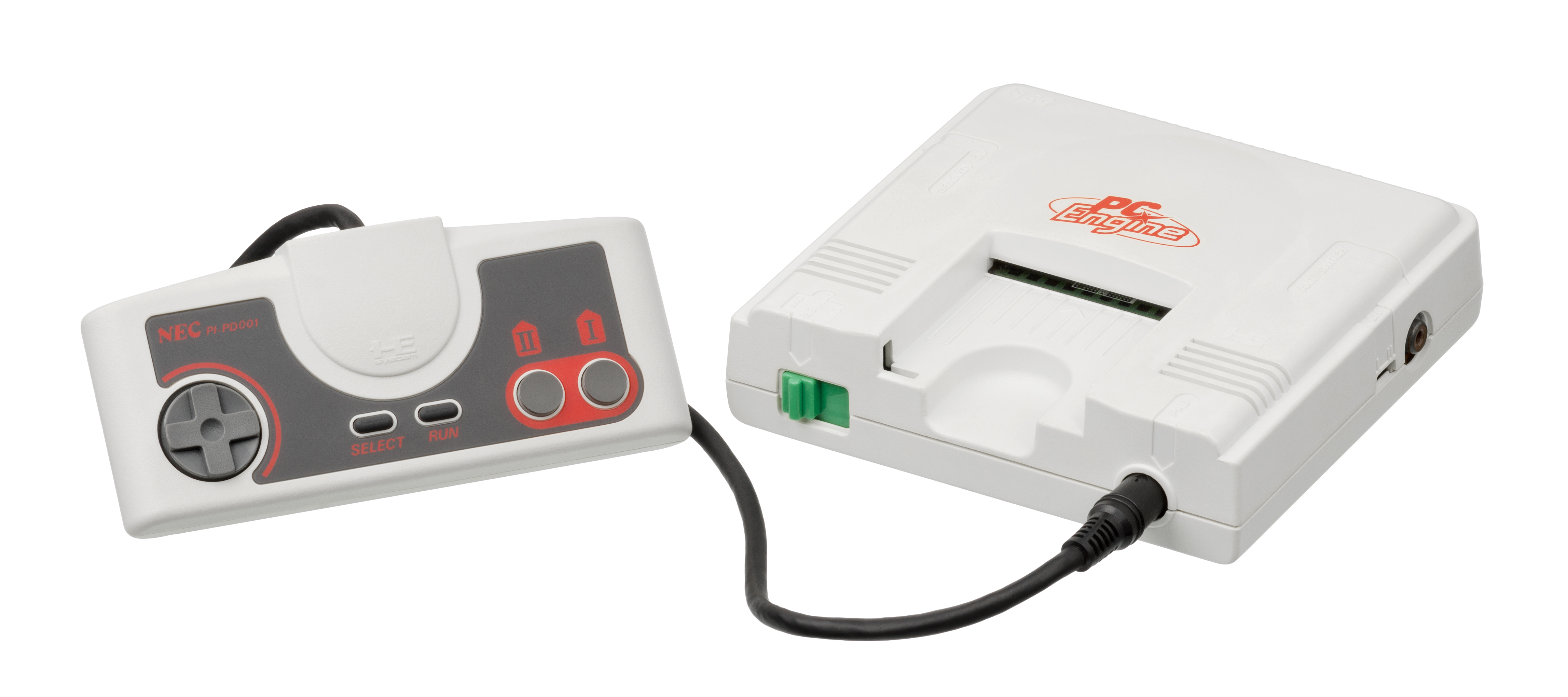
NEC PC Engine original white console - 1987
The original PC Engine (1987) in its distinctive cream-white casing. The machine measured just 14 × 14 × 3.8 cm and weighed 380 grams.
We didn’t think of it as a game console. We thought of it as a dedicated computer for entertainment. The size was a statement about Japanese precision engineering. — NEC engineer, PC Engine development retrospective (1990)

Japan Dominance

Beating the Mega Drive to Market

The PC Engine launched in October 1987 into a Japanese market dominated by the Famicom. Within months, it was outselling the aging Nintendo hardware in many retail categories. Most crucially, it launched two years before the Sega Mega Drive (October 1988) and four years before the Super Famicom (1990). That head start — in hardware installed base and software library — gave the PC Engine an enduring foothold in Japan that competitors never fully dislodged.

R-Type’s 1988 HuCard release was the pivotal moment. Irem’s arcade hit had been declared impossible to port convincingly to home hardware. Hudson proved otherwise, splitting the game across two HuCards for the initial Japanese release and producing an arcade-quality version that demonstrated the platform’s ceiling to everyone who saw it. Console sales accelerated sharply.

The CD-ROM² Expansion: 1988

In December 1988 NEC and Hudson released the PC Engine CD-ROM² interface unit, connecting to the console’s expansion port. It was the world’s first console CD-ROM add-on, and it transformed the platform completely. Where HuCards offered megabytes, CDs offered hundreds. Where HuCard audio was PSG synthesis, CD-ROM audio was full redbook stereo.

The first wave of CD titles demonstrated what this meant in practice. Ys I & II (1989) arrived with full voice acting in a genre — the action RPG — where voice work had never before been a feature of a home release. The experience was categorically different from anything available on any console, and it established the PC Engine CD-ROM² as the platform for cinematic gaming ambition in Japan.

Did You Know?

The CD-ROM² expansion added 64 KB of additional RAM and a dedicated CD buffer, effectively doubling the system’s RAM. Later iterations — the Super CD-ROM² and Arcade Card — expanded this further, enabling games impossible on any other 1990s console.

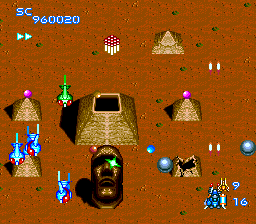
Blazing Lazers gameplay - one of the PC Engine's early showcase titles, 1989
Blazing Lazers (1989) - Compile’s vertical shooter was among the PC Engine’s most technically impressive early HuCard titles, demonstrating the hardware’s sprite capabilities during its peak Japan dominance period.
Putting voice acting into Ys on PC Engine CD felt impossible right up until we shipped it. Then we realised the CD wasn’t just bigger storage — it was an entirely different medium. — Falcom development note, 1989

Regional Differences & the West

TurboGrafx-16: The Western Identity

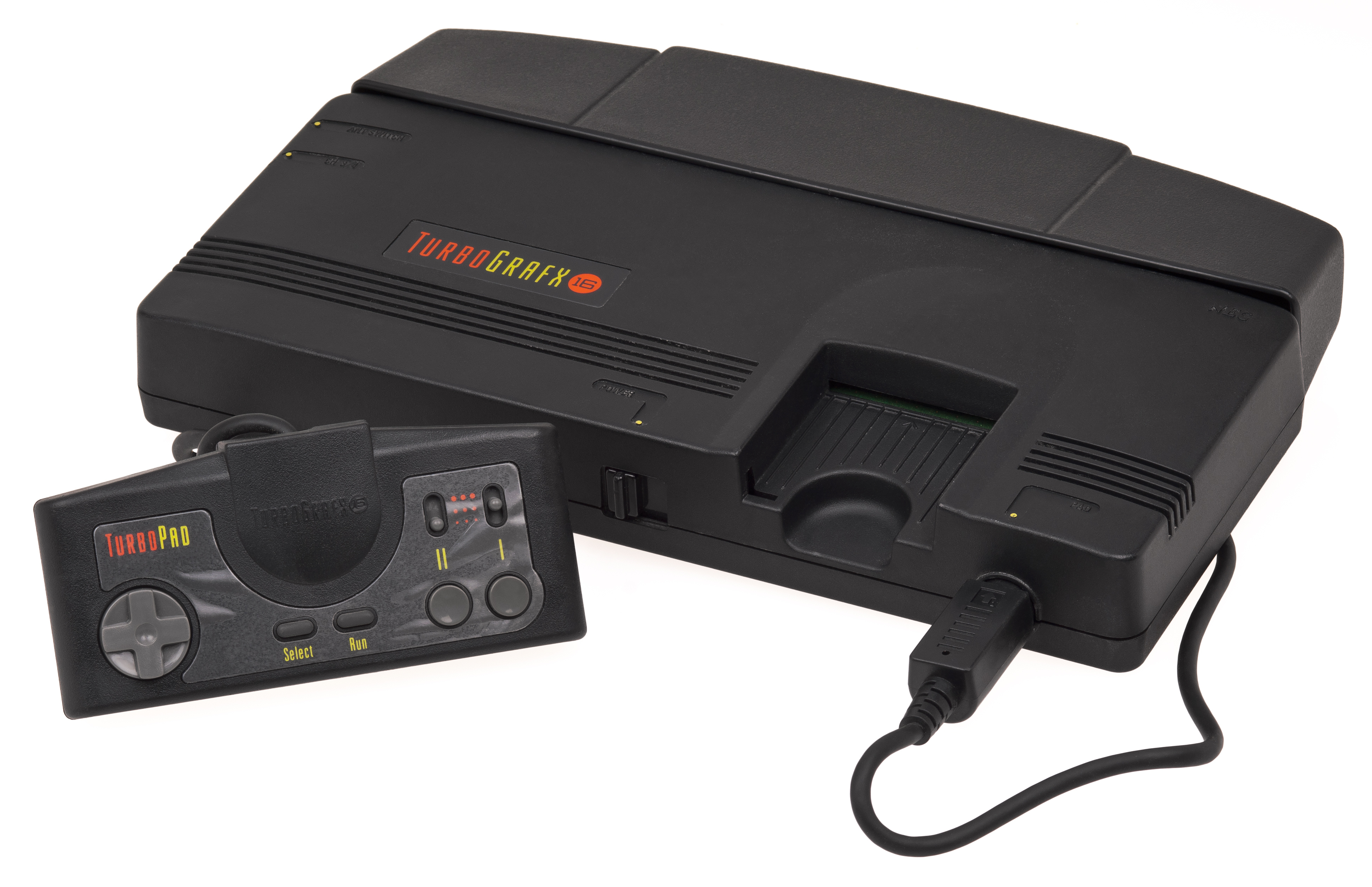
NEC Technologies marketed the console in North America as the TurboGrafx-16, launching in August 1989. The hardware was identical to the Japanese PC Engine, with minor cosmetic differences: a black housing rather than white, a slightly larger form factor, and the TurboGrafx-16 branding emphasizing the console’s graphical credentials in the emerging 16-bit marketing war.

The North American launch was troubled. NEC’s marketing budget was modest compared to Sega’s aggressive Genesis campaign. The launch lineup — strong as it was technically — leaned heavily on Japanese conversions that lacked the cultural resonance of the Sega or Nintendo brands in North America. The TurboGrafx-16 never achieved more than a niche position in the West despite its hardware superiority.

Japan Exclusives: The Hidden Library

The divergence between PC Engine and TurboGrafx-16 libraries was significant. Dozens of the platform’s finest titles — Castlevania: Rondo of Blood (1993), Sapphire (1993), The Dynastic Hero, Dracula X’s original form — remained Japan-exclusive for years, some indefinitely. The PC Engine’s true library was accessible only to players willing to engage with import gaming.

This exclusivity has only deepened the platform’s mystique among collectors. PC Engine CD-ROM² software — particularly SuperGrafx titles, Arcade Card releases, and late-generation CD games — commands significant sums at auction, reflecting both scarcity and the quality of the games themselves.

Did You Know?

Castlevania: Rondo of Blood (1993) remained Japan-exclusive for 14 years after its original release. When it was finally made available in the West via the PSP Collection in 2007, it was immediately recognised as one of the series’ finest entries — a verdict the Japanese fanbase had held for over a decade.

TurboGrafx-16 console set - the North American version
The TurboGrafx-16 (1989) - NEC’s North American identity for the PC Engine. Black housing, same hardware inside.

History Documentary

History of the Amazing PC Engine - Book I

Shmup Junkie’s comprehensive breakdown of the PC Engine’s history, hardware, and library — covering the console’s Japanese origins, the NEC and Hudson partnership, and the CD-ROM² expansion that changed everything.

Documentary · Shmup Junkie