Flagship Titles
Deep editorial dives into the games that defined Ocean Software’s legacy — their design, their soundtracks, their cultural impact, and why they still matter.
ROBOCOP
Defining the Film Tie-In Genre
From Orion Pictures to Old Trafford
Paul Verhoeven’s RoboCop arrived in cinemas in July 1987 as one of the most violent and satirically charged science-fiction films of the decade. Distributed by Orion Pictures, the film was an immediate commercial phenomenon, grossing over $53 million in its North American theatrical run and generating enormous ancillary interest in merchandise, sequels, and, inevitably, a video game adaptation. Ocean Software, already established as the pre-eminent British publisher of film and television licences, moved quickly to secure the rights.
The race to obtain high-profile film licences was, by the late 1980s, intensely competitive. Ocean’s Manchester offices had built a well-oiled pipeline for turning Hollywood properties into home computer software, and RoboCop represented exactly the kind of instantly recognisable, action-oriented IP that translated most readily to the arcade-style gameplay conventions of the era. The deal was structured to deliver the game simultaneously with the film’s home video release - a timing strategy that required Ocean to work from pre-release film materials, stills, and production notes rather than waiting to see the finished product.
The Game Design Challenge
Translating a film as viscerally violent as RoboCop into a form acceptable for home computers and consoles in 1988 posed a genuine design challenge. The certification landscape was different then — the PEGI system did not yet exist, and platform holders were sensitive about content — but more fundamentally, the question of how to communicate the film’s kinetic action in software form demanded a clear structural answer.
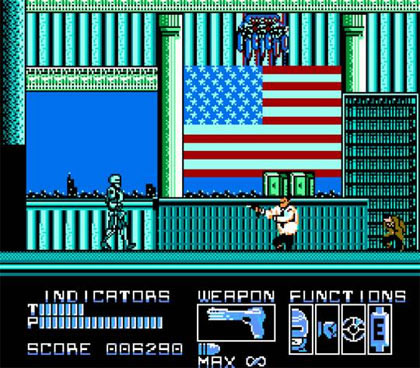
The solution arrived at was a horizontally scrolling run-and-gun shooter, a format that had been popularised in arcades by titles such as Green Beret and its home conversions. RoboCop walked from left to right, shooting gang members and recovering hostages across five stages that loosely mirrored the film’s narrative arc. Bonus stages required players to replicate RoboCop’s marksmanship test sequences from the film, adding variety and a direct visual reference that audiences who had seen the film would immediately recognise.
The engineering challenge was compounded by the requirement for a simultaneous multi-platform release. The Commodore 64, ZX Spectrum, Amstrad CPC, Amiga, Atari ST, DOS, NES, and later the SNES and Game Boy all received versions, each requiring the game to be rebuilt from the ground up to suit the hardware constraints of the target platform. The C64 version, produced in-house at Ocean, became the reference against which the others were judged.
Jonathan Dunn’s Soundtrack
If there is a single element of the RoboCop C64 release that has outlasted every other aspect of its production, it is Jonathan Dunn’s original soundtrack. Basil Poledouris had written a full orchestral score for the film, a propulsive, militaristic work built around repeating brass figures and a memorably heroic main theme. Dunn’s task was to render something of that sensibility within the constraints of the SID chip’s three oscillators and limited filter capabilities.
What he produced was a remarkably faithful translation. The SID version of the RoboCop theme captures Poledouris’s martial swagger while also demonstrating complete mastery of the 6581 chip’s characteristic sound — the filter sweeps, the pulse-width modulation, and the rhythmic percussion patterns that no other sound chip of the period could produce. It is a piece of music that sounds unmistakably like the film and equally unmistakably like the Commodore 64, an achievement that requires real compositional skill.
The full soundtrack extends beyond the main theme to include stage music and jingles that maintain the film’s tone throughout play. Dunn would go on to become one of the most celebrated composers in the Ocean stable, but RoboCop represents his introduction to a wider audience. Listen to Jonathan Dunn’s RoboCop score on the Music page →
Top of the Charts for Weeks
RoboCop was an extraordinary commercial success for Ocean. Published in late 1988 and early 1989 across its many platforms, it became one of the best-selling home computer games of the year in both the United Kingdom and continental Europe. The C64 version reached number one in the sales charts and remained there for several weeks; the Spectrum version performed similarly strongly in the United Kingdom market, where the machine retained a substantial user base into the late 1980s.
The game’s success had consequences that extended well beyond Ocean’s balance sheet. It demonstrated to the broader software industry that a film tie-in, if executed with genuine craft and a sense of occasion, could achieve sales comparable to or exceeding the game’s closest arcade competitors. Publishers who had previously treated film licences as guaranteed but creatively undemanding projects were forced to reconsider their approach. RoboCop, more than any other single title, established the template for the high-quality, heavily marketed, simultaneous-release film tie-in that would dominate the British and European software charts for the next several years.
RoboCop is a stunning achievement. The graphics are excellent, the gameplay is gripping, and Jonathan Dunn’s soundtrack is simply the best music yet heard on the Commodore 64. Ocean has set a new standard for film conversions that its rivals will struggle to match.
Zzap!64 magazine, issue 40, 1988
Three Sequels and a Defining Template
Revisiting RoboCop today is to encounter a game that wears its period constraints proudly but has not been entirely diminished by time. The core run-and-gun action is straightforward by contemporary standards, but the controls are responsive, the difficulty curve is reasonably judged, and the Dunn soundtrack remains a genuine pleasure. More importantly, the game functions as a primary document of what British software publishing looked like at its commercial and creative apex.
The RoboCop licence relationship with Ocean would continue through two sequels, both of which maintained the run-and-gun format while varying the specific implementation. Neither achieved quite the same combination of critical and commercial success as the original, though RoboCop 3 (1992), with a C64 score by Jeroen Tel, is regarded by some SID enthusiasts as musically superior to the original. See the full RoboCop catalogue entry →
BATMAN: THE MOVIE
A Jonathan Dunn Masterwork
Eight Platforms, One Release Date
By 1989 Ocean had refined its film licence pipeline considerably, but Tim Burton’s Batman presented challenges of a different order to anything the company had previously handled. The film was one of the most anticipated theatrical releases of the decade - Batman is perhaps the most culturally omnipresent superhero in Western popular culture - and Warner Bros, acutely conscious of the character’s commercial value, imposed tighter creative controls than Ocean had encountered with previous licences.
The expectation of a simultaneous worldwide release, matching the film’s own June 1989 opening date, compressed the development timeline severely. Ocean had perhaps eighteen months from the signing of the licence agreement to the need for finished, localised, manufactured product on shop shelves. The game had to work on the Commodore 64, Amiga, Atari ST, ZX Spectrum, Amstrad CPC, DOS, and the NES - a broader platform spread than RoboCop had required - and it had to look and feel commensurate with the cultural weight of the property it was adapting.
The pressure produced, arguably, the finest game Ocean ever released.
Game Design and Structure
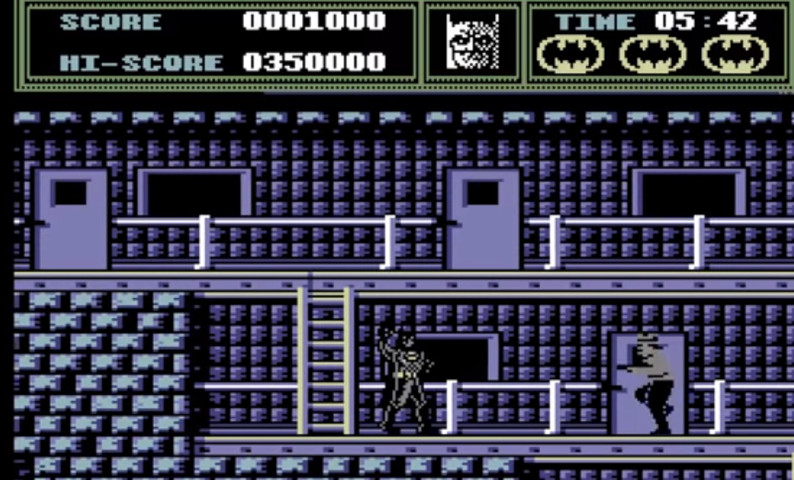
Where RoboCop had settled on a single gameplay mode for its entire duration, Batman: The Movie was designed around variety. The game featured five distinct gameplay modes spread across its five stages: a running-and-fighting street brawl in the Gotham City prologue; a bat-gadget platformer inside a chemical factory; a Batmobile driving sequence through Gotham’s streets; a Batskiboat pursuit through the city’s sewer network; and a final vertical-scrolling flight sequence up Gotham Cathedral in which Batman must ascend to confront the Joker.
This structural variety was a deliberate design philosophy. Ocean’s lead designer on the project understood that a film as visually varied as Burton’s Batman demanded a game that moved through different registers rather than settling into a single mechanical loop. Each stage uses the film’s visual language — the gothic architecture, the anachronistic machinery, the Art Deco styling — as its backdrop, and each mode is implemented with sufficient polish that none feels like a lesser afterthought grafted onto the core experience.
The Amiga version, benefiting from the hardware’s superior colour depth and audio capabilities, is arguably the definitive rendition. The C64 version, however, makes a persuasive case for itself on the basis of Dunn’s soundtrack alone.
The SID Score
Jonathan Dunn’s score for Batman: The Movie on the Commodore 64 is, by the consensus of the SID community and retrogaming criticism more broadly, one of the finest pieces of computer game music ever written. The claim is not hyperbolic. The main theme — Dunn’s original composition, not a direct transcription of Danny Elfman’s celebrated film score — is a heroic, gothic fanfare that exploits virtually every expressive capability of the 6581 SID chip. The filter resonance, the arpeggio patterns, the rhythmic bass pulse, the lead melody’s precise envelope shaping: every element is exactingly crafted.
Dunn’s relationship to Elfman’s film score is one of creative translation rather than literal transcription. Elfman’s Batman theme is built around an ascending four-note motif that became one of the most recognised film cues of the late 1980s. Dunn acknowledges that sensibility — the grandeur, the darkness, the operatic scale — while writing music that is entirely his own and is optimised for the specific timbral characteristics of the SID chip rather than struggling against them. The result sounds precisely like Batman ought to sound on a home computer of 1989.
Subsequent stage music and the various jingles and fanfares throughout the game maintain this exceptional standard. The Batman: The Movie SID file remains among the most downloaded in the HVSC archive and is regularly cited in discussions of game music composition as a demonstrative example of what constraint-driven composition can achieve. Listen to Jonathan Dunn’s Batman: The Movie score →
Reception and Impact
The critical reception was extraordinary across platforms. Zzap!64 awarded the C64 version 92%, describing the music as exceptional and the variety of gameplay modes as setting a new standard for licensed titles. Crash magazine, reviewing the Spectrum version, awarded 93%, noting the game’s ambition in attempting to capture multiple aspects of the film’s visual and narrative range. Amiga Power, in a retrospective assessment, gave the Amiga version 87%, acknowledging that the 16-bit conversion, while visually impressive, lost something of the C64 version’s concentrated intensity.
The NES version, developed separately for the North American and Japanese markets, received its own strong notices in the American games press. ACE magazine, which reviewed across multiple formats, noted that the Batman licence had been handled with unusual intelligence and care. The consensus across all reviewing publications and all platforms was that Ocean had produced something genuinely exceptional — a game that justified its licence rather than merely exploiting it.
Sales matched the critical reception. Batman: The Movie was the top-selling home computer title in the United Kingdom for several weeks following its release, becoming Ocean’s biggest commercial success to that point and establishing a benchmark against which all subsequent film tie-ins would be measured.
Why Batman Matters
Batman: The Movie’s enduring reputation rests on the convergence of several factors that rarely align so completely: a culturally significant licence, a genuinely ambitious game design, and a soundtrack that transcends its original context. Most film tie-ins achieve one of these things, occasionally two. Batman: The Movie achieved all three.
The game established Jonathan Dunn as the pre-eminent game music composer of the late 1980s and cemented Ocean’s reputation as a publisher capable of treating the medium seriously. It also demonstrated that the Commodore 64, a machine that manufacturers were already beginning to describe as obsolescent in 1989, still had expressive capabilities that had not been fully exhausted. See the full Batman: The Movie catalogue entry →
Batman is the complete film tie-in. Five completely different game modes, staggering visuals on the Amiga, and a Jonathan Dunn SID soundtrack that is the finest piece of computer music we have ever heard. This is the game every licensed title should aspire to be.
Zzap!64 magazine, issue 51, 1989
WIZBALL
Sensible Software’s Creative Peak
Sensible Software and Ocean
Wizball emerged from the creative partnership between Jon Hare and Chris Yates at Sensible Software, a small Chelmsford-based studio that would later become famous for Sensible Soccer and Cannon Fodder. In 1987, Sensible Software was a young team with a surplus of creative ideas and the technical skill to realise them, but limited publishing infrastructure. Ocean provided the latter: the marketing budget, the distribution network, and the retail relationships that transformed a promising prototype into one of the most widely reviewed games of the year.
The relationship between developer and publisher in the British software industry of the 1980s was rarely uncomplicated, but the Wizball partnership appears to have functioned well. Ocean gave Sensible Software unusual latitude — Wizball is an emphatically idiosyncratic game, and it is not obvious how it would have been packaged and marketed by a publisher less confident in its ability to sell unconventional titles. That Ocean committed to it fully, with a prominent release, strong advertising, and a competitive retail price, reflects credit on the publishing operation as much as on the development team.
Game Design
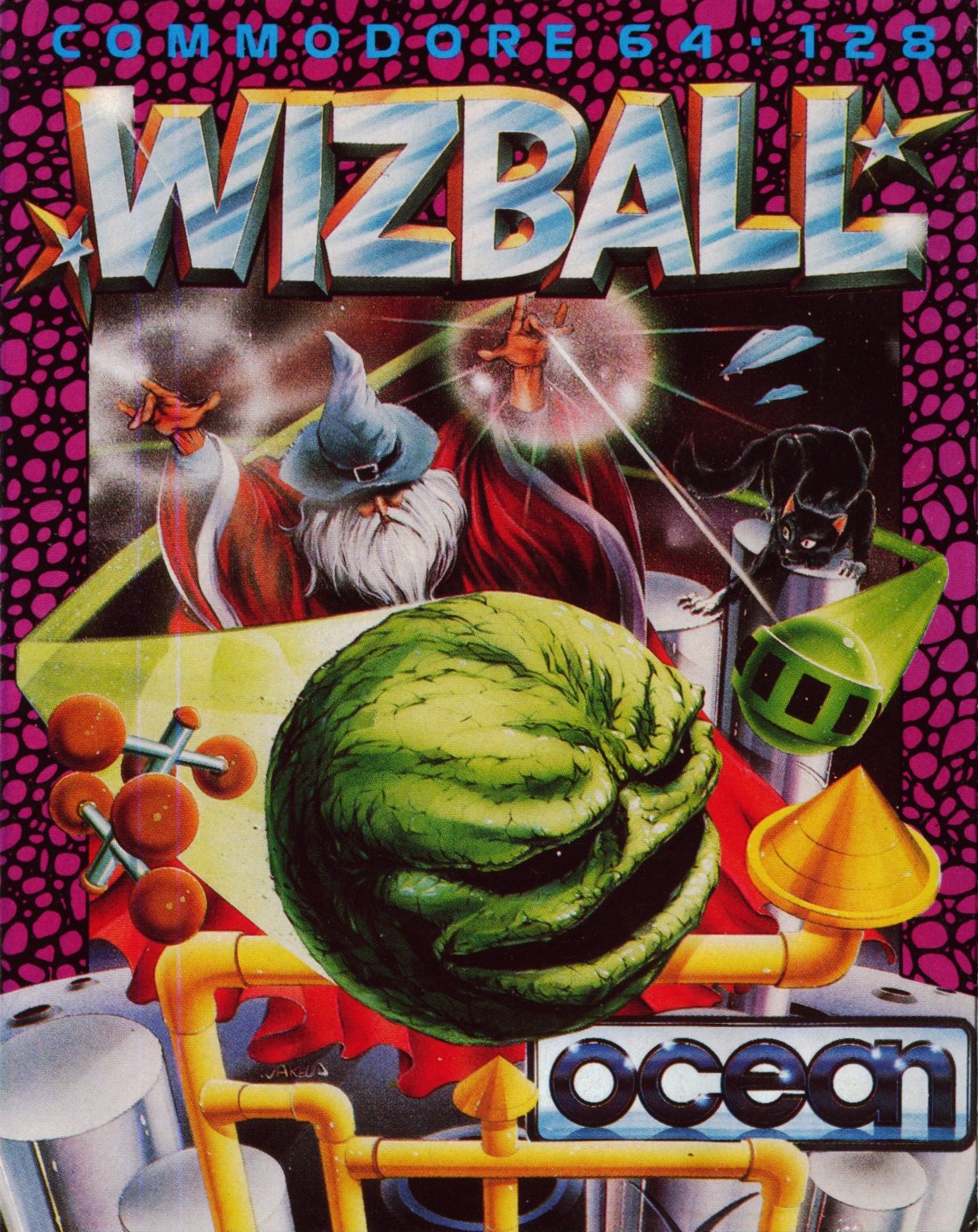
Wizball’s central conceit is unlike anything else in the software library of its era. The player controls Wiz, a wizard who has been transformed into a ball and stripped of his powers, bouncing across a world that has been simultaneously drained of all colour. The game’s objective is to restore colour to the world by shooting enemies, collecting the coloured droplets they release, and mixing them to recreate the full spectrum — a mechanic that functions as both an abstract puzzle system and a satisfying progression reward, since the world visibly transforms as the player succeeds.
The control system is a masterpiece of emergent complexity. Wiz can bounce but cannot directly change horizontal direction without first accumulating momentum — a deliberate inertia system that takes several minutes to master but rewards mastery with a sense of fluid control that feels unlike any other game of the period. A secondary character, Wiz’s cat Nifta, is controlled simultaneously by the second joystick or by CPU in single-player mode, collecting the falling colour droplets that Wiz creates. The interplay between the two characters, and the management of colour-mixing priorities, gives the game a strategic depth unusual for an arcade-style title of 1987.
What elevates Wizball from clever curiosity to genuine masterwork is the coherence of its vision. Every element — the control system, the colour mechanic, the enemy design, the visual style — serves the central idea. Nothing feels added for its own sake; everything is in service of the experience of restoring a world to colour.
Martin Galway’s Score
Martin Galway’s soundtrack for Wizball is, by the considered assessment of the SID music community, the finest body of work produced for the Commodore 64 platform. Where the Ocean Loader tunes - also Galway compositions - were optimised for the specific requirement of filling loading time with something engaging, the Wizball score has the space and ambition of a genuine musical composition. Seven distinct pieces accompany different stages and events in the game, each demonstrating a different facet of the 6581 chip’s capabilities.
Galway’s technique on the SID is characterised by an unusually sophisticated understanding of the chip’s filter as a musical instrument rather than merely an effect. His filter sweeps are precisely timed to the musical phrase structure; his use of ring modulation and synchronisation creates timbral colours that no other composer of the period was exploiting with equivalent control. The Wizball theme, in particular, has a melodic and harmonic sophistication that stands comparison with any instrumental popular music of the 1987 period.
The score’s reputation has only grown in the decades since its composition. Galway’s Wizball file is among the most analysed in the SID community, with dedicated technical breakdowns examining exactly how particular sounds are produced. It remains a primary reference point for anyone seeking to understand what the SID chip’s outer limits of expressiveness actually sound like. Listen to Martin Galway’s Wizball score →
Martin Galway’s music for Wizball is quite simply the best music ever to grace a home computer. Seven magnificent pieces of music which make the most of the SID chip’s capabilities in a way we have never heard before. An extraordinary composition on an extraordinary game.
Zzap!64 magazine, issue 28, 1987 - Gold Medal review
Critical and Cult Reception
Wizball was critically acclaimed from its release, earning Gold Medal status from Zzap!64 (90%) and a Crash Smash from Crash magazine (92%). The reviews emphasised the originality of the central mechanic, the quality of the soundtrack, and the depth of engagement that the control system rewarded over extended play. Despite this critical reception, the game did not achieve the chart-topping sales of Ocean’s film licences. Wizball was, by the standards of the software market, a mid-range commercial performer — respected, reviewed, and purchased by a discerning audience, but not a mass-market phenomenon.
The gap between critical reception and commercial performance is one of the recurring features of 1980s gaming, and Wizball is one of its most instructive examples. The game asked something of its players that more straightforward titles did not: it required an adjustment period, a willingness to persist through the early stages of mastering its unusual control system, and an engagement with its abstract goal structure that not all buyers were prepared to make. Those who made the adjustment almost universally became devoted advocates, and Wizball’s reputation spread primarily through enthusiast word-of-mouth rather than chart position.
Lasting Significance
Wizball’s significance for the history of Ocean Software is somewhat paradoxical. The company’s commercial identity was built almost entirely on film and television licences, and it is for titles such as RoboCop and Batman that Ocean is most readily remembered. But Wizball demonstrates that Ocean was also capable of recognising and publishing genuinely original creative work — that the company’s relationship to the medium was not purely transactional.
The game is now regarded as one of the canonical masterpieces of the Commodore 64 era. It appears in virtually every list of the greatest games of the 1980s and is cited frequently by game designers as an influence and reference point. Its soundtrack has been performed live, analysed in academic contexts, and released in various fan remastering projects. For a game that was a mid-range commercial performer in 1987, this is an extraordinary afterlife. See the full Wizball catalogue entry →
HEAD OVER HEELS
The Finest Isometric Game Ever Made
Jon Ritman and Bernie Drummond
Jon Ritman and Bernie Drummond were among the most technically accomplished development partnerships working in British home computing in the mid-1980s. Ritman handled the programming, Drummond the graphics, and together they had a track record of pushing the ZX Spectrum and other 8-bit platforms to their absolute limits. Their earlier collaborative work had included the original Batman (1986), an isometric action-adventure released through Ocean that demonstrated the format’s commercial viability and established the technical foundation on which Head Over Heels would be built.
The Batman game was itself a landmark — a technically ambitious, commercially successful isometric adventure that showed audiences and publishers what the format was capable of. But Ritman and Drummond were already thinking beyond it. Head Over Heels was conceived as an escalation of every dimension of the Batman design: more rooms, more puzzle variety, more characters, more world-building. The ambition was to create not merely a successful game but a comprehensive demonstration of what the isometric format could sustain.
Game Design
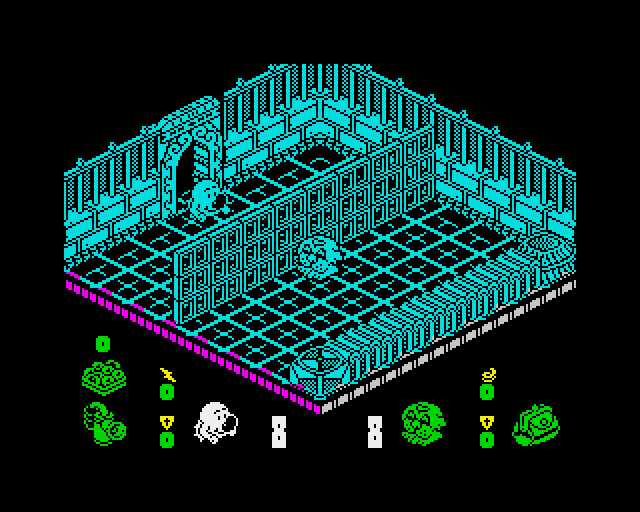
Head Over Heels introduces two separate player characters — Head, who can jump high and shoot; and Heels, who can run fast and carry objects — who begin the game separated and must find each other before they can be combined into a single, more capable character. The dual-character mechanic is not merely a cosmetic variation on a standard formula. Head and Heels have genuinely complementary abilities, and the puzzle design throughout the game is constructed specifically around the interplay between those abilities: puzzles that neither character can solve alone but that both can solve together, areas that one character can reach and the other cannot, items that one character can carry that the other needs.
The five worlds of Blacktooth — the planet-prison ruled by the Emperor — are designed with a density of detail and a consistency of internal logic that was virtually unprecedented in 1987. Each world has its own visual identity, its own environmental hazards, and its own contribution to the overarching puzzle of escaping from Blacktooth. The game’s 300-plus rooms form a coherent geography that rewards careful mapping and revisitation; a room that seemed impassable on first encounter becomes navigable once a specific item has been acquired elsewhere. The design is, in the structural sense, genuinely architectonic.
The replayability is built into the design. Multiple routes through the game world exist; multiple strategies for achieving key objectives are possible; and the choice of which character to prioritise in the early stages of the game has downstream consequences for which areas are accessible at which point. This is game design operating at a level of sophistication that was rare in any format in 1987, let alone in an 8-bit isometric adventure.
Three Hundred Rooms on 48K
Bernie Drummond’s sprite work for Head Over Heels is, by common consent, among the finest pixel art produced for the ZX Spectrum and Commodore 64 in the 1980s. The two central characters are immediately distinctive and expressive despite being constructed from a tiny number of pixels; the environmental objects and enemy characters are inventive and consistently characterised; and the isometric perspective is maintained with a visual rigour that never breaks the game world’s internal consistency.
Ritman’s isometric engine was a significant technical achievement in its own right. The ZX Spectrum, operating with its 48K of RAM and its distinctive display hardware, was not an obviously natural host for complex three-dimensional projection. The engine handles collision detection, character animation, environmental interaction, and the management of a game world comprising hundreds of rooms within the machine’s tight constraints without perceptible compromise to the playability of the result. The Spectrum version, in particular, is a demonstration of what thorough knowledge of a specific piece of hardware can produce when applied by a sufficiently skilled programmer.
The Commodore 64 conversion maintains the game design’s integrity while adapting it to the C64’s different hardware characteristics. The Amiga version, produced later, benefits from the 16-bit machine’s superior colour and audio capabilities, but the game design is unchanged: the puzzle architecture that makes Head Over Heels compelling translates intact across platforms.
Highest Marks Crash Had Ever Given
The critical reception was extraordinary. Crash magazine awarded the Spectrum version a Crash Smash with a score of 96%, using language that had rarely been deployed in the magazine’s history: reviewers described it as the finest game ever released for the Spectrum, a claim that was, at the time, broadly shared across the specialist press. Zzap!64 gave the C64 version 91%, similarly effusive in its assessment of the game’s design ambition and execution. Multiple publications awarded the game their highest honours and it appeared on the cover of Crash and several other publications around its release period.
The accolades reflected genuine critical engagement rather than merely promotional enthusiasm. Reviewers in 1987 were grappling with a game that was doing something qualitatively different from its contemporaries - constructing an experience of unusual depth and coherence on hardware that most developers were using for far simpler ends. The reviewing community recognised this, and the recognition was expressed in scores and language that communicated the game’s exceptional nature.
Head Over Heels is the most ambitious, most original, and most accomplished game ever written for the ZX Spectrum. Jon Ritman and Bernie Drummond have created a game world of extraordinary depth and internal logic. Every room has been individually designed; every puzzle has a solution; the two-character mechanic is unlike anything else in software. This is the new benchmark.
Crash magazine, issue 45, 1987 - Crash Smash review, 96%
The Summit of the Isometric Form
Head Over Heels stands at the end of a particular tradition in British home computing: the isometric adventure game, a format that had reached its commercial peak in the mid-1980s and would decline in prominence as the industry moved toward 16-bit hardware and different aesthetic conventions. As the culmination of that tradition, Head Over Heels is an endpoint that is also a summit. No subsequent isometric game on 8-bit hardware matched its ambition, its execution, or its critical reception.
The game has been preserved, emulated, and celebrated by the retrogaming community with a care commensurate with its historical importance. Fan remakes have been produced for multiple modern platforms; the game design has been analysed in academic contexts concerned with the history of three-dimensional representation in games; and Jon Ritman and Bernie Drummond have, in the years since, been recognised as significant figures in the history of the medium. For Ocean, Head Over Heels represents the furthest reach of the company’s engagement with original, developer-led creative work - a reminder that the company’s identity was not reducible to its film licences. See the full Head Over Heels catalogue entry →