Music
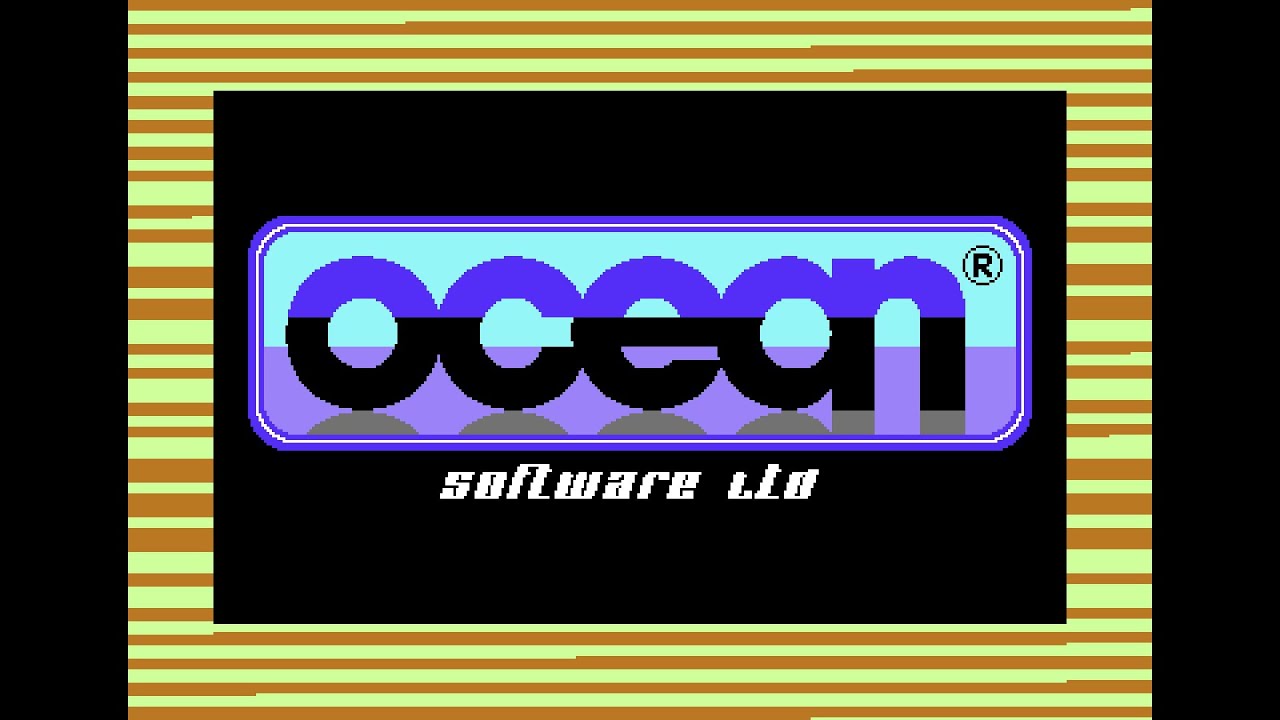
Ocean Software employed composers whose work on the Commodore 64 SID chip produced some of the most celebrated music in video game history. For a generation of home computer users, the Ocean loading screen was not dead time - it was a concert.
Loading Music as an Art Form
In the cassette era, loading a game on a Commodore 64 typically took between two and five minutes. That was dead time - hardware reading magnetic tape at 300 baud, the player waiting with nothing to do. Ocean Software transformed that dead time into an experience. Their composers - first Martin Galway, then Jonathan Dunn, and later contracted figures from the European demo scene such as Jeroen Tel - produced dedicated loading music of such quality that players would set down their joysticks and simply listen.
The Ocean Loaders are the most famous expression of this, but they represent only a fraction of the musical output. Galway's Wizball soundtrack, Dunn's Batman: The Movie score, the game-specific music commissioned for RoboCop, Total Recall, and Terminator 2 - these were not incidental accompaniments but fully realised compositions produced under severe technical constraints and to a consistently extraordinary standard.
Three composer eras define Ocean's musical identity. The Galway era (roughly 1985–1990) established the template: ambitious SID music that exploited the chip's full sonic range and treated loading screens as performance opportunities. The Dunn era (1988–1992) continued and in some respects deepened that ambition, producing the Batman soundtrack that many regard as the finest piece of game music ever created on 8-bit hardware. The contracted era brought in figures from the European demo scene - composers for whom pushing hardware limits was a creative and competitive discipline - and added further variety to Ocean's sonic palette. All three eras are represented in the track listing below.
Track Listing
Curated Ocean Software tracks from the High Voltage SID Collection. Each links to DeepSID for in-browser playback.
Tracks link to DeepSID - an in-browser SID player that requires no plugins or additional software. The HVSC (High Voltage SID Collection) contains the full archive of Ocean SID files, with Martin Galway's and Jonathan Dunn's directories holding dozens of additional tracks beyond those listed here.
Martin Galway
Ocean's first composer. Creator of the Ocean Loaders 1, 2, and 3, and the Wizball soundtrack - one of the most celebrated musical works in C64 history.
The Loader Tradition
Martin Galway arrived at Ocean in the mid-1980s and almost immediately began producing work that would define the company's sonic identity. The Ocean Loaders were his most prominent commission - discrete pieces of music designed not for any single game but to accompany the loading process across multiple Ocean releases. This was an unusual brief: loading music needed to be long enough to fill several minutes without becoming repetitive, complex enough to reward repeated listening, and distinctive enough that players would associate it immediately with the Ocean brand.
Galway met all three requirements with apparent ease. The first Ocean Loader (1987) is a composition of considerable harmonic sophistication, exploiting the SID chip's three-voice architecture to create layered melodic lines that develop and resolve across its duration. It became, almost immediately, one of the most recognised pieces of music in British home computing - heard by anyone who owned a Commodore 64 and an Ocean title during the late 1980s, and remembered by virtually all of them.
His work extended beyond the loaders to include full game soundtracks. The Wizball OST (1987) comprises seven distinct pieces, each tailored to a different section of Sensible Software's surreal arcade adventure. Together they constitute the most sustained musical statement of Galway's Ocean career, demonstrating a compositional range that moved from propulsive action cues to contemplative atmospheric passages with the fluency of a trained composer working in a fully conventional medium. He joined id Software in the early 1990s, where his contribution to the audio of Wolfenstein 3D and Doom extended his influence into the first-person shooter genre that would dominate the following decade.
Jonathan Dunn
Galway's successor at Ocean. His Batman: The Movie soundtrack is considered one of the greatest achievements in 8-bit game music.
The Batman Soundtrack
Jonathan Dunn took over from Galway at Ocean and faced the particular challenge of following a composer whose work had already acquired the status of a cultural touchstone. The Ocean Loaders 4 and 5 - Dunn's most direct engagement with that legacy - are both accomplished compositions that stand comfortably alongside their predecessors. But it was the Batman: The Movie soundtrack (1989) that secured Dunn's place in the history of game music.
The Batman score is a complete film score achieved within the three-voice limitations of the SID chip. It encompasses multiple themes - an opening title sequence of genuine grandeur, character motifs, action cues, a finale - and develops them across the arc of the game's levels with the kind of structural thinking that would be unremarkable in a professional film composer but was extraordinary in the context of 8-bit game audio. The score conveys the gothic atmosphere of Tim Burton's film without simply reproducing Danny Elfman's arrangements; Dunn found equivalences in the SID's sonic palette that served the same dramatic functions while being wholly original compositions.
Dunn's output across 1988 to 1992 was prolific and consistently distinguished. RoboCop, Total Recall, Terminator 2: Judgment Day, Navy SEALs - each received a soundtrack that was crafted to the specific tonal requirements of the licence rather than adapted from a generic template. His ability to work quickly without sacrificing quality, across multiple platforms simultaneously, made him one of the most productive game composers of the era. The High Voltage SID Collection's Jonathan Dunn directory contains dozens of tracks that reward exploration well beyond the famous titles.
Jeroen Tel
The Dutch composer who brought European demo scene ambition to Ocean's commercial catalogue.
From the Demo Scene to Ocean
Jeroen Tel's contribution to Ocean's catalogue - the RoboCop 3 soundtrack for C64 (1992) - arrived relatively late in the company's 8-bit output, but it brought with it a perspective shaped by a very different musical tradition. Tel was a leading figure in the European C64 demo scene, a competitive and technically obsessive community that had been pushing the SID chip to limits well beyond what commercial game developers typically attempted. Demo scene composers approached the hardware as a creative challenge in itself: the question was not merely what music to write but what the chip could be made to do that no one had previously achieved.
That orientation produced a different kind of SID music - more technically adventurous, more concerned with timbral complexity and the exploitation of edge-case hardware behaviours, more willing to prioritise sonic spectacle over melodic accessibility. Tel's commercial work retained something of that character while remaining accessible to a general audience. The RoboCop 3 soundtrack reflects the franchise's harder, more industrial aesthetic while showcasing the filter modulation techniques and harmonic density that Tel had developed through years of demo scene work.
Tel's broader discography, archived in the HVSC's Jeroen Tel directory and documented in the C64 Scene Database, is one of the most extensive and varied bodies of SID composition in existence. His commercial output for Ocean represents a small but significant portion of a career that spans from the earliest years of C64 computing to the present day. For listeners who exhaust the Ocean catalogue and want to hear what else the SID chip was capable of in the hands of a master technician, Tel's demo scene productions are essential.
Resources
The archives, databases, and tools that preserve the Ocean musical legacy.
HVSC — High Voltage SID Collection
The definitive archive of Commodore 64 SID music, containing tens of thousands of files including complete directories for Martin Galway and Jonathan Dunn. The canonical source for Ocean SID files. Includes STIL notes with track context and credits.
HVSC — Martin Galway Directory
Browse all of Martin Galway's archived SID compositions within the HVSC. Includes the complete Ocean Loaders, Wizball, Arkanoid, R-Type, and many further tracks spanning his full tenure at Ocean and subsequent work.
HVSC — Jonathan Dunn Directory
The full Jonathan Dunn archive within HVSC, covering Ocean Loaders 4 and 5, Batman: The Movie, RoboCop, Total Recall, Terminator 2, Navy SEALs, and dozens of additional tracks from across his prolific 1988–1992 output.
DeepSID
An in-browser SID player built on the reSID emulation engine. No plugins required - load any SID file from the HVSC directly in your browser. The fastest way to hear Ocean's music as it sounded on original Commodore 64 hardware. All track links on this page point here.
CSDb — C64 Scene Database
The comprehensive archive of the Commodore 64 demo scene, including the complete output of Jeroen Tel and other composers who worked in both commercial and demo contexts. Essential for understanding the technical and creative culture from which much of the most adventurous SID music emerged.