MicroProse Flagship Titles
Civilization (1991)
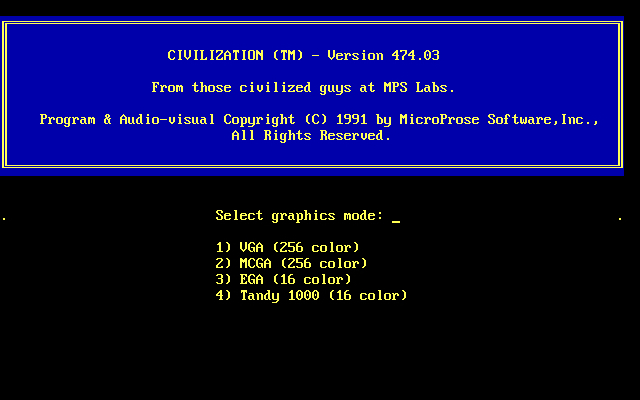
Civilization is Sid Meier's masterwork: a turn-based strategy game that compresses the entire span of human history from 4000 BC to the space age into a single playable arc. Players found a city, expand their empire, research technologies, manage diplomacy with rival civilisations, and race to either dominate the globe militarily or launch a colony ship to Alpha Centauri. Released in 1991, it did not invent the god game, but it perfected it - and in doing so created a template that dozens of developers have tried to replicate in the three decades since.
Fourteen Months and an Avalon Hill Designer
After Railroad Tycoon (1990), Sid Meier wanted to attempt something more ambitious: a game about all of human history. He hired Bruce Shelley, a veteran of Avalon Hill - the board game publisher behind Squad Leader, Diplomacy, and Kingmaker - to co-design it. Shelley brought a boardgamer's instinct for meaningful choices and balanced economics; Meier brought the code and the interface.
Development took fourteen months. Meier drew on Francis Tresham's 1980 board game Civilization for the basic concept of advancing through historical ages, but the design diverged quickly. Where Tresham's game was a multiplayer negotiation exercise, Meier's version became a solo empire-building simulation with a full AI to compete against. The technology tree - a branching graph of 72 advances from Pottery and Bronze Working to Space Flight and Spaceship Structural - required careful balancing across hundreds of playtests.
One More Turn
The fundamental loop is deceptively simple: each turn, every city produces something - food to grow, shields to build units or improvements, trade to fund research and diplomacy. Choose which technology to research from the tree, decide which city improvement to build, move units, negotiate with the Greek ambassador or ignore him. The decisions compound over hundreds of turns: a wrong research path early leaves you behind militarily or economically by the medieval period. A correct early expansion locks in the best city locations and puts you ahead for the entire game.
The "one more turn" phenomenon - the compulsive desire to complete just one more research cycle, build one more unit, explore one more territory - is Civilization's defining quality. Players who sat down to play for an hour would look up to find it was 3am. The New York Times reviewed it as "the most addicting computer game ever created." This was not a review of a children's toy or a puzzle game. It was a full-page assessment of a strategy simulation that reviewers could not stop playing long enough to write about.
"A game is a series of interesting decisions."
Sid Meier, GDC 2010 keynote "Everything I Know Is Wrong" - the design principle that Civilization proved most definitively
Compressing History Into a Game Board
The technology tree was the game's central technical achievement. Seventy-two advances, each requiring a number of turns to research proportional to your civilisation's science output, arranged so that some paths naturally led to military dominance while others opened economic or scientific routes to victory. The tree was not arbitrary: Meier and Shelley mapped actual historical dependencies - you cannot research Gunpowder without Iron Working, cannot develop Computers without the Scientific Method.
The AI civilisations were given named historical leaders - Caesar, Cleopatra, Gandhi, Alexander - each with programmed personality traits governing their aggressiveness, tendency to build wonders, and response to diplomacy. Gandhi's AI was famously misconfigured: a bug reduced his aggression value below zero, which wrapped around to maximum, producing an unexpectedly warlike Gandhi in later game stages. This "nuclear Gandhi" became the game's most famous unintended character.
When the New York Times Reviewed a Strategy Game
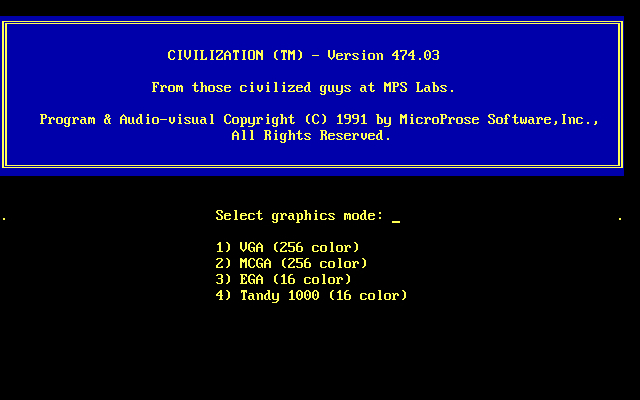
Civilization was reviewed as news. Computer Gaming World, the leading American PC games magazine of the era, gave it top marks and featured it across multiple issues. The New York Times review - genuinely unusual for a game in 1991 - described the "addicting" quality that kept players at their screens through the night. British magazines including PC Format and PC Gamer UK were equally enthusiastic.
The game won every major award that year. It was the benchmark against which all other strategy games were measured for the next decade. Within two years, MicroProse had sold hundreds of thousands of copies across DOS, Amiga, and Mac versions.
Civilization (DOS, 1991) - full longplay demonstrating the early-game expansion phase that defines the first 200 turns
Thirty-Five Years and Six Sequels
When Sid Meier, Jeff Briggs, and Brian Reynolds left MicroProse in 1996 to found Firaxis Games, they took the Civilization licence with them. Brian Reynolds designed Civilization II (1996), which sold three million copies and refined the original's mechanics. Subsequent sequels - designed by Reynolds, then Soren Johnson (IV), then Jon Shafer (V), then Ed Beach (VI) - have extended the franchise across multiple platforms including consoles and mobile.
The Civilization name has appeared on over a dozen titles. The sixth numbered entry, released in 2016, remains actively supported and played. The original 1991 game is preserved on the Internet Archive and playable in browser. A community of modders has extended every entry in the series; the Civilization IV modding scene produced Fall from Heaven and dozens of total conversions still maintained today.
See also: Civilization in the catalogue · Jeff Briggs' score for Civilization · Sid Meier biography · Civilization VI and the modern legacy
Sources: Wikipedia - Civilization (video game) · MobyGames - Civilization · Sid Meier's Memoir! (2020)
X-COM: UFO Defense (1994)
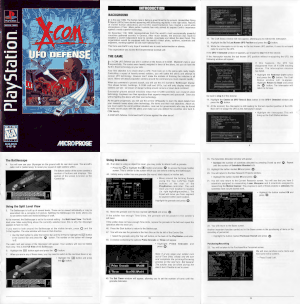
X-COM: UFO Defense - released as UFO: Enemy Unknown in Europe - is one of the most precisely designed strategy games ever made. Published by MicroProse and developed by Julian Gollop's Mythos Games in Stroud, England, it combines a real-time strategic layer with a turn-based tactical layer in a way that has never been fully replicated. The two halves are inseparable: what you do in the boardroom directly determines whether your soldiers survive the firefight.
From Laser Squad to Alien Invasion
Julian Gollop and his brother Nick had been making turn-based tactical games since the early 1980s. Rebelstar Raiders (1984) and Laser Squad (1988) established the action-point system that would anchor X-COM's tactical combat. The concept for X-COM emerged from wanting to add a strategic management layer on top of the Laser Squad engine - a global command structure that would give context and consequence to every individual mission.
Mythos Games signed a publishing deal with MicroProse. Development was challenging: MicroProse wanted features; Mythos was a small studio in a market town. The final game required both parties to compromise on scope. Some planned features - including a more sophisticated alien political layer - were cut in favour of a tighter, more polished core. The result was better for the discipline. The game that shipped was not the game originally envisioned, but it was complete and extraordinarily well-balanced.
Two Layers, One Near-Impossible Mission
At the strategic level - the Geoscape - players manage a global paramilitary organisation defending Earth against alien invasion. They allocate funding from member nations, construct and expand underground bases across multiple continents, research alien technology captured from crash sites, manufacture equipment for their soldiers, and track UFO activity on a real-time globe spinning with incoming contacts.
Every Geoscape decision has tactical consequences. Underfund a region and it withdraws its monthly contribution; neglect research and alien weapons outclass yours by late game; lose too many soldiers and the morale of your remaining veterans collapses under the panic system. The two layers were calibrated so that neither could be optimised independently - a player who ignored the tactical casualties to focus on research would find their Geoscape undefended by experienced troops.
At the tactical level, each UFO interception or alien site produces a turn-based ground mission on a procedurally generated map. Soldiers move on action point budgets. Fog of war is absolute: alien positions are unknown until your soldiers encounter them. The panic system - soldiers exposed to alien horrors may break and flee, or in extreme cases turn their weapons on colleagues - created moments of genuine human drama within a mechanical framework. A sergeant with twenty missions' experience was worth more than a fresh recruit with better equipment.
Maps That Never Repeated and Soldiers Who Could Break
The procedural map generation was X-COM's most significant technical achievement. Each mission placed a different combination of terrain tiles, buildings, and alien spawn locations, ensuring that no two Battlescape encounters felt identical even when fighting the same alien type in the same terrain type. The line-of-sight system calculated exposure from every tile, making elevation and cover mechanically meaningful.
The panic system was equally innovative. Soldiers accumulated a "morale" stat affected by witnessing alien attacks, losing colleagues, and facing certain enemy types. A soldier below a panic threshold might freeze, run away, or - most catastrophically - turn and fire on adjacent allies. This mechanic transformed what could have been a pure puzzle into something that felt unscripted and unpredictable, with genuine tension in every encounter.
"X-COM received 94% - the highest score PC Gamer US had awarded to any game that year. The editors called it a masterpiece of design that 'no strategy fan should be without.' PC Gamer UK echoed the assessment at 92%."
PC Gamer US, 1994 review; PC Gamer UK, 1994 review - both naming X-COM: UFO Defense Game of the Year
Ninety-Four Percent and Game of the Year
X-COM: UFO Defense was voted Game of the Year 1994 by multiple publications. PC Gamer US awarded it 94% - their highest score for any game that year. PC Gamer UK agreed at 92%. Computer Gaming World's coverage ran across multiple issues. The game's critical reception was not merely strong; it was unanimous in a way that few strategy games achieve.
The European version under its UFO: Enemy Unknown title was particularly successful in the UK, where it became a bestseller across DOS and Amiga formats. The Amiga version was technically demanding - the game pushed the machine's capabilities - but retained the essential design intact.
What Two Decades of Imitators Finally Caught Up To
The original X-COM spawned a direct sequel, X-COM: Terror from the Deep (1995), developed primarily by MicroProse rather than Mythos. Several further X-COM sequels of varying quality followed before the series went dormant.
Julian Gollop's Mythos Games dissolved in 1997. The X-COM open-source engine OpenXcom (launched 2010) allowed modern hardware to run the original game with bug fixes and optional enhancements. Xenonauts (2014) by Goldhawk Interactive was a deliberate spiritual successor. Most significantly, Firaxis's XCOM: Enemy Unknown (2012) is a full modern remake that introduced the franchise to a new generation; Firaxis's Julian Gollop-acknowledged interpretation won major industry awards.
Julian Gollop returned to the genre with Phoenix Point (2019), a crowd-funded tactical strategy game designed to address the compromises forced on the original X-COM during development.
See also: X-COM in the catalogue · John Broomhall's score for X-COM · Julian Gollop biography · OpenXcom for modern play
Sources: Wikipedia - X-COM: UFO Defense · UFOpaedia - ufopaedia.org · PC Gamer US (1994) · PC Gamer UK (1994)
Sid Meier’s Pirates! (1987)
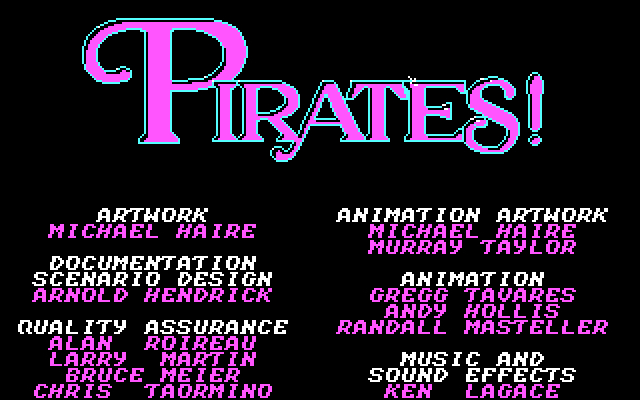
Sid Meier’s Pirates! was MicroProse's first major departure from military simulation and the game that established the design language of emergent open-world adventure. Players took the role of a young privateer in the 17th-century Caribbean, with total freedom to choose their path: sail for profit as a merchant, hunt pirates as a privateer, serve one of the four European powers, or plunder indiscriminately. No two playthroughs produced the same story.
Putting Sid Meier's Name on the Box
The decision to put Sid Meier's name in the title was Bill Stealey's. Stealey, MicroProse's co-founder and business driver, recognised that Meier's name had become associated with quality in the minds of serious game buyers. Pirates! was the test of that theory. The branding worked: the game sold well enough to establish a naming convention that would extend to Civilization, Railroad Tycoon, and Colonization.
Meier designed Pirates! primarily alone, drawing on research into 17th-century Caribbean history. The game needed to feel authentic - the political relations between Spain, England, France, and the Netherlands, the trade routes between ports, the treasure fleet schedules - while remaining playable by someone without a history degree. The solution was a world that behaved plausibly without being accurate in every detail.
Four Game Modes and One Caribbean
Pirates! blended four distinct modes: ship-to-ship naval combat (real-time, side-scrolling, with a full sailing physics simulation), land combat (top-down tactical raids on forts and towns), a dancing minigame (used to impress governors' daughters and earn diplomatic standing), and a strategic layer governing relations with all four European crowns simultaneously.
No single mode was deep enough to sustain a game alone. Together they created something unique. A player might sail into a port flying Spanish colours, dance convincingly with the governor's daughter to secure information about a treasure fleet, intercept that fleet at sea in a tense broadside engagement, then storm a rival pirate's fort to rescue a kidnapped family member. All of this in a single session.
The family members were a critical design element. Scattered across the Caribbean in captivity, they gave each playthrough a persistent narrative goal beyond simple wealth accumulation. Finding your captured sibling, cousin, or father required intelligence - earned through dancing, bribing, or capturing the right ship - that directed play towards specific ports and encounters.
"There's never been another game like Pirates! No other single game has ever given you five completely different ways of playing and made all of them work. It's the most complete open-world game that isn't actually open-world."
Computer Gaming World retrospective, 1994 - revisiting Pirates! seven years after release
A Living World on 64 Kilobytes
Pirates! ran on Commodore 64 (64K RAM), Apple II, Atari 8-bit, and DOS. The Caribbean world was simulated using procedural elements: port populations, treasure fleet positions, pirate captain locations, and political relations all updated dynamically. The simulation was not complex by modern standards, but it was complex for 1987 - and it produced the illusion of a living world more convincingly than any contemporary game.
The Amiga version, released later, added enhanced graphics and superior audio that became many players' definitive version. The NES port (1991) adapted the experience for console controls. Over the game's commercial life, Pirates! was released on eleven platforms.
The Open-World Blueprint
Pirates! did not invent open-world games. But it demonstrated in 1987 that a game could give players genuine agency within a simulated world without becoming a formless sandbox. The structure - a persistent world with goals the player could pursue or ignore, emergent situations arising from dynamic systems, and multiple paths to victory - was the template that later open-world design built on.
Sid Meier revisited the design in 2004 with Pirates! (2004), a full remake for PC and Xbox with updated graphics, 3D naval combat, and reworked minigames. It recaptured the spirit of the original while adding modern production values. Both versions remain playable today.
See also: Pirates! in the catalogue · Sid Meier biography · Pirates! Gold (1993)
Sources: Wikipedia - Sid Meier’s Pirates! · MobyGames - Pirates!
Sid Meier’s Pirates! (DOS, 1987) - full longplay across the Caribbean
Railroad Tycoon (1990)
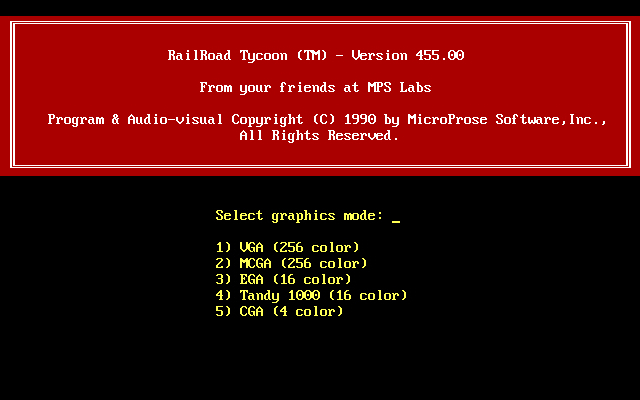
Railroad Tycoon is the founding text of the management simulation genre and the game that proved Sid Meier's design sensibility could extend beyond military subject matter into pure economic strategy. Released in 1990, it gave players a railroad empire to build across four historical maps - Eastern United States, Western United States, Great Britain, and Europe - and filled those maps with economic systems sophisticated enough to sustain years of subsequent analysis.
Board Games and Computer Code
Bruce Shelley joined MicroProse from Avalon Hill, the board game publisher whose titles - Squad Leader, Diplomacy, Civilization (Francis Tresham's version) - defined complex strategy games for an earlier generation. Shelley brought a boardgamer's instinct for layered mechanics and balanced economies. Meier provided the programming and the interface clarity that made complexity accessible.
The game began as a design experiment: Meier wanted to build something set in the 19th century with the same layered decision-making he had explored in his military simulations. Railroad networks were the natural vehicle - they were capital-intensive, required long-term planning, interacted with the broader economy, and had a rich historical record to draw on. The result was a game where building the right track was only the beginning.
The Economics of Steam
Players built and managed a railroad empire: laying track, placing stations, scheduling trains on shared infrastructure, managing freight contracts, taking companies public on a simulated stock market, and competing with an AI baron who would undercut routes and sabotage track.
The economic model was unusually sophisticated for 1990. Cargo types had different economic weights: steel and coal were more valuable than grain; passengers paid premium fares over short distances. Distances affected profitability in non-linear ways. Technology eras unlocked faster locomotives and more valuable commodities. A player who built an efficient steam-era network might find their routes obsolete when diesel technology arrived, requiring investment in upgraded rolling stock to maintain margins.
The AI baron was the game's most effective tension mechanism. He would identify profitable routes already established by the player and build competing lines to capture market share. He could also bribe politicians to raise your track costs, acquire stock in your company to dilute your holdings, and arrange hostile takeover bids if your share price fell. Managing the competitive threat while expanding your network added a layer of economic warfare absent from most management games of the era.
"Railroad Tycoon has the most complex economic model in any entertainment software I have encountered. It is a genuinely sophisticated financial simulation wrapped inside an accessible interface. This is the game of the year, without qualification."
Computer Gaming World, September 1990 - awarding Railroad Tycoon Game of the Year for 1990
A Stock Market in a 1990 Game
The financial layer was what distinguished Railroad Tycoon from other simulation games of the period. Players could issue bonds to fund expansion, take their railroad company public, trade shares in rival railroads, and manage their personal financial position separately from their company's balance sheet. Stock prices responded to actual in-game performance metrics - profits, route density, cargo volume.
This was not a simplified abstraction. The stock market behaved according to rules consistent enough that experienced players could manipulate it deliberately: buying shares in a competitor before a profitable route opened, short-selling before announcing a dividend cut. The sophistication was remarkable for a game designed to run on an IBM PC XT.
The Genre That Transport Tycoon Built On
Computer Gaming World named Railroad Tycoon its Game of the Year for 1990. The assessment proved more justified with each passing decade as the genre it founded produced hundreds of descendants. Chris Sawyer's Transport Tycoon (1994) - published by MicroProse - extended the template to roads, airports, and shipping. OpenTTD, an open-source rebuild of Transport Tycoon, remains actively maintained and played in 2024.
Railroad Tycoon II (1998) and Railroad Tycoon 3 (2003) extended the franchise. The original game is preserved on the Internet Archive and remains playable. A community of modders has continued to maintain and extend OpenTTD with new scenarios, graphics sets, and AI improvements for over twenty years.
See also: Railroad Tycoon in the catalogue · Railroad Tycoon score · Bruce Shelley biography · Transport Tycoon
Sources: Wikipedia - Railroad Tycoon · MobyGames - Railroad Tycoon · Computer Gaming World, Issue 74 (September 1990)
F-19 Stealth Fighter (1988)
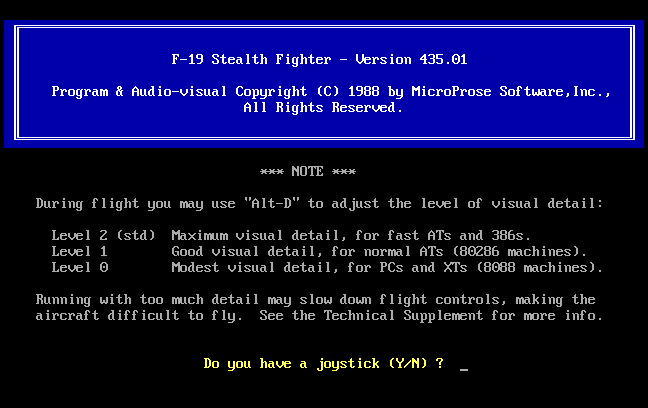
F-19 Stealth Fighter represents the pinnacle of MicroProse's military simulation line. Designed by Sid Meier and Andy Hollis, it modelled a speculative stealth aircraft drawn from publicly available documentation at a time when the U.S. Air Force's actual stealth programme remained classified. The resulting game was so accurate in its modelling that its release in 1988 preceded the official acknowledgement of the F-117 Nighthawk by six months - and prompted unwanted attention from the Department of Defence.
Designing a Plane Nobody Had Officially Seen
By 1987, enough had leaked about the USAF's stealth programme through trade publications, congressional budget documents, and occasional aviation press reports to give an expert enough information to characterise the aircraft's approximate capabilities. Hollis and Meier assembled this public record and built a simulation around it.
The "F-19" designation was MicroProse's own: the actual aircraft was the Lockheed F-117A Nighthawk, which bore no sequential relationship to F-19 in the fighter numbering series. MicroProse's F-19 was a composite of speculation and published intelligence. The cockpit layout was designed with reference to actual USAF instrument standards. The radar cross-section modelling and ECM systems were derived from published stealth theory. The result was a simulation that looked and felt like classified technology.
Twelve Feet Off the Desert Floor
F-19 Stealth Fighter tasked players with flying low-observable strike missions across four theatres of conflict: Libya, the Persian Gulf, the Soviet Union, and Central America. Each theatre had a distinct geopolitical situation, different air defence networks, and different target priorities.
Mission planning was a game in itself. Players selected payloads appropriate to the target type - laser-guided bombs for hardened structures, anti-radiation missiles for radar sites, air-to-air missiles for potential intercepts - and planned penetration routes through the enemy's integrated air defence system to minimise radar exposure. Fly too high and your radar cross-section increased; fly too fast and your engine heat signature rose; carry too much ordnance and your stealth characteristics degraded.
In the air, the simulation was demanding. SAM batteries tracked your aircraft using a realistic engagement model; interceptor aircraft had patrol patterns that could be observed and avoided or triggered and evaded. Electronic countermeasures had limited charges. Fuel management was precise. A mission that went wrong required improvisation - and improvisation usually meant deviating from the low-observable flight profile that kept you invisible.
The Cockpit That Made Military Pilots Look Twice
The cockpit HUD - rendered in phosphor yellow-green on military black - became the defining visual aesthetic of MicroProse's military line. Hollis designed the instrument layout with reference to actual USAF cockpit standards: the combination of analogue instruments, digital readouts, and tactical displays gave the simulation an authenticity that contemporary games could not approach.
The simulation modelled fuel consumption, weapons load effects on aircraft performance, and radar cross-section changes based on aircraft attitude - all calculated in real time. The result was a game that rewarded study of the manual and punished inattention with the same fidelity as real military procedure.
"The best flight simulation on any home computer. MicroProse has produced something that no other developer has managed: a simulation that feels authentic without being inaccessible. F-19 is, simply, the finest piece of software we have reviewed."
ACE: Advanced Computer Entertainment, 1988 - reviewing F-19 Stealth Fighter on DOS
The Review That Made Every Other Flight Sim Seem Amateur
F-19 Stealth Fighter received universal praise in the enthusiast press. ACE magazine's verdict - "the best flight simulation on any home computer" - was echoed across Computer Gaming World, Amiga Power (for the Amiga version), and Zzap!64 (for the Commodore 64 port). The game sold hundreds of thousands of copies across DOS, Amiga, Atari ST, and Commodore 64.
Andy Hollis became one of the premier simulation designers of the era. His subsequent work included Gunship 2000 (1991) and continued MicroProse's military simulation line through the mid-1990s.
The Pentagon Noticed
When Lockheed's F-117A was publicly revealed in November 1988, MicroProse was already selling a simulation of an aircraft with nearly identical capabilities. The company quickly released an updated version of F-19 Stealth Fighter acknowledging the F-117A revelation, making it one of the few commercial entertainment products to have independently modelled a classified military programme with sufficient accuracy to prompt a government investigation.
The F-117A Nighthawk entered commercial game form more directly in Microprose's F-117A Nighthawk Stealth Fighter 2.0 (1991), Hollis's follow-up built on declassified details. F-19 Stealth Fighter remains the more significant historical artefact: a commercial game that preceded official acknowledgement of its subject by half a year.
See also: F-19 in the catalogue · F-19 music · F-19 gallery images · Period reviews of F-19
Sources: Wikipedia - F-19 Stealth Fighter · MobyGames - F-19 Stealth Fighter · ACE: Advanced Computer Entertainment (1988)