Series History
Eight years that built one of gaming’s most atmospheric trilogies.
Origins: R&D1 and the Alien Influence
The concept that would become Metroid took shape within Nintendo R&D1 — the division
led by Gunpei Yokoi that had already created the Game & Watch series and was actively
developing the Game Boy. Designer Yoshio Sakamoto and character artist Hiroji Kiyotake
began exploring a science-fiction action game unlike anything Nintendo had produced.
Their reference points were deliberately cinematic: Ridley Scott’s Alien (1979)
and H.R. Giger’s biomechanical aesthetic set the visual tone for the alien world they
envisioned. Where Mario’s Mushroom Kingdom was bright and cartoonish, the new game’s
world would be dark, corroded, and genuinely hostile. The protagonist would be an armoured figure
whose identity was deliberately ambiguous — designed so that players could not tell if
they were controlling a man or a woman, or even a human at all.
We wanted the player to feel like a lone explorer — cut off from everything, relying only on what they could find and discover. That isolation was the atmosphere.
— Yoshio Sakamoto, Metroid co-creator and director
The concept that would become Metroid took shape within Nintendo R&D1 — the division led by Gunpei Yokoi that had already created the Game & Watch series and was actively developing the Game Boy. Designer Yoshio Sakamoto and character artist Hiroji Kiyotake began exploring a science-fiction action game unlike anything Nintendo had produced.
Their reference points were deliberately cinematic: Ridley Scott’s Alien (1979) and H.R. Giger’s biomechanical aesthetic set the visual tone for the alien world they envisioned. Where Mario’s Mushroom Kingdom was bright and cartoonish, the new game’s world would be dark, corroded, and genuinely hostile. The protagonist would be an armoured figure whose identity was deliberately ambiguous — designed so that players could not tell if they were controlling a man or a woman, or even a human at all.
We wanted the player to feel like a lone explorer — cut off from everything, relying only on what they could find and discover. That isolation was the atmosphere.
— Yoshio Sakamoto, Metroid co-creator and directorMetroid (Famicom Disk System)
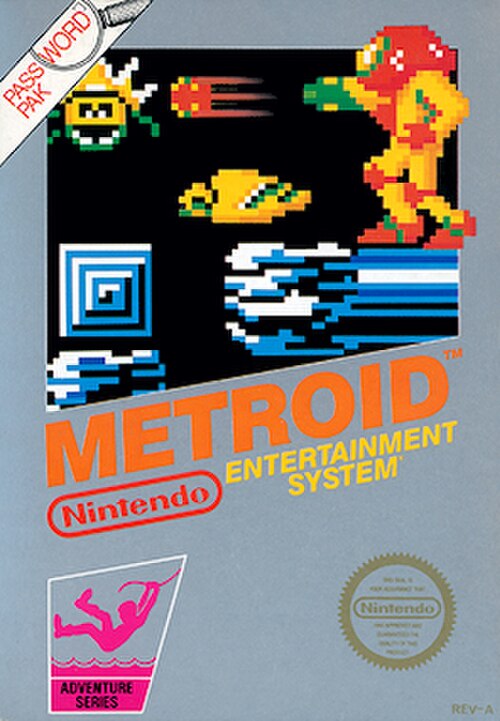
Metroid launched on the Famicom Disk System in Japan in August 1986, arriving in North America on NES cartridge in 1987. The game placed Samus Aran on planet Zebes: a labyrinthine alien world with no linear path, where progress required finding and equipping power-ups hidden in the environment. Doors were colour-coded to beam types; certain passages required the Morph Ball; the Varia Suit halved incoming damage. Every upgrade reshaped the accessible world.
Hirokazu Tanaka’s score was unlike anything else on the Famicom: long, pulsing bass lines, sparse melody, the famous dripping water sound effect. Where other Nintendo soundtracks were cheerful and propulsive, Tanaka’s Zebes was a place of silence and dread. The music existed to make the player feel alone.
The game’s most celebrated feature was its secret: fast completion revealed that Samus was a woman — unprecedented for a 1986 action game protagonist. The decision was deliberate. Sakamoto and Kiyotake wanted the reveal to be a reward for skilled play, not publicity.
North American Release & the Password Discovery
The NES cartridge release brought Metroid to North American audiences, expanding its reach dramatically. The cartridge format required a password system to save progress — Zebes was too large to complete in a single session. Players discovered that the 12-character password format produced, by accident, a sequence that had become legend: JUSTIN BAILEY, which started the game with Samus in a leotard without her armour. Nintendo never acknowledged it as intentional; the leading theory is that it was a valid password the format happened to generate.
The game’s structure was unlike anything else in the NES library: no lives, no fixed level order, and an ending that changed based on completion time. Skilled players discovered that finishing under an hour revealed Samus without her helmet. Under 3 hours showed her in a leotard with the helmet. Over 3 hours showed her in full Power Suit. The game rewarded mastery with revelation.
Metroid II: Return of Samus (Game Boy)
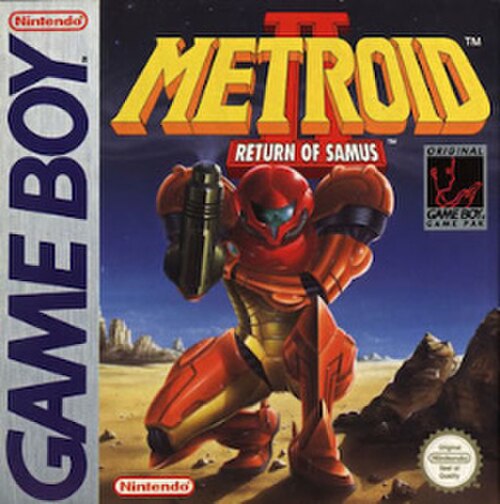
Five years after the original, the series moved to the Game Boy — the hardware that Gunpei Yokoi’s R&D1 division had created. The mission was galactic extermination: Samus dispatched to the Metroid home world of SR388 to eliminate every Metroid before the Space Pirates could weaponise them.
The structure shifted from open exploration to progressive elimination: the planet’s poisonous liquid drained as each Metroid was killed, opening new passages forward. For the first time, players witnessed the full Metroid life cycle — from larval forms through Alpha, Gamma, Zeta, and Omega varieties to the colossal Queen Metroid at game’s end.
The game’s final sequence was its most consequential: after defeating the Queen, a Metroid egg hatches. The larva imprints on Samus — the first creature it sees — and follows her to the surface. She cannot bring herself to kill it. It becomes the baby Metroid, and its fate would define Super Metroid’s emotional climax three years later.
Super Metroid (Super Nintendo)
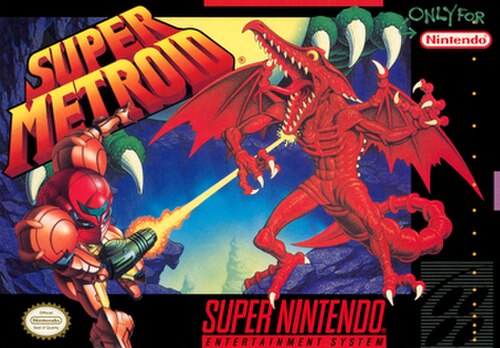
Super Metroid — released in Japan in March 1994 and North America in April — is the series’ apex and one of the most lauded games ever made. Yoshio Sakamoto returned as director with a larger team and the full power of the Super Nintendo, and every element of the original’s design was refined: the world expanded into a seamlessly interconnected Zebes, the in-game map made exploration trackable, and the control scheme was rebuilt for precision.
The game opened with ten minutes on Ceres Space Colony — rain on the hull, the baby Metroid behind glass, Ridley arriving to steal it — before the colony self-destructed and the player found themselves alone on a Zebes that had rebuilt itself. Every major zone of the original was present but transformed: Brinstar, Norfair, Ridley’s Lair, and finally Tourian — where Mother Brain waited.
The climax — Mother Brain’s second form delivering a lethal energy blast to Samus, the baby Metroid arriving to drain Mother Brain of her power before being destroyed, its final gift transferring hyper energy to Samus for one last stand — was designed by Sakamoto to be the emotional core of the trilogy. Players who had raised the baby Metroid since Metroid II were meant to feel the sacrifice.
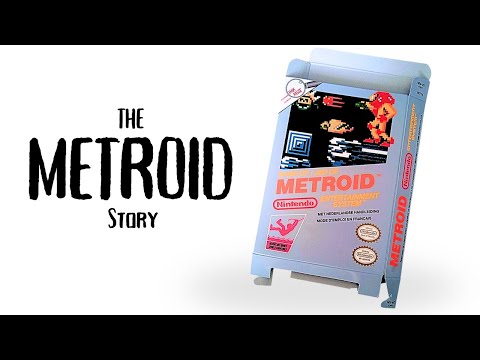
The baby Metroid’s sacrifice was the moment the series had been building to from the beginning. We wanted players who had carried that creature from Metroid II to feel it as a real loss.
— Yoshio Sakamoto, Director, Super Metroid
Legacy of the Trilogy
The original trilogy ended with Super Metroid in 1994, but its influence extended far beyond its era. The term “Metroidvania” entered the critical vocabulary in the late 1990s and early 2000s as developers recognised and named the structural genre that Sakamoto’s team had pioneered — a genre now encompassing thousands of games across every platform.
Super Metroid’s speedrunning community — active since the mid-1990s and one of the earliest formalised speedrunning scenes — continues to push the game’s limits in 2024, discovering new routes and refining times in categories including any%, low%, and 100%. The game that Sakamoto’s team finished in 1994 is still being mastered thirty years later.
Samus Aran joined the Super Smash Bros. roster in 1999, introducing the character to a generation that had not experienced the original trilogy. The series continued with Metroid Fusion (2002), Metroid Prime (2002), and eventually Metroid Dread (2021) — a direct sequel to the events of Super Metroid. The trilogy’s legacy is inseparable from what followed.