From the Famicom to the Super Famicom — eight years that defined action platformers.
NES Debut — Rockman
1987
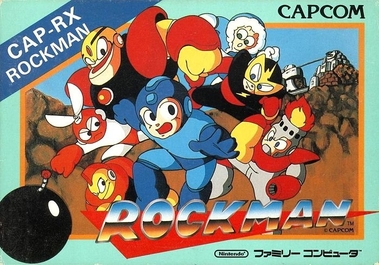
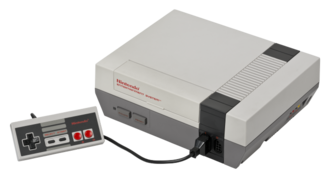
Rockman (JP) - Keiji Inafune's original box art, December 1987The Famicom - the hardware platform for the classic series debut
Mega Man — released in Japan as Rockman on December 17, 1987 — was directed by Akira Kitamura, with character design
by Keiji Inafune and music by Manami Matsumae. The concept was straightforward in description and radical in execution: a robot hero
who defeated other robots and absorbed their abilities. The six robot masters of MM1 — Cut Man, Guts Man, Ice Man, Bomb Man,
Fire Man, and Elec Man — could be tackled in any order, their stages unlocked from a password screen that dispensed with
conventional linear level progression.
Kitamura's design insight was the robot master weapon system: each master's defeat yields a special weapon that exploits the
weakness of another. This creates a directed graph of advantage that rewards experimentation and replayability without locking
players into a single path. The player could always complete any stage with the default Mega Buster, but learning the weapon
chain rewarded effort with dramatically easier boss fights.
"The key concept was that each robot master should have a personality — not just as an enemy, but as a design object. Players
should look at the name, look at the sprite, and immediately understand what this machine does."
— Akira Kitamura, on the robot master design philosophy of Mega Man 1
Mega Man 1 sold modestly — estimates range from 300,000 to 500,000 units in Japan — leaving the franchise's future
uncertain. Capcom considered the series concluded. What followed would be one of gaming's most consequential sequels.
NES Golden Era — MM2 & MM3
1988–1990
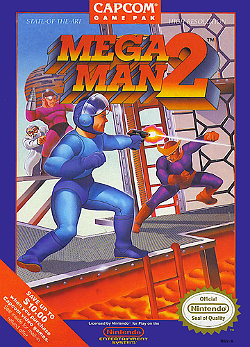
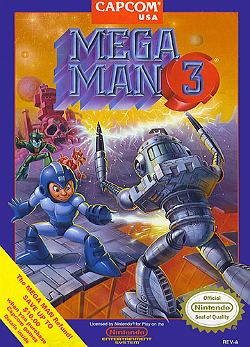
Mega Man 2 (NA box art) - the game that saved the franchise, 1989Mega Man 3 - Rush introduced; Shadow Man becomes a fan favourite
Mega Man 2, released in Japan as Rockman 2: Dr. Wily no Nazo on December 24, 1988, is the defining entry in the classic series.
A small development team, working additional hours beyond their regular Capcom assignments, built the game as a skunkworks project
after management's tepid response to MM1's sales. When the completed prototype was presented internally, Capcom approved it for release.
The result was a masterwork. Eight robot masters — Metal Man, Air Man, Bubble Man, Quick Man, Crash Man, Flash Man, Heat Man,
Wood Man — with weapon weaknesses forming a circular dependency chain. A new password system with 40-dot codes.
And Takashi Tateishi's OST, widely regarded as the finest NES soundtrack ever composed. MM2 sold over 1.5 million copies worldwide.
"The team was small. We worked at night, on weekends. But the motivation was there — everyone wanted to prove that Mega Man
had a future. When we showed the bosses, when people heard the music, they understood."
— Keiji Inafune, on the development of Mega Man 2
Mega Man 3 (1990) continued the momentum, introducing Rush the robot dog — Mega Man's multi-function companion —
alongside Proto Man (disguised as Break Man), a rival character who would recur throughout the series. Shadow Man emerged as
a fan-favourite robot master. Composer Yasuaki Fujita contributed to the MM3 OST alongside Tateishi, beginning his long
association with the series.
Late NES Era — MM4 through MM6
1991–1993
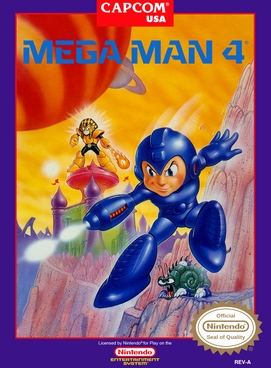
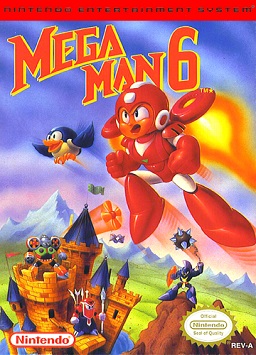
Mega Man 4 - Mega Buster charge shot introduced; Dr. Cossack antagonistMega Man 6 - international design contest; final classic NES entry
Mega Man 4 (December 1991, Japan; NA 1992) introduced the Mega Buster charged shot, a held-button power attack that
fundamentally altered the game's moment-to-moment combat. Where MM1–3 encouraged weapon switching and resource management,
MM4 gave players a default tool capable of dispatching many enemies without switching — a design choice that diluted
the weapon dependency incentive but broadened accessibility. Dr. Cossack appeared as an apparent antagonist, later revealed
to be coerced by Wily, adding narrative texture unusual for the series.
Mega Man 5 (1992) refined the charged shot formula and introduced the Super Mega Buster upgrade. Mega Man 6 (1993) closed
the classic NES series with an international twist: Capcom held a public design contest inviting fans worldwide to submit
robot master concepts. Winning submissions became the eight masters of MM6 — Wind Man, Centaur Man, Knight Man, Flame Man,
Plant Man, Blizzard Man, Tomahawk Man, and Yamato Man. MM6 was notable also in that Nintendo published it in North America
rather than Capcom, reflecting Capcom's view that the NES market had concluded.
"By MM4 and MM5 we were finding ways to keep the series fresh while maintaining what players loved. The charged
Mega Buster was controversial internally — some felt it made the special weapons redundant. The debate
never fully resolved."
— Keiji Inafune, on design evolution in the late NES entries
Game Boy Era
1991–1994
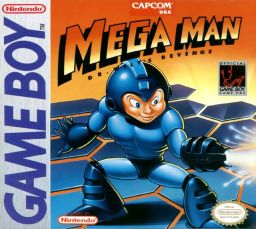
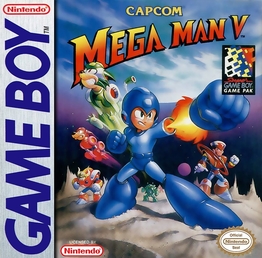
Mega Man: Dr. Wily's Revenge - the first Game Boy entry (1991)Mega Man V - Stardroids replace robot masters; considered the best GB entry
Five Mega Man titles released on the Game Boy between 1991 and 1994, developed by Minakuchi Engineering under Capcom's direction.
Mega Man: Dr. Wily's Revenge (1991, known as Rockman World in Japan) adapted masters from MM1 and MM2 for the 160×144
monochrome screen, demonstrating that the series' formula compressed convincingly to handheld hardware.
Mega Man V (1994) stands apart from its predecessors. Rather than recycling NES robot masters, it introduced the Stardroids
— eight space-themed bosses with names drawn from the solar system (Terra, Mercury, Venus, Mars, Saturn, Uranus, Pluto, Neptune).
The game received exclusive content and a dedicated OST. It is widely considered the finest entry in the Game Boy series.
SNES Era — Mega Man X
1993–1995
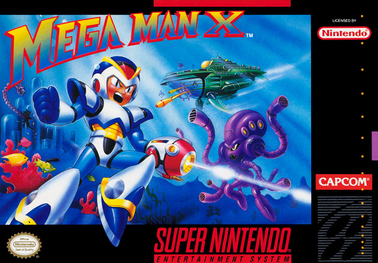
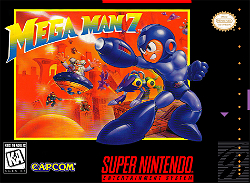
Mega Man X - wall-jumping, dashing, armour upgrades; a new eraMega Man 7 - classic series returns on SNES, introducing Bass
Mega Man X (December 1993, Japan; January 1994, North America) was not a sequel but a reinvention. Set a century after
the classic series, X features a new protagonist — X, the first robot capable of independent thought — and a dramatically
expanded moveset: wall-climbing, air dashing, and upgradeable armour capsules found within stages. The eight Maverick bosses
— Storm Eagle, Chill Penguin, Spark Mandrill, Armored Armadillo, Launch Octopus, Boomerang Kuwanger, Sting Chameleon,
Flame Mammoth — replaced robot masters in nomenclature and design.
The tone shifted to match. Where the classic series was bright and almost cartoonish, X opened with Chill Penguin's stage in
frozen silence, with Vile kidnapping Zero in the opening act and a post-credits scene hinting at darker threats to come.
The SNES SPC700 sound chip enabled composers Makoto Tomozawa and Yuko Takehara to produce an OST with richer timbres —
distorted guitar tones, sustained bass, and textured percussion impossible on the 2A03.
"With X we wanted to start fresh — same DNA, different expression. The question was: what kind of Mega Man
fits the world of the Super Famicom? The answer was X."
— Keiji Inafune, on the creation of the Mega Man X sub-series
Two further SNES X titles followed — Mega Man X2 (1994, using the Cx4 chip for pseudo-3D effects) and Mega Man X3 (1995,
the first X game to make Zero briefly playable). Mega Man 7 (March 1995, Japan) brought the classic series to SNES,
introducing Bass (Forte in Japan) as a recurring anti-hero rival. The SNES era closed the period covered by this site,
though the series would continue on PlayStation, Saturn, and beyond.