Kikstart
1985 · C64, ZX Spectrum, Amstrad CPC · Mastertronic
The £1.99 Game That Sounds Like a Hit Record
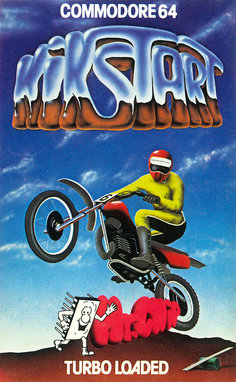
Kikstart is the Mastertronic title that more than any other demonstrates what the £1.99 model could produce at its best. Released in 1985 for the Commodore 64, ZX Spectrum, and Amstrad CPC, it placed the player on a motorcycle navigating obstacle courses - logs, gaps, ramps, and barrels - with a pure trial-and-error satisfaction driving the gameplay loop. The premise was simple. The execution, particularly on the C64, was extraordinary.
The game became as famous for its music as its gameplay. Rob Hubbard's SID chip composition for Kikstart entered C64 culture immediately - discussed in Zzap!64 reviews, passed around on copied tapes, and reproduced on SID player apps and tribute compilations four decades later. In 1985, buying a Mastertronic cassette for £1.99 sometimes meant getting a piece of music you would remember for the rest of your life.
Shaun McClure, Rob Hubbard, and a Tight Brief
Kikstart was developed by Shaun McClure at Mr Chip Software - one of the small independent studios that supplied Mastertronic's catalogue on a flat-fee commission basis. Mastertronic's model was clear: pay the developer a fixed amount, retain all rights and distribution, price the result at £1.99. The developer took certainty over royalties; Mastertronic took the upside if the game sold well.
For the C64 version, Mastertronic commissioned Rob Hubbard to compose the soundtrack. Hubbard was at this point establishing himself as the SID chip's foremost composer - methodical, technically innovative, and capable of turning budget commissions into showcases. Kikstart was one of his earliest Mastertronic commissions, and the result established a working relationship that would span dozens of titles and define the label's sonic identity on C64.
The Spectrum and Amstrad versions were separate conversions adapted to each platform's different audio capabilities. The gameplay translated well; the music, inevitably, could not follow the SID chip's lead. On C64, Kikstart existed in a different class.
Obstacle by Obstacle, Learnable by Design
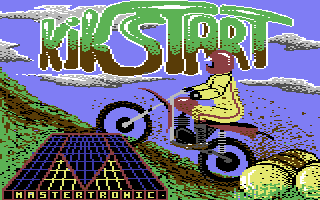
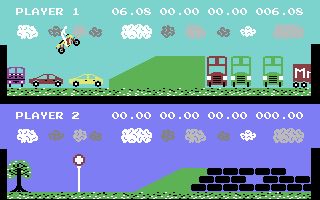
The mechanics were deceptively simple. Accelerate, brake, wheelie. The courses escalated in difficulty with the precision of a well-designed puzzle - each obstacle learnable through repetition, each failure immediate and legible. You could see exactly what killed you. The game understood its own pace completely: failure was never unfair, always instructive.
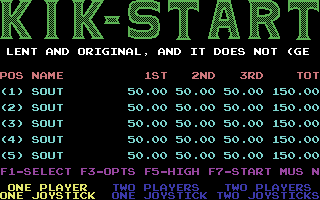
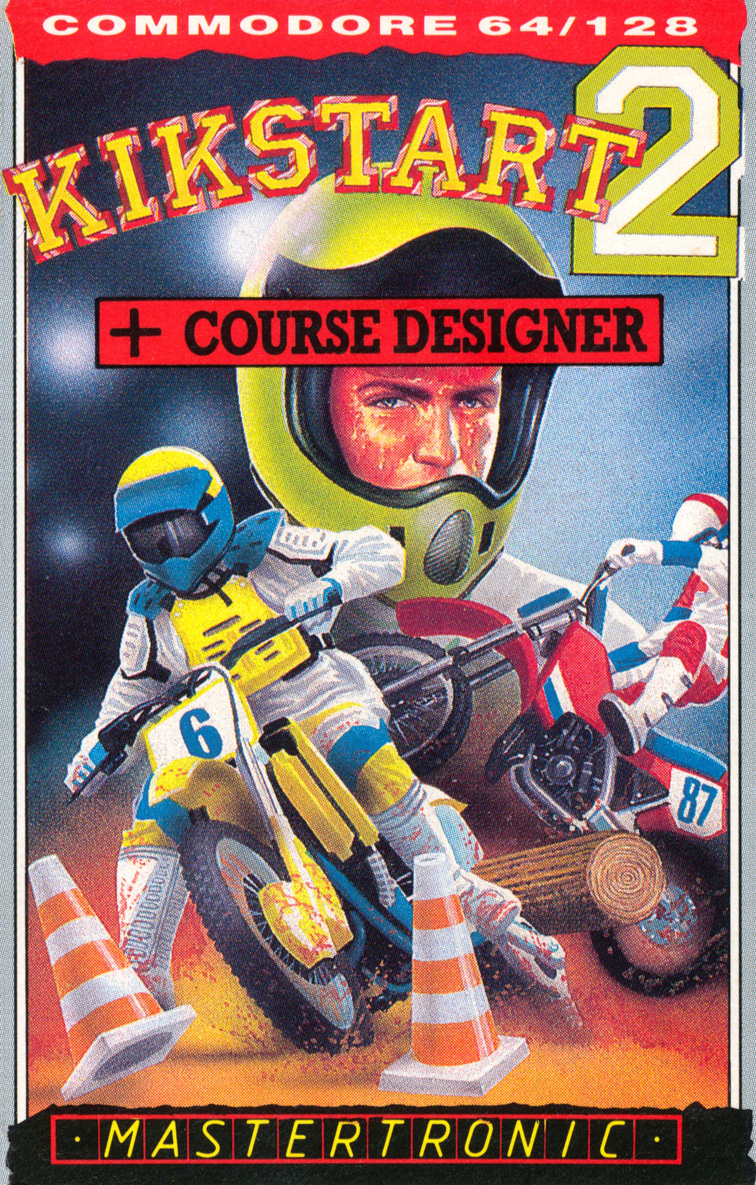
The single-player campaign offered progressively harder courses. A two-player competitive mode ran both motorcycles on screen simultaneously - rare for a budget title and a significant draw for anyone with a sibling or friend willing to share the joystick. Kikstart 2 (1987) expanded the concept further with a full track editor and enhanced two-player mode, confirming that the original's design had room to grow. See the full catalogue for both Kikstart titles.
Three Oscillators and a Filter Nobody Else Had
The Commodore 64's SID chip (Sound Interface Device) was designed by Bob Yannes and contained three independent voice channels, each supporting multiple waveforms, plus a resonant filter that could sweep across the frequency spectrum. No other home computer of the period had anything comparable. The BBC Micro, ZX Spectrum, and Amstrad CPC all used simpler audio chips that produced far more basic output.
Hubbard's Kikstart composition used all three SID voices in combination with the filter to create a piece that had genuine melodic complexity and tonal warmth - sounds that felt synthesised rather than merely beeped. The piece ran at 50Hz on PAL hardware, updating the filter sweep and voice modulation on every video frame. The technical density was invisible to listeners; the result was simply music that moved them.
The gameplay code itself reflected the tight constraints of budget development: McClure's engine had to fit collision detection, course scrolling, and motorcycle physics into the C64's 64KB of RAM alongside the graphics and Hubbard's music data. The result was lean code that did exactly what was needed and nothing more.
"The SID chip's filter was the thing that set it apart. Nobody else had a filter you could sweep in real time. You could make sounds that were genuinely impossible on any other machine."
Rob Hubbard, composer; as documented in the High Voltage SID Collection (HVSC) composer notes and multiple retrospective interviews with the C64 SID community
Zzap!64 Called It a Classic - the Market Agreed
Contemporary C64 press received Kikstart warmly. Zzap!64 - the dominant Commodore 64 magazine of the period - praised both the gameplay's tight design and, specifically, the Rob Hubbard soundtrack. Music was treated as a genuine criterion of quality in C64 reviews of the era, and a Hubbard score was understood to represent an investment by the publisher in the product's quality.
Commercial performance matched critical reception. Kikstart moved in large numbers at Woolworths and W.H. Smith, becoming one of Mastertronic's most successful catalogue titles. The combination of an accessible gameplay concept, a genuinely excellent C64 implementation, and a soundtrack that gave people a reason to load the game even when not playing it made the cassette stand out on the spinner rack.
The SID Music That Outlasted the Hardware
Kikstart 2 arrived in 1987 with a track editor - a remarkable feature for a budget sequel - and an expanded Hubbard soundtrack. The sequel confirmed the original's standing as Mastertronic's most beloved franchise. See both titles in the catalogue.
The Rob Hubbard Kikstart composition entered the SID music preservation community almost immediately. The High Voltage SID Collection (HVSC), which has documented C64 SID music since 1996, includes multiple Kikstart variants and platform ports. The piece is playable today in browser-based SID players and continues to appear in C64 tribute concerts and chip music compilations.
Kikstart's legacy is inseparable from Hubbard's. The game gave him one of his earliest Mastertronic platforms; Mastertronic's budget model gave him the volume of commissions that made him the era's most prolific SID composer. The pairing worked for both. You can play Kikstart in-browser on the play page.
Kikstart (C64, 1985) - full longplay including the Rob Hubbard SID soundtrack that made the game famous beyond its gameplay.