Deep Dive · Musical Analysis

Ghosts ‘n Goblins NES

The definitive musical analysis of Masashi Kageyama’s 1986 masterwork — Stage 1 chord structure, graveyard atmosphere, hardware constraints, and how five channels create existential dread.

The Port That Rewrote the Music

Ghosts ‘n Goblins (魔界村, Makaimura) arrived on the NES in 1986. It was a port of Capcom’s 1985 arcade hit - but Masashi Kageyama did not port the music. The arcade original, composed by Ayako Mori, used a Yamaha YM2203 FM synthesis chip and an AY-3-8910 PSG - hardware fundamentally incompatible with the Ricoh 2A03 APU in the NES.

Kageyama composed an entirely new soundtrack for the NES. The melodies, harmonies, rhythms, and themes are original to the NES version. What you hear in Ghosts ‘n Goblins NES is not a transcription of the arcade — it is a wholly independent compositional work shaped by the NES hardware’s constraints and by the specific gameplay experience Tokuro Fujiwara’s NES design required.

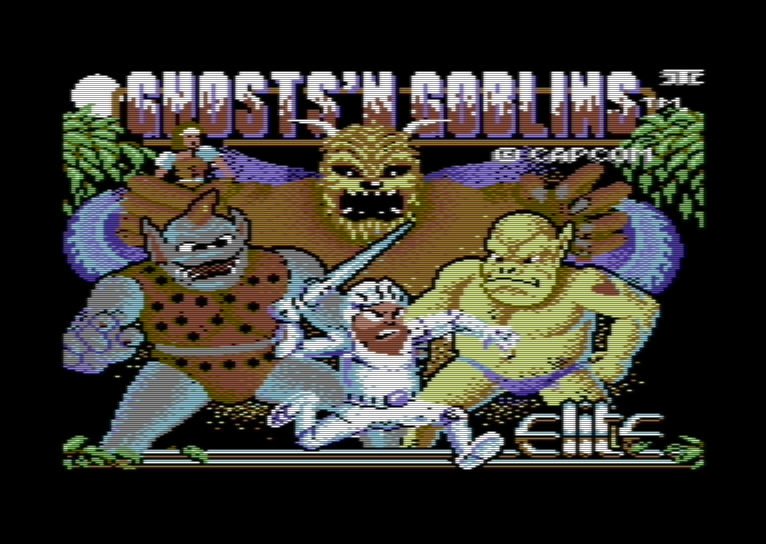
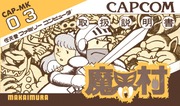
Ghosts 'n Goblins NES box art - the Elite Systems 1986 release, featuring Arthur in the graveyard
Ghosts ‘n Goblins (NES, 1986). Elite Systems UK release. The box art’s nighttime graveyard aesthetic matches the audio atmosphere Kageyama composed.

“The Ghosts ‘n Goblins NES soundtrack is not a port of Ayako Mori’s arcade music. It is a Masashi Kageyama original, composed within the 2A03’s five-channel constraints from scratch. The two soundtracks share a title but not a note.”

VGMPF Community Analysis — Ghosts ‘n Goblins (NES) credit documentation

The Stage 1 Main Theme

The Stage 1 main theme (Ground BGM) is among the most recognisable pieces of NES music ever written. It opens in the first moments of play - Arthur drops into the graveyard and the melody begins immediately, establishing the sonic character of the entire game.

The theme is composed in A minor with borrowed chord usage. Kageyama draws on modal mixture - specifically, borrowing chords from the parallel major scale (A major / A Ionian) into the minor-key context. This creates harmonic movement that feels simultaneously familiar (the minor-key melody line) and unexpected (the borrowed chord arriving where a diatonic chord would be).

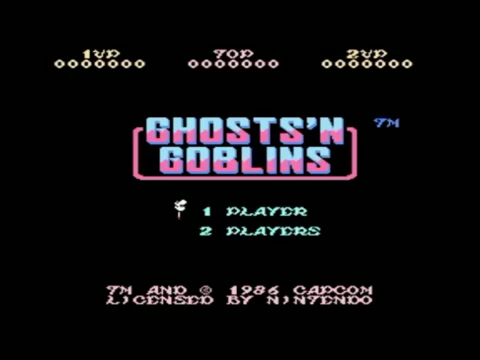
Ghosts 'n Goblins NES Stage 1 - opening graveyard with tombstones and Arthur
Stage 1 opening - the graveyard where the main theme plays. The pulse wave melody carries immediately over Arthur’s sprite. The dread in the music is immediate and intentional.

Borrowed Chords and Modal Mixture

In standard diatonic A minor harmony, the chords available are: Am, Bdim, C, Dm, Em, F, G. These are all derived from the A natural minor scale.

Borrowed chords (modal mixture) introduce chords from the parallel major - for A minor, this means chords from A major: A, Bm, C#m, D, E, F#m, G#dim. The most common borrowings are the major I (A major), the major IV (D major), and the ♭VI (F major from Aeolian) already available in natural minor, but also the major VI (F#m-related borrowings) and the ♭VII (G major from Mixolydian).

In the Stage 1 theme, the borrowed chord creates a momentary harmonic surprise — the melody line continues in minor, but the harmony beneath it shifts to a chord outside the pure minor scale. This produces the characteristic sense of epic minor-key drama that distinguishes the GnG NES soundtrack from contemporaneous platformer music of the same era.

“The Stage 1 harmonic language combines the minor-key urgency you’d expect from a graveyard platformer with borrowed chords that add unexpected colour. In 1986, most NES composers were working entirely within diatonic major or relative minor. Kageyama was doing something harmonically more sophisticated.”

NES Music Community Analysis — GnG harmonic structure retrospective
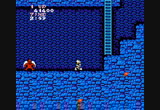
Ghosts 'n Goblins NES - Stage 1 action with enemies and Arthur without armour
Stage 1 action. The pulse-wave melody runs throughout, regardless of what happens to Arthur on screen. The music’s indifference to failure is part of its atmosphere.

The Graveyard Theme

The Graveyard BGM (Stage 2) establishes a different harmonic and rhythmic character. Where the Stage 1 theme is driving - pulse, forward, urgent - the Graveyard theme is oppressive. The pace is slower, the harmonic movement more deliberate, the noise channel providing rhythmic texture that implies a heartbeat or funeral drum.

The Graveyard theme is widely regarded, alongside the Stage 1 theme, as the most musically distinctive piece in the GnG NES soundtrack. Its use of the minor key at a slower harmonic pace creates a dread that matches the visual atmosphere of the stage: a literal graveyard, populated by the undead, at midnight.

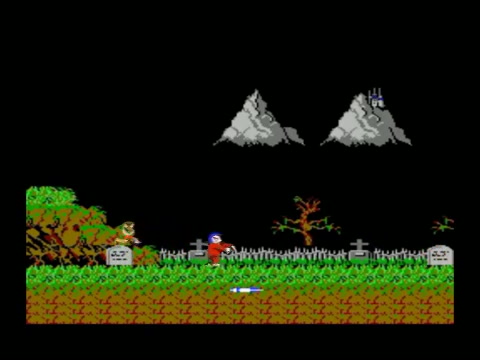
Ghosts 'n Goblins NES - mid-game stage demonstrating the game's atmospheric design
GnG NES mid-game. The atmospheric density of the game - graveyard, castle, demon world - is matched by Kageyama’s harmonic density across the soundtrack.

The Village Theme

The Village BGM (Stage 3) is the most harmonically contrasting piece in the GnG NES score. After two minor-key stages - the graveyard urgency of Stage 1 and the oppressive weight of Stage 2 - the Village theme shifts register: brighter, more major-leaning, with a melodic character that implies relief rather than dread.

This is deliberate tonal architecture. Kageyama understood that continuous minor-key writing would desensitise the player; the Village theme exists to provide contrast, so that the return to minor-key music in subsequent stages registers as a fresh shock rather than background noise.

Chord Structure: Contrast by Major-Key Borrowing

Where the Stage 1 theme borrows chords into a minor context (modal mixture from parallel major into minor), the Village theme works in the opposite direction: its primary tonality is closer to major, with the characteristic GnG harmonic colour produced by the borrowing of minor-mode chords into that brighter context.

The effect is a piece that sounds comparatively cheerful - but is not actually diatonic major. Kageyama keeps the same borrowed-chord harmonic language throughout the soundtrack, maintaining compositional unity while varying the emotional register. The Village theme uses the same technique as the Stage 1 theme; only the direction of borrowing shifts.

This gives the GnG NES soundtrack a structural coherence unusual for NES game music of 1986: every stage uses a consistent harmonic palette, varied by tonality and tempo rather than by wholesale stylistic change.

Ghosts 'n Goblins NES - mid-game stage representing the atmospheric transition into the village section
GnG NES mid-game - the atmospheric shift from graveyard to village. Kageyama’s Village BGM provides tonal relief here, before the game returns to minor-key dread.

“The Village theme’s major-key brightness is not a stylistic break - it is a deliberate contrast within a unified harmonic system. Kageyama uses the same borrowed-chord technique across all three early stage themes; only the tonal centre changes. This is compositional architecture, not just background music.”

NES Music Community Analysis — GnG NES soundtrack structure retrospective

How Five Channels Create Dread

The Ricoh 2A03’s hardware constraints are not just technical limitations - they are aesthetic materials. Kageyama used the specific sonic properties of each channel to construct an atmosphere that the higher-fidelity FM synthesis of the arcade could not replicate on the NES.

The pulse channels (Square 1 and Square 2) produce a thin, cutting timbre at medium duty cycles. This is not a warm orchestral string - it is a hard, insistent tone that demands attention. At full duty cycle (50%), the pulse channel sounds closest to a square wave; at 12.5%, it produces a thin, reedy sound. Kageyama uses this timbral variation deliberately.

The triangle channel’s stepped waveform produces audible aliasing at lower pitches - a characteristic “grit” that gives NES bass lines a rough, somewhat oppressive quality. In a major-key, brighter NES game, this artefact is barely noticed. In a minor-key graveyard game, it contributes to the atmosphere of menace.

Ghosts 'n Goblins NES - late game stage showing the game's visual density
GnG NES late-game. The visual density of enemy placement matches the sonic density of Kageyama’s score. Neither offers relief.

“Creating dread under hardware constraints: the narrow pitch range of the APU channels, the triangle channel’s step-wave timbre producing audible aliasing at lower pitches, and the 4-bit envelope decay available to the pulse channels all contribute to the oppressive atmosphere Kageyama achieves. The listener’s perception of ‘gloom’ is partly a byproduct of hardware limitation exploited with compositional intent.”

Technical Analysis — NESdev community, chip music retrospectives

The five-voice allocation Kageyama uses in the GnG NES soundtrack is:

  • Pulse 1 - Primary melody voice
  • Pulse 2 - Countermelody or harmony voice
  • Triangle - Bass line
  • Noise - Rhythm / percussion texture
  • DPCM - Drum hits or short impact samples

This five-voice texture - melody, countermelody, bass, rhythm, impact - defines the sound of the GnG NES soundtrack. No channel is wasted. Each contributes a distinct harmonic or rhythmic function to the whole.

Ghosts ‘n Goblins NES — Full Longplay. The complete two-loop run, with Kageyama’s full soundtrack heard in context. The music never lets up; neither does the game.

The Arcade vs The NES Soundtrack

The arcade Ghosts ‘n Goblins (1985) used Capcom’s arcade board hardware - the same board as Legendary Wings - incorporating Yamaha YM2203 FM synthesis and AY-3-8910 PSG for sound. Composer Ayako Mori wrote the arcade score.

FM synthesis produces a fundamentally different timbre from the 2A03 pulse wave. The arcade score has a warmth and tonal complexity unavailable on the NES. Mori’s arcade compositions take advantage of FM’s ability to produce bell-like, organ-like, and bass-heavy timbres through operator modulation.

Kageyama’s NES score does not attempt to replicate this - it works with the 2A03’s specific properties to produce something harmonically and atmospherically distinct. The NES score is harsher, thinner in timbre, but arguably more immediately recognisable - the pulse wave melody cuts through with a directness that FM synthesis does not have.

“Two different composers, two different hardware platforms, one title. Mori’s arcade score and Kageyama’s NES score share the game’s title but not its music. Both are independently valuable compositions, constrained by and expressive of their respective hardware.”

Retrospective Analysis — VGMPF community documentation notes