Bill Rizer & Lance Bean vs the Galaxy
Contra was released in arcades by Konami in 1987 and on the Nintendo Entertainment System in 1988. It was designed as a run-and-gun action game supporting two players simultaneously - Bill Rizer and Lance Bean, two commandos battling an alien force on a remote island and eventually inside the alien hive itself.
The game drew heavily on 1980s action cinema. Aliens (1986) supplied the template: marines versus insectoid aliens, escalating from jungle combat to claustrophobic interior warfare. The H.R. Giger aesthetic that saturated the late stages - the organic corridors, the pulsing alien architecture - placed Contra in a specific moment of pop-cultural crossover between film and games that few NES titles matched.
On NES, Contra became one of the definitive co-operative experiences of the 8-bit era. The shared screen, shared life pool, and punishing default difficulty (three lives, one hit to die) created a game where the Konami Code's 30-life extension felt genuinely useful for most players - not a cheat, but an accessibility valve that Konami built in deliberately. See the full games catalogue for Contra's sequels and related titles.
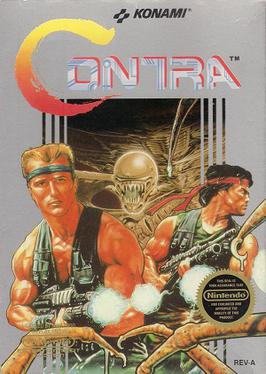
Contra (NES, 1988) - North American box art featuring commandos styled after the era's action cinema icons.
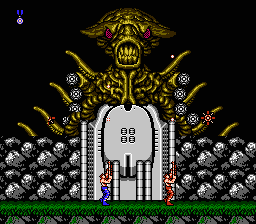
From Arcade Boards to 256 Kilobytes
Contra was directed by Koji Hiroshita and developed at Konami's arcade division, running on custom Konami hardware with capabilities far beyond anything the NES could replicate directly. The arcade cabinet used dedicated sprite hardware and a more powerful processor, which meant the NES port - developed by a separate team - was not a straight conversion but a substantial redesign.
Konami's standard practice throughout the 1980s was to suppress individual developer credits, fearing that visible talent would attract poaching by competitors. The NES port team worked without public credit. Composers Hidenori Maezawa and Kyouhei Sada, who scored the NES version, were among the few whose contributions are documented through the Konami Kukeiha Club record.
The NES port shipped on a 256-kilobyte cartridge - standard for the era - containing content that exceeded the arcade original in stage count. The North American version was published under the Ultra Games label, one of Konami's subsidiaries created to bypass Nintendo's four-cartridge-per-year licensing restriction.
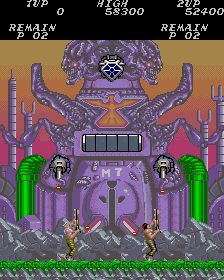
Contra arcade (1987) - the original on dedicated Konami hardware, with higher-resolution sprites and a different stage structure from the NES port.
The NES version added Stage 1 (a horizontal scrolling jungle absent from the arcade), expanded the base top-down stages from two to four, and extended the alien lair sequences across two full stages. The Konami Code - ↑↑↓↓←→←→BA - was carried over from the NES Gradius port (1986), where it had originated as a testing shortcut left in by accident. In Contra, the code was included intentionally to grant 30 lives.
“I put it in to make testing easier and forgot to take it out. I never thought it would become something this famous.”
— Kazuhisa Hashimoto, creator of the Konami Code; quote cited in his Polygon obituary, 25 February 2020
One Hit, One Death, Eight Weapons
Contra operates on a simple rule: one bullet kills your commando. No health bar, no damage absorption - a single enemy shot or contact sends Bill or Lance to their deaths. This constraint, combined with a constant stream of enemies from every direction, gives the game its defining tension. You are never safe; standing still is always fatal; the question is always which threat to address first.
The weapon pickups scattered across each stage directly shape the run's difficulty. The default rifle fires fast and straight. The Machine Gun improves the fire rate. The Laser pierces enemies in a line. The Flamethrower handles close-range crowds. But the Spread Gun - the S pickup, shooting five bullets in a fan pattern - is categorically better than every other weapon in the game. Carrying a Spread Gun into a difficult section transforms it; losing it to a single enemy bullet resets the challenge entirely. Much of Contra's tension in two-player comes from protecting each other's Spread Gun.
The stage design covers four distinct formats. Horizontal side-scrolling stages (Stages 1, 3, 5, 7) play as straightforward run-and-guns. Waterfall stages use a vertical climb format. The base top-down stages (Stages 2, 4, 6, 8) switch to an overhead view, tasking players with destroying a series of enemy sensors guarded by soldiers and gun turrets. The alien lair stages replace everything with organic enemy patterns and corridor fights leading to the hive boss.
All eight stages can be completed in under 30 minutes. This short runtime is not a flaw - it is the constraint that makes Contra a game worth replaying. A player who clears it once will clear it faster next time. The skill ceiling is high enough that dedicated players can complete it without losing a life; the floor is low enough that anyone with the Konami Code can see the ending.
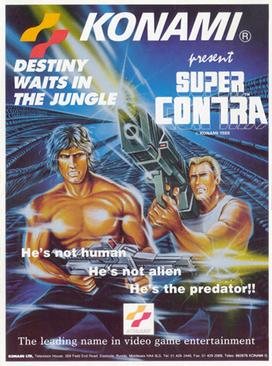
Super Contra (NES, 1990) - the follow-up that expanded the stage variety and boss complexity, building directly on the original's formula.
More Than the Arcade, on Less Hardware
The NES port of Contra is technically notable for what it added rather than what it lost in translation. Ports of the era almost universally reduced content to fit the host platform's constraints. Contra inverted this: the NES version is longer, more varied, and in several respects more polished than the arcade original it was adapting.
The NES hardware was running a 1.79 MHz 6502-derived CPU and a Picture Processing Unit with 64 sprites, 2KB of VRAM, and no hardware scaling or rotation. Fitting Contra's scrolling stages, top-down base sequences, and simultaneous two-player action into this architecture - without slowdown that made the game unplayable - was a significant programming achievement. The NES version maintains consistent frame pacing through almost all of its content.
| Feature | Arcade (1987) | NES (1988) |
|---|---|---|
| Horizontal scrolling stages | Yes | Yes (Stage 1 unique to NES) |
| Base top-down stages | Yes (Stages 2, 4) | Yes (Stages 2, 4, 6, 8) |
| Waterfall stage | No | Yes (Stage 3) |
| Alien lair stages | Final stage | Stages 5, 7 + final boss |
| Players | 2 simultaneous | 2 simultaneous |
| Default lives | 3 | 3 (30 with Konami Code) |
| Total stages | 6 | 8 |
The four base top-down stages in the NES version were more numerous than the arcade's two and required a completely different rendering approach - an overhead perspective with perspective-correct enemy movement that the side-scrolling stages never attempted. Switching between rendering modes within a single game, on NES hardware, without a cartridge mapper chip, was not common. The 256KB Contra cartridge used no special mapper hardware; all of this was achieved with a standard NROM configuration.
The Designers Who Knew When to Add
Contra's NES port team made choices that show a clear understanding of the differences between arcade and home play. An arcade game must be over in minutes - long enough to take another quarter, short enough to keep the machine occupied. A home cartridge can justify an hour's play across a single session.
The NES team added Stage 1 (the horizontal jungle, the game's most iconic stage), Stage 3 (the waterfall climb), and doubled the base top-down sequences from two to four. The alien lair was expanded from a single final section to two full stages before the queen boss. Every addition increased the home version's runtime while maintaining the arcade's escalating difficulty curve.
The Konami Code's role shifted between versions too. In the arcade, there was no equivalent - coin-operated games do not offer 30-life insurance. On NES, the code was included deliberately, acknowledging that home players needed a difficulty release valve the arcade quarter-drop provided naturally.
How a Testing Tool Became Cultural History
The Konami Code had appeared in Gradius (NES, 1986) before Contra, but it was Contra that made it famous. In Gradius, the code granted all power-ups at once - useful, but the game had a comparatively limited audience. In Contra, the code granted 30 lives where the default was 3. The difference between an average player reaching Stage 3 and an average player seeing the final boss.
The code spread through word of mouth, schoolyard culture, and Nintendo Power magazine. By 1990, it had appeared in multiple Konami NES titles and had begun to appear in games from other publishers. By 2000, it was referenced in film and television. When Kazuhisa Hashimoto died on 25 February 2020, tributes across the gaming press used ↑↑↓↓←→←→BA as an obituary notation - the sequence had become, as Polygon wrote at the time, "the single most famous cheat code ever created."
Nintendo Power's Cover Game
Contra was featured extensively in Nintendo Power's premiere issue (Vol. 1, 1988) - the magazine that would become the primary review source for NES games throughout the era. The coverage positioned Contra as one of the must-own NES titles, highlighting the two-player co-op mode as the standout feature for players who had previously only experienced single-player action games.
Contemporary reception focused consistently on two elements: the co-operative mode, which was unusual enough at the time to function as a selling point in its own right, and the game's difficulty, which Electronic Gaming Monthly praised while acknowledging the Konami Code as a meaningful accessibility option. The game's length (under 30 minutes for a competent player) was noted positively - reviewers understood that NES action games were designed to be replayed, not completed once and shelved.
Contra's NES release sold strongly throughout 1988 and 1989, becoming one of the most-traded cartridges in the schoolyard economy of NES ownership.
Contra's long-term critical standing has improved with retrospective review. GameFAQs community rankings have consistently placed it among the highest-rated NES titles. The 2019 Contra Anniversary Collection (PC, Switch, PS4, Xbox One) sold well enough that Konami included production notes and supplemental materials - a sign the company recognised the original as historically significant.
Nintendo Power Vol. 2 (1988) characterised Contra as a game that knows exactly what it is - unsubtle, direct, and demanding. That clarity was widely read as a design strength. Contra did not attempt to be an adventure game or a puzzle game; it set out to be the best possible version of the thing it was, and reviewers in 1988 recognised that ambition.
The Run-and-Gun Blueprint
Contra's direct sequel, Super Contra, appeared in arcades in 1988 and on NES in 1990. Contra III: The Alien Wars (SNES, 1992) expanded the formula with Mode 7 overhead sequences and is considered the series' creative peak. Contra: Hard Corps (Sega Genesis, 1994) pushed the difficulty ceiling further and introduced branching paths, marking the series' experimental peak.
Beyond its own sequels, Contra defined what a run-and-gun game was expected to be: two-player simultaneous, one-hit deaths, escalating enemy density, stage-type variety, and weapon pickups that materially change play. The influence is visible in Metal Slug (SNK, 1996), Gunstar Heroes (Treasure, 1993), and Cuphead (Studio MDHR, 2017), each of which credits the run-and-gun tradition Contra formalised.
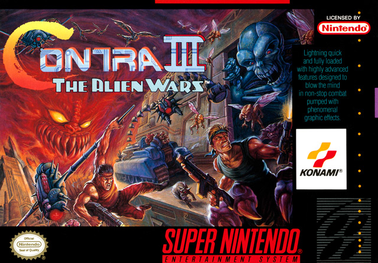
Contra III: The Alien Wars (SNES, 1992) - the series' SNES debut, featuring Mode 7 overhead boss sequences and widely regarded as the finest entry in the franchise.
The Contra Anniversary Collection (2019, all major platforms) gathered ten titles from the series' history - Contra, Super Contra, Contra III, Operation C (Game Boy), Contra: Hard Corps, and others - alongside a digital museum of development materials. It confirmed that Konami still regarded the original as the foundation worth celebrating, three decades after its release.
The Konami Code's cultural afterlife is inseparable from Contra. The sequence appeared in the game as an accessibility feature and ended up in over 100 games, advertising, television, and the obituary of its own creator. No other cheat code achieved this. Browse the full catalogue to trace Contra's place in Konami's broader output, or visit the people page for the composers and designers who built it.
When Kazuhisa Hashimoto died on 25 February 2020, Polygon and other gaming publications led their tributes with the sequence itself - ↑↑↓↓←→←→BA - printed as a visual shorthand for the man and what he left behind. The code had outlasted the arcade era, the cartridge era, and the company that produced it. It now appears in browser games, streaming service interfaces, and social media easter eggs from publishers who have no other connection to Konami's history.
Hidenori Maezawa & Kyouhei Sada
The Contra (NES) soundtrack was composed by Hidenori Maezawa and Kyouhei Sada, working within the constraints of the NES 2A03 audio chip: two pulse wave channels, one triangle wave channel, one noise channel, and one DPCM channel.
The Stage 1 theme (often called "Jungle") opens with a driving pulse that has been arranged, remixed, and covered by musicians across genres for over 35 years. It establishes Contra's sonic identity in under 10 seconds: urgent, military, relentless.
The Snowfield stage music, the Base stages' electronic march, and the alien lair's dissonant tension all demonstrate the composers' ability to shift mood rapidly across 8-bit hardware while maintaining the game's emotional throughline. Full composer credits and Konami Kukeiha Club history are on the music page.
Contra (NES, 1988) - complete soundtrack by Hidenori Maezawa and Kyouhei Sada. Stage 1 "Jungle" theme opens the collection.
Full Playthrough
Contra (NES, 1988) - full longplay from Stage 1 through to the alien queen boss. Maezawa/Sada soundtrack throughout. The Konami Code is entered at the title screen.