Wasteland
Post-nuclear Arizona, 1988 - the RPG that invented the skill-based system, permadeath consequences, and the Fallout legacy.
Wasteland was the game where we decided to take RPGs seriously - not just as entertainment but as a medium for exploring what happens when civilisation falls apart.
- Brian Fargo, producer and designer, Wasteland (1988)
The Game That Changed Everything
Released in 1988 by Interplay Productions and published by Electronic Arts, Wasteland was not simply another RPG. It was a categorical statement about what the genre could be: morally complex, permanently consequential, and set in a world of genuine bleakness and beauty.
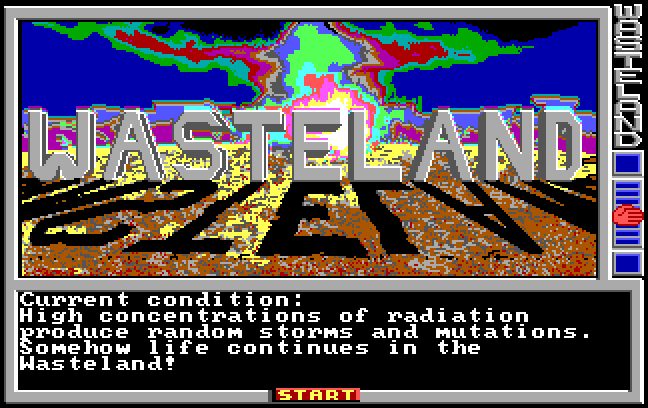
Post-nuclear Arizona, 2087. The Desert Rangers - what remains of a US Army unit stationed in the Mojave when the missiles fell - maintain a fragile order across the irradiated Southwest. You lead a squad of Rangers into a world of mutants, raiders, damaged robots, and the remnants of a human civilisation that preceded the war.
The setting was conceived with extraordinary care by designers Brian Fargo, Ken St. Andre, Michael Stackpole, and Alan Pavlish. The post-nuclear aesthetic drew on Cold War anxieties and post-apocalyptic fiction - notably Leigh Brackett's stories and Roger Zelazny's Damnation Alley - but synthesised them into something entirely native to the interactive medium. In 1988, there was nothing quite like it.
Development Story - The Four Designers
Wasteland emerged from a remarkable design partnership. Brian Fargo, already established as a capable producer on The Bard's Tale series, brought together three collaborators whose backgrounds were unusually diverse for a video game development team.
Ken St. Andre was the creator of Tunnels & Trolls (1975), one of the earliest tabletop role-playing games published after Dungeons & Dragons. His experience in skill-based tabletop design was the direct source of Wasteland's character system. Michael Stackpole was a game designer who would later become a prominent science fiction and fantasy novelist (Star Wars: X-Wing series). Alan Pavlish completed the foursome, contributing to scenario design and system development.
Development ran on the Apple II as the lead platform, with DOS to follow. Published by Electronic Arts - the same publisher behind The Bard's Tale trilogy - Wasteland had the commercial infrastructure to reach a wide audience. The Cold War context was not incidental: the game was designed in 1986 and 1987, when nuclear anxiety was still a live cultural force. Wasteland's synthesis of tabletop design, post-apocalyptic fiction, and computer RPG conventions was original.
We wanted characters who felt real - people who were good at specific things, not just 'levels' of a class. The skill system came from Ken St. Andre's tabletop work and from our frustration with existing RPG design.
- Brian Fargo
How It Plays - Desert Rangers in the Field
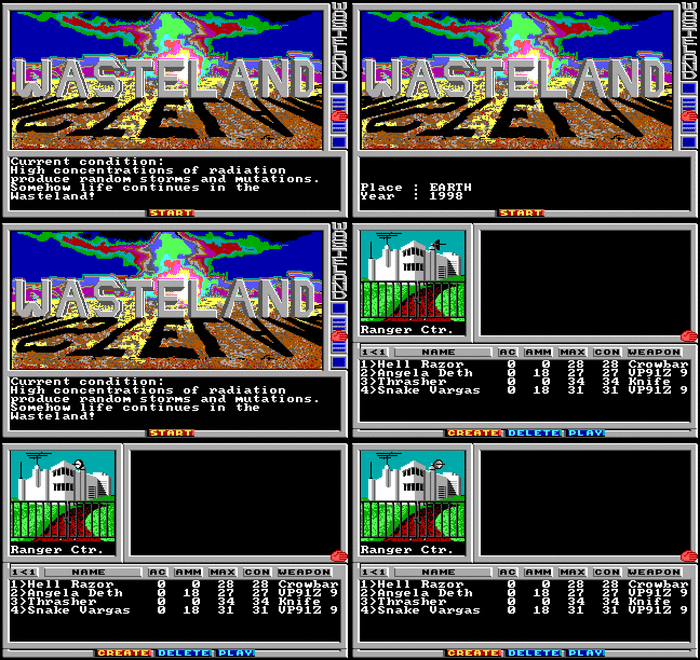
You command a party of up to seven characters - four Desert Rangers of your own creation and up to three recruitable NPCs encountered in the world. Each Ranger is defined not by a class but by a spread of individual skills chosen at creation and developed through use. Skills range from Assault Rifle and Energy Weapons to Medic, Picklock, Safecrack, and Demolitions.
The world is divided into overworld map areas and detailed location maps - towns, dungeons, and outposts each rendered in their own tile-based environment. Encounters are flagged on the overworld; many can be resolved without combat if the right skills are available. A locked door yields to Picklock; a blocked tunnel collapses under Demolitions; a hostile encounter dissolves under sufficient Confidence.
Combat is turn-based, governed by action points that determine how many attacks or movements a character can make per turn. The system rewards tactical thinking: flanking positions, managing cover, and deploying the right weapons against the right enemies all matter. Dead characters do not respawn. Injury is persistent and reduces skill effectiveness until treated by a character with the Medic or Surgeon skill.
The physical Paragraphs booklet distributed with the game extended the narrative beyond what could fit on disk. When the game directed players to a numbered paragraph, they turned to the printed booklet to read the encounter's full text - an elegant solution to storage constraints that also put the world literally in players' hands.
Technical and Design Achievement
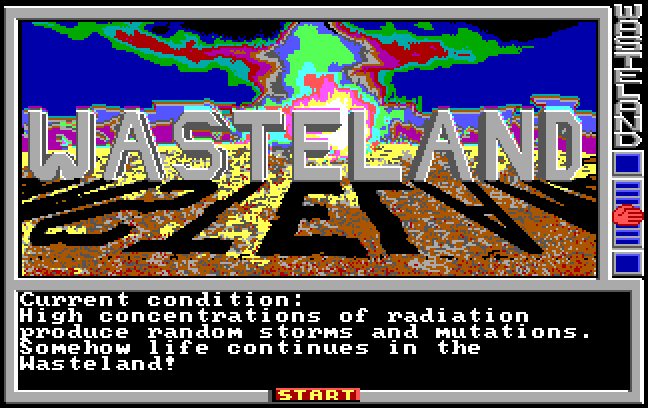
Wasteland's most consequential innovation was its skill-based character system. Where previous RPGs - including The Bard's Tale, Interplay's own breakthrough title - used class-based advancement, Wasteland allowed players to invest experience points into individual skills from a menu of over 30 options. A character could specialise in Medic and Assault Rifle while leaving Picklock and Safecrack to another party member. Skills had tangible effects on the world: high Perception revealed hidden passages; Demolitions opened blocked routes; Surgeon reversed otherwise permanent injuries. The system created characters who felt genuinely individual - not instances of a class template but people with distinct competencies.
The second innovation was persistent world state. Wasteland's world remembered everything. Characters who died in combat stayed dead - no reload, no resurrection. Environmental changes persisted: a ruined building remained ruined; an NPC killed did not return; a cache of supplies, once taken, was gone. This was not merely a difficulty feature. It was a narrative stance: the apocalypse was real, and choices mattered because they could not be undone.
Reception - Game of the Year, 1988
Wasteland's critical reception was exceptional. Computer Gaming World, the authoritative PC gaming publication of the era, called it "the most ambitious RPG ever created for a microcomputer" and awarded it Game of the Year for 1988 - a strong field that included significant competition from the dungeon-crawling subgenre Interplay itself had helped define.
The tabletop RPG community, reaching Wasteland through publications like Dragon Magazine, responded warmly to its skill-based character system - a design philosophy much closer to tabletop tradition than the class hierarchies common in computer RPGs of the era. The game sold well enough on the Apple II and DOS platforms to validate Interplay's ambition and fund the company's next creative phase.
Commercially, Wasteland performed strongly for an RPG of its complexity and price point, cementing Interplay's reputation as the premier PC RPG developer of the late 1980s. It remained the benchmark for Western CRPGs for nearly a decade - until the studio's own Fallout arrived in 1997 to claim the title for a new generation.
See all Wasteland titles in the game catalogue and the full creative team - Fargo, St. Andre, Stackpole, Pavlish - on the people page.
Legacy - The Ancestor of Fallout
Fallout (1997) was not merely inspired by Wasteland - it was a direct continuation of its design programme, updated for the technical capabilities of the late 1990s. The connections are explicit and numerous: the post-nuclear American Southwest setting, the party-based structure, the skill-based character system, the commitment to permanent consequences, the moral ambiguity. Tim Cain has been unambiguous about the lineage, and Brian Fargo framed the Fallout project from the outset as completing what Wasteland had started.
Fallout is Wasteland with better technology. The core ideas - the post-nuclear world, the skill system, the permanent consequences - those all come directly from Wasteland. We were completing something we'd started in 1988.
- Brian Fargo
Electronic Arts retained the Wasteland IP after the original game, preventing Interplay from making a direct sequel. Fallout filled the creative void for 26 years. It was not until 2012 that Brian Fargo's inXile Entertainment Kickstarted Wasteland 2, raising $2.9 million - one of the largest crowdfunding campaigns for a video game at that time. Wasteland 2 shipped in 2014; Wasteland 3 followed in 2020; Wasteland Remastered appeared in 2020. inXile was acquired by Microsoft in 2018.
The skill-based character system pioneered in Wasteland runs through Fallout's SPECIAL framework, through Arcanum, through The Outer Worlds, and into virtually every Western RPG produced since. The concept of a persistent, consequence-driven game world - now considered a defining quality of serious RPG design - was articulated here first. Read the full story of Fallout's development below.
Wasteland (Apple II, 1988) - Full Longplay
Fast Facts
- Title: Wasteland
- Developer: Interplay Productions
- Publisher: Electronic Arts
- Year: 1988
- Platforms: Apple II, DOS, C64
- Designers: Fargo, St. Andre, Stackpole, Pavlish
- Setting: Post-nuclear Arizona, 2087
- System: Skill-based (no classes)
Design Innovations
- Skill-based characters (no class system) - industry first
- Permanent death - no resurrection
- Persistent world state - actions remembered
- Party-based non-linear exploration
- Paragraphs booklet extending narrative into physical space
- Multiple solutions per encounter
- Non-combat skill use (Medic, Lockpick, Demolitions)
The Lineage
- Wasteland (1988, Interplay)
- Fallout (1997, Black Isle / Interplay)
- Fallout 2 (1998, Black Isle)
- Fallout: New Vegas (2010, Obsidian)
- Wasteland 2 (2014, inXile)
- Wasteland 3 (2020, inXile)
- The Outer Worlds (2019, Obsidian)
Fallout
Post-nuclear California, 1997 - the game that defined the Western RPG for a generation.
I had this idea for a post-apocalyptic game that was a spiritual sequel to Wasteland. I pitched it to Brian Fargo and he gave me a small team to try it out. We were about five or six people at the start - and the whole thing grew from there.
- Tim Cain, lead designer and programmer, Fallout (1997)
The Game That Defined a Genre
Released in October 1997, Fallout was developed by Interplay's internal Black Isle Studios division and published by Interplay Productions. It is one of the most celebrated role-playing games ever made - the work that translated Wasteland's design philosophy into an incomparably richer, more technically sophisticated form.
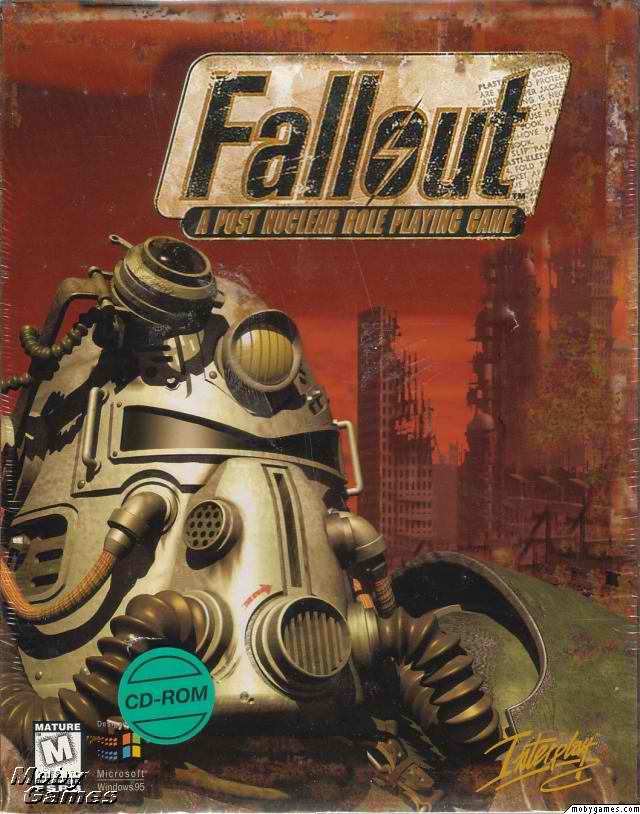
The setting is post-nuclear California, 2161. A catastrophic nuclear exchange has reduced the world to a blasted wasteland governed by scattered survivors, raider gangs, and isolated communities shaped by the 1950s atomic-age optimism that preceded the war. You are the Vault Dweller - a resident of Vault 13, one of the vast underground bunkers built by the pre-war government. Your vault's water chip has failed. You have 150 days to find a replacement before your entire community dies.
The premise is tight, the world is vast, and the game refuses to lead you by the hand. From the moment you emerge from the vault into the California wasteland, you are free to pursue the quest or ignore it - to build a character, explore the world, and engage with its factions and inhabitants on your own terms. Fallout's essential promise was freedom: freedom to play as a diplomat, a fighter, a thief, or a philosopher, in a world that responded to every choice.
Development Story - GURPS, SPECIAL, and a Small Team
Fallout began as a modest internal project. Tim Cain, a programmer and designer at Interplay, proposed a post-apocalyptic RPG in 1994 as a spiritual successor to Wasteland. Brian Fargo approved the project and assigned Cain a small team - initially five or six people - to develop a prototype.
The project's original title was "Vault 13: A GURPS Post-Nuclear Adventure." Interplay licensed the GURPS system (Generic Universal Role-Playing System) from Steve Jackson Games, intending it as the mechanical backbone of the game. The arrangement did not hold: Steve Jackson Games withdrew the licence after finding the content too violent, leaving Cain's team without a rules system with the project already underway.
Cain's response was the SPECIAL attribute system: Strength, Perception, Endurance, Charisma, Intelligence, Agility, Luck. Seven attributes, each influencing a network of derived statistics and dozens of individual skills. The system was designed under real pressure and has since become one of the most beloved and recognised frameworks in RPG history. Chris Taylor, working alongside Cain as co-lead designer, contributed significantly to world content, quest design, and skill system implementation.
By the time Fallout shipped in October 1997, the team had grown from its initial handful to approximately 30 people. Deadlines were tight, scope was ambitious, and several planned features did not survive to the final build. But what shipped set a new standard for RPG depth, moral complexity, and player agency.
How It Plays - SPECIAL, Skills, and Consequence
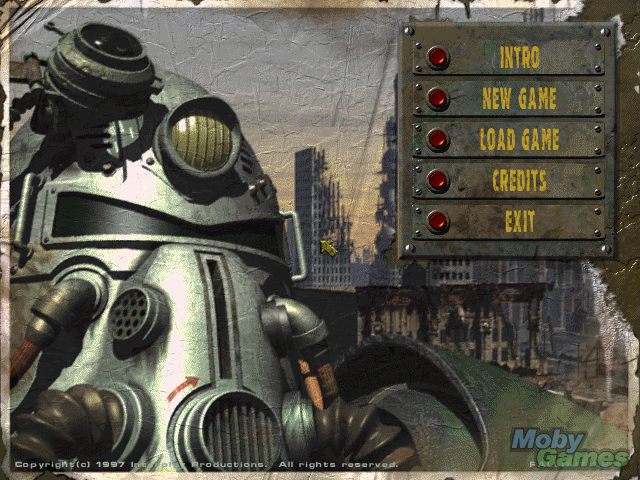
Fallout is played from an isometric perspective. The world is explored in real time but combat shifts into a turn-based mode governed by Action Points (AP) - a resource pool that determines how many actions a character can take per turn: attacks, movements, reloads, use of items. The system rewards tactical thinking without the frantic pace of real-time combat; decisions matter precisely because you have time to make them.
Character creation begins with SPECIAL: seven attributes that shape every derived statistic. A high Charisma unlocks better dialogue options and improves companion effectiveness. A high Intelligence provides more skill points per level and additional dialogue choices. A low Intelligence produces a genuinely different game - NPCs react accordingly, and some quests become inaccessible. Attribute choices made at character creation are consequential for the entire playthrough.
Skills are developed from points earned on level-up, distributed across categories: Small Guns, Energy Weapons, Unarmed, Melee; Doctor, First Aid, Science, Repair, Lockpick, Steal, Sneak; Speech, Barter, Gambling. Skills are checked at critical moments - picking a lock, persuading a faction leader, bypassing a terminal. High skills open paths; low skills close them, but rarely without alternatives.
The dialogue system is Fallout's crowning achievement. Conversations branch based on skill checks (Speech, Intelligence, Charisma), faction standing, and prior choices. Every major NPC has a distinct voice, motivation, and relationship to the world. Some quests can be resolved entirely through talk; others have multiple violent and non-violent solutions. The game is genuinely non-linear: the Master, Fallout's primary antagonist, can be talked to death - if you understand his philosophy well enough to argue it against him.
Technical and Design Achievement
The SPECIAL system was an achievement of unusual elegance. Seven attributes generate a web of derived statistics - Hit Points, Armour Class, Action Points, Carry Weight, Melee Damage, Sequence, Healing Rate, Poison and Radiation Resistance - that interact in ways players can understand and exploit. Deep enough for obsessive optimisation, transparent enough for a first-time player to navigate without a manual.
Fallout's engine supported a world that was, for 1997, strikingly reactive. Faction reputations changed as players' actions accumulated; towns remembered killings and thefts; companions had their own personalities and departure conditions. The game's moral ambiguity was enforced mechanically: the "good" outcome of many quests depended on values the player might not share, and the game rarely judged.
The cinematic presentation was a significant achievement for a PC RPG of the era. Ron Perlman's opening narration ("War. War never changes.") was recorded with full voice acting and custom animations. Key NPCs featured partial voice acting, giving the world an audio presence unusual for 1997 CRPG standards. The 1950s atomic-age aesthetic - Raygun Gothic architecture, retrofuturist technology, big band music - created a visual and tonal identity that has proved endlessly evocative.
When the GURPS license fell through, I had to design a new system from scratch under real deadline pressure. I think SPECIAL actually turned out better - it was exactly what Fallout needed, nothing more and nothing less.
- Tim Cain, lead designer, Fallout (1997)
Reception - Game of the Year, 1997
Fallout's critical reception was exceptional. PC Gamer US awarded it a score of 90/100 and called it "a masterpiece of role-playing game design" - high praise from a publication not given to superlatives. Computer Gaming World awarded Fallout its Game of the Year for 1997, the most prestigious annual award in PC gaming criticism of the era. Multiple other publications named it their GOTY in a year of strong competition.
The game sold over 600,000 copies in its first months - exceptional for a complex, text-heavy PC RPG in the period before widespread mainstream PC gaming. It established Black Isle Studios as the leading Western RPG development team of the late 1990s and created an audience that sustained Fallout 2 (1998) and Planescape: Torment (1999) in the years that followed.
Retrospective assessments have been, if anything, more generous. Fallout appears on "greatest games of all time" lists compiled by IGN, PC Gamer, and Edge decades after its release. The No Mutants Allowed community - the largest active Fallout fansite, founded in 1997 - remains one of the oldest dedicated gaming communities on the internet.
For full catalogue context, see all Fallout titles in the game catalogue. Tim Cain, Chris Taylor, and Brian Fargo's contributions are covered on the people page.
Legacy - The IP That Outlived Its Creator
Fallout 2 (1998), also from Black Isle, expanded the world and added satirical edge. Planescape: Torment (1999) - also Black Isle, also Interplay - is widely regarded as the most narratively ambitious RPG ever made. By the end of the 1990s, Interplay and Black Isle had produced three of the genre's greatest works in three consecutive years.
Financial difficulties brought the era to a close. Black Isle was shuttered in December 2003; Interplay sold the Fallout intellectual property to Bethesda Softworks in 2007 for $5.75 million. Bethesda's Fallout 3 (2008) reimagined the series in first-person 3D. Fallout: New Vegas (2010), developed by Obsidian Entertainment - founded by former Black Isle developers - returned many of the original's design values to the series. Fallout 4 (2015) and Fallout 76 (2018) followed from Bethesda.
The original Black Isle creative alumni spread across the industry after Interplay's collapse. Tim Cain and Leonard Boyarsky, both Fallout veterans, later created The Outer Worlds (2019) at Obsidian Entertainment - widely understood as a direct spiritual successor to the original Fallout, produced by the people who built it.
In 2024, Amazon Prime Video released a Fallout television series that became one of the most-watched streaming shows of that year. The series - set in the established Fallout universe - introduced the franchise to an audience tens of millions strong, and sent sales of the older games surging on Steam and GOG. War, as Perlman's narration reminds us, never changes.
Fallout (PC, 1997) - World of Longplays Full Playthrough
Fast Facts
- Title: Fallout
- Developer: Black Isle Studios / Interplay
- Publisher: Interplay Productions
- Year: 1997
- Platforms: DOS, Windows, Mac
- Lead Designers: Tim Cain, Chris Taylor
- Exec Producer: Brian Fargo
- Setting: Post-nuclear California, 2161
The SPECIAL System
- Strength
- Perception
- Endurance
- Charisma
- Intelligence
- Agility
- Luck
Devised by Tim Cain after the GURPS licence was dropped; became one of RPG history's most beloved attribute frameworks.
Critical Reception
- PC Gamer US: 90/100 - "a masterpiece"
- Computer Gaming World: GOTY 1997
- Multiple publications: GOTY 1997
- Sales: 600,000+ (first months)
The Fallout Family Tree
- Wasteland (1988) - ancestor
- Fallout (1997, Black Isle)
- Fallout 2 (1998, Black Isle)
- Fallout 3 (2008, Bethesda)
- New Vegas (2010, Obsidian)
- Fallout 4 (2015, Bethesda)
- The Outer Worlds (2019, Obsidian)
- Amazon TV series (2024)