Before the Engine Existed
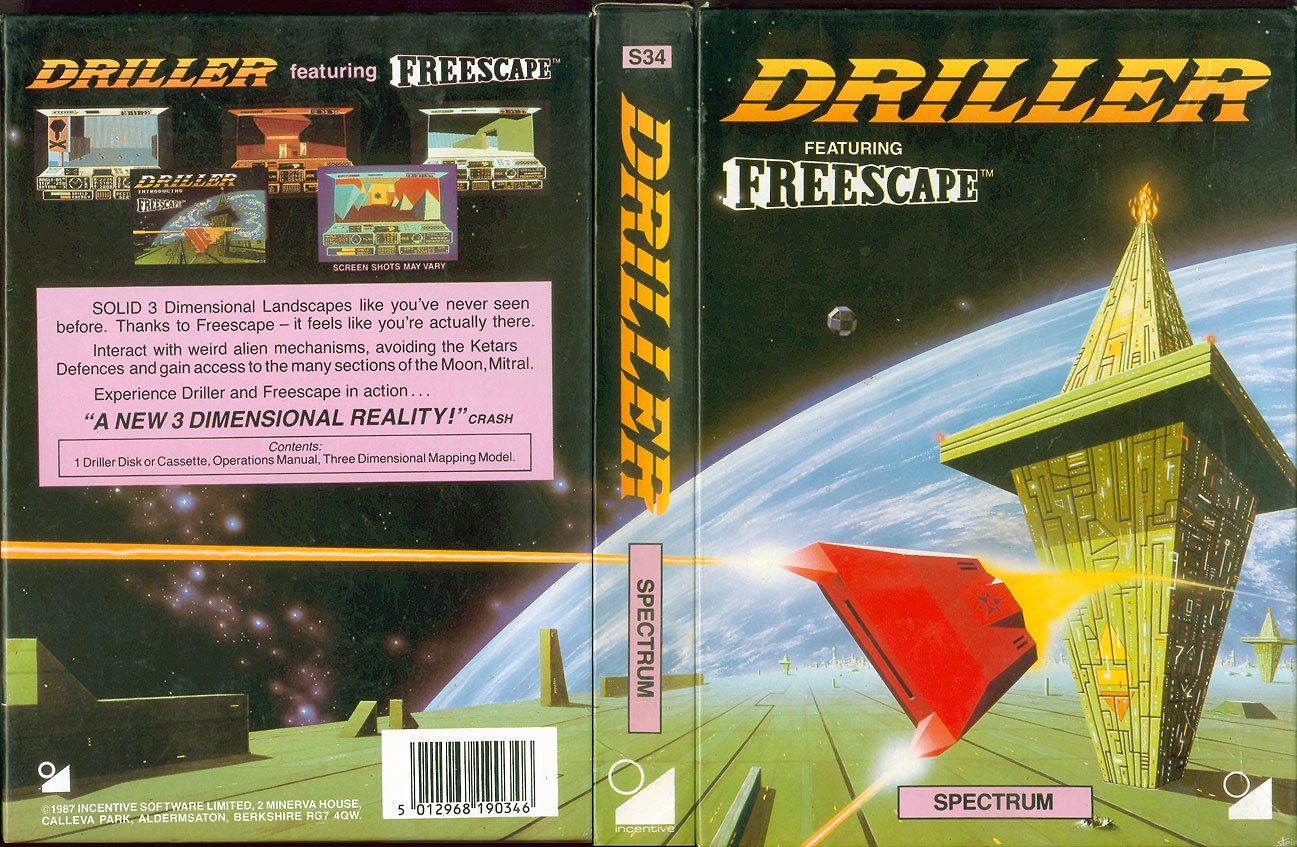
Driller, 1987 - the game that launched Freescape
Incentive Software was founded in 1983 in Reading, Berkshire. Like most British software houses of the era, it began as a cottage industry - small teams writing and selling programs for the platforms that had just transformed British living rooms: the ZX Spectrum, the BBC Micro, and the Commodore 64. The founders saw the new home computer market as an opportunity to build a business from the ground up, without the infrastructure or capital that traditional publishing required.
The early years produced workmanlike titles that sold modestly through the magazine cover-mount and mail-order channels that defined the UK games market of the early 1980s. Games like their Graphic Adventure Creator (1985) - a utility allowing non-programmers to create their own text adventure games - showed the studio's interest in tools and creation as much as pure entertainment software. It was an early sign that Incentive was thinking about what players could do, not just what they could play.
None of this predicted what was coming. By 1986, the studio was a going concern but not yet remarkable - a competent British software house among dozens of competent British software houses. Then programmer Chris Andrew began work on something that had not been done before on home hardware.
Fourteen Months and a Geometry Problem
The Freescape engine took approximately fourteen months to develop. The central problem was not speed - it was correctness. Previous 3D games on home computers used wireframe rendering without hidden-line removal: lines that should be invisible behind solid objects were drawn on top of them, creating a visual hash that broke immersion and made navigation impossible. Freescape solved this with a complete hidden-surface removal algorithm, producing solid 3D geometry that occluded correctly.
The technical constraints were severe. The ZX Spectrum had 48 kilobytes of RAM - total, for both program and data. The Commodore 64 had 64 kilobytes. Neither machine had a floating-point unit, a graphics coprocessor, or hardware sprites capable of representing a 3D scene. Every polygon transformation, every depth sort, every occlusion test was computed in software on the CPU - typically a Zilog Z80 running at 3.5 MHz on the Spectrum, or a MOS 6510 at 1 MHz on the C64.
Chris Andrew's solution partitioned the world into discrete cells - rooms, corridors, and outdoor spaces - and only rendered geometry within the current cell and immediately adjacent ones. This spatial partitioning kept the geometry count manageable while maintaining the illusion of an open, navigable world. The player could move freely through the space, and the engine would load the next cell's geometry as required. The approach prefigured the portal rendering techniques that would become standard in 3D game engines years later.
"The biggest challenge was making it work on the Spectrum at all. You're doing floating point in Z80 assembler and you need to finish a frame before the user gives up waiting."
Chris Andrew, Retro Gamer issue 97, on the development of Freescape
Driller Hits Number One
Dark Side (1988) - sequel to Driller, set on the dark side of Evath's moon
Driller was released in 1987 under the label "Space Station Oblivion" in North America - a different title for the same game with the same engine. In the UK, Driller launched simultaneously on ZX Spectrum, Amstrad CPC, Commodore 64, BBC Micro, and Amiga. The Atari ST and DOS versions followed.
The game's commercial performance was remarkable. It reached number one on the UK software sales charts, a feat that no 3D game had achieved before it, because no fully navigable 3D game had existed before it. The industry press responded with something between amazement and disbelief. Magazines that had reviewed thousands of games struggled to contextualise what Freescape had done - the usual vocabulary for home computer games simply did not apply.
The premise of Driller was simple enough: the player is sent to drill capping devices into gas pockets on a moon of the planet Evath to prevent a catastrophic explosion. But the world the player navigated was genuinely three-dimensional, with rooms connected by corridors and outdoor areas open to a simulated sky. Objects could be picked up and carried. Puzzles were spatial. The game asked players to form a mental map of a three-dimensional space - a cognitive demand that arcade games had never placed on their audience.
Building the Freescape Universe: 1988-1990
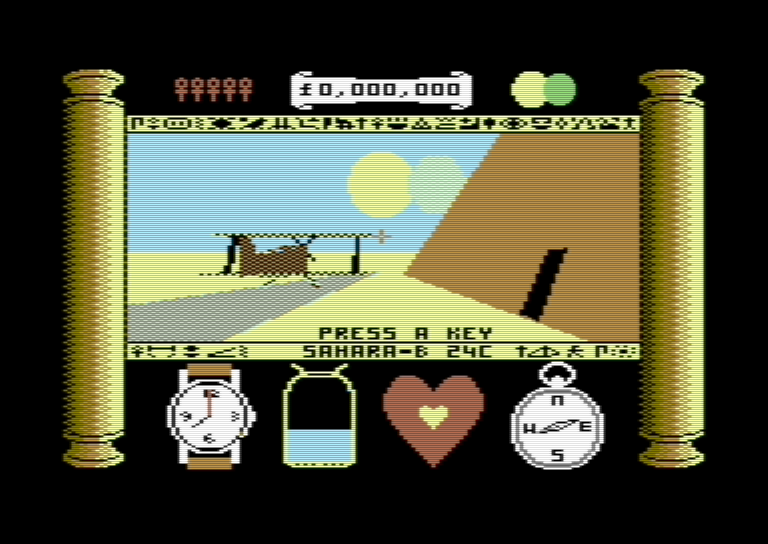
Total Eclipse (1988) - the player must prevent a solar eclipse from destroying the Earth by climbing an ancient pyramid
Following Driller's success, Incentive moved quickly to expand the Freescape universe. Dark Side (1988) was a direct sequel, set on the other side of the same moon. Where Driller had concentrated on the mechanics of exploration and drilling, Dark Side introduced more complex enemy behaviour and tighter puzzle design. The world was darker - literally, set on the shadowed hemisphere of Evath - and the atmosphere was correspondingly tense.
Total Eclipse (1988) represented the most ambitious Freescape title yet. Set inside and around an ancient Egyptian pyramid, it told a race-against-time story: a solar eclipse was approaching that would charge the pyramid's crystal and destroy the Earth, and the player had to climb the pyramid and stop it. The exterior sequences - approaching the pyramid across open desert - showcased the engine's ability to handle large-scale outdoor environments. The interior was a labyrinth of chambers, traps, and puzzles drawn from Egyptian mythology.
Total Eclipse II: Sphinx Jinx followed in 1989, extending the Egyptian setting with new puzzles and world geometry. By this point, Incentive had published five Freescape games in two years - an extraordinary output rate for titles of this technical complexity, each requiring a bespoke conversion for every target platform.
Castle Master (1990), published by Domark, marked the maturation of the Freescape concept. The castle setting allowed for more naturalistic architecture than the modular corridors of the earlier games - towers, great halls, drawbridges, moats. The player's goal was to rescue a princess trapped in the castle's keep, navigating a world inhabited by ghosts and other supernatural entities. For the deep editorial on Castle Master and Driller, see the flagship page.
Giving Freescape to the World
The 3D Construction Kit, released in 1991, was Incentive's most unusual product - and arguably its most important. Rather than building another Freescape game, the studio packaged the entire Freescape engine as a user-accessible construction tool. Players could build their own three-dimensional worlds using the same geometry engine that had powered all six Freescape games. They could populate those worlds with objects, puzzles, and interactive elements. They could publish the results.
The Construction Kit was genuinely usable. It shipped with a tutorial, a set of example worlds, and documentation comprehensive enough for enthusiastic beginners. A significant community of players created their own games and shared them through the UK's network of Public Domain software libraries - physical disks mailed between enthusiasts before the internet made such sharing trivial.
"We wanted to put what we'd built into people's hands. The engine was good enough that anyone could make something interesting with it."
Incentive Software spokesperson, Amiga Format interview, 1991
The 3D Construction Kit also established Incentive as a company interested in democratising technology - putting professional-grade tools in the hands of ordinary players. This was not a marketing position but a genuine design philosophy. The studio had always been as interested in tools as in games, going back to the Graphic Adventure Creator of 1985. The Construction Kit was that instinct at its fullest expression.
Legacy: What Freescape Built
Incentive Software ceased active game development in the late 1990s, as the British home computer market that had supported it transformed beyond recognition. The ZX Spectrum and Amstrad CPC were long gone. The Amiga, which had been the premium home computer of the Freescape era, was in commercial freefall. The games industry had consolidated around Windows PCs and the Sony PlayStation, where the barriers to 3D development were both higher and lower - more powerful hardware made ambitious 3D straightforward, but the capital requirements had grown enormously.
What Freescape left behind is harder to quantify than its chart positions. It proved that 3D gaming was possible on home hardware - not merely as a visual novelty but as a complete interactive environment. It established the spatial puzzle game as a genre. It demonstrated that players would accept - and enjoy - the cognitive demand of navigating a three-dimensional space without a map. When id Software released Wolfenstein 3D in 1992 and Doom in 1993, they were not inventing a new form; they were making that form commercially dominant. The form itself had existed since 1987.
For the modern community keeping Freescape alive through remakes, emulation, and new 3D Construction Kit worlds, see the Modern Scene page. For the people who built it, see People.
FREESCAPE UNLOCKED
The engine that changed home computing. Invented by Chris Andrew at Incentive Software, 1987.
Nine platforms. Six commercial games. One 3D Construction Kit. Thousands of player-made worlds.