Hudson Soft · Hardware Partnership

Hardware

How a software studio from Sapporo co-designed one of gaming’s most technically innovative consoles - and changed the industry in the process.

NEC/Hudson Co-Development

The partnership that produced the PC Engine - NEC’s manufacturing reach combined with Hudson’s silicon design expertise.

An Unusual Arrangement

When NEC decided to enter the home console market in the mid-1980s, they chose an unconventional approach: partnering with a software studio - Hudson Soft - not merely to supply games, but to co-design the hardware itself. This was unprecedented in the Japanese market, where hardware manufacturers and software developers maintained distinct roles.

Hudson Soft had earned NEC’s respect through years of technically accomplished software development on NEC’s PC-88 and PC-98 computer platforms. Hudson understood NEC’s silicon ecosystem better than most external developers, and their track record in pushing hardware limits made them an unusual but credible hardware design partner.

The HuC6280 CPU

Hudson Soft’s primary technical contribution was the HuC6280 - the PC Engine’s custom CPU. Based on a modified MOS 6502 core (the same family used in the NES), the HuC6280 ran at 7.16 MHz and incorporated several enhancements including:

  • A built-in 6-channel wavetable sound generator
  • A programmable sound unit capable of hardware-level audio processing
  • Memory management capabilities for bank-switching ROM data
  • Direct Memory Access support for rapid data transfer to the video hardware

The CPU was an 8-bit processor driving a genuinely 16-bit graphics subsystem - a hybrid architecture that allowed the PC Engine to produce visuals rivalling consoles that marketed themselves as purely 16-bit. The distinction between 8-bit CPU and 16-bit graphics was a technical nuance that mattered in marketing terms throughout the console wars of the early 1990s.

The HuCard Format

Hudson also designed the HuCard - the PC Engine’s game storage format. HuCards were credit-card-sized PCB units containing game ROM chips, thinner and smaller than any cartridge format available at the time. The name “HuCard” combined Hu from Hudson with the flat card form factor.

HuCards ranged from 2 Mbit (the smallest early titles) to 20 Mbit (late-generation titles pushing the format’s limits). The compact format was central to the PC Engine’s aesthetic identity - a console that fit in a jacket pocket could have games that fit in a shirt pocket. The form factor also kept manufacturing costs low and retail packaging minimal.
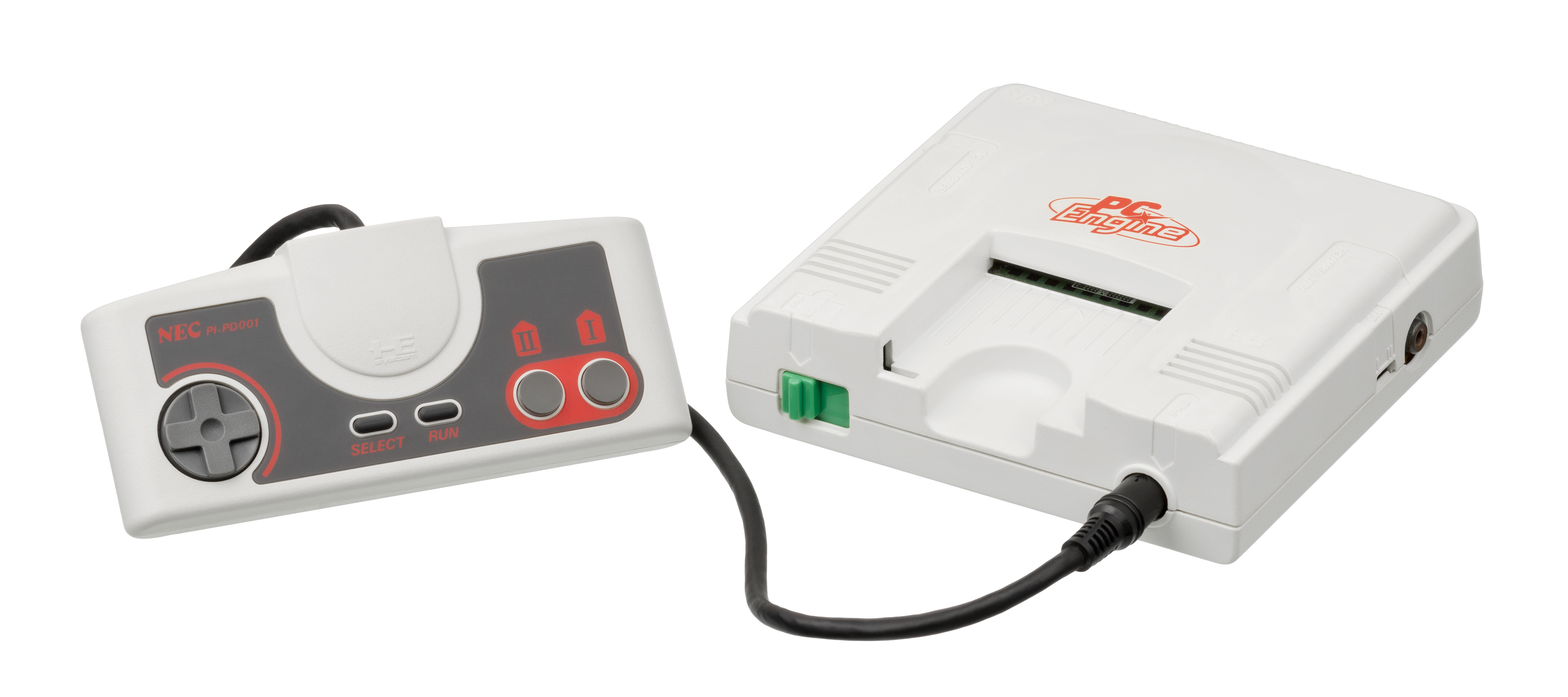
PC Engine - Japan Launch

The world’s most compact home console at launch - smaller than a paperback, faster than the competition.

NEC PC Engine original white console with controller - Japan, October 1987

PC Engine

Japan · October 1987

The original PC Engine - cream-white, 14 × 14 × 3.8 cm, 380 grams. At launch, the world’s most compact home gaming console. HuCard slot on the right; single controller port (additional controllers via multitap). Launched at ¥24,800.

CPU

CoreHudson HuC6280
Architecture8-bit (MOS 6502)
Clock7.16 MHz
Sound6-ch wavetable built-in

Video

VDCHudson HuC6270
Resolution256 × 212 (typical)
Colours512-colour palette
Sprites64 sprites on screen

Storage

FormatHuCard (ROM)
Min Capacity2 Mbit
Max Capacity20 Mbit
CD-ROM²Add-on (1988)

Physical

Dimensions14 × 14 × 3.8 cm
Weight380 g
Launch Price¥24,800
Launch Date30 October 1987

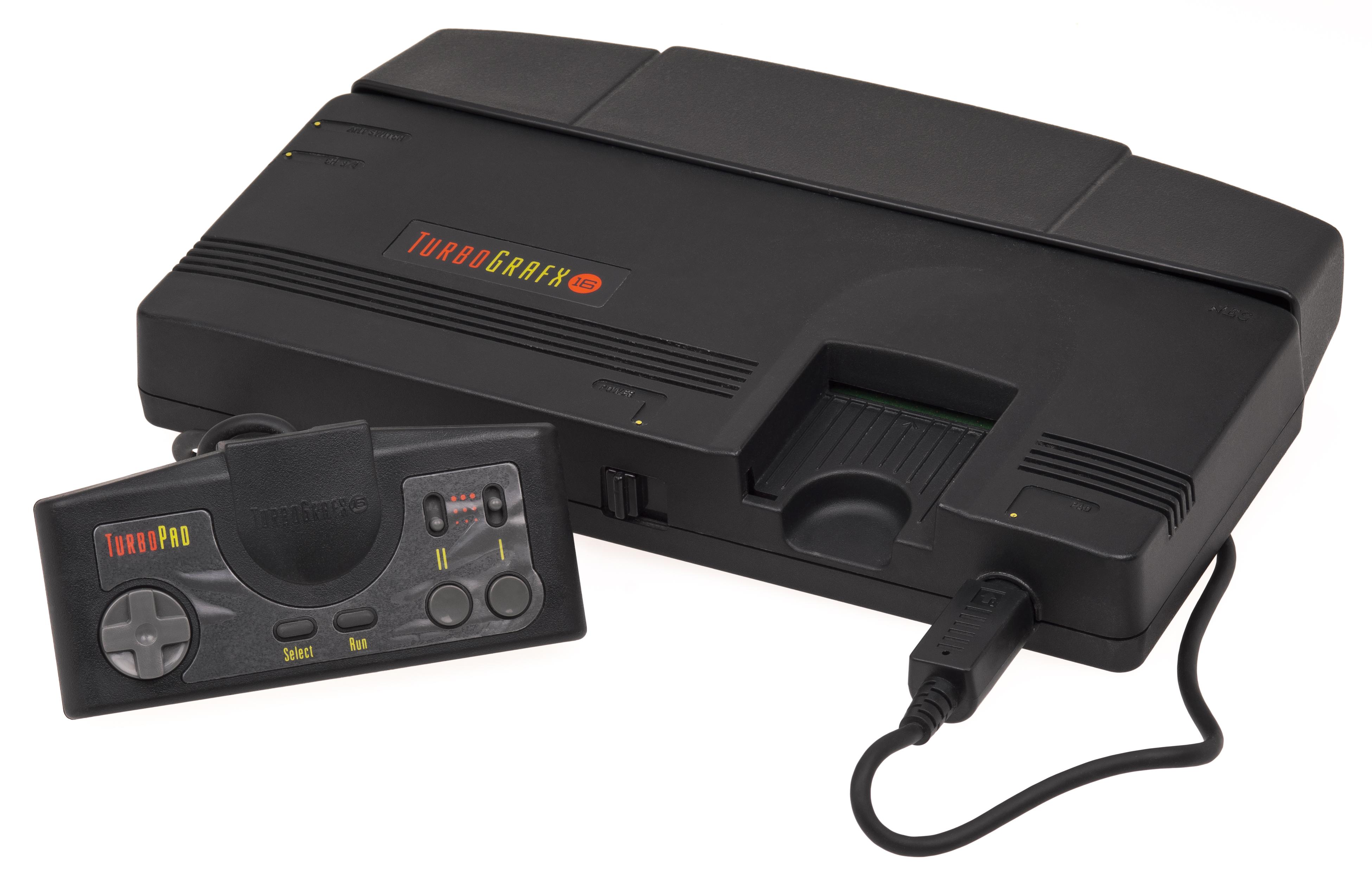
TurboGrafx-16 - Western Release

The PC Engine arrives in North America, renamed and repackaged for the 16-bit marketing wars.

TurboGrafx-16 console - North American PC Engine, August 1989

TurboGrafx-16

North America · August 1989

The North American release of the PC Engine, distributed by NEC Technologies. Larger than the Japanese original, with a different visual design. The “16” in the name referenced the 16-bit graphics subsystem - technically accurate, though the CPU remained 8-bit. Launched at $199 USD.

The 16-Bit Marketing Wars

By 1989, Sega’s Mega Drive (Genesis in North America) had framed the coming console generation as a “16-bit war.” NEC’s marketing team responded by emphasising the TurboGrafx-16’s 16-bit graphics hardware in the console’s very name - even though the HuC6280 CPU was technically 8-bit.

The TurboGrafx-16 never achieved the North American market penetration of the Genesis or Super Nintendo. Distribution was limited, the game library was smaller than in Japan, and the console lacked a clear killer-app equivalent to Sonic the Hedgehog. Hudson’s software support - Bonk’s Adventure, Neutopia - was well-regarded but insufficient to drive mass adoption.

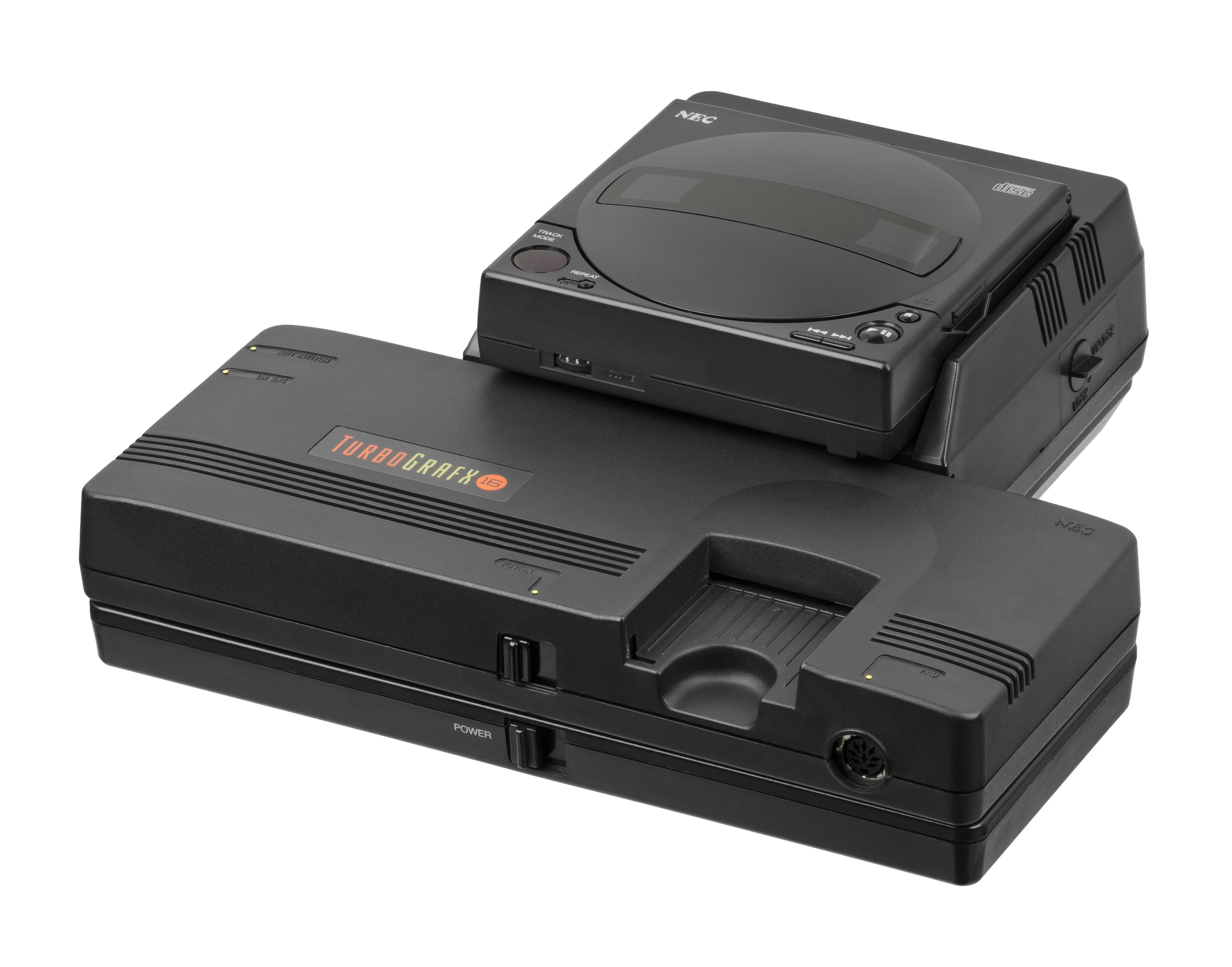
CD-ROM² - First CD Console Add-On

The peripheral that changed everything - the first CD-ROM add-on for any home console, arriving in 1988.

TurboGrafx-CD (CD-ROM² equivalent) attached to TurboGrafx-16 - 1989

CD-ROM²

Japan · December 1988

The world’s first CD-ROM peripheral for a home gaming console. The PC Engine docked into the base of the unit, which added a CD-ROM drive and additional RAM. Launched at ¥57,800 - expensive, but enabling games of unprecedented scope. Voice acting. CD audio. Cinematic presentation.

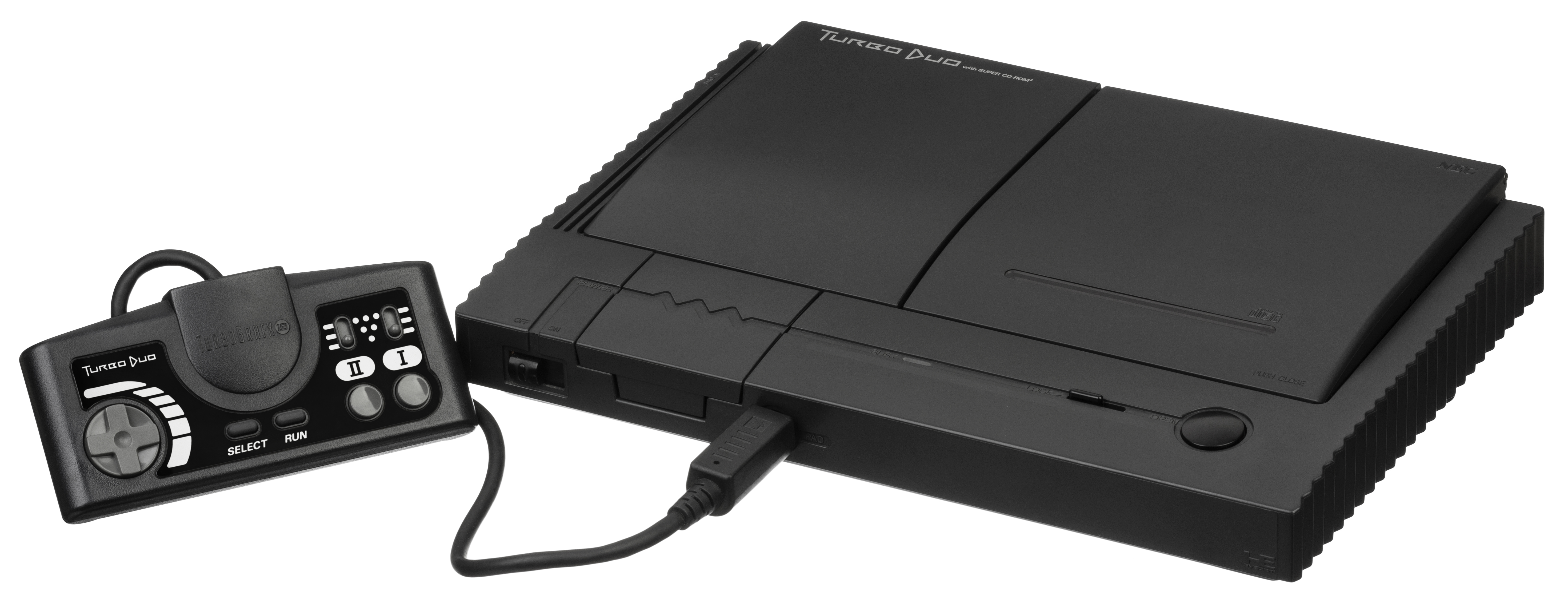
NEC TurboDuo (PC Engine Duo equivalent) all-in-one console - 1992

PC Engine Duo

Japan · September 1991

The all-in-one PC Engine with built-in CD-ROM² drive, combining base console and add-on into a single unit. Eliminated the awkward dock configuration of the original add-on. Launched at ¥59,800 and became the definitive PC Engine hardware configuration.

A New Category of Game

The CD-ROM² add-on, launched in December 1988, predated the Sega CD by over three years and the SNES CD-ROM (which was cancelled entirely) by decades. The format enabled a category of game that simply could not exist on ROM cartridges: full voice acting, CD-quality redbook audio, animated cutscenes, and game content measured in hundreds of megabytes rather than single-digit megabits.

Hudson developed extensively for the format from the beginning. Dungeon Explorer was among the early CD-ROM² releases; Gate of Thunder (1992) became the format’s definitive technical showcase; and Hudson’s decision to publish Castlevania: Rondo of Blood (1993) in Japan gave the format one of its most celebrated titles.

Visit the PC Engine Fan Page →