Geoffrey Crammond's career in games ran from 1982 to 2002 - twenty years that took him from a BBC Micro on a kitchen table to software that Formula 1 drivers used to learn circuits.
From Fortran to 6502: The Accidental Game Developer
Geoffrey Crammond holds a degree in physics from a British university. Before entering the games industry he worked as a systems engineer at Marconi, writing software for defence applications using early computers - including, as he has described it, machines with only 32K of RAM that filled entire rooms. He programmed in Fortran. At no point did he anticipate making games.
The pivot came when he bought a BBC Micro and a textbook on 6502 assembly language. He taught himself the language at home, after hours, as a creative outlet - something he has compared to his earlier interest in oil painting. The BBC Micro's analogue joystick port caught his attention as a foundation for a flight simulator. He built one.
"I had done oil painting when I was younger. Programming was another outlet for that creative side. I just happened to be at Marconi and I bought a BBC Micro - and that's how it started."
- Geoff Crammond, From Bedrooms to Billions documentary
Eight Seconds to a Frame: The BBC Micro Years (1982-1986)
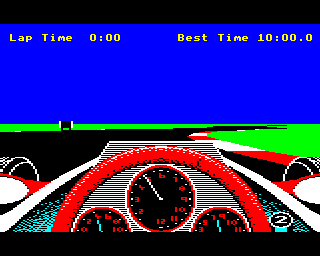
Revs (1984) on the BBC Micro - the first realistic racing simulation on a home computer
Crammond's first published game was Super Invaders (1982), a Space Invaders clone released by Acornsoft for the BBC Micro. It was competent. It was not the thing that made his name. Aviator (1983) was.
Aviator was a wire-frame Spitfire flight simulator with a genuine aerodynamic model. Crammond simulated g-forces, wing loading, and the physics of a dive. If you pushed the nose down too hard and pulled out too sharply, the wings would come off. It was launched at the RAF Museum in Hendon, with Air Vice Marshal Sandy Johnstone in attendance. He called it "just like the real thing."
Revs (1984) came about because Acorn was sponsoring Formula 3 driver David Hunt, younger brother of ex-F1 World Champion James Hunt. Acornsoft asked Crammond to make a racing game. He was given access to the Eddie Jordan Racing team at Silverstone to understand how the cars worked. He had no particular interest in motor racing at the time. He built the most accurate racing simulation a home computer had ever run - and in the process became a lifelong Formula 1 fan.
"I had little interest in motor racing before Revs. But as a consequence of that project I became a fan of Formula One racing."
- Geoff Crammond, Altered Gamer biography interview
Revs shipped with Silverstone only. Demand for expansion tracks arrived immediately; a 1985 update added Brands Hatch, Donnington Park, Oulton Park, and Snetterton. Crammond had quit Marconi by this point to develop games full-time.
The Sentinel followed in 1986. It was a radical departure - a 3D puzzle game using solid-filled polygon rendering, one of the first home computer games to use the technique. It had 10,000 procedurally generated levels. It won the Golden Joystick Award for Best Original Game of the Year. Zzap!64 gave the C64 version a Gold Medal, refusing to assign a numeric score because the game was, in their assessment, in a class of its own. Read the deep editorial on The Sentinel's design and legacy in Flagship.
The Ramp-Jump That Became a Game: Stunt Car Racer (1989)
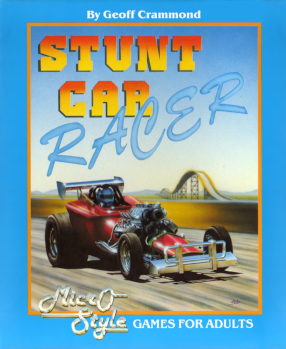
Stunt Car Racer (1989) - published by MicroStyle for Amiga, Atari ST, C64, and DOS
After The Sentinel, Crammond found himself experimenting with a land-rover vehicle simulation. The physics were accurate; the experience was dull. Then he added a ramp. The vehicle went off the ramp. It was, by his account, uniquely fun. He abandoned the original project and built a whole game around that moment.
Stunt Car Racer (1989) was published by MicroStyle, the budget label of MicroProse, and released for the Amiga, Atari ST, Commodore 64, and DOS. The game featured roller-coaster elevated tracks with genuine suspension physics, a damage system that rewarded restraint, and a league structure that gave the game session-to-session stakes. It was critically acclaimed across all platforms.
Amiga Power magazine, the highest-circulation Amiga title of the early 1990s, began calling Crammond "Sir Geoff" around this period. The nickname caught on broadly in the retro gaming community and persists to this day.
Lap Times, World Championships, and One Man Working Alone (1991-2002)
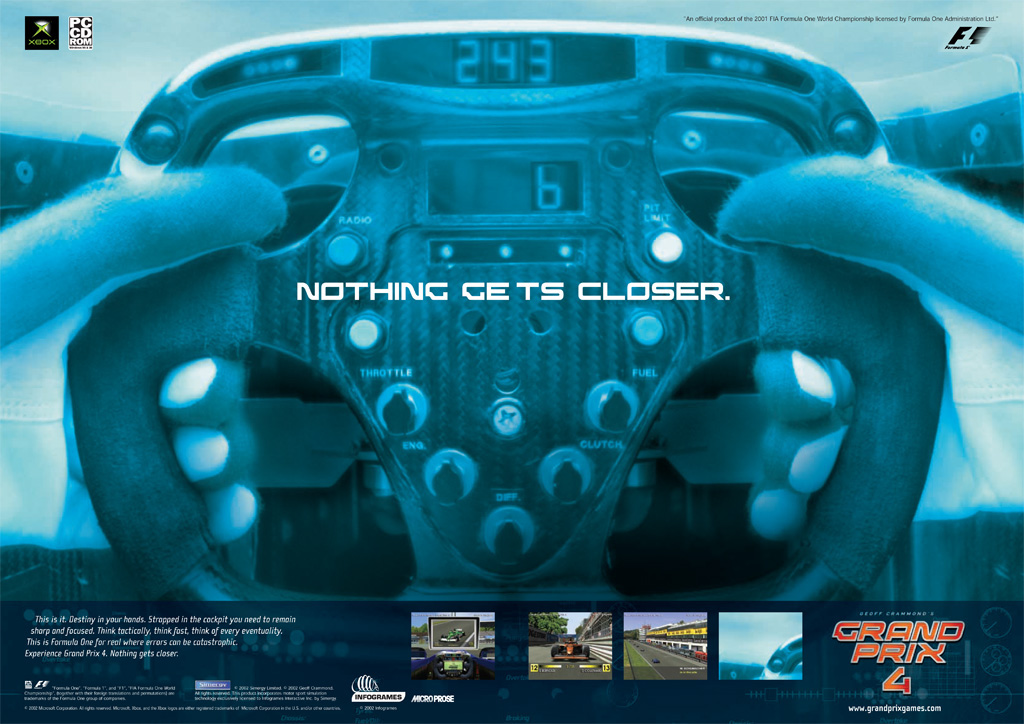
Grand Prix 4 (2002) print advertisement - "Nothing Gets Closer" - the final game in the series
Formula One Grand Prix (F1GP) was released by MicroProse in 1991 for the Amiga and 1992 for DOS - with an Atari ST port following, and a North American release titled World Circuit. It was Crammond's first fully licensed F1 simulation, the spiritual successor to Revs, and an immediate critical and commercial success. The game modelled the full 1991 Formula 1 season with period-accurate car liveries and driver line-ups.
Grand Prix 2 (1996) was developed over three years, largely by Crammond working alone. It simulated the 1994 FIA Formula 1 World Championship - Michael Schumacher's first title season, Ayrton Senna's fatal crash at Imola, the season that changed Formula 1 safety permanently. The game captured the technical reality of that year's cars with an accuracy that no other developer had attempted. It was almost universally regarded as the finest F1 simulation available on PC when it shipped. Read the full editorial in Flagship.
"Jacques Villeneuve reportedly used Grand Prix 2 to learn the F1 circuits before his 1997 championship season - and won the title that year."
- Gamesnostalgia.com, Legendary Game Designers: Geoff Crammond
Grand Prix 3 (2000) followed a difficult development that Crammond has described as the project where he made the most technical advances - specifically an all-new wet weather system with variable water depths, grip changes, and mixed-condition sections that could shift as a race progressed. Some critics found the game a step backward in other areas; the wet weather system was universally praised.
Grand Prix 4 (2002) was co-developed by Crammond's studio Simergy with Infogrames' Chippenham team - the most collaborative project of his career. It is generally regarded as the most technically accurate game in the Grand Prix series. It was also the last game Crammond released. After 2002, rumours of a Stunt Car Racer Pro (with developer Lost Toys) circulated; Lost Toys closed in 2003 and the project was confirmed cancelled in 2005.
After the Finish Line: 2002 to Now
Since Grand Prix 4, Crammond has maintained a low public profile. He has been documented as writing C++ recreationally without commercial release. He gave a preserved interview to Autosport Forums in 2009 - one of the few extended public statements he has made in the post-2002 period.
In December 2025, MicroProse announced a collaboration with Crammond to re-release all four Grand Prix games on Steam in 2026. It is the first formal public involvement in the games industry he has been associated with in more than two decades.
The Grand Prix 4 fan community at grandprixgames.org continues to release annual mods updating the game with current F1 seasons - more than twenty years after the original release. Mark Moxon has published fully documented source code disassemblies of Aviator, Revs, and The Sentinel at aviator.bbcelite.com, revs.bbcelite.com, and thesentinel.bbcelite.com. The ongoing modding and disassembly work is documented in Modern Scene and Resources.