A Game Nobody Else Would Have Built
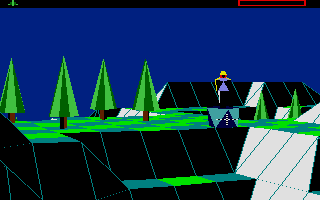
The Sentinel (1986) is a 3D puzzle game that puts you inside 10,000 landscapes you cannot see all of at once. You are a disembodied robot. You can only look where you stand. The Sentinel, the game's antagonist, stands on the highest point of the landscape. It rotates slowly. If it sees you, it drains your energy. Your goal is to steal its position: absorb the objects around you to gain height, create new positions to teleport to, climb higher, and eventually stand where the Sentinel stands. Then you absorb it. The game was released for the BBC Micro in 1986 by Firebird. It had been made by one person.
No other game in 1986 looked like this, played like this, or thought like this. The closest analogue anyone could offer was chess - a game of information, position, and the disciplined exploitation of sight lines. The Sentinel did not have jump puzzles, combat, or a score. It had a model of vision and geometry that most games of the era - or any era - never attempted.
Writing the Renderer from Scratch on 32K of RAM
Crammond wrote The Sentinel on the BBC Micro - a machine with 32K of RAM. He implemented solid-filled polygon rendering on this hardware from first principles. It was, by the technical assessment of the gaming press and later disassembly work, among the first home computer games to use solid-filled 3D polygons. The visual result was arresting: landscapes of grey polygonal hills that looked unlike anything else on a home computer screen in 1986.
The 10,000 levels were procedurally generated - stored as seeds, not as full level data. The game computed each landscape from its seed number. This allowed the game to contain more unique environments than could ever be stored on a floppy disk while keeping the codebase within the BBC Micro's memory constraints. Crammond wrote the Amstrad CPC conversion himself using a cross-compiler he had built; the Amiga, Atari ST, ZX Spectrum, and PC ports were handled by other developers. Steve Bak ported the Amiga and Atari ST versions; Mike Follin ported the ZX Spectrum version; Mark Roll ported the IBM PC version.
Position as the Only Resource That Matters
The Sentinel plays like a very slow, very tense game of chess where the board is three-dimensional and neither player can see it fully. You can only look where you are standing. You must create a new robot on higher ground to see further. You can only teleport to a position you can see. If you create a robot in a spot the Sentinel can see, it will absorb the robot before you can teleport to it. The game forces you to think about sightlines before you act - to model, in your head, what the Sentinel would be able to see from where it is.
Each of the 10,000 landscapes is numbered. Players who completed one landscape received a code to begin from the next. Crammond has noted that he never expected anyone to work through all 10,000. He did not program a congratulatory ending sequence because he assumed nobody would reach level 10,000.
"I never expected anyone to finish all 10,000 levels. I never put an ending in because I thought it would never be reached." - Geoff Crammond, Gamesnostalgia.com profile
How 1987 Reviewers Tried to Describe It
Contemporary press struggled to frame The Sentinel in terms their readers would understand. It was not an action game. It was not an adventure game. The Zzap!64 Gold Medal review resorted to calling it simply "unique" and noting that any attempt to place it in a genre would be misleading. The Spectrum version review in Your Sinclair noted the meditative, chess-like quality and the unusual sensation of planning moves several positions ahead in a game that offered no obvious feedback on whether a move was correct until it was too late to change.
The game appeared on multiple "best games of all time" lists in Retro Gamer magazine and similar retrospective publications. A sequel, Sentinel Returns (1998), was published by Psygnosis for PC and PlayStation. Crammond is not credited as developer on Sentinel Returns.
Still Playing It
The Sentinel remains playable today through BBC Micro, C64, and Amiga emulators. Mark Moxon's complete source code disassembly at thesentinel.bbcelite.com documents the BBC Micro original down to individual routines with explanations of how the rendering and level generation work. See Play for emulation setup instructions, and Games for platform availability details.