CRL Group (1982-1991) was never quite mainstream and never quite fringe. It found its identity in the gap between.
The Accident That Became a Career
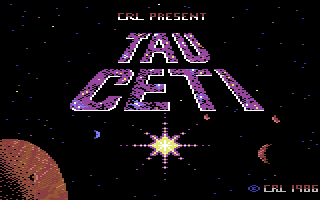
Tau Ceti on C64 - the game that justified everything
Clement Chambers was nineteen years old in 1982 when he started Computer Rentals Limited. He had failed to secure a university place and his father had provided 10,000 pounds in startup capital. The plan was simple: rent out computers to businesses that could not afford to buy them outright.
The plan failed. The rental market proved harder to crack than expected, and by the time the business had run through most of its capital, only about 2,500 pounds remained. Chambers chose to redirect what was left into software rather than close the company entirely. CRL - the initials of Computer Rentals Limited - became a software publisher by necessity.
The early releases targeted the ZX Spectrum, which dominated UK home computing at the time. CRL published text adventures and early action titles in 1983 and 1984, gradually building a catalogue broad enough to attract the attention of the industry's bigger players.
The Electronic Arts Deal Changes Everything
In 1984 Chambers rebranded the company as CRL Group PLC - a more professional corporate identity that suggested scale and ambition even if it remained privately held and never pursued a stock market listing. The PLC suffix was marketing as much as anything else.
The same year, Ian Ellery joined as production and operations manager. Ellery brought organisational discipline to what had been a fairly chaotic publishing operation, overseeing the in-house development team and coordinating external projects. His arrival coincided with a distribution deal that would define CRL's best years: Electronic Arts agreed to handle UK distribution, placing CRL titles in shops that many smaller publishers could not reach.
The EA distribution put CRL among the best-distributed publishers in Britain. It expanded rapidly across platforms - ZX Spectrum, Commodore 64, Amstrad CPC, and MS-DOS - and began publishing work from external studios as well as developing in-house.
"Tau Ceti is a star which lies just 11.8 light years from our sun. It is one of the few nearby stars to have a similar spectral type to our sun, and would therefore be capable of supporting life."
Tau Ceti game manual, CRL Group, 1985
Pete Cooke's Engine Rewrites the Rules
Pete Cooke designed Tau Ceti for the ZX Spectrum and CRL published it in 1985. The game placed the player in an isometric 3D city - a fully navigable alien urban environment rendered on a machine running at 3.5MHz with 48KB of RAM. The shadow system, which Cooke reverse-engineered from techniques in another game, simulated a convincing day/night cycle. Nothing in British home computing looked quite like it.
John Twiddy converted the game to the Commodore 64 in 1986. The C64 version attracted even more critical attention than the Spectrum original - Zzap!64 awarded it 93%, C&VG gave it 10/10, and Crash scored the Spectrum version 94%. The word "Zzap!64 Gold Medal" carried enormous weight with buyers, and Tau Ceti earned one.
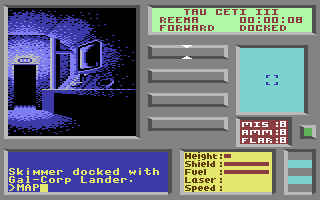
The day/night shadow system in Tau Ceti, C64 version
A Special Edition with enhanced graphics followed in 1987, along with a sequel - Academy: Tau Ceti II - that continued the isometric city setting. Pete Cooke remained the designer on the sequel. The franchise demonstrated that CRL could sustain a critical hit across multiple releases, not just produce one-off surprises.
The Horror Pivot Nobody Planned
The gothic horror turn of 1986 to 1988 was less a strategic decision than an opportunity that presented itself. Rod Pike developed Dracula for CRL in 1986, a three-part graphic text adventure based on Bram Stoker's novel. The game had enough adult content that CRL applied for a BBFC classification - a move with no precedent in British gaming history.
The BBFC awarded Dracula a 15 certificate. It became the first commercially released video game in the United Kingdom to carry a British Board of Film Classification rating. CRL had stumbled into history. The certificate generated press coverage that no advertising budget could have bought.
Frankenstein (also 1986) and Wolfman (1988) followed the gothic template, each developed by Rod Pike or St. Bride's School. But the most significant title came in between: Jack the Ripper in 1987. Developed by St. Bride's School with graphics by Jared Derrett, it received a BBFC 18 certificate - the first game ever to do so.
"The game is set during the actual Whitechapel murders of 1888. You play a journalist investigating the case, piecing together evidence before the killer strikes again."
Jack the Ripper game documentation, CRL Group, 1987
June 1988 and the EA Dispute
The company that had benefited most from the Electronic Arts distribution deal was also the company most exposed when that deal went wrong. In June 1988 EA withheld payments during a commercial dispute over distribution terms. The cash shortfall hit CRL at exactly the wrong moment.
Roughly half the staff were made redundant within weeks. The in-house development team that had produced Tau Ceti and its sequels was largely dismantled. CRL continued to publish titles from external studios, but the creative engine that had driven its best years had stopped.
The company published games for three more years, gradually running down its catalogue without the injection of original development that had sustained it. CRL Group finally closed in May 1991. The closure was noted in The One for ST Games magazine.
What Stayed
CRL published approximately 90 games for ZX Spectrum and dozens for Commodore 64 over its nine-year existence. Of those, the ones that still attract attention are concentrated in a three-year window: Tau Ceti (1985-1987) for technical achievement, and Dracula through Jack the Ripper (1986-1987) for their role in establishing content classification in British gaming.
The BBFC ratings for Dracula and Jack the Ripper established a precedent that would eventually become the basis for industry-wide age classification. When the Video Standards Council and then PEGI created formal rating systems for games, CRL's work in the mid-1980s had already proved there was an audience for explicitly adult gaming content and a framework for classifying it.
Tau Ceti is remembered as one of the technically most impressive games of its era on both C64 and Spectrum. Pete Cooke's 3D engine with its day/night shadow effects was far ahead of what the hardware was conventionally thought capable of. The game influenced how designers and programmers thought about 3D environments on 8-bit machines. See the Flagship page for a full account of both Tau Ceti and Jack the Ripper.
Timeline
1982 - Clement Chambers founds Computer Rentals Limited in London
1983 - Pivots to software publishing; first ZX Spectrum releases
1984 - Rebrands as CRL Group PLC; Electronic Arts distribution deal
1985 - Tau Ceti released for ZX Spectrum; 94% in Crash
1986 - Tau Ceti C64 (93% Zzap!64); Dracula becomes first BBFC-rated game
1987 - Jack the Ripper: first BBFC 18-rated game; Academy: Tau Ceti II
1988 - EA dispute; half the staff made redundant; Wolfman released
1991 - CRL Group closes in May
Watch
Wolfman - The Last of the Horror Series
Wolfman (1988) was the final title in CRL's gothic horror sequence, released the same year the EA dispute ended in-house development.