Flagship Title I
Tau Ceti
The city that shouldn't have moved, but did.
A Star With a Nice-Sounding Name
Tau Ceti is a real star. It sits 11.8 light years from the Sun, close enough to be visible to the naked eye in the southern hemisphere, and it has the right spectral characteristics to potentially support life. Pete Cooke chose it for his game for two reasons: it sounded good, and it meant something. The name gave the game's alien city setting a plausible astronomical anchor.
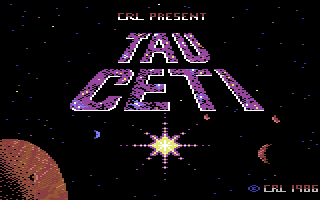
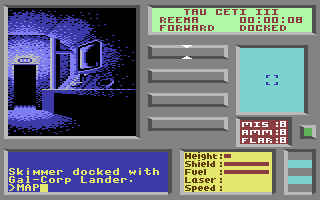
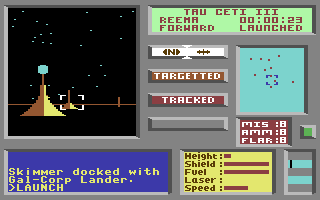
The game put the player in control of a robot vehicle navigating an isometric 3D city on the surface of a colony world. The reactor cores had been sabotaged by rogue Cedrex robots. The player's task was to reactivate them while surviving in a hostile environment. The concept was straightforward enough. What made Tau Ceti exceptional was the city itself - a navigable 3D environment rendered on an 8-bit machine at a time when most contemporaries were still working in 2D.
Fourteen Months and a Problem Nobody Had Solved
Pete Cooke spent fourteen months building Tau Ceti. The central engineering problem was the isometric perspective: how to represent a three-dimensional city on a two-dimensional screen in a way that felt navigable rather than merely decorative. Cooke studied how other programmers had approached the problem and reverse-engineered a sphere rendering technique from a game he'd been playing, which gave him the foundation for the shadow system.
"I chose the name Tau Ceti because it had a nice-sounding name - and it's also a real star that scientists think might harbour extraterrestrial life."
Pete Cooke, Crash magazine issue 24, 1986
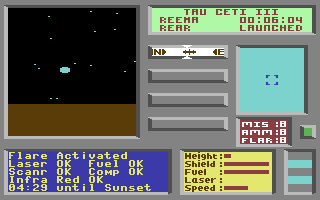
The shadow system was the technically unusual element. Rather than a static 3D environment, Tau Ceti's city existed in real time with a day/night cycle. Shadows moved as time passed. Buildings cast different silhouettes depending on the light angle. On a ZX Spectrum running at 3.5MHz with 48KB of RAM, this was not supposed to be possible in a way that looked smooth. Cooke made it work anyway.
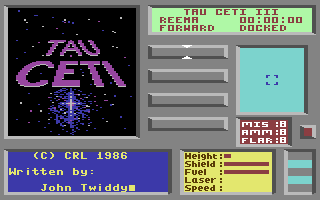
The C64 conversion in 1986 was handled by John Twiddy, not Pete Cooke. Converting a Spectrum game to C64 was not a simple task: the processor architectures differed, the colour systems were different, and the memory layouts required significant reworking. Twiddy adapted the engine faithfully enough that the C64 version matched the Spectrum reviews in critical reception and exceeded them in magazine visibility - Zzap!64 had a larger readership than any Spectrum publication of the period.
How the Robot Moves
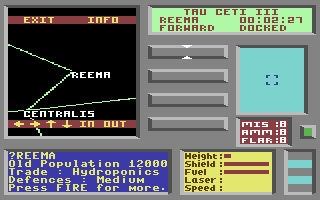
Tau Ceti was categorised as an action/strategy hybrid. The player controlled a NEMA (Non-Expendable Mobile Agent) robot vehicle through the isometric city, locating and reactivating reactor cores while avoiding or destroying Cedrex robots. The city was divided into multiple levels connected by lift shafts. Navigation required building a mental map of the environment - the isometric view made orientation non-trivial in a way that rewarded players who paid attention.
The robot could be upgraded with weapons and systems collected during gameplay. Energy management mattered: the robot's power supply depleted over time, requiring strategic choices about which routes to take and which confrontations to avoid. The tension between exploration and efficiency gave the game its strategic depth.
Controls were straightforward by the standards of the period, but the isometric perspective made precise movement require practice. Players accustomed to top-down or side-scrolling games found the diagonal movement initially disorienting. Once mastered, the city felt genuinely navigable - a three-dimensional space rather than a backdrop.
What the Magazines Said
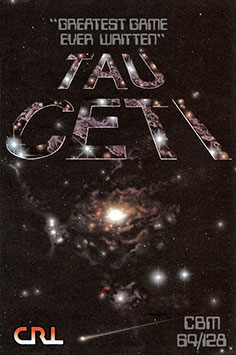
Tau Ceti's critical reception was exceptional by any standard. Zzap!64's 93% review in August 1986 made it one of the highest-scoring games of the year. C&VG's 10/10 was essentially a perfect score. The Crash review for the Spectrum version, at 94%, made it one of the publication's recommendations for the year. Sinclair User awarded 5/5.
"An excellent game, combining several elements with stunning graphics that create a remarkable 3D city environment. The shadow effects are particularly impressive."
Crash magazine, issue 24, 1986 - ZX Spectrum version
The Lemon64 user score settled at 8.11/10 from 54 votes over subsequent decades - not the highest user score in the C64 library, but solid evidence that the game held up for players who came to it later. The magazine averages of 87% (C64) and 94% (Spectrum) put Tau Ceti in the top tier of 8-bit releases by any measure.
The game appeared on multiple "best of" lists in contemporary publications and was frequently cited in later retrospectives as evidence of what 8-bit machines could achieve when programmers pushed against their constraints.
The Engine That Kept Working
Tau Ceti's influence on isometric gaming is harder to trace precisely than, for example, Knight Lore's influence - Ultimate's 1984 game established the isometric aesthetic for British gaming and is cited more frequently in design histories. Tau Ceti arrived a year later and took the technique in a different direction: instead of platform puzzles, it created an open navigable environment with strategic depth.
The game's use of day/night cycles influenced later designers working in isometric spaces. The idea that time could pass visibly within an isometric environment - that the game world would change its lighting as the player navigated - was genuinely novel. It pointed toward the kind of living environments that open-world games would develop in later decades.
Pete Cooke's direct follow-up, Academy: Tau Ceti II (1987), extended the franchise and demonstrated that the engine could sustain a sequel. The series effectively ended there; by 1988 the EA dispute had dismantled the development team that might have continued it. Cooke's subsequent work was not connected to CRL. The Tau Ceti catalogue is two entries and a Special Edition - a complete body of work for a designer who might have produced much more under different circumstances. Hear the soundtrack on the Music page.
Tau Ceti in Motion
Tau Ceti - C64 Playthrough
Tau Ceti Special Edition - ZX Spectrum 128K
Flagship Title II
Jack the Ripper
The first 18-rated game. The last crime of its century, replayed at 1MHz.
The Game That Changed the Rating System
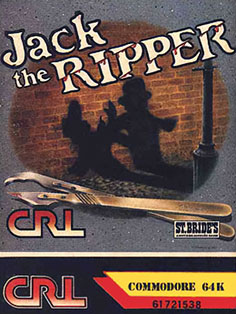
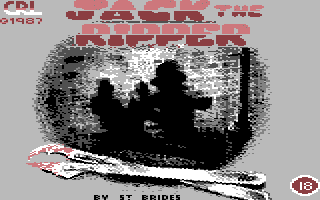
Jack the Ripper arrived in 1987 carrying a BBFC 18 certificate - the first video game ever to receive one. The British Board of Film Classification had rated Dracula 15 the previous year, also for CRL Group, but an 18 certificate carried heavier implications. Shops selling the game had a legal obligation. The press had a story. CRL had a bestseller.
The game was set in Victorian London during the actual Whitechapel murders of 1888. The player took the role of a journalist investigating the killings, gathering evidence, interviewing witnesses, and attempting to identify the Ripper before more murders occurred. The setting was based on documented historical events - real streets, real dates, real victims. That combination of actual criminal history and adult classification made Jack the Ripper one of the most talked-about games of its year.
Victorian Research as Game Design
St. Bride's School, the external studio that developed the game for CRL, approached the project as a documentary-style adventure rather than a horror game in the gothic tradition of Dracula and Frankenstein. The horror in Jack the Ripper was historical rather than supernatural. Players were investigating real events from a century earlier, and the game required them to engage with the period on its own terms.
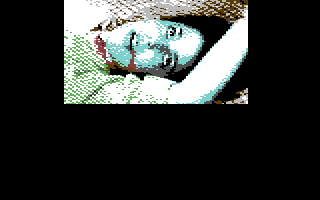
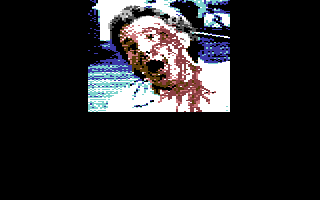
The graphic adventure format - combination of illustrated scenes and text parser - was well suited to the investigative premise. Players navigated between locations in Victorian Whitechapel, examining evidence, and parsing text descriptions of what they found. The graphics by Jared Derrett depicted period-accurate environments: gas-lit streets, fog-bound alleys, cramped East End interiors.
"The game is set during the actual Whitechapel murders of 1888. You play a journalist investigating the case, piecing together evidence before the killer strikes again."
Jack the Ripper game documentation, CRL Group, 1987
The moral dimension was genuine. Players were not playing as a hero preventing crimes - by 1987 the murders had already happened. They were assembling a case against a perpetrator who was never historically identified. The game's ending required the player to have gathered enough evidence to make a convincing accusation, which meant engaging with the real details of the case rather than working through a conventional adventure puzzle sequence.
What You Actually Do for Three Hours
Jack the Ripper played as a classic text adventure with graphic illustrations. The player typed commands in natural language - directions, actions, conversation prompts - and received both text responses and illustrated scenes. The parser was relatively forgiving by period standards, recognising a reasonable range of synonyms and phrasing variations.
The investigation structure meant that the game had a time element: the Ripper's murders followed a historical schedule, and players who delayed too long would find that opportunities for evidence collection had passed. This created genuine urgency without resorting to action mechanics. The game was fundamentally a puzzle - of logic, evidence assembly, and Victorian social navigation.
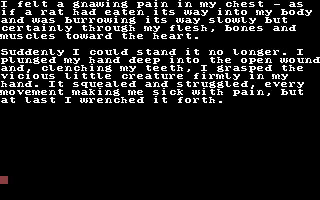
Critics Made Their Case
Jack the Ripper received strong reviews across the specialist press. C&VG awarded 9/10 in January 1988 and Commodore User gave 8/10 the same month. Zzap!64 and Games Machine each gave 78% in February. The magazine average of 82% put it among the better-reviewed text adventures of its year, though not in the exceptional territory of Tau Ceti's reviews.
"A very well-researched Victorian adventure. The attention to historical detail is impressive, and the atmosphere is sustained throughout. Not for the faint-hearted."
C&VG, January 1988 - Commodore 64 version
The Lemon64 user score of 6.94/10 from 18 votes is notably lower than Tau Ceti's 8.11. This reflects the different nature of the game: text adventures age less gracefully than action games when replayed decades later, and the historical content - once fresh and unusual - is now more familiar ground for anyone who has watched documentaries about the Ripper case. Contemporary reception was warmer than the retrospective user scores suggest.
The game's significance was never primarily about its review scores. Its significance was about its classification, its subject matter, and what it demonstrated about gaming's potential for adult content. That argument did not require a 90% Zzap! score to land.
The Certificate That Outlasted the Game
Jack the Ripper's BBFC 18 certificate established a precedent that outlasted the game by decades. When the Video Standards Council took over game ratings in the 1990s and eventually handed responsibility to PEGI in the 2000s, the framework that CRL had pioneered was already embedded in British gaming culture. The idea that games could require age classification, that their content warranted the same regulatory framework as film, had been demonstrated by Dracula and Jack the Ripper years before it became standard practice.
The game is cited regularly in histories of games censorship and content classification as the moment when British gaming crossed from implicit to explicit adult content. Whether that counts as cultural significance depends on what you think about content classification in general, but the game's position in that history is not disputed.
The full horror series - Dracula, Frankenstein, Jack the Ripper, Wolfman - is available on the Catalogue page. The SID music from these games can be played on the Music page. The people who made them are profiled on the People page.
Jack the Ripper in Motion
Jack the Ripper - C64 Gameplay
Jack the Ripper - Walkthrough