Flagship Titles
Deep Dives
Detailed examinations of the three titles that define what the Commodore PET could do as a gaming platform — each remarkable for different reasons.
Cosmic Cosmiads
Derek J. Hipkin — Published by Commodore Business Machines — Also known as Cosmiads M
What It Is
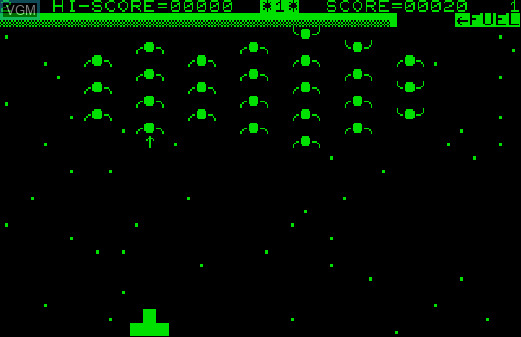
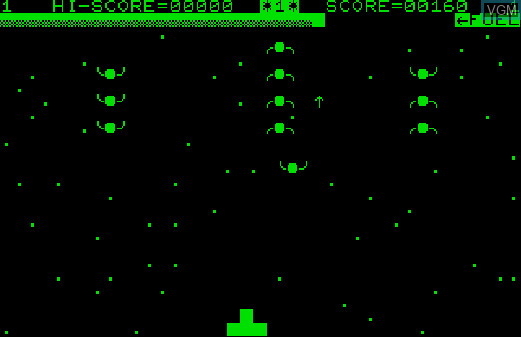
Cosmic Cosmiads is a fixed shooter built entirely in PETSCII block graphics, released in 1981 for the Commodore PET. The player controls a tank at the bottom of the 40-column display. Above, a formation of Cosmiads occupies the top portion of the screen; periodically, individual Cosmiads break formation and dive toward the player. Both player and Cosmiads fire projectiles represented as PETSCII characters.
The core loop is familiar from Space Invaders: clear the formation, avoid the dive attacks, do not let anything reach the bottom. But Cosmic Cosmiads adds one crucial mechanic that elevates it above imitation: a fuel counter. Every shot the player fires costs fuel. Run out of fuel and the tank is immobile and unable to fire. Accuracy is not merely rewarded - it is mandatory for survival.
One Developer, Commodore’s Catalogue
Cosmic Cosmiads was a solo production from start to finish. Hipkin designed the concept, wrote the machine code, laid out the PETSCII graphics, and tuned the gameplay balance without a team. He submitted the completed game directly to Commodore Business Machines, who published it under their own label. Commodore’s endorsement placed the game in their official software catalogue and distributed it through CBM dealers - the most effective route for an independent developer in 1981.
The game is also listed in some Commodore catalogues under the alternative title “Cosmiads M”, the “M” likely designating its machine-code implementation and distinguishing it from the BASIC programs that made up most of the PET library.
The design constraints of the PET shaped every decision. Without hardware sprites, objects had to be written character by character into the 40-column screen memory each game loop. Without a dedicated sound chip, feedback was limited to CPU-driven speaker beeps. Without colour, contrast between game elements depended entirely on character selection and positioning. Hipkin worked within all three constraints simultaneously, using PETSCII block characters that read as a tank, as alien formations, as projectiles - the aesthetic was not an approximation of arcade graphics but a complete visual language in its own right.
The Zylon Boss
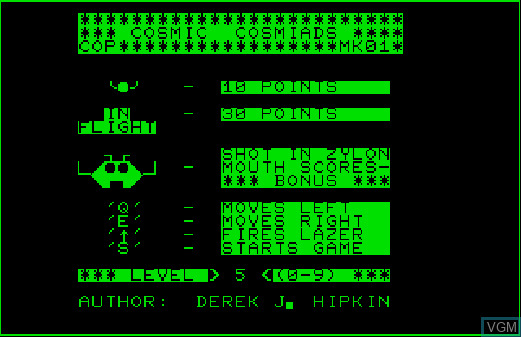
After all Cosmiads are destroyed, a “Zylon” boss creature appears. The Zylon has a specific weakness: it can only be killed by firing into its open mouth when it gapes. Shooting it at any other time has no effect. This single-condition vulnerability prefigures the vulnerable-core boss design that would become standard in the 16-bit era, though it appears here in pure PETSCII, in 1981.
What 1 MHz and No Sprites Could Do
The PET had no hardware sprites, no bitmap mode, and no sound chip. Hipkin built a convincing arcade game from PETSCII character movements, careful timing loops in machine code, and the 1 MHz 6502. The fuel mechanic was a design solution to a technical constraint: limiting the rate of fire reduced the collision calculation load on each game loop. The constraint became the game’s defining feature.
The Zylon boss’s mouth-open vulnerability required the game to track a state change in the boss character and respond differently to projectile contact depending on that state. On hardware with no dedicated collision detection logic, this was all handled in software on a CPU running at 1 MHz. The result is a boss encounter that plays more like a puzzle than a damage sponge - a design choice that the hardware constraints may have made inevitable.
The Standard CBM Published, Not Reviewed
Cosmic Cosmiads reached players through Commodore’s official software catalogue - one of the more visible distribution channels for PET games in 1981. The broader PET software market of the period was dominated by hobbyist BASIC programs of inconsistent quality; machine-code games published directly by Commodore occupied a different tier. No specific magazine reviews of Cosmic Cosmiads in Byte, Compute!, or Creative Computing have been located from the period, which was typical for PET games outside the major commercial releases. Its quality is better assessed by the company it kept in the CBM catalogue and by the sustained reputation it has maintained in the PET preservation community.
A peer developer’s retrospective comment captures the quality bar of the era. Courtland Wood, who created PET Millipede in 1982, explained his motivation as the poor quality of games then available for the PET. Cosmiads, distributed by the platform holder itself and built in machine code, represented the higher standard that capable independent developers could achieve.
“The quality of the games available for the PET was not very good.” — Courtland Wood, developer of PET Millipede (1982), on his motivation for creating a better PET shooter (MobyGames)
Still Running in VICE, Still Cited in PETSCII Surveys
Cosmic Cosmiads is fully preserved and playable in the VICE emulator, which supports all Commodore PET models with cycle-accurate 6502 emulation. Original cassette copies have been imaged to digital archives. The game appears in the major PET databases: commodoregames.net, uvlist.net, and MobyGames.
In June 2025 - more than four decades after the original release - Hipkin posted a YouTube Short demonstrating loading Cosmic Cosmiads from cassette on real 1980s hardware. The video documents both the physical procedure and the hardware, and represents the developer’s own contribution to the game’s preservation record. It is also evidence that Hipkin still considers the game worth demonstrating.
Cosmic Cosmiads is regularly cited in surveys of PETSCII gaming as one of the cleaner examples of the form - a game that works with the platform’s constraints rather than against them. Its fuel mechanic, which prefigures resource-management elements that became standard in later shooters, is the design feature most often noted in historical retrospectives of PET game design.
Videos
Developer Loading from Tape
Derek Hipkin himself loads Cosmic Cosmiads from cassette on real 1980s hardware (2025)
Real Hardware Longplay
Cosmic Cosmiads on a Commodore PET 4032 — real hardware, full gameplay
Restored PET 2001
Cosmic Cosmiads on a restored PET 2001 — original hardware aesthetic with white phosphor
Cosmic Jailbreak
Derek J. Hipkin — Published by Commodore Business Machines — PET in-game title: “Cosmic Fighter”
The Premise
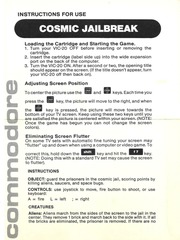
Cosmic Jailbreak adapts Universal’s 1979 coin-op Cosmic Guerilla into a PET PETSCII game, released in 1982. The scenario is a role reversal on most shooters: the attacking aliens are trying to rescue prisoners from a central jail structure, and the player must stop them. Aliens chip away at the prison wall brick by brick; if they succeed in breaching it, prisoners escape and the game advances to a harder phase.
Soldiers, Generals, and the Prison Wall
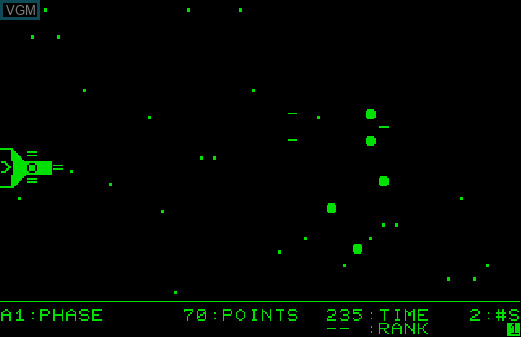
The alien force divides into soldiers (20 points each) and generals (50 points). Targeting decisions carry genuine risk-reward tension: shooting a general earns more points but a hit general splits into three soldiers, which continue the attack from three separate positions. A player who focuses on eliminating generals earns faster points but must immediately manage a larger formation. A player who ignores generals accumulates fewer points but faces a more predictable assault pattern.
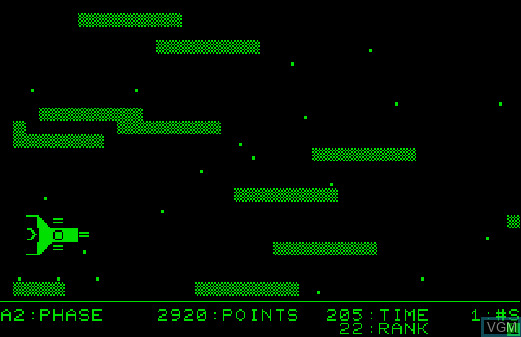
Both the player and the aliens fire simultaneously. The aliens fire down at the player; they also chip at the prison wall, which degrades visibly as specific bricks are removed. When the wall is breached and prisoners escape, the game advances to a harder phase - the screenshot series shows Phase A1, Phase A2, and later stages, each with faster movement and more aggressive attack patterns. The phase labeling gives the player a visible indication of how deep into the game they have reached.
The Title Screen Discrepancy
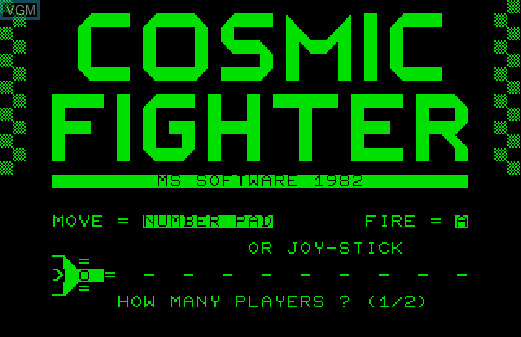
The PET version of the game displays “COSMIC FIGHTER” on its title screen rather than “Cosmic Jailbreak.” The commercial name “Cosmic Jailbreak” appears only in Commodore’s product catalogue and advertising materials. Whether this represents a development build title that was never updated, a localisation decision, or a naming miscommunication between Hipkin and Commodore’s production team is not documented in available sources. The discrepancy became central evidence in the royalty dispute.
Five Simultaneous Projectile States on a 1 MHz CPU
Adapting Cosmic Guerilla’s coin-op mechanics to the PET required Hipkin to translate what the arcade achieved with dedicated hardware - animated sprites, multiple simultaneous projectiles, RGB colour - into PETSCII block graphics on a 1 MHz 6502. The prison wall degradation was particularly demanding: each brick removal required tracking which character cells belonged to the wall and replacing them with empty space as specific alien attacks connected, while the main game loop continued handling movement, collision, and scoring.
The alien hierarchy - soldiers and generals that split on hit - required the game engine to track multiple entity types with different point values and different destruction behaviours. The phase-labeling system was generated dynamically. That Hipkin achieved this level of mechanical complexity in a form that became a confirmed best-seller demonstrates the quality of the implementation.
The Royalty Dispute
After Cosmic Jailbreak shipped and sold well, Hipkin sought royalties from Commodore Business Machines. Commodore initially denied the game had been commercially released at all. Hipkin’s brother then produced United States advertising materials showing Cosmic Jailbreak as a Commodore best-seller - material Commodore had themselves printed and distributed. Confronted with their own evidence, Commodore settled the royalty claim out of court.
The dispute ended Hipkin’s working relationship with Commodore and was the direct reason a planned C64 port was never officially completed.
“My brother found the US advertising showing Cosmic Jailbreak as a best-seller. That was the proof they couldn’t argue with.” — Derek J. Hipkin, recounting the royalty dispute with Commodore (via Indie Retro News, 2021)
A Confirmed Best-Seller, Then a Disputed Royalty
Cosmic Jailbreak was a confirmed Commodore best-seller - not a claim by Hipkin, but a fact Commodore’s own US advertising demonstrated when Hipkin’s brother produced it during the royalty dispute. Commodore would not have produced advertising for a game that was not selling. The best-seller designation implies significant distribution through CBM dealers across North America.
No specific magazine reviews from 1982 have been located for Cosmic Jailbreak in the standard PET coverage venues (Byte, Compute!, Creative Computing). PET software of the period received buyer-guide coverage through the CBM dealer network rather than independent press reviews, and the game’s commercial record is better documented by the legal dispute than by any surviving review.
The C64 Port That Sat Unreleased for Forty Years
A VIC-20 port of Cosmic Jailbreak was released alongside the PET version, extending the game to Commodore’s newer consumer machine. The C64 conversion was planned and partially completed but was halted by the royalty dispute before it could be published.
In 2021, that unreleased C64 version was recovered from original media and released by “Black” of Black Liquid, with coverage by Games That Weren’t and Indie Retro News. The recovery renewed attention to Hipkin’s original PET work and prompted him to speak publicly about the dispute that had prevented the C64 version from reaching players four decades earlier. Both the PET and VIC-20 versions are fully preserved in VICE emulation.
Videos
VIC-20 Port Gameplay
No PET-only longplay is available; the VIC-20 port is faithful to the original
The Lost C64 Conversion
Covers the PET/VIC-20 origin story and Hipkin’s royalty dispute with Commodore
Microchess 2.0
Peter R. Jennings (engine) & Brad Templeton (PET UI) — Published by Personal Software
The First Commercial Success
Microchess 2.0 is historically significant as the first commercially successful microcomputer game and the first to sell more than 10,000 copies. The chess engine was originally written by Peter R. Jennings in 924 bytes of 6502 machine code for the MOS Technology KIM-1 single-board computer, completed on December 18, 1976. The PET version arrived in 1978, with a user interface contributed by Brad Templeton.
Jennings required 8 KB of RAM for the PET version - which excluded the original 4 KB machines but was standard on the 2001-N and all later models. The board was displayed using PETSCII characters: pieces identified by single letter (K, Q, R, B, N, P), squares by algebraic coordinate. Functional, readable, and remarkable for 1978.
PETSCII Chess in Algebraic Notation
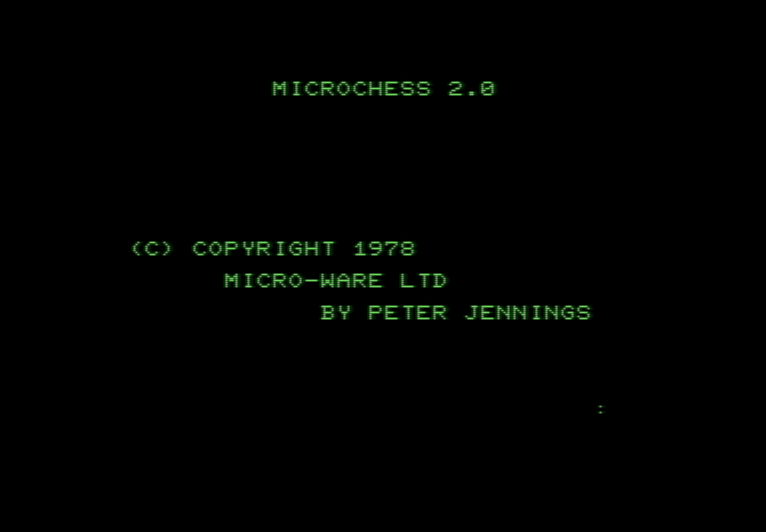
The Microchess 2.0 PET interface displays a complete chess board in PETSCII characters. Pieces use their standard single-letter designators: K for king, Q for queen, R for rook, B for bishop, N for knight, P for pawn. Squares are addressed by algebraic notation - columns A through H, rows 1 through 8. To make a move, the player types the source and destination coordinates (for example, E2 to E4), and Microchess validates the move, updates the PETSCII board display, then calculates and plays the computer’s response.
The engine supports multiple difficulty levels by varying its search depth. At lower depths the computer plays quickly but weakly; at higher depths it thinks longer and plays stronger. On the 1 MHz 6502 of a PET 2001-N, deep calculation could take several minutes per move - which, for a home computer chess program in 1978, was considered impressive rather than frustrating. The player had time to study the board while waiting. Brad Templeton’s user interface handled the board display and move input; Jennings’s original engine handled all chess logic.
924 Bytes That Became a Million-Dollar Business
The KIM-1 original was 924 bytes of 6502 machine code - a complete alpha-beta minimax search engine, move generation for all piece types including en passant and castling, and a board representation, all within memory that made the KIM-1’s 1 KB address space nearly full. That this program played recognisable, improving chess was a genuine feat of constrained software engineering in 1976.
The PET version expanded the program significantly to support the larger PETSCII display, a more comfortable coordinate-entry interface, and the deeper search depth that 8 KB could accommodate. The commercial achievement was equally technical in a different sense: Jennings’s mail-order distribution model - print a cassette, price it at $10, advertise in hobbyist magazines - was a template for commercial software distribution that predated the retail software industry.
The $1,000 Offer
When Jennings demonstrated Microchess to Chuck Peddle at the West Coast Computer Faire in April 1977, Peddle offered $1,000 for the full rights to the game. Jennings refused. By the end of 1978, Micro-Ware had earned over $1 million from Microchess sales alone. The difference between accepting and refusing that offer is approximately $999,000.
“Chuck Peddle offered me $1,000 for the rights to Microchess. I said no. By the end of 1978, Micro-Ware had earned over a million dollars from Microchess alone.” — Peter R. Jennings, Computer History Museum oral history
The First Microcomputer Game to Sell 10,000 Copies
Microchess received broad coverage in the hobbyist computing press of 1977-1978 - Byte, Creative Computing, and Kilobaud Microcomputing all covered the early microcomputer software market, and Microchess was among the most visible commercial software products of the period. Creative Computing’s coverage noted the game’s accessibility for casual players alongside its strength at higher difficulty settings. The program was reviewed not merely as a game but as evidence that microcomputers could support useful, commercially viable software independent of the hardware manufacturer.
The commercial milestone - first microcomputer game to sell more than 10,000 copies, Micro-Ware earning over $1 million by the end of 1978 - was significant enough to be cited repeatedly in industry retrospectives as proof that an independent developer could build a viable software business on a single program. Jennings’s figures appear in Wikipedia’s Microchess article and are confirmed in the Computer History Museum oral history recording.
The ChessMate and Bobby Fischer
In 1978, Commodore built a dedicated chess computer called the ChessMate using Jennings’s engine as its core. The ChessMate was a standalone device with a purpose-built chess board interface running the Microchess engine. As part of the launch activities, Jennings met Bobby Fischer - the world’s most famous chess player, who had retired from official competition in 1975 but remained the dominant name in the game globally. Fischer considered licensing his name for the ChessMate. The deal was not concluded, but the episode illustrates how rapidly computer chess had moved from academic curiosity to commercially viable consumer product in just two years.
Funding VisiCalc
When Jennings merged Micro-Ware with Personal Software in 1978, he deferred his Microchess royalties to help fund a new project Dan Bricklin and Bob Frankston were developing: VisiCalc. VisiCalc was the first spreadsheet application, the software that convinced corporations to buy Apple IIs by the thousands, and by most accounts the first true “killer app.” Jennings’s willingness to defer his royalties made VisiCalc’s development possible.
The line runs directly from Microchess on a PET to the modern spreadsheet application - and from Jennings’s refusal of Peddle’s $1,000 offer to the commercial software industry as it exists today.
From KIM-1 Listing to the Spreadsheet Industry
Microchess 2.0 remains playable via VICE emulation and is archived at the Internet Archive as a downloadable PET cassette image. The benlo.com site maintains a comprehensive history of Microchess’s development that Jennings has contributed to directly. The Computer History Museum’s oral history collection holds a recording of Jennings’s account of the development and commercialization story.
The program that started as 924 bytes typed on a KIM-1 in Toronto in December 1976 is now one of the most thoroughly documented early commercial software products in existence. It is cited in histories of the video game industry, in academic accounts of the commercial software market’s origins, and in computer museum collections as evidence of what a single developer with a technical idea could achieve before the industry had formal distribution infrastructure.
Videos
Microchess 2.0 Gameplay on PET
Direct gameplay footage of Microchess 2.0 on a Commodore PET
The KIM-1 Original
World’s first commercial chess program — the original 1976 KIM-1 version that preceded the PET port
Temple of Apshai Longplay (PET 1979)
Full Part 1 playthrough of Temple of Apshai on the PET — another era-defining title