PET Game Catalogue

Notable titles from the Commodore PET’s 800+ game library, 1977–1982. All rendered in monochrome PETSCII. All remarkable for their constraints.

Cosmic Cosmiads

1981 Fixed Shooter Flagship

Developer: Derek J. Hipkin — Publisher: Commodore Business Machines

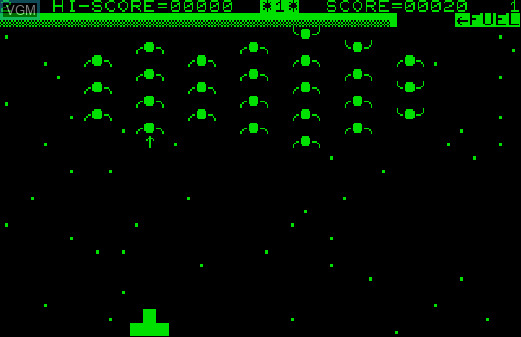
The PET’s defining arcade game. A fixed shooter built entirely in PETSCII: the player controls a tank at the bottom of the screen while Cosmiads occupy a formation at the top and occasionally dive. The crucial twist is the fuel mechanic — every shot costs fuel, so accuracy matters strategically rather than just aesthetically. After all Cosmiads are destroyed, a “Zylon” boss creature appears that can only be killed by firing into its open mouth.

Also known as Cosmiads M. Hipkin coded the game solo; it was published by Commodore itself rather than through a third-party publisher.
Full deep dive →

Cosmic Cosmiads gameplay: alien grid and player tank with FUEL meter

Cosmic Jailbreak

1982 Fixed Shooter Flagship

Developer: Derek J. Hipkin — Publisher: Commodore Business Machines

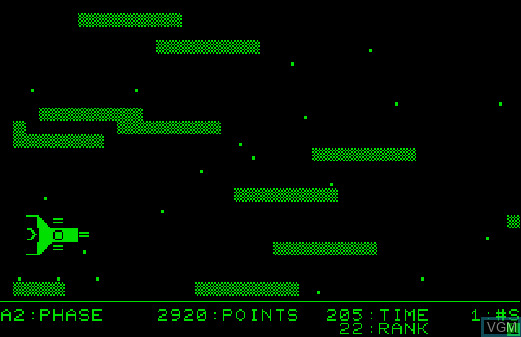
Inspired by Universal’s 1979 coin-op Cosmic Guerilla. Aliens attempt to rescue prisoners from a central jail by removing bricks from the prison wall. The player must prevent escapes. Aliens score 20 points as soldiers, 50 as generals; hit generals split into three soldiers. The PET version appeared on screen as “Cosmic Fighter” rather than “Cosmic Jailbreak” — a version-naming discrepancy documented in the legal dispute records.

Hipkin sought royalties from Commodore; they initially denied the game had launched. His brother produced US advertising proving it was a best-seller. The case settled out of court.

Full deep dive →

Cosmic Jailbreak gameplay: Phase A2 showing prison grid

Microchess 2.0

1978 Chess Flagship

Developer: Peter R. Jennings (engine); Brad Templeton (PET UI) — Publisher: Personal Software

The first commercially successful microcomputer game. Originally written as 924 bytes of machine code for the MOS Technology KIM-1 (December 18, 1976), Microchess reached the PET in 1978 via Jennings’s Micro-Ware. It required 8 KB RAM and displayed a text chess board using PETSCII. By 1978, Micro-Ware had earned over $1 million from Microchess sales.

Bobby Fischer met Peter Jennings and considered licensing his name for a dedicated chess computer Commodore were building using the same engine.

Full deep dive →

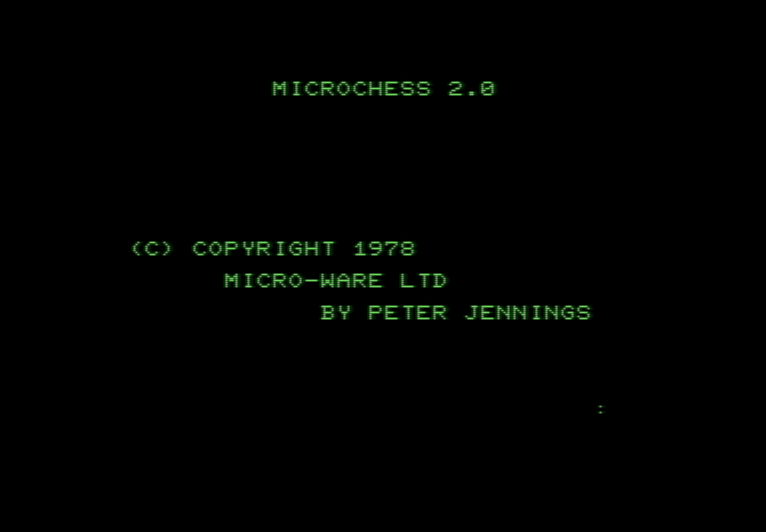
Microchess 2.0 title screen: BY PETER JENNINGS

Temple of Apshai

1979 RPG

Developer: Jim Connelley & Jon Freeman (Automated Simulations) — Publisher: Automated Simulations

Jim Connelley bought a PET computer to organise his Dungeons & Dragons notes. Finding it unsuitable for that purpose, he wrote a dungeon-crawl game instead. Temple of Apshai featured four dungeons, over 200 rooms, and an RPG system designed by Jon Freeman. By 1981 it had sold 20,000 copies; by 1986, 400,000. It won Best Computer Game at the 1980 Origin Awards and launched the studio that became Epyx.

The original PET version was a text-mode dungeon using PETSCII. The colourful screenshots widely reproduced online are from the later C64/Atari 8-bit ports.

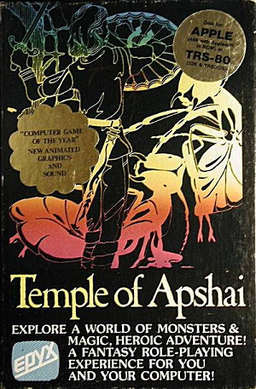
Temple of Apshai box art

Time Trek

1979 Strategy

Developer: Brad Templeton — Publisher: Personal Software / Connan Enterprises

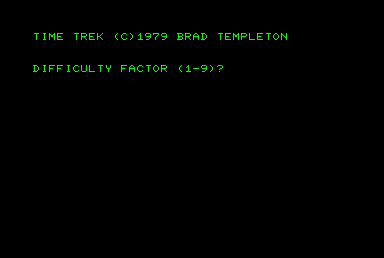
A Star Trek–inspired text strategy game for the PET. The player commands the Enterprise, firing torpedoes at Klingons by entering an angle, and navigating between quadrants using long-range and short-range scanners. Nine difficulty levels. Brad Templeton — also the author of the PET user interface for Microchess 2.0 — developed the PET version in 1979.

NO IMAGE
AVAILABLE

PET Space Invaders

1980 Fixed Shooter

Developer: Satoshi Matsuoka (high school student) — Publisher: Unlicensed

Written in BASIC by Satoshi Matsuoka as a high-school student in Japan, PET Space Invaders offered a faithful PETSCII rendition of Taito’s arcade classic. The tank fires at descending aliens; bunkers wear away faster than the arcade version; speed increases as aliens advance. No colour, no sound beyond basic speaker beeps, but the gameplay loop was unmistakably there.

Matsuoka later co-founded HAL Laboratory. His game inspired PET Space Invaders 2 (2022), a modernised homebrew sequel. See modern PET →

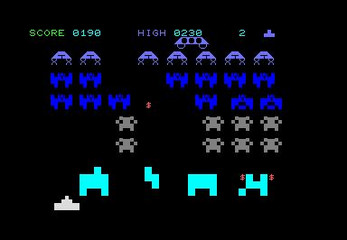
PET Space Invaders gameplay (colour version shown)

CBM Draw Poker

1978 Card Game

Developer: Commodore Business Machines — Publisher: Commodore Business Machines

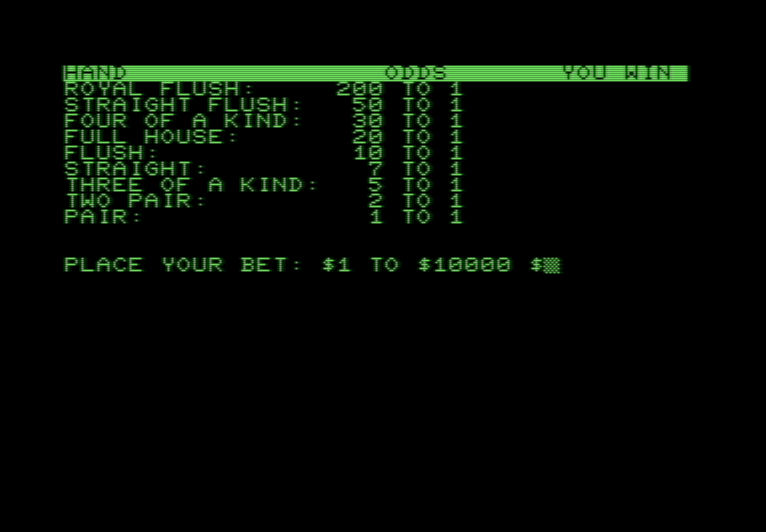
Standard five-card draw poker for one player. The player receives five cards dealt from a simulated shuffled deck, can swap once, and wins multiples of the bet on better hands. The deck is reshuffled when all cards have been dealt. PETSCII card suit characters (♠♣♥♦) made poker games a natural demonstration of the character set — Peddle had specifically requested their inclusion.

CBM Draw Poker payout table display

Millipede

1982 Fixed Shooter

Developer: Courtland Wood — Publisher: Independent

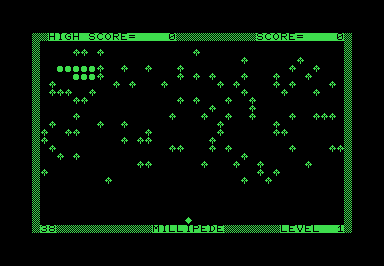
Courtland Wood created this PET adaptation of Atari’s Millipede arcade game (itself a follow-up to Centipede), motivated by the poor quality of other PET games available at the time. A PETSCII shooter requiring the player to fire upward at a descending millipede that segments and accelerates when hit. One of the later PET original titles, released in the final year of the platform’s commercial life.

NO IMAGE
AVAILABLE