Mega Man 2
The game built on borrowed time - and the one that proved Capcom’s NES mastery.
Release
| Japan | December 24, 1988 |
| North America | June 1989 |
| Platform | Nintendo Entertainment System |
| Developer | Capcom |
| Publisher | Capcom |
Credits
| Director | Takashi Nishiyama |
| Character Designer | Keiji Inafune |
| Composer | Takashi Tateishi (Ogeretsu Kun) |
| Genre | Action Platformer |
| Robot Masters | 8 |
Reception
| Nintendo Power | 4.3 / 5.0 (Gameplay) |
| Legacy | Universally acclaimed |
| Sales | 1.5 million+ copies |
| Ranking | Frequently cited as best NES game |
Why It Matters
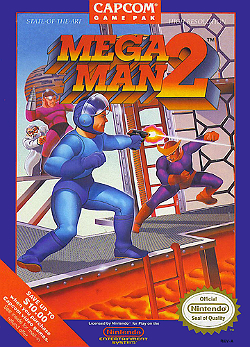
Mega Man 2 arrived in Japan on December 24, 1988, and reached North America in June 1989. It is an action-platformer in which the player navigates themed stages, defeats Robot Master bosses, and uses their acquired weapons against other bosses and the fortress levels beyond. That description fits dozens of NES games. What makes Mega Man 2 singular is the quality of execution at every level - level design, boss balance, music, visual identity - achieved by a small team that believed they were making their last game.
The original Mega Man (1987) sold poorly in North America. Capcom Japan almost shelved the sequel entirely. The team that built Mega Man 2 did so largely as a passion project, working beyond their scheduled hours, pouring ideas into a game they were not sure would ever reach players. The result is one of the most beloved 8-bit games ever made - a title still cited in discussions of NES greatness more than three decades after release.
Built on Borrowed Time
The original Mega Man released in December 1987 and underperformed commercially, particularly in North America where it sold roughly 300,000 copies in its first year. Capcom’s management considered the series finished. The sequel happened because a core group of developers - Keiji Inafune among them - persuaded the company to let them make one more, working on it partly in their own time.
Director Takashi Nishiyama pushed for eight Robot Masters, up from the original’s six, and for each stage to feel meaningfully distinct. Inafune’s character designs for the new bosses - Air Man, Metal Man, Bubble Man, Quick Man, Crash Man, Flash Man, Heat Man, Wood Man - remain among the most iconic in the franchise. The constraint of limited development time paradoxically sharpened the team’s decisions: every design element that survived made it because someone fought for it.
“The first Mega Man didn’t sell well, so for Mega Man 2 we knew we were on borrowed time. Everyone poured their best ideas in - because we thought it might be the last chance to do it right.” Keiji Inafune, GDC 2009 retrospective on Mega Man 2
Eight Bosses, Any Order
Mega Man 2’s central mechanic is the boss weapon system: defeat a Robot Master and absorb their weapon, which is then effective against other bosses in a specific order. The player can face the eight stages in any sequence, but knowledge of the weapon cycle transforms a difficult run into an efficient one. This creates two distinct gameplay experiences - the improvised first run and the optimised repeat - within the same structure.
Stage design complements each boss’s personality. Air Man’s stage opens with a bird-sweeping scroll across a twilight sky. Quick Man’s stage places the player under timed laser beams that punish hesitation. Bubble Man’s underwater environment alters movement physics and rewards the Air Shooter. The Dr. Wily fortress stages escalate through new hazards culminating in a final boss revealed as a hologram - an unprecedented narrative subversion for the era.
The Japanese and European releases offered Normal and Difficult modes. North America received only the harder setting, rebalanced. Despite this, Mega Man 2 was widely considered more accessible than its predecessor, broadening the series to a mainstream audience. Energy tanks, password continuation, and the weapon system’s built-in difficulty modifiers all contributed to a game that challenged players without punishing them arbitrarily.
Five Channels, One Unforgettable Score
The Nintendo Entertainment System’s 2A03 audio processing unit provided five channels: two pulse wave generators, one triangle wave channel, one noise channel, and one delta modulation channel. Composer Takashi Tateishi exploited all five with unusual sophistication, creating music that felt orchestral within severe hardware constraints.
The triangle wave channel - typically reserved for bass lines - was used melodically in several tracks, creating a distinctive mid-range texture absent from most NES compositions. The Dr. Wily Stage 1 and 2 theme, built on a bass figure that refuses to resolve, has been covered by rock bands, orchestras, and amateur musicians for decades and remains the most recognised piece of Capcom NES music. Tateishi composed the entire soundtrack in approximately eight weeks.
On the visual side, Mega Man 2 refined the sprite design language established in the original. Character sprites were immediately readable at gameplay resolution; enemy designs telegraphed behaviour through posture and colour. The stage backgrounds introduced parallax-style layering effects within the NES’s tile constraints, giving Air Man’s stage an atmospheric depth unusual for the platform.
From Passion Project to NES Legend
Nintendo Power covered Mega Man 2 extensively in Volume 4 (September/October 1989), awarding it a gameplay score of 4.3 out of 5.0 and providing full stage maps - the publication’s highest endorsement of a new release. Computer Entertainer praised it as a significant improvement over the original, highlighting accessibility and stage design as standout qualities. The game appeared on Nintendo Power’s “Best Games” lists repeatedly across its print run.
Contemporary critical consensus positioned Mega Man 2 as one of the finest NES action games available. Commercial performance exceeded the original: the game sold over 1.5 million copies globally and established Mega Man as a flagship Capcom franchise. In North America it became the entry point for the series for an entire generation of players. Modern retrospective coverage consistently ranks it among the greatest NES games ever released.
The Template That Held for Thirty Years
Mega Man 2 established the template for the next four mainline NES entries and informed the design of Mega Man X (1993) - a deliberate reinvention that carried the franchise to the 16-bit generation. Every subsequent Capcom action-platformer was measured against it. Its influence extends beyond the Mega Man franchise to the broader action-platformer genre: the boss-weapon absorption system, the open stage select, and the escalating fortress structure became conventions that later games adopted and refined.
The Mega Man Legacy Collection (2015) presented the game with save states, challenge mode, and a music and art museum on PlayStation 4, Xbox One, PC, and 3DS. It remains the most accessible entry point for modern players approaching the original hardware game. Takashi Tateishi’s soundtrack has been performed in concert worldwide and officially released across multiple formats.
“I never thought my music would still be playing thirty years later. It is humbling. The constraints of the NES forced us to be melodic - there was nowhere to hide behind production polish.” Takashi Tateishi, interview with Diggin’ in the Carts (2016)
Mega Man 2 original soundtrack - composed by Takashi Tateishi in eight weeks.