Three Productions That Changed What a Cracktro Could Be
One from 1983 when the form was still finding itself. One from 1987 at the golden age's peak. One from 1991 that proved the peak was not the end. Each is treated here as a standalone cultural artifact.
In 1983, when most cracked game copies arrived with their protection stripped and nothing added, a group calling itself 1001 Crew made a different choice. Before the game loaded, a short program ran: a plain screen with scrolling text identifying the crackers and greeting the people they knew. It was a tagging tradition borrowed from graffiti culture, applied to a machine that could be told to move text across the screen in real time. It was also the founding act of an art form that would outlast everyone's expectations.
64 Legendary C64 Crack Intros (1986-1989)
The compilation that spans the years immediately after 1001 Crew's founding - showing what the tradition they started grew into.
Hardware at the Limit in 1983
The C64's VIC-II chip supported hardware smooth scrolling - the ability to shift the entire screen display by one pixel per frame at zero CPU cost. Using this feature for a scrolling text message required only a lookup table of character pixel widths and a pointer update each frame. In 1983, this was new enough to be striking. By 1987, it would be the baseline expectation that every other technique had to exceed.
1001 CREW SCROLLER SCREEN 1983
1001 Crew scroller in motion - scrolling text announcing the group and greeting fellow crackers.
C64 VIC-II BORDER EFFECT EARLY 1980s
VIC-II border manipulation - a technique that became standard by 1985 but appeared first in early cracktros.
PETSCII CREDITS SCREEN 1983
PETSCII-based credits screen. The built-in character set allowed elaborate designs without loading custom fonts.
What the Scroller Said to Its Audience
The content of early scrollers was not primarily directed at the game's player. It was directed at rival cracking groups who would copy the copy, remove the cracktro, or replace it with their own. The greetings list - a litany of group names that rotated through the scrolling text - was a social map of the scene, encoded in the intro itself. If your group appeared in someone else's greetings, you were acknowledged. If you disappeared from it, you had fallen in status.
"The greetings list was the scene's social network, printed at 50 lines per second on everyone's screen before anyone coined the term social network."
Community analysis, Freax: The Brief History of the Computer Demoscene, Tamas Polgar, 2005
Why It Mattered Past 1983
The Hunchback cracktro did not demonstrate the best raster effects or the most sophisticated SID music. It barely had either. What it demonstrated was a possibility: that a short program running before a game could be worth making for its own sake, independent of the game's quality. That idea survived and grew through everything that followed.
The Groups page has the full 1001 Crew profile. The History page traces what they started through to the demo scene split of 1987-88.
The C64 demoscene tradition grew directly from the peak-period cracking scene that produced cracktros like Hotline's Jinks intro.
Hotline - Europe - 1987
Three Techniques, One Precise Minute
By 1987 the arms race had been running for four years. Raster bars were expected; scrollers were expected; SID music was expected. What separated a memorable cracktro from a competent one was execution: how cleanly the raster bars transitioned, how precisely the scroller was timed, whether the SID tune looped without a click. Hotline's cracktro for Jinks demonstrated what precise execution looked like when all three elements worked in combination.
The raster sequence opened with a clean multi-colour gradient - six distinct palette values changing cleanly per scanline with no visible jitter. The SID music was original composition, not a ripped track from another game, and was written to loop at a specific length that allowed the scroller's greeting message to complete before the loop point. The scroller itself used hardware acceleration for smooth, flicker-free movement.
Hotline - Jinks Cracktro (1987)
The cracktro in full - multi-coloured raster bars, smooth scroller, and original SID composition. Recorded in VICE emulator.
Why 1987 Was the Right Year
Raster interrupt timing on PAL C64 hardware required cycle-counting the 1MHz CPU to ensure the colour register change occurred at exactly the right moment - between scanlines rather than mid-line. In 1983 this was difficult. By 1987 it was a skill that any competent cracktro coder had mastered. The question was no longer whether you could do it but how many other things you could do simultaneously.
HOTLINE JINKS INTRO OPENING SCREEN 1987
The opening raster bar sequence - six palette values, clean transitions, no jitter.
HOTLINE JINKS INTRO SCROLLER ACTIVE 1987
Scroller in motion - hardware-accelerated smooth scrolling with the greetings message running below the raster effect.
HOTLINE JINKS INTRO CREDITS SCREEN 1987
Credits sequence - the cracktro's final screen before handing control to the game.
SID CHIP WAVEFORM VISUALIZATION
SID chip output - three voices operating simultaneously, producing the characteristic cracktro sound.
What It Established
Hotline's Jinks cracktro is significant not because it invented its individual techniques but because of the precision of their combination. It demonstrated a standard of craft that other groups had to match. In a scene where imitation was not plagiarism but homage, the techniques in this intro were studied, reproduced, and improved upon in dozens of subsequent cracktros.
"Precise timing - that was everything. A raster interrupt that fires one cycle late looks broken. No one who saw a broken raster forgot it, and no one wanted to be the coder who made a broken one."
Reconstructed from technical community documentation, Codebase64 raster interrupt reference
See the full scene context on the History page. Hotline group profile on the Groups page. Composer information on the People page.
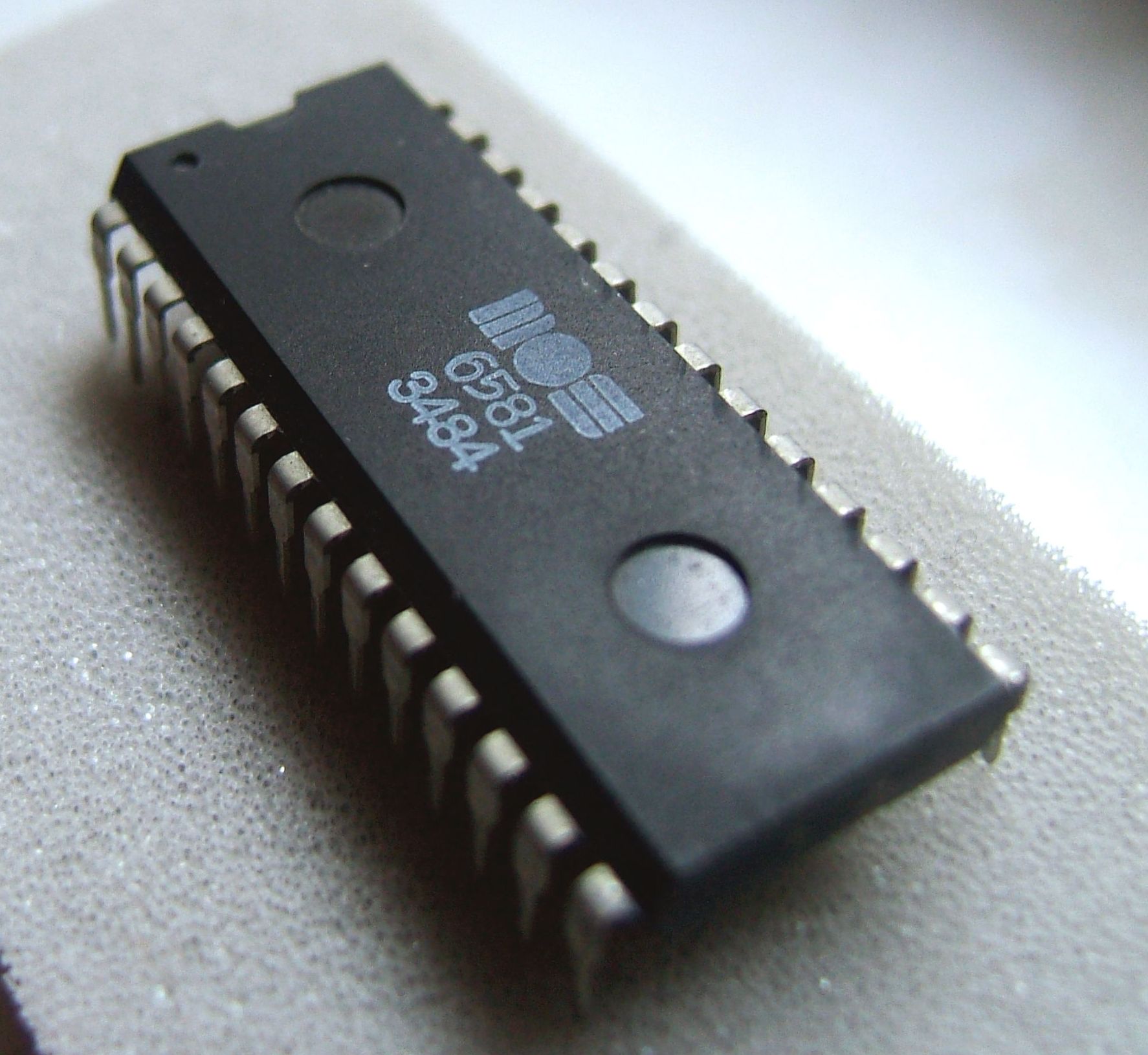
MOS 6581 SID chip - the sound processor that the Genesis Project Final Flight cracktro's composer exploited for a production that matched the demo scene in audio sophistication.
Genesis Project - Europe - 1991
Four Years After the Peak, Still Raising the Bar
The conventional history says the demo scene took the technical crown from cracking groups in 1987-88 and never gave it back. Genesis Project's cracktro for Final Flight in 1991 complicates that story. Produced four years after the demo scene split, it featured sprite multiplexing beyond hardware limits, multi-part animation sequences, and SID composition of a quality that matched anything the pure demo scene was releasing at the time.
The sprite multiplexing alone was a statement. The VIC-II hardware supported eight sprites simultaneously. Using raster interrupts to reassign sprite definitions mid-frame, Genesis Project achieved a visual density that the hardware's documentation said was impossible. The technique was not new in 1991 - the demo scene had been using it for years - but this was a cracktro, not a demo, and it ran before a game and still loaded in time for the player to actually use what they had copied.
Genesis Project - Final Flight Cracktro (1991)
The full 1991 cracktro - sprite multiplexing, multi-part animation, SID composition. Demonstrates that the cracking scene still had coders matching the demo scene.
Doing More Than Was Required
A cracktro has a practical constraint: it must load quickly, run briefly, and leave enough memory intact for the game to follow. A demo has no such constraint - it can occupy the entire machine indefinitely. Genesis Project's coders produced something of demo-quality complexity within cracktro constraints. That engineering decision - to do more than was required, under conditions that made doing so harder - is what makes this production historically significant.
GENESIS PROJECT FINAL FLIGHT MAIN SCREEN 1991
Genesis Project Final Flight cracktro - opening screen showing the level of visual production quality achieved in 1991.
The sprite multiplexing sequence - more simultaneous sprites than the VIC-II hardware officially supports, achieved through raster interrupt reassignment.
GENESIS PROJECT CREDITS SEQUENCE 1991
Credits sequence - the cracktro's social function maintained alongside its technical ambition.
"When the Amiga came everyone said the C64 was done. Then C64 coders spent the next five years proving that wrong, one raster interrupt at a time."
Community documentation, CSDb forum archives
Its Position in the Sequence
The three cracktros documented on this page form a sequence: the beginning, the peak, and the proof that the peak was not a ceiling. 1001 Crew established what a cracktro was. Hotline defined what a great cracktro looked and sounded like. Genesis Project demonstrated that the form's ceiling had not yet been reached, even in 1991. Groups like Remember were still releasing new C64 cracktros in 1998 - fifteen years after 1001 Crew set the tradition in motion.
The History page documents the full arc. The Videos page includes the 1998 Remember cracktro as evidence that the tradition continued further than most observers expected.